



What Will Restaurant Menu Screens Cost to Run in 2027? Seven Signals to Watch
What Will Restaurant Menu Screens Cost to Run in 2027? Seven Signals to Watch
Menu screens used to be a hardware decision. Heading into 2027, they are a monthly one. Component shortages, a reshuffled tariff regime, software price inflation and new rules on how prices are shown all land on the same line of the budget. Here are the seven signals worth tracking, with the numbers behind each, and a short list of what to log before next year's renewals.
Why Is the Monthly Line the One That Matters in 2027?
The monthly line matters because menu prices will keep moving, and every move runs through the screens. USDA's Economic Research Service expects prices for food away from home to rise 3.5% in 2026 and another 2.6% in 2027. The 2027 range is wide, from 0.2% to 5.1%, but every point in it means more price changes, not fewer.
That shifts the question operators ask. A screen bought once and kept for five years matters less than the bill that arrives every month for software, power, support and replacements. Three things push that bill:
- Recurring software, priced per screen and renewed every year.
- Running costs, mainly electricity for panels that stay on 12–16 hours a day.
- Refresh costs, the players and screens that fail or age out and get replaced on a schedule.
The clearest public baseline for that monthly view is a three-year model of what digital menu boards cost per month that weighs offline cache players, software tiers and electricity as separate lines over 36 months. It is a useful starting point because it treats the screen as a running cost rather than a purchase.
The signals below adjust that baseline for 2027. Some push costs up, one or two could push them down, and a few change what the screen is legally required to show.
Signals 1 and 2: Memory Shortages and the New Tariff Map
Hardware is the part of the bill most exposed in 2027, for two separate reasons.
Signal 1: the memory crunch reaches cheap devices. Media players and Android-based signage boxes run on the same DRAM and flash memory as phones and laptops, and that memory is now scarce.
- Micron's DRAM prices rose in the high teens and its NAND prices about 30% in its fiscal fourth quarter of 2026, according to Computerworld.
- TrendForce expects conventional DRAM contract prices to rise another 10–15% in the fourth quarter of 2026, and NAND 15–20%.
- Micron says supply will be "much tighter" in 2027 and 2028 than in 2026, and has already committed more than 75% of its 2027 output.
- IDC expects average PC selling prices to rise 18.3% in 2026. Low-cost devices feel it most, because they have the least margin to absorb a component increase.
For menu boards, the practical effect falls on players and system-on-chip displays. Budget for player prices that rise rather than fall in 2027, and expect some low-cost models to ship with less memory or storage.
Signal 2: tariffs settled into a new, longer-lasting form. The rules changed three times in 2026.
- On February 20, 2026, the Supreme Court ruled 6–3 that the emergency-powers law behind the 2025 "reciprocal" tariffs does not authorize tariffs at all.
- A temporary 10% surcharge under Section 122 of the Trade Act replaced them and expired on July 24, 2026.
- A Section 301 tariff took effect the same day, with no time limit. It sits at about 10% for Mexico, Taiwan, the EU and the UK, and about 12.5% for China, Vietnam, Japan and South Korea. For Taiwan, the EU, Japan and South Korea, that figure is a ceiling that includes the normal duty rather than an extra charge on top.
Two details matter for screens. USMCA-qualifying goods from Mexico, where many displays are assembled, remain exempt. Semiconductors are exempt too, and some finished electronics are excluded, but the tariff on a given display or player depends on its exact classification. Ask vendors which country assembled the panel and the player, and whether the quote assumes the current rate.
Signal 3: The Cheapest Player Route Is Closing
The $50 streaming stick, long the entry ticket for a one-screen menu board, is becoming a narrower option.
- Amazon told developers that starting with the Fire TV Stick 4K Select, launched in October 2025, all future Fire TV Sticks will run Vega, its own Linux-based operating system.
- Vega does not support sideloading. Apps must come from Amazon's store, which had about 3,000 apps against roughly 40,000 on the Android-based sticks, by Cord Busters' estimate.
- Android apps do not run on Vega and have to be rebuilt by their developers.
- The 4K Max is now the last Android-based stick. At the end of September 2026, Amazon replaced the 4K Select and 4K Plus with a third-generation Fire TV Stick 4K that runs Vega.
For a café planning a stick-based menu in 2027, the checklist is short:
- Confirm the signage app exists in the Vega store, not only as an Android download.
- Check which stick model is actually on the shelf, because the box design barely changes between generations.
- Price a dedicated player as the fallback, since stick prices no longer guarantee app support.
Signal 4: Software Subscriptions Are Inflating Faster Than Food
Software is usually the heaviest recurring line for multi-screen setups, and SaaS prices are rising faster than menu prices.
- SaaS spending platform Vertice tracked SaaS price inflation at 13.2% in the first quarter of 2026.
- The rate reached 16.4% in June 2026, its highest monthly reading on record, after a previous peak of 14.7% in November 2025.
- That is roughly five to six times the 2.6% USDA expects for restaurant menu prices in 2027.
Not every signage vendor raises prices, and per-screen plans differ widely. But the direction across business software is clear, and a menu board subscription renewed in 2027 is likely to cost more than the same plan did in 2025. Three contract terms soften the effect:
- a price lock for the length of the agreement;
- a cap on annual increases written into the renewal clause;
- per-screen pricing that scales down when screens are removed, not only up when they are added.
Signal 5: Electricity Keeps Climbing
Electricity is a small line per screen, but it is rising and it grows with every panel and every operating hour.
- The October 2026 Short-Term Energy Outlook from the Energy Information Administration expects the average residential price to rise from 17.3 cents per kilowatt-hour in 2025 to 18.2 cents in 2026 and 18.7 cents in 2027.
- EIA expects electricity use in the commercial sector, which includes data centers, to grow 2.8% in 2027.
Business rates follow the same path: the outlook's tables put the average commercial price at 13.41 cents per kilowatt-hour in 2025, 14.00 cents in 2026 and 14.21 cents in 2027. The lever operators control is the schedule. A screen that switches off after closing and on before opening uses a third to a half less power than one left on around the clock, depending on trading hours, and that saving grows as the rate rises.
Signals 6 and 7: New Rules on What the Board Shows
Two kinds of regulation change what a menu screen must display and how often it must be updated.
Signal 6: price-setting disclosure. New York's Algorithmic Pricing Disclosure Act took effect on November 10, 2025.
- Businesses that set prices with an algorithm using a customer's personal data must show, near the price, the statement "THIS PRICE WAS SET BY AN ALGORITHM USING YOUR PERSONAL DATA."
- Violations carry civil penalties of up to $1,000 each, enforced by the state attorney general.
- Several other states are weighing similar transparency rules.
A standard menu board that shows the same price to every guest is not personalized pricing. But operators testing time-of-day or demand-based prices on screens should confirm whether personal data feeds the price before 2027 pilots begin, and leave room on the layout for a disclosure if it does.
Signal 7: labor for manual updates gets more expensive. Minimum wages keep rising in 2027.
- Michigan's minimum wage reaches $15.00 on January 1, 2027, and Alaska's reaches $15.00 on July 1, 2027.
- More than a dozen states adjust their minimum wage for inflation on January 1, 2027.
Every price change that a manager edits by hand, exports and uploads to each screen costs staff time. Higher wages make that hidden line larger, which strengthens the case for prices that flow from the point-of-sale system rather than from a design file.
A 2027 Budget Checklist and the Numbers to Log
Forecasts give direction, not a budget. The useful work is to turn the seven signals into explicit assumptions and then check them against your own data during the year.
A worked scenario for one screen
The figures below are assumptions, chosen to show the method rather than to predict your bill.
| Line, per screen per month | 2026 baseline | 2027 assumption | 2027 scenario |
|---|---|---|---|
| Software | $30.00 | +12% renewal increase | $33.60 |
| Electricity | $8.00 | +3% rate increase | $8.24 |
| Hardware, $1,500 over 36 months | $41.67 | +10% on replacement units | $45.83 |
| Total | $79.67 | $87.67 |
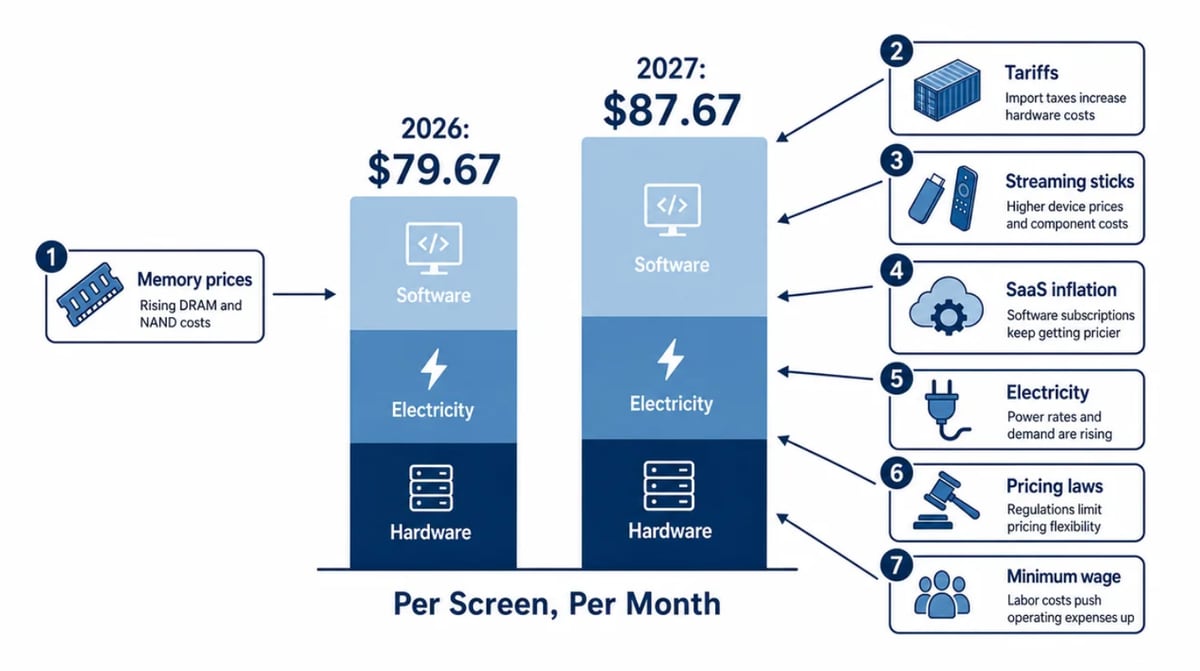
In this scenario the monthly cost of one screen rises about 10%, with software and hardware doing most of the work. Change the assumptions to match your contracts and the total moves with them.
What could push the bill down
- Display panels are moving the other way from memory. Industry trackers reported that LCD TV panel prices fell through the third quarter of 2026, which helps the screen itself even if the player costs more.
- Free single-screen tiers and longer trials remain common, which lets a café test a layout for weeks before any subscription starts.
- Multi-year contracts signed before renewal season can lock 2026 software prices into 2027.
Questions to settle before 2027 renewals
- Does the software contract cap annual price increases, and by how much?
- Which country assembled each player and display on the quote, and is the tariff rate stated?
- Is the player supported on the operating system that ships on new hardware, not only on last year's model?
- Are screens scheduled to switch off outside trading hours?
- Do any planned price tests use customer data, and if so, where would a disclosure appear?
Numbers worth logging every month in 2027
- Price changes made, and staff minutes spent on each one.
- Screen hours lit versus scheduled, so dark time shows up as a cost.
- Metered or estimated kilowatt-hours per screen.
- Software invoice per screen, compared with the same month a year earlier.
- Replacement parts bought, with unit prices, to see whether the memory shortage reaches your players.
Twelve months of these numbers will say more about the cost of menu screens in 2028 than any forecast published today.
The screen is only one place a menu price shows up. The same changes have to reach the restaurant's website, online ordering pages and Google Business Profile, and AI assistants now quote those prices too (see GEO for restaurants). eSEOspace's restaurant and food service marketing work covers keeping those listings in step with the board.
Put this into action with eSEOspace
We help businesses grow with website design that actually performs. Explore the services behind this guide:
Get a FREE Audit
We'll perform a comprehensive SEO, AEO, GEO & CRO audit of your website — completely free — and show you exactly how to outrank your competitors.
Don't have a site yet? Get in touch →
Get a FREE GEO/AEO/SEO Audit
We'll analyze your site's SEO, GEO, AEO & CRO — completely free — and show you exactly how to get found across Google and AI answers.
Don't have a site yet? Get in touch →
Great — your audit is on the way!
We'll send your free SEO/GEO/AEO/CRO audit within the next few hours. Where should we send it?
You're all set! ✓
Your free audit is being prepared — check your inbox in the next few hours. Talk soon!


On this page
- Why Is the Monthly Line the One That Matters in 2027?
- Signals 1 and 2: Memory Shortages and the New Tariff Map
- Signal 3: The Cheapest Player Route Is Closing
- Signal 4: Software Subscriptions Are Inflating Faster Than Food
- Signal 5: Electricity Keeps Climbing
- Signals 6 and 7: New Rules on What the Board Shows
- A 2027 Budget Checklist and the Numbers to Log






