The Most Secure Way to Build a Website: Languages and Stacks Compared
The Most Secure Way to Build a Website: Languages and Stacks Compared
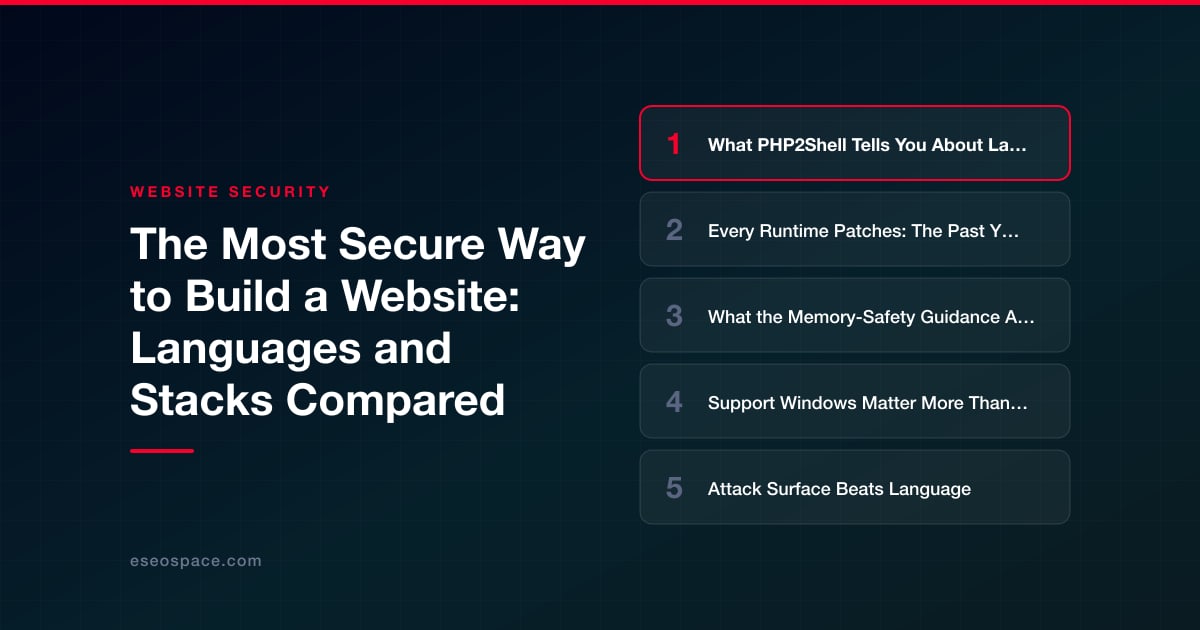
As of 23 October 2026, the PHP project has fixed PHP2Shell, and in the same week Node.js and Ruby both shipped their own security releases. That is the short answer to "which language is most secure for a website?": every major web runtime ships security fixes, and no stack is patch-free. The more useful questions are how much code your site exposes to the internet, whether that code runs on a supported version, and who applies the fixes.
PHP2Shell has led some business owners to ask whether they should leave PHP. The flaw was a memory-safety bug in the C code of the PHP engine, not a mistake in the PHP code that websites are written in. Python and Ruby, whose runtimes are also implemented largely in C, fixed their own use-after-free bugs this year. JavaScript sites had React2Shell, a 10.0-rated flaw in React Server Components.
This guide compares languages and stacks using the projects' own security pages, government memory-safety guidance and what each architecture puts on the public internet. It doesn't crown a winner, because the evidence doesn't support one.
Key Takeaways
- Node.js shipped a security release on 21 October 2026, the same day as PHP2Shell, including a high-severity flaw that "permits remote code execution" (CVE-2026-111497). Ruby shipped regex-engine fixes on 23 October.
- Python's security advisory database lists 45 advisories so far in 2026, including use-after-free bugs in its C modules. A "memory-safe" language still runs on C underneath.
- CISA's memory-safety roadmap lists Python, Java, Go, Rust, C# and Swift as memory safe and doesn't list PHP, but says those languages "will almost certainly need to rely on libraries written in languages such as C and C++."
- Attack surface and support status matter more than the language name. An end-of-life runtime on any stack stops getting fixes.
- Who patches is the biggest practical lever. Managed runtimes and hosted platforms patched PHP2Shell for customers; self-built containers and self-managed servers needed their owners to act.
What PHP2Shell Tells You About Languages
PHP2Shell is two flaws, CVE-2026-109618 and CVE-2026-109619, in the PHP engine. PHP's advisories classify both as CWE-416, "use after free," a memory-safety bug class. The PHP engine is written mainly in C, according to its GitHub repository. The fix was a new PHP build plus a restart, not changes to WordPress, Drupal or any site's own code. Our explainer on what PHP2Shell is covers the details, and the fixed versions list shows which builds to install.
So the lesson isn't "PHP code is unsafe." It is that every interpreted language rests on a runtime, and runtimes are large programs that need patching. Python and Ruby show the same pattern: their 2026 memory-safety fixes were in C-implemented code underneath the language.
Every Runtime Patches: The Past Year in One Table
Here are recent security fixes from each project's own announcements. These are examples, not a full list, and severity labels are the projects' own. Python's advisory records carry no severity score, so none is given.
| Runtime or framework | Recent fix (project's own description) | Date |
|---|---|---|
| PHP | PHP2Shell, two engine flaws that "can allow unauthenticated remote code execution"; PHP rates both 9.2 (CVSS v4.0) | 21 Oct 2026 |
| Node.js | "Brotli decoder out-of-bounds write permits remote code execution (CVE-2026-111497) - (high)," in releases v22.23.4, v24.22.1 and v26.12.1 | 21 Oct 2026 |
| Node.js | "HTTP/2 re-entrant send can cause heap-use-after-free (CVE-2026-56848) - (High)" | 29 Jul 2026 |
| Ruby | Ruby 4.0.9, 3.4.12 and 3.3.13 fix regex-engine bugs "that GitLab found could be used for remote code execution on GitLab servers" | 23 Oct 2026 |
| Ruby | CVE-2026-46727, "Use-after-free in pthread-based getaddrinfo timeout handler" | 20 May 2026 |
| Python | PSF-2026-43 / CVE-2026-19445: a TLS client "can make a server crash or call through a freed pointer" under a specific callback setup | 30 Sep 2026 |
| Python | PSF-2026-18 / CVE-2026-6100: "Use-after-free (UAF) was possible" in decompression modules | 13 Apr 2026 |
| React (JavaScript) | React2Shell, CVE-2025-55182: "unauthenticated remote code execution" in React Server Components, "rated CVSS 10.0" | 3 Dec 2025 |
Two points stand out. First, the Ruby fixes only affect apps that compile attacker-controlled regular expressions, and Ruby notes that "Regexp.timeout does not protect against these bugs." Scope details like this matter more than the headline. Second, React2Shell is in CISA's Known Exploited Vulnerabilities catalog, added on 5 December 2025. As of the catalog released on 23 October 2026, PHP2Shell is not. A JavaScript stack is not a shelter from exploited flaws.
What the Memory-Safety Guidance Actually Says
CISA, the NSA, the FBI and international partners published The Case for Memory Safe Roadmaps in December 2023. It says "memory safety vulnerabilities are the most prevalent type of disclosed software vulnerability," names C and C++ as "examples of memory unsafe programming languages," and lists C#, Go, Java, Python, Rust and Swift as memory safe. PHP doesn't appear in the document at all.
The same roadmap is careful about what that list means. Memory safe languages "will almost certainly need to rely on libraries written in languages such as C and C++," and "most developers will need to work in a hybrid model." Python and Ruby are good examples: the use-after-free fixes in the table above were in parts of their runtimes and libraries written in C. The roadmap also says "No one MSL is right for all programming needs," and it is aimed at software manufacturers planning long-term changes, not at a business choosing a website stack.
Our article on whether AI hacking will kill WordPress looks at the same guidance from the WordPress side. The takeaway for a website owner: language choice matters to the people who write runtimes and libraries. For you, the runtime's support status and patch path matter more.
Support Windows Matter More Than the Language Name
Every language project stops fixing old versions. Once a branch reaches end of life (EOL), new flaws in it go unfixed by the project. Node.js puts it bluntly: "End-of-Life versions are always affected when a security release occurs."
| Runtime | Support status as of 23 Oct 2026 (project's own pages) |
|---|---|
| PHP | 8.3, 8.4 and 8.5 supported; 8.2 gets security fixes until 31 December 2026; 8.1 reached end of life on 31 December 2025 |
| Node.js | "Production applications should only use Active LTS or Maintenance LTS releases"; v22 and v24 are LTS, v20 is end of life |
| Python | 3.14 and 3.15 get bug fixes; 3.11 to 3.13 are security-only; 3.10 reached end of life on 1 October 2026 |
| Ruby | 3.3 is in security maintenance with an expected end of life of 31 March 2027; 3.2 reached end of life on 1 April 2026 |
An unmaintained Node or Python site on an EOL version is in the same position as a PHP 7.4 site: the project has moved on. For PHP2Shell, the PHP project made an exception and published source-only backports for 7.4, 8.0 and 8.1, but it released no official builds for them. Our guide to upgrading old PHP safely covers that path.
Attack Surface Beats Language
Attack surface is everything on your site an attacker can reach: pages that run code, forms, logins, APIs, admin panels and file uploads. OWASP's attack surface cheat sheet advises reducing it "by simplifying the model," "not storing confidential data that you don't absolutely have to" and "turning off features and interfaces that aren't being used." It also warns that attack surface "will increase over time as you add more interfaces and user types and integrate with other systems."
The Five Eyes cyber agencies made the same point in June 2026: "Challenge whether systems need to be exposed at all and isolate those that do not." For a website, that translates into practical questions that have nothing to do with the language name:
- Does every page need code running on a server at request time, or could most pages be prebuilt files?
- Is the admin panel reachable by anyone on the internet?
- How many plugins, packages or modules does the site load, and who updates them?
- Are forms and file uploads limited to what the business actually needs?
Third-party code is part of the surface on every stack. A Node.js app pulls in npm packages; a WordPress site pulls in plugins. OWASP's 2025 Top 10 lists "Software Supply Chain Failures" as its own category. Our guide to plugin, app and package supply chain security covers that risk.
Stack Options Compared
Here is how the common ways to build a business website compare on the questions above. "Who patches the runtime" is the PHP2Shell question: who had to install the fix.
| Stack | Code running on a public server | Who patches the runtime | What you still own |
|---|---|---|---|
| Hosted builder (Shopify, Wix, Squarespace, Webflow) | The vendor's, not yours | The vendor | Logins, apps, custom code and scripts |
| CMS on a managed host (WordPress, Drupal) | The CMS and its plugins | The host | Plugins, themes, users |
| CMS on your own server or VPS | The CMS, plugins and the whole server | You or your developer | Everything |
| Static site on a CDN | Little or none, unless you add functions | The host, for the edge | Build pipeline, dependencies, any forms or functions |
| Headless (CMS backend plus separate frontend) | The CMS backend and any server-rendered frontend | Depends on where each part is hosted | Both halves, the API between them and dependencies |
| Custom app on a managed runtime (PaaS) | Your application code | The provider, if you use its built-in runtime | Your code, packages and any custom containers |
Our guides on static versus dynamic website security and the most secure website platforms go deeper on the first five rows, and our headless and custom website security guide covers dependencies, secrets and API routes.
Managed Runtimes: Who Patches the Language for You
Cloud providers showed during PHP2Shell that "who patches" depends on how you deploy, even with the same language. Their own notices, as of 22 and 23 October 2026:
- Google Cloud. App Engine standard (PHP 8.2 and newer) apps "are updated automatically." App Engine flexible apps "are not updated automatically," so customers must redeploy. Google adds: "Container images you build yourself are your responsibility."
- AWS. Elastic Beanstalk customers "with Managed Platform Updates enabled will receive the update automatically during their next maintenance window." Lightsail instances can't be updated in place; customers create new instances from updated blueprints.
- Microsoft Azure. App Service on Linux rolled out patched built-in PHP images, but "If you run PHP in a custom container, or bring your own PHP runtime, App Service does not patch it."
The same split applies to Node.js, Python and Ruby on those platforms. A built-in, provider-managed runtime gets patched for you. A container you built yourself has to be rebuilt and redeployed by you, whatever language is inside it.
Questions to Ask Before You Choose a Stack
- Who will apply runtime, framework and plugin updates, and how quickly after a critical release?
- Is the runtime version on a supported branch, and when does that support end?
- How much of the site has to run code on a public server? Could more of it be prebuilt?
- Is the admin or content backend exposed to the whole internet, or limited?
- How many third-party packages or plugins will it depend on, and who reviews them?
- If you use a cloud platform, are you on its managed runtime or your own container?
- What does the vendor's shared responsibility page say stays with you?
If a developer answers these well, the language they prefer is a reasonable choice. If nobody can answer the first question, no language will make the site safe.
Conclusion
As of 23 October 2026, PHP, Node.js, Python, Ruby and React have all shipped serious security fixes within the past year, and PHP2Shell was a memory bug in the C engine beneath PHP, not a flaw in the websites built on it. The most secure way to build a website is the stack with the smallest public attack surface you can live with, a supported runtime version and a named owner who applies fixes quickly. If you run PHP today, patch it and restart it first; our emergency PHP patching team can help, and stack changes can be planned afterward. Every PHP2Shell guide is in our PHP2Shell Resource Center.
Frequently Asked Questions
Which programming language is most secure for a website?
No language is secure on its own terms. CISA lists Python, Java, Go, Rust, C# and Swift as memory safe, but also says they rely on C and C++ libraries, and Python and Ruby both fixed use-after-free bugs in 2026. For a website, a supported runtime version, a small attack surface and fast patching matter more than the language name.
Is PHP less secure than Node.js or Python?
The evidence doesn't support a ranking. PHP2Shell was serious, but Node.js shipped a high-severity remote code execution fix the same day, and React2Shell, a 10.0-rated JavaScript framework flaw, is in CISA's Known Exploited Vulnerabilities catalog. Each project fixes its supported versions; each stops fixing end-of-life versions.
Should I move my website off PHP because of PHP2Shell?
Not as a response to this flaw. The fix is a patched PHP build and a restart, which takes far less time than a rebuild. If you later rebuild for other reasons, choose the stack based on who will maintain it and how much it exposes, not on one week's headlines.
Was PHP2Shell a bug in my website's code?
No. It was in the PHP engine, which is written mainly in C. Updating WordPress, Drupal, Joomla, plugins or your own PHP code does not fix it. The runtime on the server must be updated and every PHP worker restarted.
Does a static or headless site avoid these problems?
It can reduce them. A site made of prebuilt files has no runtime on the public server for pages. But forms, search, logins and a headless CMS backend still need server code, and React2Shell showed that server-rendered JavaScript frameworks can have critical flaws too.
Does it matter which version of Node.js or Python I run?
Yes. Node.js says production apps should use only Active or Maintenance LTS releases and that end-of-life versions "are always affected" when a security release occurs. Python 3.10 reached end of life on 1 October 2026. Check your version against the project's own release page.
What is the safest way for a small business without a developer?
Choose a model where someone else patches the runtime: a hosted builder, or a managed host that patches PHP for you. You still need two-factor authentication, a short list of well-maintained plugins or apps, and tested backups.
Put this into action with eSEOspace
We help businesses grow with maintenance & support that actually performs. Explore the services behind this guide:
Get a FREE Audit
We'll perform a comprehensive SEO, AEO, GEO & CRO audit of your website — completely free — and show you exactly how to outrank your competitors.
Don't have a site yet? Get in touch →
Get a FREE GEO/AEO/SEO Audit
We'll analyze your site's SEO, GEO, AEO & CRO — completely free — and show you exactly how to get found across Google and AI answers.
Don't have a site yet? Get in touch →
Great — your audit is on the way!
We'll send your free SEO/GEO/AEO/CRO audit within the next few hours. Where should we send it?
You're all set! ✓
Your free audit is being prepared — check your inbox in the next few hours. Talk soon!


On this page
- Key Takeaways
- What PHP2Shell Tells You About Languages
- Every Runtime Patches: The Past Year in One Table
- What the Memory-Safety Guidance Actually Says
- Support Windows Matter More Than the Language Name
- Attack Surface Beats Language
- Stack Options Compared
- Managed Runtimes: Who Patches the Language for You
- Questions to Ask Before You Choose a Stack
- Conclusion
- Frequently Asked Questions