



The Three Fronts of Digital Security Every Business Has to Defend
The Three Fronts of Digital Security Every Business Has to Defend
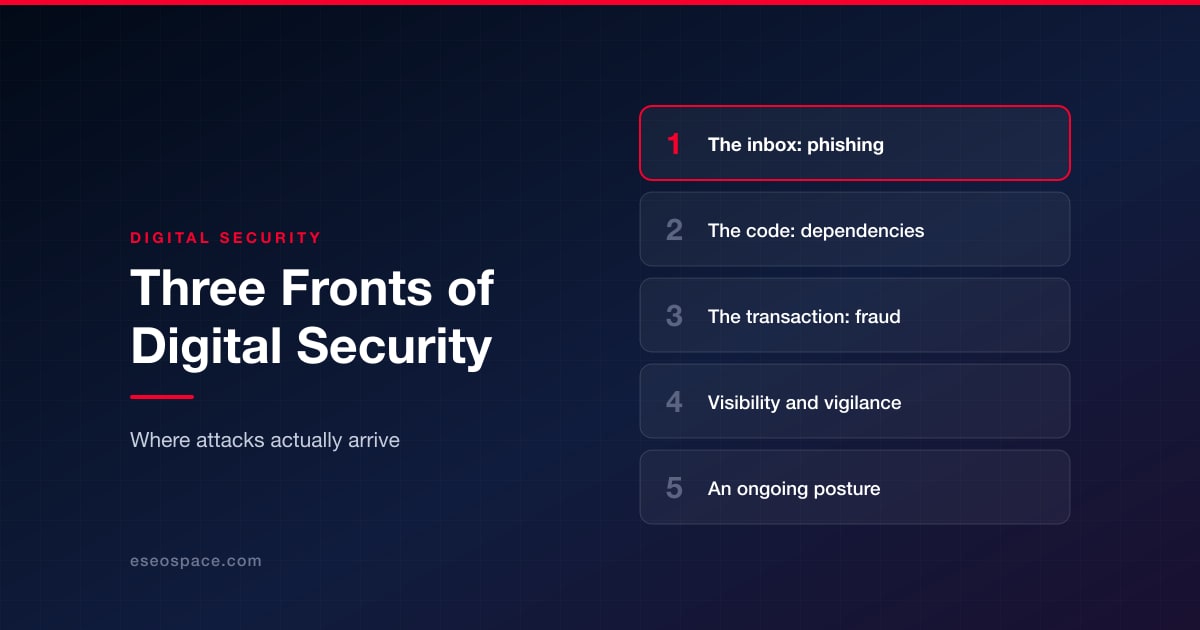
There's a comforting myth that cyberattacks are rare, sophisticated events that happen to other people, the sort of thing you read about when a major corporation makes headlines. The reality is far more ordinary and far more relevant to every business, large or small. Attacks are constant, mostly unglamorous, and aimed at the everyday weak points that businesses tend to leave unguarded. They don't usually arrive as a dramatic break-in through a firewall. They come through an email someone trusts, a flaw hidden in the software a company runs, or a fraudulent transaction that looks legitimate until the money is already gone. These are the front lines of digital security, and they're where the real battle is fought.
What makes this challenging is that these threats come through completely different channels, targeting different parts of a business, and defending against one does nothing to protect against the others. A company can have impeccable software security and still be devastated by a phishing email that fools an employee. It can train its people to spot scams and still be breached through a vulnerability buried deep in its code. It can secure both and still bleed money through fraudulent transactions it never learned to prevent. Real security means defending all three fronts at once, because attackers will always probe for the one that's weakest. This is a look at those three fronts, why each matters, and how businesses can actually defend them.
The first front: the inbox
Begin with the entry point that touches every single person in a business: email. It remains the single most common way attacks begin, not because of any technical weakness in email itself, but because it targets people, and people can be deceived. Phishing, the practice of sending deceptive messages engineered to trick someone into clicking a malicious link, surrendering a password, or trusting a fraudulent request, is the workhorse of cybercrime precisely because it works so reliably.
Modern phishing bears little resemblance to the crude scams of years past. Today's deceptive emails convincingly imitate real companies, trusted services, and even colleagues within the same organization, often crafted with a sense of urgency designed to make the recipient act before they stop to think. The sophistication is the point: a message that looks exactly like a legitimate request from a known source, aimed at someone with no easy way to tell it's fake, is a formidable weapon. And because the appearance of a sender can be faked, employees are often left trusting messages that never came from who they claim.
Defending this front requires giving people the means to see through the deception, and one of the most practical tools is the ability to inspect what an email actually reveals about itself. Every message carries technical header information recording how it traveled and where it genuinely originated, and a tool like the EasyDMARC email header analyzer lets you examine those headers to trace a message's true path and source rather than trusting the name it displays. When an email seems suspicious, being able to read what its headers show, including whether it passed the authentication checks that verify a legitimate sender, transforms a nervous guess into an informed decision. A spoofed message that looks flawless on the surface often falls apart the moment its headers are examined, revealing an origin that has nothing to do with the company it pretends to represent.
But tools are only half the defense. The other half is a workplace culture where people pause on unexpected requests, verify anything unusual through a separate channel, and treat urgency as a reason for caution rather than compliance. The overwhelming majority of phishing attacks collapse the instant their target stops to ask whether the message is really what it claims to be. Combining technical inspection with human vigilance is what makes the inbox defensible.
The second front: the code
Now move to a front that's invisible to most employees but every bit as critical: the security of the software a business builds and runs. Modern software is assembled at high speed, and an enormous share of it is built not from original code but from open-source components, prewritten building blocks that let developers avoid reinventing everything from scratch. This is how nearly all contemporary software gets made, and it's a huge driver of efficiency. It also introduces a serious and frequently overlooked vulnerability.
The issue is that when an application depends on dozens or hundreds of external components, a security flaw in any one of them becomes a flaw in the application itself. A vulnerability discovered in a widely-used open-source component can silently expose every application that relies on it, often without the teams running those applications knowing they're at risk. These dependencies sit deep in the software supply chain, far removed from the code a team actually writes, which makes them easy to miss and difficult to track by hand. One vulnerable component, buried among many, can be exactly the opening an attacker needs.
This is why tools built to secure the software itself have become indispensable, and it's a domain where artificial intelligence is increasingly being brought to bear. A platform like Aikido helps development teams find and fix vulnerabilities across their code and dependencies, bringing visibility to risks that would otherwise remain hidden and even applying AI to probe applications for weaknesses the way an attacker might. The value lies in exposing what's normally invisible: instead of hoping none of their many components harbor a known flaw, teams are shown precisely where their exposure lies and can address it before it's exploited. In a world where almost all software rests on a foundation of code the team didn't write, keeping that foundation secure is fundamental to keeping the entire application secure.
The most effective approach catches these problems early, integrating security into the development process so that vulnerabilities are found while code is still being written rather than after it's been deployed and potentially attacked. Discovering a flaw during development is vastly cheaper and safer than discovering it once it's live and exposed. Security woven into how software is built, rather than bolted on afterward, is what makes the code front defensible.
The third front: the transaction
The third front is one many businesses neglect entirely until it starts costing them real money: the integrity of the payments they accept. Every business that takes payments online is exposed to fraud, and one of the most damaging and least understood forms is chargeback fraud, where a customer disputes a legitimate charge to get their money back while keeping the goods or services they received.
The chargeback system was created as a genuine consumer protection, allowing people to dispute fraudulent or undelivered charges, and that protection is necessary and good. The problem is its abuse. Some customers dispute purchases they actually made and received, effectively obtaining the product for free while the business loses both the goods and the payment. Sometimes it's deliberate dishonesty; sometimes it's a customer who genuinely forgot a purchase or failed to recognize a charge; sometimes it's someone using a family member's card. Regardless of the cause, the business absorbs the cost, and not just the lost sale but additional fees, staff time spent disputing, and, if it happens too often, damage to its standing with payment processors that can jeopardize its ability to accept cards at all.
This is why serious chargeback fraud prevention has become an essential discipline rather than an afterthought. The costs accumulate faster than most merchants realize, quietly eroding margins and, in severe cases, threatening the viability of the business. Preventing this kind of fraud involves layering sensible practices: identifying high-risk transactions before they complete, using clear billing descriptors so customers recognize their charges, keeping detailed records that provide evidence when a dispute must be contested, and offering responsive customer service so problems get resolved directly rather than escalating straight to the bank. Together, these practices both reduce fraudulent disputes and equip a business to win the legitimate fights.
Like the other fronts, this one rewards ongoing attention rather than a one-time fix. Fraud patterns shift, and a business that monitors its chargebacks, understands why disputes are happening, and adjusts accordingly keeps the problem contained. The transaction front is defensible, but only for businesses that take it as seriously as they take the more familiar threats.
Why all three must be defended together
It might be tempting to prioritize one front and hope the others take care of themselves, but that's precisely the mistake attackers count on. The three fronts are connected by a simple, unforgiving logic: a business is only as secure as its weakest point. Brilliant software security means nothing if a phishing email hands an attacker the keys. Vigilant employees can't help if a hidden vulnerability in the code lets attackers in directly. And securing against intrusion does nothing to stop the steady financial drain of fraudulent transactions. Attackers don't respect the boundaries between these categories; they simply find and exploit whichever is least defended.
There's a unifying principle that ties all three together, though, and it makes the challenge more manageable than it first appears. In every case, the defense comes down to visibility and vigilance: refusing to take things at face value and using the right tools to see what's really there. Phishing hides the true origin of a message, and header inspection reveals it. Vulnerable dependencies hide in the depths of the software supply chain, and scanning brings them to light. Fraudulent transactions hide among legitimate ones, and careful monitoring distinguishes them. The same fundamental discipline, applied across three different fronts, is what keeps a business secure. Organizations that internalize this, that treat all three entry points as things to be actively watched and inspected rather than assumed safe, are the ones that avoid becoming cautionary tales.
This also means security can't be the concern of a single person or department working in isolation. The inbox is defended by everyone who reads email. The code is defended by the development team. The transactions are defended by the people managing payments and customer service. A business that treats security as a shared responsibility across all these areas, rather than delegating it to one corner and forgetting about it, builds the kind of comprehensive defense that actually holds. The fronts are different, but the commitment has to be unified.
It's worth adding that defending these three fronts is not a project with an end date but an ongoing posture. The tactics attackers use evolve constantly, and defenses that were adequate a year ago can quietly become insufficient as phishing grows more convincing, new vulnerabilities are discovered, and fraud schemes adapt. The businesses that stay secure treat security as a continuous practice, revisiting their defenses regularly, staying aware of how threats are changing, and adjusting before a gap becomes a breach. This doesn't require enormous resources or a dedicated security army; it requires the habit of paying attention and the willingness to act on what that attention reveals. A modest business that stays vigilant across all three fronts is far safer than a larger one that set up defenses once and assumed the job was done.
The bottom line
The real threats to a business aren't exotic feats of hacking; they're the everyday attacks that come through three ordinary fronts: the inbox, the code, and the transaction. Phishing exploits the people who read email, and defending it means inspecting suspicious messages and cultivating healthy caution. Vulnerable dependencies expose the software a business runs, and defending it means bringing visibility to hidden flaws and catching them early. Chargeback fraud drains revenue through abused disputes, and defending it means active prevention and vigilant monitoring. No single front can be neglected, because a business is only as secure as its weakest point, and attackers will always find it. The encouraging truth is that all three yield to the same underlying discipline of visibility and vigilance, and the tools to achieve it have become genuinely accessible. Defend all three fronts with equal seriousness, refuse to take anything at face value, and a business closes off the paths through which the overwhelming majority of real damage actually arrives.
Put this into action with eSEOspace
We help businesses grow with maintenance & support that actually performs. Explore the services behind this guide:
Get a FREE Audit
We'll perform a comprehensive SEO, AEO, GEO & CRO audit of your website — completely free — and show you exactly how to outrank your competitors.
Don't have a site yet? Get in touch →
Get a FREE GEO/AEO/SEO Audit
We'll analyze your site's SEO, GEO, AEO & CRO — completely free — and show you exactly how to get found across Google and AI answers.
Don't have a site yet? Get in touch →
Great — your audit is on the way!
We'll send your free SEO/GEO/AEO/CRO audit within the next few hours. Where should we send it?
You're all set! ✓
Your free audit is being prepared — check your inbox in the next few hours. Talk soon!








