Trust Factor: What Makes Google & AI Search Engines Trust Your Website?
Trust Factor: What Makes Google & AI Search Engines Trust Your Website?
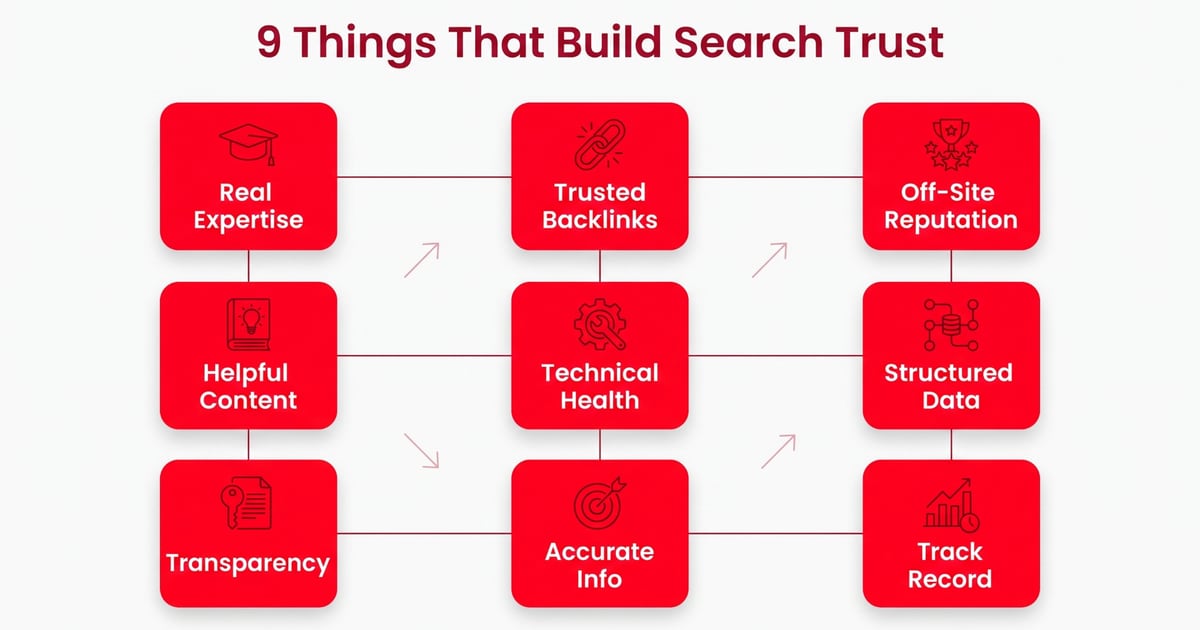
Every website has a trust factor, even if you never think about it. It is the running verdict Google and AI search engines reach about whether you are worth believing. Get it right, and you become the answer people see. Get it wrong, and you stay invisible, no matter how much you publish.
That is exactly what we are here to help you sort out. We will show you 9 signals that actually earn you trust. After that, a simple way to check where your own site already stands.
Why Winning Trust Factor from Google & AI Search Engines Is Important: 5 Key Benefits
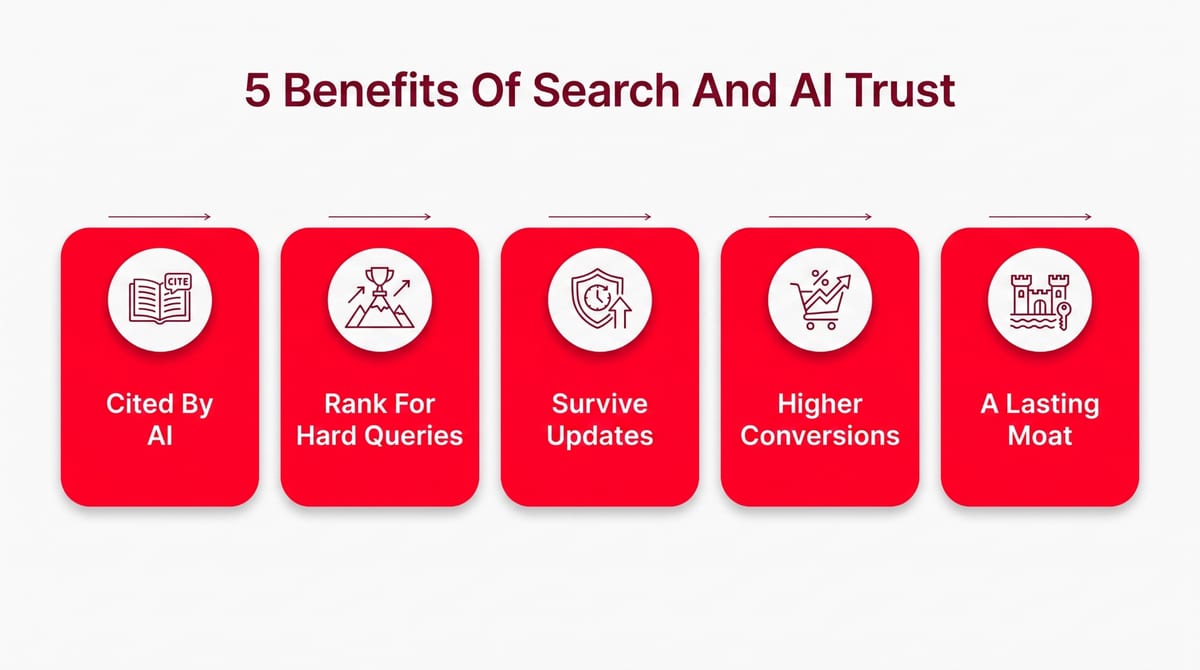
Before we get into the how, it is fair to ask what a strong trust factor actually buys you. Building it takes real work, so here is what that work pays back. Five wins, and they feed off each other.
1. You Get Cited in AI Answers, Not Just Ranked
Search is bigger than 10 blue links now. AI Overviews and chatbots pull their answers straight from sources they trust, and being one of those sources puts you in front of people who never scroll to a regular result. Semrush data shows AI Overviews hit nearly 25% of queries at their 2025 peak, so this isn't some side channel.
2. You Can Compete for High-Stakes, Competitive Queries
The searches worth the most money are also the hardest to win because Google guards them closely. For anything touching health or your finances, it won't rank a site it doesn't trust, however sharp the writing is. A strong trust factor is what gets you into those results at all, where low-trust rivals simply can't follow.
3. Your Rankings Hold Steady Through Algorithm Updates
Every core update shakes up the rankings, and the sites that get flattened are usually the ones standing on thin trust. Once you have earned real credibility, updates tend to reward you instead because you are exactly what they are built to promote. Trust is what turns shaky rankings into ones that actually hold.
4. Visitors Trust You Too, So More of Them Convert
And here is the bonus most people overlook. The same signals that convince a search engine you are legit also reassure an actual human. Someone who arrives on a credible and upfront page is far likelier to buy or get in touch than someone who arrives somewhere sketchy. Trust ranks you, then helps close the visitor it brought.
5. You Build an Advantage Rivals Can't Copy Overnight
Trust is slow to build, and that is exactly why it is worth building. A rival can copy your page layout in an afternoon. What they can't copy is years of credibility and hard-won links. Every signal you add puts more distance between you and anyone trying to catch up.
9 Things That Make Google and AI Search Engines Trust Your Website
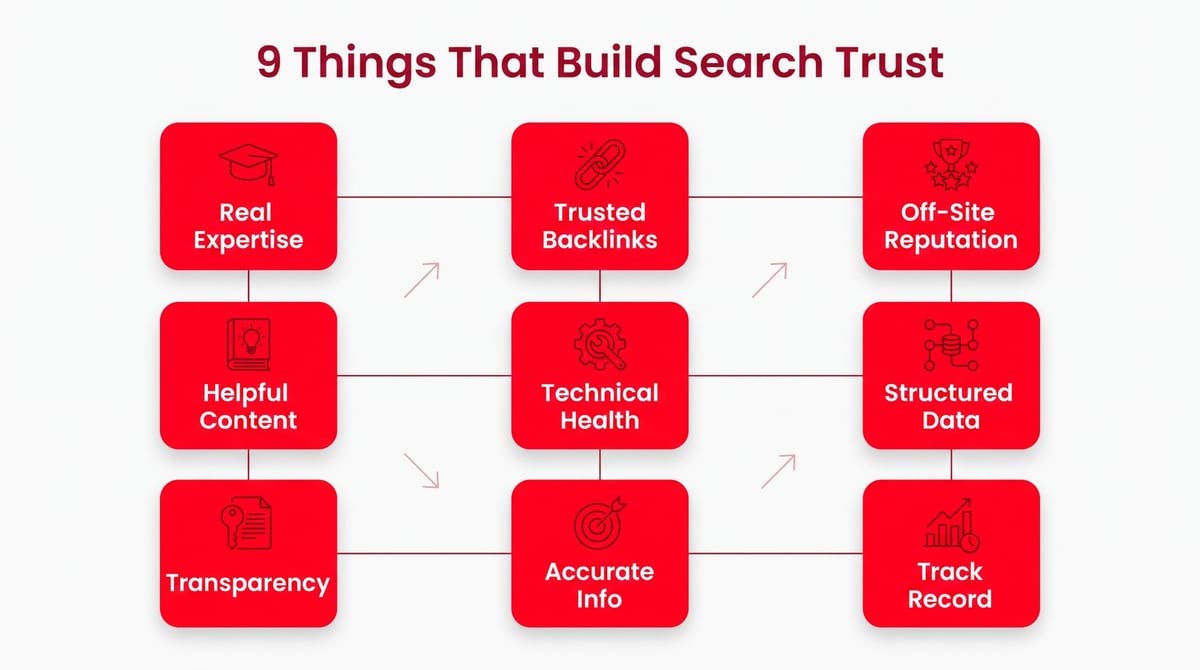
Alright, the actual signals. These are the 9 that genuinely shape how much Google and AI engines trust you, and we have kept them strictly separate so none of them repeat another. Pull enough of them, and you have got the trust factor that decides whether anyone sees you.
1. Genuine Expertise and Real Authorship
Search engines want a real and qualified person standing behind what you publish. This is the core of what Google's quality rater guidelines call E-E-A-T, where trust is the most important part and experience and expertise help support it. Content from nobody in particular reads as low-trust by default, no matter how clean it looks.
- Put a real byline on every article, with the author's actual credentials.
- Build detailed author bio pages showing genuine first-hand experience and real qualifications.
- Have a qualified expert review and sign off on your sensitive topics.
- Show first-hand experience with original photos and your own real test results.
This signal matters everywhere, but in a few corners of the web it is the entire game. Anything touching health or money gets held to a brutal standard because a wrong answer can genuinely hurt someone. There, content from an unnamed writer doesn't just rank poorly. It gets actively distrusted, however well written it is.
Medicine is the sharpest case. A page about a rare cancer like peritoneal mesothelioma has to prove real expertise up front because so many health sites are thin lead-generation fronts wearing the costume of advice.
Look closely at how the peritoneal mesothelioma guide at mesothelioma.net earns it. It names the writer, then shows the article was medically reviewed by Dr. Paul Sugarbaker, the surgeon who developed the standard treatment for this cancer.
Every survival figure is tied to a cited study rather than just stated. And a fact-checked label appears near the top, with the date it was last checked.
That is what a reader can actually see and trust, and it is exactly what Google reads too. A named expert stands behind each claim, and the claims point back to real sources. If your topic carries any real-world stakes, that is your bar. Put identifiable and credentialed people behind the work and let them show it.
2. Backlinks From Sites Search Engines Already Trust
Backlinks are still the web's original trust signal, one site publicly vouching for another. A link from a respected site reads as a real endorsement, which is why quality backlinks still move rankings so hard. Backlinko found the top result has, on average, 3.8x more backlinks than the pages just below it.
- Earn links by publishing original research or a genuinely useful free tool.
- Always chase relevance and real authority over the raw number of links.
- Disavow or clean up any spammy links that could drag trust down.
- Get mentioned on trusted industry sites, never random low-quality link directories online.
3. A Reputation That Exists Beyond Your Own Site
Trust doesn't stop at your own domain. Search engines and AI models also weigh what the rest of the web says about you, from public reviews to plain brand mentions with no link attached. A brand people talk about and search for by name looks trustworthy in a way self-promotion never can.
People rely on this more than you would think. BrightLocal's 2026 survey found 97% of consumers read reviews for local businesses before they decide, and search engines watch that same reputation to judge whether you are the real thing. For AI answers especially, mentions and citations are turning into the new backlink.
- Actively collect real customer reviews on Google and other trusted third-party platforms.
- Earn press and unlinked mentions on the sites your audience already trusts.
- Keep your business name and contact details identical everywhere they appear online.
- Respond to reviews, good and bad, so people see you genuinely engaged.
4. Content That Genuinely Answers the Search
None of the other signals count for much if your content doesn't answer the question behind the search. Google and AI both reward pages that fully satisfy the intent and add something original, rather than rehashing whatever already ranks. Thin, me-too content is the quickest way to look untrustworthy. Real depth balanced with clarity is what wins.
- Answer the whole question, including the follow-ups the searcher will obviously have.
- Add original data or first-hand insight your competitors simply do not have.
- Match the format to the intent, whether that is a guide or comparison.
- Cut the fluff so every paragraph gives the reader a real reason to stay.
Content gets tested hardest when you are selling something people don't fully understand yet. New product categories are the classic case. The searcher shows up skeptical, carrying a very specific list of worries. A vague page that dodges those worries loses them because there is no reputation yet to fall back on.
Take AI phone answering. Most buyers walk in assuming the AI will sound like a robot and fumble their callers, so the page has one real job: answer that fear with something concrete.
That is what DialMyCalls AI phone answering page does instead of hand-waving. It gives the actual response time, under a second, and explains that the AI works from a knowledge base you upload yourself. It even puts a number on the problem that shows how many calls a small business typically misses.
That is content answering the search, not just describing a product. Each worry a nervous buyer would type gets a straight and specific reply, and that is what earns trust in a category with no track record yet. The page wins by refusing to be vague, and vague is precisely what search engines have learned to distrust.
5. A Technically Healthy, Secure Site
A site that is slow or throws security warnings looks neglected, and neglect burns trust quickly. Search engines treat technical health as a stand-in for how reliable you are. Fall behind on speed or security, and you undercut every other signal before a visitor reads a single word. Passing Core Web Vitals is the baseline now.
- Always serve every single page over HTTPS with a valid and current certificate.
- Pass Core Web Vitals so your pages load fast and stay stable.
- Fix broken links and crawl errors quickly, before they start to pile up.
- Make sure the whole site works cleanly and quickly on a phone.
6. Structured Data That Verifies Your Claims
Structured data is how you state your claims in a language machines read without having to assume. Schema markup lets you label who wrote a page and confirm details like a product's price or a real review. It won't boost rankings on its own, but it removes doubt. And removing doubt is how you win a machine's trust.
- Mark up your organization and author details with clean, valid schema code.
- Validate every markup so a single typo does not break the whole thing.
- Only mark up content that genuinely appears on the visible page itself.
- Keep the schema updated whenever your underlying prices or details actually change.
7. Obvious Transparency and Accountability
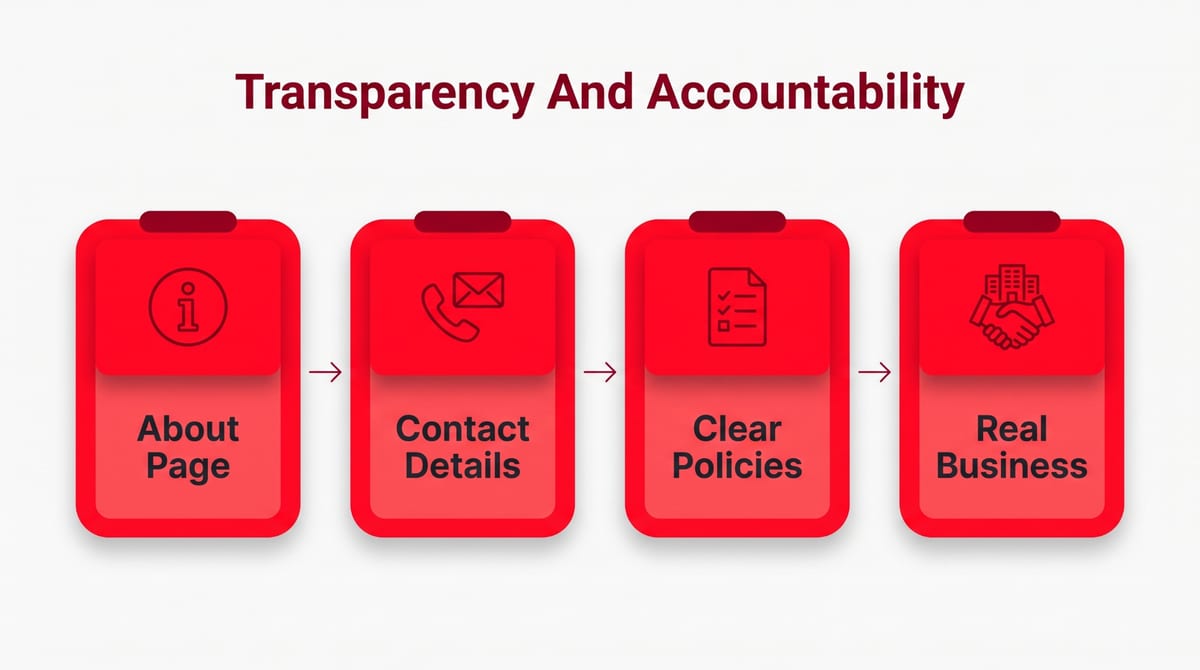
Trustworthy sites don't hide who runs them. A real About page and contact details you can actually find tell both people and search engines there is an accountable business behind the screen. Faceless sites with no owner and no clear way to reach a person read as risky, and risky rarely ranks in serious niches.
- Publish a genuine About page with real names and your company history.
- Show a physical address and a genuine, monitored way to contact you.
- Keep your privacy and refund policies clear and genuinely easy to find.
- Openly name the real people and the actual team behind the brand.
Transparency stops being optional the moment you ask someone to make a big, high-stakes decision. Picture the deals people do once in a lifetime, where the money is huge, and the buyer has no past experience with you to go on. Any hint of a faceless operation there ends the conversation.
Look at how this business-sale marketplace handles that worry. It shows a real address and phone number, and lists the exact price of each package instead of hiding it behind a contact form. It even puts its own money on the table, promising to spend $1,000 promoting your listing if you don't find a buyer within 120 days.
Every one of those details answers the same silent worry about whether a real, accountable company stands behind the site. Named people and pricing you can see up front give a visitor something solid to hold onto. That reassures a cautious search engine and a cautious buyer for the very same reasons.
8. Accurate, Consistent, Citable Information
Being trustworthy also means being right… and staying right consistently. Search engines and AI models cross-check your claims against what they already know, so one factual slip or a detail that contradicts the rest of the web eats away at trust. Accurate and well-sourced information is what makes a source safe to quote.
- Always cite a reputable primary source for every statistic and factual claim.
- Keep the same facts consistent across your whole site, with no contradictions.
- Update or remove any claim the very moment it goes out of date.
- Stay specific and checkable rather than hiding behind vague marketing everywhere.
This one gets unforgiving in fields where a claim is either exactly right or dangerously wrong. Highly technical industries are where it bites hardest. The audience knows enough to catch a bluff on sight, and AI engines increasingly favor sources whose claims are specific and checkable over ones saying a lot without saying much.
Look at CyberProof’s agentic SOC for cybersecurity, for example. Rather than vague promises, it names the exact framework it maps threats against, and it spells out where the AI acts on its own versus where a human has to approve first. Then it backs the whole thing with a hard number about cut in security-operations cost.
That precision is the trust signal itself. Specific and verifiable claims are what a skeptical expert and a citation-hungry AI both reward, while hedged clichés get skipped over. When your information is accurate enough to check and consistent everywhere it shows up, you become the kind of source an answer engine will quote by name.
9. A Proven Track Record Over Time
Trust builds up over time, and search engines notice a steady history. A domain that is published quality for years and earned real engagement looks far safer than one that appeared last month making big claims. You can't shortcut this, which is the whole reason it carries weight. Authority built over time is the hardest signal to fake.
- Publish consistently over time rather than in short bursts you then abandon.
- Keep older content refreshed so your whole library stays accurate and current.
- Earn genuine engagement, since people who come back are a sign your content is useful.
- Protect your domain's history and avoid risky migrations that reset your trust.
Some decisions are so weighty that people only trust a long and provable history. High-stakes professional services are the clearest case. When the outcome can change someone's life, a shiny new site full of confident promises isn't enough because anyone at all can claim to be good.
What actually earns trust there is proof of having done the thing, over and over, for years. A wrongful-death law firm is right in the middle of that. Look at how this page for Finch McCranie wrongful death lawyer leans on its record. It points to more than 50 years of this exact work and over $500 million recovered for clients, then names specific outcomes like an $11.7 million judgment.
Those are concrete and checkable proofs, not adjectives. A record like that is hard to fake and impossible to buy overnight, which is exactly why search engines treat it as a strong signal. Sustained results over the years tell Google the same thing they tell a grieving family: this source earned its standing instead of just claiming it.
Where to Start: Auditing Your Low Trust Factor
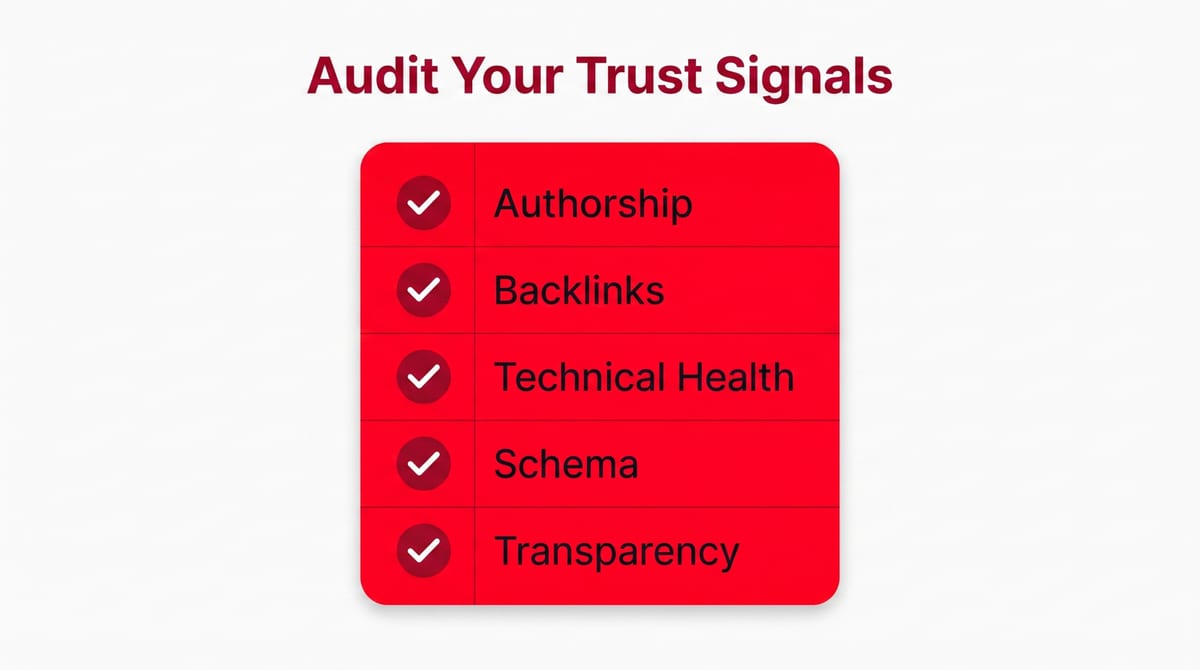
Nine signals is a lot to stare at, so don't try to fix all of them at once. Start by working out which ones you already do well and which are silently costing you, then take them in the order that gets you the most, fastest.
Check Your Trust Factor Gaps That Are Costing You Most
Run an honest audit of the 9 against your own site. Some gaps jump out the second you look, like a missing About page or no author bios anywhere. Others hide under the hood, which is where a proper technical SEO audit pays off on crawl errors and speed. Score each signal and the weak spots make themselves obvious.
Fix the Fast Wins First, Then Work on the Bigger Stuff
Some fixes take an afternoon, and others take a year, so put them in order. Add author bios and tighten up security this week, since both are quick and hit hard. Then commit to the slow burners, the earned links and the track record, that only pay off if you start today.
Conclusion
So it all comes down to one idea. There is no single trust factor you can buy or switch on. Trust is the sum of 9 honest signals, each telling Google and every AI engine the same thing: this is a source worth believing. Build enough of them, and you stop chasing rankings altogether, because you have turned into exactly what the algorithms are looking for.
It is a lot to build on your own, and it happens to be what we do every day. At eSEOspace, we work these trust signals into your SEO from the ground up, starting with whichever ones are holding your rankings back. If you would rather hand it to specialists, get in touch now and see where your trust stands.
Put this into action with eSEOspace
We help businesses grow with website development that actually performs. Explore the services behind this guide:
Get a FREE Audit
We'll perform a comprehensive SEO, AEO, GEO & CRO audit of your website — completely free — and show you exactly how to outrank your competitors.
Don't have a site yet? Get in touch →
Get a FREE GEO/AEO/SEO Audit
We'll analyze your site's SEO, GEO, AEO & CRO — completely free — and show you exactly how to get found across Google and AI answers.
Don't have a site yet? Get in touch →
Great — your audit is on the way!
We'll send your free SEO/GEO/AEO/CRO audit within the next few hours. Where should we send it?
You're all set! ✓
Your free audit is being prepared — check your inbox in the next few hours. Talk soon!