How Modern Companies Build Their Voice: Content, People, and Reputation
How Modern Companies Build Their Voice: Content, People, and Reputation
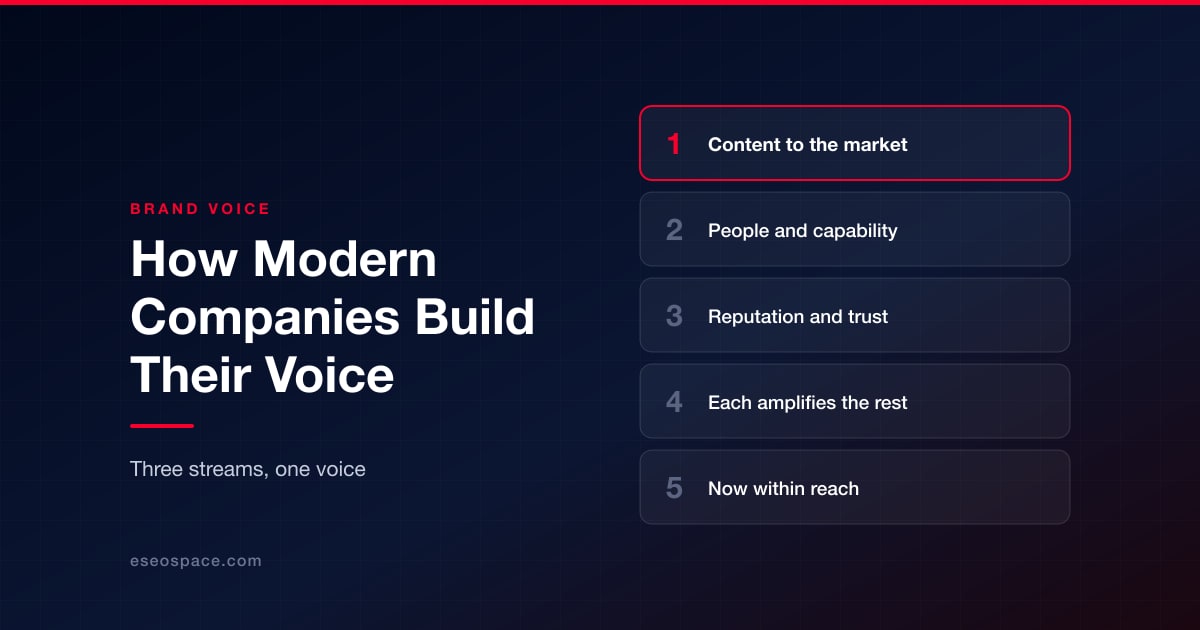
Every company, whether it knows it or not, is constantly communicating. It communicates with the market through the content it publishes, with its own people through how it develops and equips them, and with the wider world through the reputation it builds. These three streams of communication shape how a company is perceived, how effectively it operates, and ultimately how well it succeeds. Yet they're often treated as separate, unrelated functions, handled by different teams who rarely coordinate, when in truth they're three expressions of a single thing: a company finding and projecting its voice.
Getting this right has become both more important and more achievable than ever. More important because attention is scarce, competition is fierce, and audiences, customers, and employees alike have high expectations shaped by a polished, fast-moving digital world. More achievable because the tools to create compelling content, develop capable people, and build a strong reputation have grown dramatically more powerful and accessible. The companies that thrive are increasingly those that understand these three streams as connected and invest in all of them thoughtfully. This is a look at how modern companies build their voice across content, people, and reputation, and why treating them as a unified effort makes all the difference.
Speaking to the market through content
Start with the most outward-facing stream: the content a company creates to reach and engage its audience. In a crowded digital landscape, content is how a company gets noticed, communicates its value, and builds a relationship with its market. And increasingly, the content that cuts through is visual. Video in particular has become the dominant form of communication online, commanding attention and conveying messages in ways that text and static images simply can't match. A company that communicates well through video has a real advantage in reaching and holding the attention of its audience.
The obstacle has always been that producing quality video was expensive, slow, and technically demanding, putting it out of reach for many companies, especially smaller ones. That barrier has fallen dramatically. Tools like the Renderforest AI video generator now let companies create professional-looking videos without the traditional costs and complexity, using artificial intelligence to streamline what once required specialized skills, equipment, and substantial budgets. This democratization matters enormously, because it means a company's ability to communicate through video is no longer determined by the size of its production budget. A small business can now create the kind of polished visual content that was once the exclusive domain of large companies with dedicated creative teams, and it can do so quickly enough to keep up with the relentless pace at which modern audiences consume and move past content.
What this changes, practically, is that content creation shifts from a rare, resource-intensive event to an ongoing capability. A company can produce video for its marketing, its social media, its product explanations, and its brand storytelling regularly rather than occasionally, maintaining the consistent visual presence that modern audiences expect. The strategic value isn't just in any single video but in the ability to communicate visually as a matter of routine, keeping a company visible and engaging in the channels where its audience actually spends time. Content is how a company speaks to its market, and accessible creation tools mean it can speak often, clearly, and professionally.
Building capability through people
The second stream turns inward, to how a company develops the people who make everything else possible. A company's capability is ultimately its people's capability, and in a world where skills, technologies, and best practices evolve rapidly, developing those people continuously has become essential rather than optional. The companies that invest in their people's growth build a workforce that's more capable, more adaptable, and more engaged, while those that neglect it watch their capabilities stagnate and their best people leave for organizations that will help them grow.
The challenge is that traditional approaches to workforce development often fall short. Generic training that doesn't connect to real work, one-off sessions that are quickly forgotten, and programs that fail to keep pace with how fast the world is changing all produce disappointing results. What companies increasingly need is training that's relevant, practical, and aligned with the actual skills their people need to succeed in a fast-moving environment. This is especially true as new technologies reshape how work gets done, demanding that employees continually learn and adapt rather than relying on skills that may soon be outdated.
This is where modern approaches to workforce development come in, and where AI corporate training has become particularly relevant. As artificial intelligence transforms how businesses operate, helping employees understand and work effectively with these new tools has become a genuine priority, and training focused on building real, applicable capability in a changing landscape addresses exactly this need. The value of good corporate training lies in its practicality: it develops skills people can actually use, keeps a workforce current with the technologies and methods reshaping their work, and signals to employees that the company is invested in their growth. A company that trains its people well builds the internal capability that underpins everything else it does, and it retains talent by offering the development that ambitious people seek. Developing people is how a company builds the capability to execute on its ambitions, and it's an investment that compounds over time.
Shaping perception through reputation
The third stream reaches out to the wider world: the reputation a company builds and how it's perceived beyond its immediate customers. A company's reputation shapes how much the market trusts it, how seriously it's taken, and how effectively it can achieve its goals. This is especially critical for companies in competitive or fast-moving industries, where being seen as credible, innovative, and worth paying attention to can make an enormous difference to success. Reputation isn't a soft, secondary concern; it's a real asset that opens doors, attracts customers and talent, and lends weight to everything a company says and does.
Building reputation well is a genuine discipline, and it's why many companies work with specialists who understand how to shape perception effectively. For companies in the technology sector especially, working with a tech PR agency that understands the particular dynamics of the industry can be transformative, helping a company earn the visibility, credibility, and positive perception that fuel growth. The value of specialized public relations lies in expertise that's hard to replicate internally: knowing how to tell a company's story compellingly, how to earn attention from the right places, how to position a company as a credible and noteworthy player, and how to navigate the specific landscape of a particular industry. For a technology company competing for attention in a crowded, fast-evolving field, this kind of specialized reputation-building can be the difference between being overlooked and being recognized as a leader.
What makes reputation particularly powerful is how it amplifies everything else a company does. Content lands harder when it comes from a company the market already respects. A company's claims carry more weight when its reputation supports them. Even recruiting and retaining talent gets easier when a company is seen as credible and noteworthy. Reputation is the multiplier that makes a company's other efforts more effective, which is why building it deliberately, often with specialized help, is such a worthwhile investment. Reputation is how a company shapes the way the world sees it, and that perception influences nearly everything else.
Three streams, one voice
Step back and the connection between these three streams becomes clear. Content, people, and reputation might be handled by different teams and thought of as separate functions, but they're really three expressions of a single thing: how a company communicates and projects itself. And crucially, they reinforce one another. Great content builds reputation. A strong reputation makes content more effective. Capable, well-developed people create better content and strengthen reputation through their work. When these three streams are aligned and mutually reinforcing, a company projects a coherent, powerful voice. When they're disconnected, the effect is muddled and weaker than it should be.
This is why the most effective companies think about these streams together rather than in isolation. They recognize that the video content they create, the capabilities they build in their people, and the reputation they cultivate are all part of the same project of establishing a strong, credible, engaging presence in the world. They invest in all three, understanding that neglecting any one weakens the others. A company with brilliant content but poorly developed people can't sustain its output. One with a great reputation but weak content fails to capitalize on the attention it earns. One with capable people but no reputation struggles to get noticed. The strength comes from the combination, from treating content, people, and reputation as the unified voice they truly are.
There's also a shared thread of accessibility and expertise running through all three. Creating professional content has become accessible through modern tools. Developing people effectively is achievable through practical, relevant training. Building reputation is attainable through specialized expertise. In each case, capabilities that were once difficult or exclusive have become reachable for companies willing to invest in them thoughtfully. This democratization means that a company's voice is no longer determined solely by its size or budget, but by how wisely it uses the tools and expertise now available. The playing field has leveled in ways that reward thoughtful investment over sheer resources.
It's worth dwelling on what this leveling actually means for smaller and younger companies, because it represents a genuine shift in what's possible. Not long ago, a small business simply could not compete with a large one on the quality of its video, the sophistication of its workforce development, or the reach of its public relations. These things required budgets and teams that only established players possessed. That's no longer true. A modest company that uses accessible content tools well, invests in practical training for its people, and works with the right expertise to build its reputation can project a voice that punches well above its size. The barriers that once protected large incumbents have eroded, and the companies that recognize this and move to take advantage of it can establish a presence that belies their scale. This is genuinely good news for ambitious companies of any size, and it rewards those who understand the new landscape and act on it rather than assuming the old limitations still apply.
The companies that struggle, by contrast, tend to be those that either neglect these streams entirely or treat them as disconnected afterthoughts. A business that never invests in content stays invisible. One that neglects its people watches its capability erode. One that ignores its reputation fails to build the trust that makes everything else easier. And one that pursues all three without coordinating them dissipates its effort. The lesson is consistent: these streams matter, they're now accessible, and they work best together.
The bottom line
Every company is constantly communicating, whether deliberately or not, through the content it creates, the people it develops, and the reputation it builds. These three streams shape how a company is perceived, how well it operates, and how successfully it competes, and they're most powerful when understood as a unified voice rather than separate functions. Accessible tools now let companies create professional visual content as a routine capability. Practical, relevant training builds the human capability that underpins everything else. And specialized expertise helps companies earn the reputation that amplifies all their efforts. The companies that thrive are those that invest in all three and recognize how they reinforce one another, projecting a coherent and compelling presence in a crowded world. Building a company's voice isn't about excelling at one of these streams while neglecting the others; it's about weaving content, people, and reputation into a single, powerful whole that speaks clearly and credibly to the market, the workforce, and the world.
Put this into action with eSEOspace
We help businesses grow with website development that actually performs. Explore the services behind this guide:
Get a FREE Audit
We'll perform a comprehensive SEO, AEO, GEO & CRO audit of your website — completely free — and show you exactly how to outrank your competitors.
Don't have a site yet? Get in touch →
Get a FREE GEO/AEO/SEO Audit
We'll analyze your site's SEO, GEO, AEO & CRO — completely free — and show you exactly how to get found across Google and AI answers.
Don't have a site yet? Get in touch →
Great — your audit is on the way!
We'll send your free SEO/GEO/AEO/CRO audit within the next few hours. Where should we send it?
You're all set! ✓
Your free audit is being prepared — check your inbox in the next few hours. Talk soon!