



Blog
Why Your Brand Isn’t Recognized as an Entity Yet
Key Takeaways
- Search engines treat your brand as a mere keyword string, not a distinct entity, which scatters your search results and limits authority.
- Modern algorithms shifted from literal keyword matching to understanding entities as unique, well-defined concepts connected by context and relationships.
- The Google Knowledge Graph stores entities and their relationships, and earning a spot there often triggers a rich Knowledge Panel in search results.
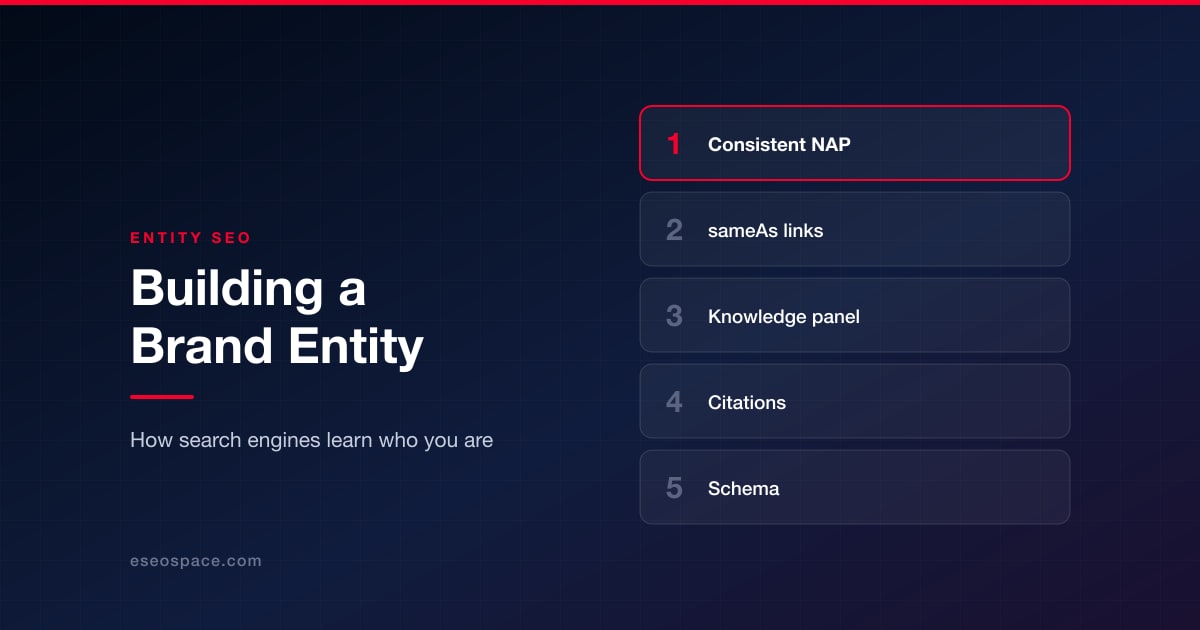
- Inconsistent NAP (Name, Address, Phone) data across your site, social profiles, and directories confuses algorithms and blocks entity recognition.
- Missing or incorrect Schema markup makes your details harder for machines to read. Organization structured data helps, though it does not guarantee Knowledge Graph recognition.
You have spent years building a business, serving clients, and perfecting your services. You publish content regularly and optimize your pages for search engines. Yet, when people search for your company name, the results look scattered. Search engines do not display a neat, organized panel of your business details.
This happens because search engines do not see your business as a distinct concept. They see your brand name merely as a string of keywords. In modern search environments, being a keyword is no longer enough. You must become an entity.
Understanding how artificial intelligence and search algorithms classify information is critical for digital growth. Search engines now rely on complex webs of data to understand the real world. When algorithms recognize your brand as a valid entity, your visibility and authority skyrocket.
This guide will explain the mechanics of Entity-Based SEO and the Google Knowledge Graph. You will learn exactly why AI struggles to identify your business. Finally, we will share actionable steps to establish your brand as a recognized digital entity.
Understanding the Shift from Keywords to Entities
Search algorithms look very different today than they did a decade ago. Early search engines operated like digital librarians. They matched the words a user typed with the words printed on a webpage.
This literal matching system had severe limitations. Words have multiple meanings based on context. "Apple" could mean a fruit or a massive technology company. To solve this, search engines evolved to understand concepts, relationships, and context.
This evolution sparked the transition from keyword-centric indexing to Entity-Based SEO. Modern algorithms process language dynamically. They map out how different ideas, places, people, and brands connect to one another.
What is an Entity in SEO?
An entity is a singular, unique, well-defined, and distinguishable thing or concept. It does not have to be a physical object. An entity can be a person, a place, a color, an idea, or a brand.
For search engines, an entity represents a node of information. When you search for a famous actor, the search engine knows their birthday, their movies, and their spouses. It understands the actor as a complete concept.
Your goal is to make search engines view your business the same way. When an algorithm understands your brand as an entity, it confidently connects your business to relevant industry topics. This builds immense trust and ranking power.
The Google Knowledge Graph Explained
The Google Knowledge Graph is the database that stores all these entities and their relationships. Think of it as a massive, invisible encyclopedia that powers search results.
When a brand earns a spot in the Knowledge Graph, it often triggers a Knowledge Panel. This is the rich information box that appears on the right side of desktop search results. It displays the company logo, location, founders, and social profiles.
If your brand does not have a Knowledge Panel, you are likely missing from the Knowledge Graph. This means the algorithm still relies on guesswork to figure out who you are and what you do. Partnering with experts like eSEOspace can help strengthen the public signals Google uses for Knowledge Graph entries, though no one can submit data directly to it or guarantee a Knowledge Panel.
Why Your Brand Remains Invisible to AI
You might have a beautiful website and a great product, but AI algorithms do not experience the web like humans do. They read code, structured data, and mathematical patterns.
If your brand is invisible to AI, you are likely failing to provide these technical signals. Algorithms require overwhelming consistency to confirm that a brand is real. When information conflicts, AI loses confidence and drops the entity classification.
Let us explore the most common reasons why search engines fail to recognize your business as a distinct entity.
Lack of Consistent NAP Data
NAP stands for Name, Address, and Phone number. This is the most basic identifier for any local or national business.
If your website lists one address, your social media profiles list another, and your directory listings use an old phone number, you confuse the algorithm. Search engines hate confusion. Conflicting contact details make it harder for them to connect information to your brand confidently.
To fix this, you must audit your entire digital footprint. Ensure that every mention of your business matches the exact formatting found on your contact us page. Consistency builds the algorithmic trust required for entity recognition.
Missing or Incorrect Schema Markup
Schema markup, or structured data, is the native language of search engines. It is a standardized vocabulary of code that tells AI exactly what a webpage is about.
When you write a paragraph about your company, the AI has to use natural language processing to guess your meaning. When you use Organization Schema markup, you explicitly state: "This is a company, this is our logo, and these are our founders."
Failing to implement correct Schema markup forces algorithms to work too hard. If you are updating your site, incorporating structured data during website development is non-negotiable. It helps Google understand your brand details, though markup alone doesn't guarantee a Knowledge Graph entry or Knowledge Panel.
How Content Consistency Builds Entity Recognition
Technical signals are only half the battle. The words you publish on your website play a massive role in how AI categorizes your brand.
Search engines build connections by analyzing the company you keep digitally. The topics you write about, the terminology you use, and the sites you link to all form a contextual web.
If your content strategy is chaotic, the algorithm cannot pin down your primary industry. You must build topical authority through rigorous content consistency.
Establishing Topical Authority
Topical authority means becoming the absolute best source of information for a specific subject. You achieve this by covering an entire topic comprehensively, not just targeting isolated keywords.
If you offer search engine optimization (SEO) services, you cannot just write one page about SEO. You must write about technical audits, backlink strategies, local search, and algorithm updates.
When search engines crawl this tight cluster of highly related content, they connect your brand entity to the SEO entity. This semantic relationship proves to the AI that your brand is a legitimate authority in that specific space.
Get a FREE Audit
We'll perform a comprehensive SEO, AEO, GEO & CRO audit of your website — completely free — and show you exactly how to outrank your competitors.
Don't have a site yet? Get in touch →
The Role of E-E-A-T in Entity Building
Experience, Expertise, Authoritativeness, and Trustworthiness (E-E-A-T) are crucial for entity recognition. Search engines want to know that real, qualified humans stand behind a brand.
Anonymous blogs rarely earn entity status. You must clearly identify who runs the company and who writes the content. An extensive about us page provides historical context about your business.
Furthermore, showcasing your staff on an our team page connects your brand entity to the individual person entities of your employees. If your authors have their own recognized digital footprints, their authority flows directly into your brand.
Technical Foundations for Brand Entity Status
A house built on a weak foundation will eventually collapse. The same principle applies to digital marketing. If your website architecture is flawed, your entity-building efforts will fail.
Search engine crawlers need a clear, logical path to follow when they navigate your site. If they hit dead ends, broken links, or confusing menus, they abandon the crawl.
This means your website design and underlying code must prioritize algorithmic comprehension just as much as user experience.
Structuring Your Website for AI Comprehension
Website architecture refers to how your pages are organized and linked together. A flat, logical architecture helps algorithms understand which pages are most important.
You should organize your content into strict categories. Broad topics should link down to specific subtopics, and those subtopics should link back up. Mapping this out properly requires careful planning. Reviewing a quick guide on website outlines can help you structure your information hierarchy correctly before you publish.
Clear internal linking establishes a hierarchy of importance. When you link consistently to your core service pages, you signal to the AI that these concepts are central to your brand identity.
The Importance of Clean Code and Design
Your visual presentation matters to humans, but the code behind it matters to machines. Bloated code, slow loading times, and poorly structured HTML actively prevent AI from understanding your site.
This is why professional website designs must balance aesthetics with technical performance. Semantic HTML tags (like H1, H2, and H3) tell the crawler exactly how your information is prioritized.
If you run a local enterprise, investing in specialized small business web page design ensures that your site meets the strict mobile-friendliness and speed requirements demanded by modern search algorithms. Fast, clean websites are crawled more frequently, accelerating your path to entity recognition.
Off-Page Signals That Validate Your Brand
Search engines do not just take your word for it. They verify your claims by looking at what the rest of the internet says about you.
If your website claims you are a leading software agency, but no other reputable websites mention your brand, the AI remains skeptical. Off-page signals are the independent validations that confirm your brand entity actually exists in the real world.
Building these signals requires a proactive approach to digital public relations and profile management.
Digital PR and Authoritative Mentions
Backlinks have always been important for SEO, but entity recognition relies on unlinked brand mentions just as heavily. When high-authority news sites, industry blogs, or government portals mention your brand name, AI takes notice.
These mentions act as votes of confidence. They verify that your brand is active and notable. Earning these mentions requires publishing original research, issuing press releases, or participating in industry podcasts.
Showcasing these accomplishments matters, too. Maintaining a portfolio of our works provides tangible proof of your business activities, giving both users and algorithms concrete evidence of your expertise.
Social Profiles and External Consistency
Your social media presence acts as an extension of your primary brand entity. Search algorithms crawl major social platforms to verify business information and gauge public engagement.
You must claim and actively manage your profiles on platforms relevant to your industry. Furthermore, these profiles must link back to your main website.
This creates a closed loop of verification. The website links to the social profile, and the social profile links to the website. This confirms for the AI that both assets belong to the exact same brand entity.
Steps to Transform Your Business into an Entity
Transitioning from a simple keyword target to a recognized brand entity does not happen overnight. It requires a systematic, ongoing strategy.
You must align your technical infrastructure, your content marketing, and your off-page presence. Every digital asset you control must broadcast the exact same message about who you are and what you do.
Here are the actionable steps you can take to begin establishing your business as a recognized entity in the Knowledge Graph.
Audit Your Current Digital Footprint
The first step is to figure out where you currently stand. Search for your brand name across different search engines. Look at what auto-completes when you type your business name.
Check your local directory listings for NAP consistency. Identify any old, outdated websites or social profiles that might be confusing the algorithm. Consolidate or delete redundant profiles to create a single, unified digital identity.
Implement Advanced Technical SEO
Once your off-page footprint is clean, turn your attention to your website. You must translate your business details into a language the machines understand natively.
Generate and deploy comprehensive Organization Schema markup. Ensure your site architecture is logical and your internal linking connects related concepts efficiently. If you are unsure how to align your design with your marketing goals, exploring the intersection of website design & SEO will provide the technical blueprint you need.
Conclusion
Artificial intelligence has fundamentally changed how information is organized online. Search engines no longer settle for matching keywords on a page. They actively seek to understand the world through interconnected entities.
If your brand is not recognized as an entity yet, you are leaving massive digital opportunities on the table. You are forcing algorithms to guess your relevance instead of proving it to them explicitly.
By unifying your brand information, deploying structured data, and publishing authoritative content, you give search engines the confidence they need. You transform your business from a random string of text into a verified, trusted digital authority. Start auditing your technical signals today, and take control of your brand's presence in the Knowledge Graph.
Frequently Asked Questions
What is an entity in SEO?
What is the Google Knowledge Graph and why does it matter?
Why is my brand invisible to AI algorithms?
How does inconsistent NAP data hurt entity recognition?
Why is Schema markup important for becoming an entity?
Put this into action with eSEOspace
We help businesses grow with website development that actually performs. Explore the services behind this guide:
Get a FREE GEO/AEO/SEO Audit
We'll analyze your site's SEO, GEO, AEO & CRO — completely free — and show you exactly how to get found across Google and AI answers.
Don't have a site yet? Get in touch →
Great — your audit is on the way!
We'll send your free SEO/GEO/AEO/CRO audit within the next few hours. Where should we send it?
You're all set! ✓
Your free audit is being prepared — check your inbox in the next few hours. Talk soon!


On this page
- Key Takeaways
- Understanding the Shift from Keywords to Entities
- Why Your Brand Remains Invisible to AI
- How Content Consistency Builds Entity Recognition
- Technical Foundations for Brand Entity Status
- Off-Page Signals That Validate Your Brand
- Steps to Transform Your Business into an Entity
- Conclusion
- Frequently Asked Questions






