



From Traditional Eyewear to AI Glasses: How Ray-Ban's Search Strategy Is Evolving
From Traditional Eyewear to AI Glasses: How Ray-Ban's Search Strategy Is Evolving
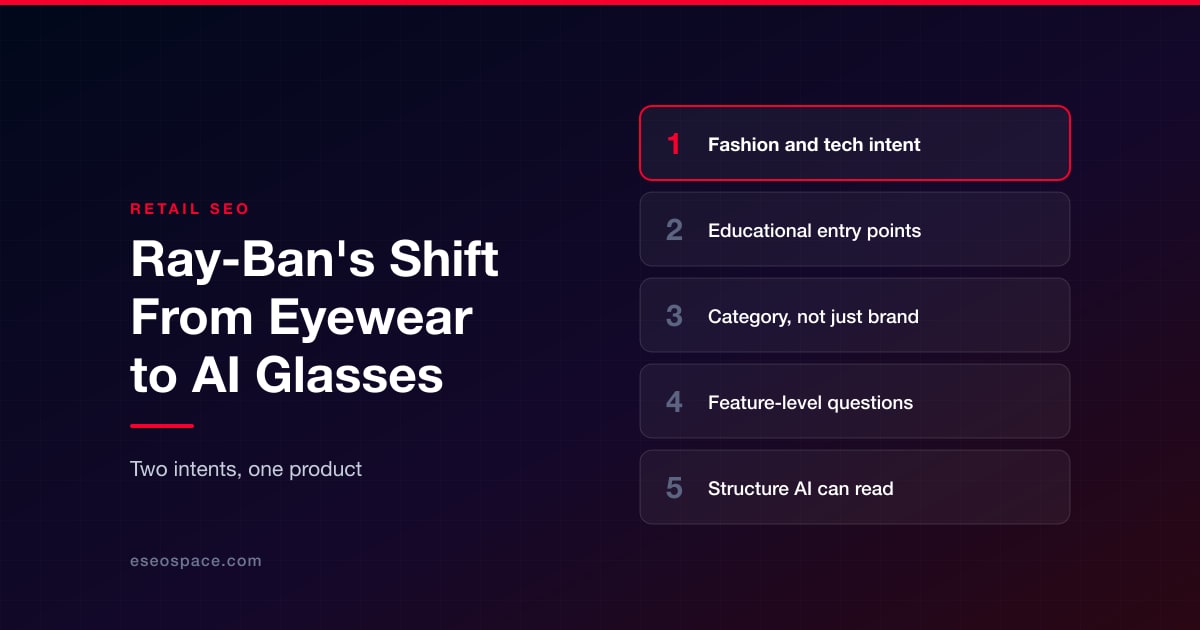
For most of its life, Ray-Ban has sold a shape. Aviator, Wayfarer, Clubmaster — the names are the product, and the search behavior around them has been settled for decades. Someone types polarized aviators or prescription Wayfarer, and a retailer can meet that query with a page organized around style, fit, color, and lens type. It is one of the most predictable search landscapes in retail.
AI-enabled eyewear breaks that pattern. The product still sits in fashion and optical retail, but it now competes for attention in consumer technology, against companies whose buyers research the way people research phones. The same pair of glasses gets searched for by brand, by device category, by a single feature, or by a use case someone read about that morning. A search strategy for that product has to explain something unfamiliar without weakening the identity that made the brand recognizable in the first place.
Search Intent Now Spans Two Categories
The eyewear shopper starts with appearance: frame shape, lens color, how it sits on their face, whether it takes a prescription. The technology shopper starts with function: hands-free photos, voice assistance, audio quality, translation, battery life. Both may end up on the same product page, wanting completely different things from it.
That is a wider spread of intent than an ordinary pair of sunglasses ever has to serve. Product and category pages now need to work for someone who already knows the model by name and for someone who has only heard that smart glasses exist. In practice that means the path between the style information and the technology information has to be obvious in both directions — not a single page trying to be everything, but clear navigation between two kinds of answer.
Educational Pages Become Part of E-Commerce SEO
When a category is unfamiliar, the product page cannot carry the whole explanation. People have questions long before they are ready to compare colors or add anything to a cart: what do these actually do, how do they connect to a phone, which features need an app, what does wearing them all day look like.
Discovery content answers those questions and creates search entry points at the same time. A page that organizes features by what the wearer is doing — asking, listening, capturing, calling — is easier to follow than a specification list, and it gives search engines much clearer context about the range of needs the product covers. This is the same discipline that separates a product page that converts from one that merely exists; our breakdown of product page SEO mistakes covers where retail pages usually lose it.
Balancing Branded and Generic Search
Brand demand is a real advantage and worth protecting. Someone searching for a specific Ray-Ban model has already made most of the decision. But growth in a new category comes from the other side of the market — people who have not picked a brand yet, and in many cases do not know which brands are in the running.
That is what a phrase like AI glasses is for. It describes the category rather than the manufacturer, which lets educational and commercial content reach buyers who are still investigating the technology itself. The strategy that works connects those generic discovery terms to branded product pages through content that earns the handoff, rather than forcing the category keyword into every section of the site and hoping it holds.
Feature-Led Content Captures Specific Questions
New technology generates a long tail of very specific searches. Can they take calls? Record video? Play audio without earbuds? Translate speech? Work with a prescription? Function without a phone nearby? Each of those is a different stage of consideration, and each one is a page-level opportunity.
Feature sections, comparison tools, support pages, and FAQs answer those searches far better than lifestyle copy does. The language should stay close to the way customers actually ask — the question as typed, not the marketing paraphrase. That plain phrasing also raises the chance that search engines and AI answer tools can locate the relevant fact without guessing, which is increasingly where the decision gets made. Writing for that surface has its own rules, and AI-friendly product pages are built differently from ones written only for a human skim.
Product SEO Still Needs Strong Retail Fundamentals
Moving into technology does not suspend the basics of eyewear e-commerce. Customers still need accurate colors, frame dimensions, fit guidance, lens options, pricing, availability, and images good enough to buy from. Product titles and structured data have to distinguish models and generations from each other without turning into strings no human can read.
Internal linking carries more weight here than it does in a mature category. Educational pages should lead to the right collection or model, and product pages should offer a route back to the feature explanations and support content. That loop is what lets a shopper move between learning and buying without starting a new search — and a new search is where a competitor gets a second chance at them. Internal linking is usually the cheapest fix available on a large retail site and the one most often deferred.
International Search Requires More Than Translation
AI features, supported languages, pricing, and availability all vary by market — more than frame colors ever did. A global search strategy needs localized pages that reflect those differences accurately, because translating a US page directly will describe a capability that behaves differently, or does not exist, where the reader lives.
Local terminology matters just as much. The everyday word for glasses, frames, smart devices, or prescription options is not consistent across markets, and regional pages should match how people actually search while keeping product naming consistent enough that search engines still understand the versions are the same product. Our guide to international SEO goes through how that structure is built without splitting the brand into unrelated sites.
AI Search Changes How Product Information Is Read
A growing share of product research now ends before anyone reaches the website. Answer engines summarize first, and the summary is assembled from whatever is easiest to parse. That raises the value of structure: descriptive headings, concise feature explanations, comparison data, and FAQs that are maintained rather than published once.
This is where answer engine optimization and generative engine optimization stop being separate disciplines from retail SEO and become part of it. A page that plainly states what the product is, what it does, which generation it belongs to, and what it costs gives an assistant something to repeat. A page of atmosphere gives it nothing, and it will find the specifics somewhere else — a review site, a forum, a competitor.
The Real Opportunity
Brand authority will keep working in Ray-Ban's favor. It is not, on its own, a strategy for a category the buyer does not yet understand — authority answers should I trust this, not what is this and do I need it. Those are different searches, and right now the second one is where the volume is growing.
The opening is to run both at once: the design story that already belongs to the brand, and content technically accurate enough to satisfy someone cross-shopping consumer electronics. Serve fashion, optical, and technology intent on the same site, and the move from traditional eyewear to smart eyewear reads as an evolution rather than a departure. If you are working through the same problem on your own catalog, our e-commerce SEO services are built around exactly this kind of transition.
Put this into action with eSEOspace
We help businesses grow with website development that actually performs. Explore the services behind this guide:
Get a FREE Audit
We'll perform a comprehensive SEO, AEO, GEO & CRO audit of your website — completely free — and show you exactly how to outrank your competitors.
Don't have a site yet? Get in touch →
Get a FREE GEO/AEO/SEO Audit
We'll analyze your site's SEO, GEO, AEO & CRO — completely free — and show you exactly how to get found across Google and AI answers.
Don't have a site yet? Get in touch →
Great — your audit is on the way!
We'll send your free SEO/GEO/AEO/CRO audit within the next few hours. Where should we send it?
You're all set! ✓
Your free audit is being prepared — check your inbox in the next few hours. Talk soon!


On this page
- Search Intent Now Spans Two Categories
- Educational Pages Become Part of E-Commerce SEO
- Balancing Branded and Generic Search
- Feature-Led Content Captures Specific Questions
- Product SEO Still Needs Strong Retail Fundamentals
- International Search Requires More Than Translation
- AI Search Changes How Product Information Is Read
- The Real Opportunity






