




Blog
International SEO: How to Scale Organic Traffic

Key Takeaways
- International SEO goes beyond translation, adapting your site to local language, culture, and technical needs in each target market.
- Clear language and location signals tell search engines which page version fits which user, boosting relevance and rankings.
- Different regions rely on different search engines, so account for Baidu, Yandex, and Naver alongside Google.
- A written strategy with SMART goals should guide markets, audiences, and technical work before you build any pages.
- Choose language targeting, country targeting, or both based on how much your pricing, shipping, and laws vary by market.
Growing organic traffic across countries is a smart move for businesses that want to grow worldwide.
International SEO is the plan that helps your website connect with people in different countries and languages, so you can earn more organic visits. It includes technical setup, local content changes, and learning how each market works.
The goal is simple: help search engines show your pages to the right people, in the right place, and in the right language. With international SEO, businesses can reach new markets, get seen more often, and turn global visitors into repeat customers.
What Is International SEO and How Does It Drive Organic Traffic?
International SEO requires optimizing your website so it can rank in search results in multiple countries and languages.
It is more than translating your pages. You need to adjust your site so it matches local language, culture, and technical needs in each market you want to reach. This helps search engines understand that your content is a good match for users in places like Germany or Japan, and it also applies to other search engines like Baidu or Yandex.
If you ask the best international eCommerce SEO agency about best practices, you'll hear that what drives organic traffic is clearly telling search engines which page version fits which user. If you show strong signals for language and location, search engines are more likely to send users to the correct page.
For example, it helps prevent a Spanish speaker in Mexico from landing on an English page meant for the UK. When this matching is accurate, your pages feel more relevant, rankings improve, and you get more visits from people who are more likely to buy or take action.
How Does International SEO Work?
International SEO works by giving search engines clear signals about who each page is for. This uses technical settings, smart content work, and a site setup that supports multiple markets.
Instead of using one version of your site for everyone, you create versions for different groups. For example, search engines need to know whether a page about “sneakers” is meant for US users, or a UK audience that searches for “trainers.” If the signals are missing, search engines can show the wrong page, and you lose traffic.
It also means learning how search works in each location. Google is common in many countries, but other regions use different search engines, such as Baidu in China, Yandex in Russia, or Naver in South Korea. Each has its own ranking style and indexing habits.
International SEO is an ongoing process of matching your site to how people search in each market.
Why Does International SEO Matter for Global Businesses?
In a connected online market, focusing on only one country often means missing large opportunities.
For global businesses, international SEO is a major growth channel. It helps you enter new markets and build visibility where new customers are already searching.
Without a clear international SEO plan, global businesses can stay hidden in many regions. They may also struggle against local competitors who already match the culture and search habits. Or they may show the wrong pages to users, creating a bad experience.
Putting time and budget into international SEO supports steady growth and stronger competition over time.
How To Plan Your International SEO Strategy
Starting international SEO without a plan is like traveling without a map. A clear strategy supports successful growth across markets.
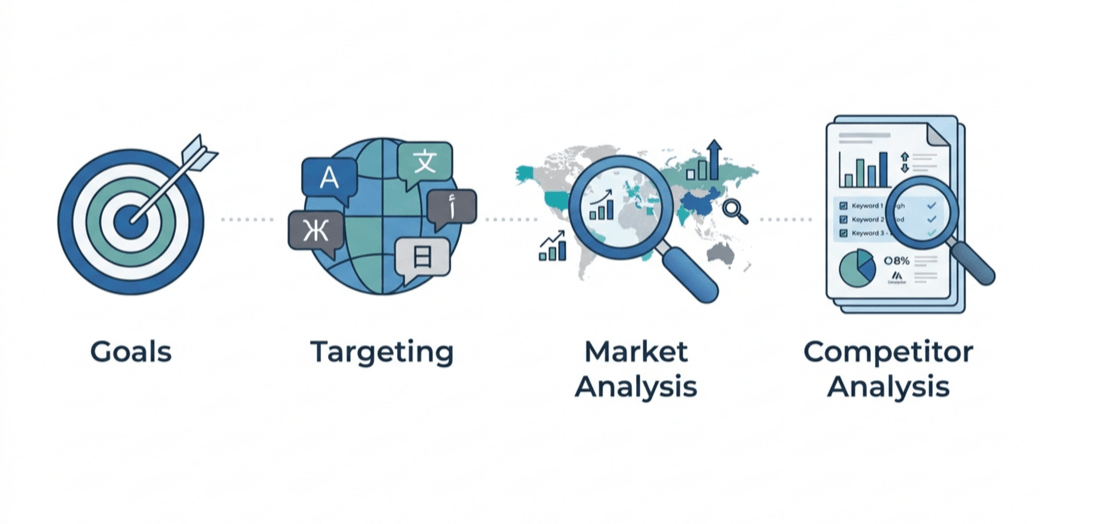
You need to think about business goals, target audiences, and how each market works before you start building pages.
Planning also helps you avoid problems and use your resources wisely. It should connect marketing, product, and technical work, so the final result feels consistent across markets. If you rush this stage, you may create expensive problems later.
1. Map Out International SEO Goals
Before you start technical work, define what you want from international SEO. Do you want more sales in certain European markets? More leads for B2B in Latin America? More awareness in parts of Asia?
Clear goals guide your priorities and how you track results. Using SMART goals (specific, measurable, achievable, relevant, time-bound) helps a lot.
Example goal: “Increase organic traffic from Germany by 30% and increase conversion rate by 10% in the next 12 months.” This gives you a clear target and helps you focus keyword research, content, and technical work on the German market.
2. Decide Between Language and Country Targeting
Early on, decide if you will target by language, by country, or both.
- Language targeting means one version per language (like Spanish for all Spanish speakers).
- Country targeting focuses on a specific country and usually includes culture, pricing, shipping, and legal details (like Spain vs. Mexico).
If your offering changes by country (pricing, shipping, laws), country targeting often fits better, such as example.com/es-es/ for Spain and example.com/es-mx/ for Mexico.
If your content is mostly the same and only language changes, one language folder may work, like example.com/es/. This choice affects your URL setup and how you use hreflang.
3. Conduct Market and Competitor Analysis
You need a clear view of each market. Learn local search trends, buyer behavior, culture, and local rules.
Which search engine is most used? What content style works best? Are there local events or topics that matter? Are there any sensitive topics you should avoid?
Also study competitors, including local sites that already rank for your target keywords. Review their content, backlinks, and technical setup. This helps you spot gaps, learn what works, and avoid mistakes in your own approach.
How To Scale Organic Traffic With International Keyword Research
International keyword research is often the main step for scaling organic traffic globally. It turns your plans into content topics and optimization tasks.
But it is not as simple as translating your keyword list. You need to understand how language, culture, and search behavior differ by market.
Good international keyword research helps you create content that people can find and actually want. It means picking the phrases locals really use, instead of guessing based on your home market.
Why Direct Translation of Keywords Fails
A common mistake is translating keywords word-for-word and expecting the same results. This usually fails because language is closely tied to culture, slang, and local habits. A phrase that works in one country may not be used in another, even if the language is the same.
Direct translation can make you target keywords with low search volume, the wrong intent, or heavy competition that does not match what you offer. It may feel faster, but it often leads to weak results.
Same Language, Different Terms
Even in one language, different countries use different words. In English, the UK uses “lift” while the US uses “elevator.” The UK uses “trainers” while the US uses “sneakers.” If you target “sneakers” in the UK, you miss people searching for “trainers.”
This also happens with product names, industry terms, and everyday phrases. A translation can be correct but still sound unusual, which makes people less likely to click or search for it.
Different Language, Different Search Habits
With different languages, the differences grow. People may structure searches differently, use longer phrases, or rely more on local slang. Some markets may use voice search more often, or use special characters and writing systems that change how queries look.
If you ignore these differences, you end up optimizing for a search style that your audience does not actually use.
How Cultural and Regulatory Factors Shape Search Intent
Culture and local rules can change what people mean when they search. “Best investment” may point to real estate in one country but stocks in another. Social norms can also affect how people ask questions online.
Laws and standards matter, too. For example, privacy rules like GDPR or local product rules can shape what users look for. People may search for products that clearly meet local rules. Knowing these drivers helps you pick keywords that match real needs.
Tools and Techniques for Global Keyword Research
Good international keyword research uses tools plus local knowledge. Many general SEO tools help, but they may not provide enough local detail. The aim is to understand how a native speaker would search for your product or topic.
Using multiple sources, including real search results and feedback from locals, leads to a stronger keyword plan and fewer wrong guesses.
Native SERPs and Manual Validation
A strong method is to review search results as they appear in the target country. You can use a VPN or SERP tools to view results from specific locations. Search your possible keywords and review what ranks, what related searches appear, and what questions show in “People Also Ask.”
This manual check helps you understand real intent. It also helps you see whether your content fits the keyword and whether ranking pages set a level you can compete with.
Leveraging Local Experts and User Interviews
Tools cannot replace local knowledge. Local agencies, in-country staff, or user interviews can give real insight into slang, phrasing, trends, and new keyword ideas. They can also warn you about wording that feels awkward or wrong.
These insights help your content sound natural and avoid cultural mistakes, which improves trust and performance in the market.
How to Structure International Websites for SEO Growth
Your site’s technical setup is a base for international SEO growth. URL structure, language tags, and geotargeting settings affect how search engines crawl and index your pages, and which version they show to users. A clear structure reduces confusion and helps users land on the correct version.
If you get this wrong, you can run into duplicate content issues, weaker link value, and a bad user experience. Making smart choices early reduces future rework.
Choosing the Right URL Structure
Your URL structure is one of the biggest choices in international SEO. It affects geotargeting signals, how easy the site is to manage, and how users see your brand. The best option depends on your goals, your team, and how many markets you want to support.
A consistent structure helps search engines understand your targeting and helps users move around the site easily.
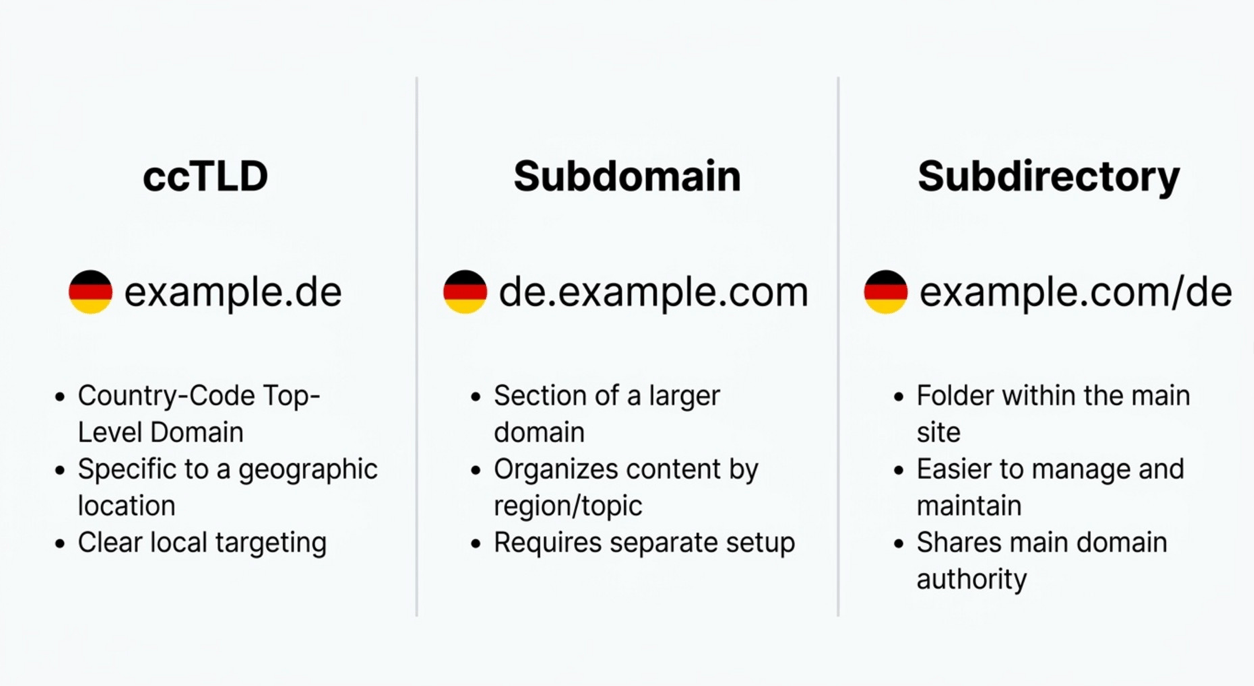
Country Code Top-Level Domains (ccTLDs)
ccTLDs like .de or .fr give a strong country signal. Users and search engines can quickly tell the site is meant for that country, which can build local trust.
The downside is workload. Each ccTLD acts like its own site, so you need separate authority building, backlinks, and often separate management. This can work well for businesses focused on a small number of key countries with enough resources.
Subdomains, Subdirectories, and Their Impact
Subdomains (example: es.example.com) can balance targeting and management. They separate markets while still staying linked to the main brand domain. Search engines can treat them as separate, but they are often associated with the main domain.
Subdirectories (example: example.com/es/) are often the easiest to manage. Everything stays on one domain, which can help share authority and simplify updates.
The country signal is not as strong as ccTLDs, but you can support it with hreflang and Search Console targeting. This is common for brands targeting many regions.
Implementing hreflang for Language Targeting
The hreflang attribute tells search engines which pages are language or region alternatives. It helps avoid duplicate content problems by showing that multiple URLs are meant for different audiences.
Without hreflang, search engines may treat similar pages (like US English and UK English) as duplicates.
You can set language (like en) and optionally region (like en-GB or en-US). You can add hreflang in the HTML header, HTTP header, or an XML sitemap.
The setup needs to be very careful, because mistakes can cause search engines to ignore the tags or use them incorrectly.
Geotargeting Settings and Best Practices
Along with URL structure and hreflang, Google offers geotargeting options in Google Search Console. For subdomains and subdirectories, you can set the target country for each part of the site. This adds another helpful signal.
Good practices include keeping all signals consistent: URL setup, hreflang, and Search Console settings should match. Server location can also help a bit by improving speed for local users.
Adding local contact details (like addresses and phone numbers) also supports local relevance for users and search engines.
Adapting Content and User Experience for Global Audiences
After the technical base is ready, international SEO depends on content and user experience that feels right for each market.
This is more than translation. You need cultural awareness, local relevance, and an understanding of what makes users in each region trust your site. A site can be technically correct and still perform poorly if the content feels wrong.
This is where international SEO becomes more than a technical project. It becomes a set of local experiences that help people feel comfortable and ready to act.
Localizing Content for Culture and Intent
Localization means adjusting your message to fit the language and culture of a market. Use phrases, examples, and references that make sense locally.
Be careful with humor and cultural references that might not translate well. For example, a campaign focused on winter sports may work in Canada but not in Australia at the same time of year.
Localization also means matching local intent. In some places, users want detailed technical details. In others, they may care more about reviews and everyday use. When your content matches what users want, engagement and conversions improve.
Design Elements That Drive Engagement Internationally
Design choices matter across cultures. Colors, images, and layout can mean different things in different places. A color that feels positive in one culture may feel negative in another. Images should also feel familiar to the local audience.
UX should match local expectations too: navigation, page layout, and calls to action should feel normal for that market. When the site feels familiar, users trust it more and stay longer.

Currency, Measurements, and Regional Preferences
Small details often shape trust. Show prices in local currency and use local units (metric vs. imperial). Also match local date formats, time formats, and address formats. Support common payment methods for the region.
Regional preferences also include customer support options (live chat, phone, or local messaging apps), plus legal and privacy pages that match local rules. Getting these details right shows respect for local customers and reduces friction.
Avoiding Cross-Market Duplicate Content
International sites often have similar pages, so you must manage duplicate content risks. Similar pages for different regions (like US English and UK English) can confuse search engines. hreflang helps by showing they are alternatives for different audiences.
Even with hreflang, it helps to adjust content where you can. Small differences in wording, offers, or examples can help. For bigger wins, create pages that are truly written for each market’s needs instead of copying the same content everywhere.
Technical SEO Best Practices for International Sites
International SEO also depends on strong technical SEO. Even great local content will not rank well if search engines cannot crawl and index it well. Technical work helps your pages load fast, work on mobile, and get understood correctly across all markets.
Ignoring technical details can limit your ability to grow organic traffic across countries.
Site Speed and CDN Optimization
Site speed affects rankings and user experience everywhere. For international sites, distance can slow things down. For example, users in Japan may have slow load times if your server is in the US. A Content Delivery Network (CDN) helps fix this.
A CDN stores cached site files on servers around the world, so users load content from a nearby location. Also optimize images, use browser caching, and reduce server response time to keep pages fast for global users.
Mobile-First Experiences in Diverse Markets
Google uses mobile-first indexing, and in many countries, mobile is the main way people go online. So your international pages must work well on phones: responsive design, fast loading, readable text, and buttons that are easy to tap.
Device quality and network speed vary by region. A design that feels fine on fast 5G can be slow in areas with weaker connections. Lighter pages and efficient code help you reach more users.
Crawling, Indexing, and Duplicate Management
Search engines must be able to crawl and index every important international page. Use clean code, create XML sitemaps for each language/country section, and watch crawl issues in Google Search Console. Set up robots.txt correctly so bots focus on the pages that matter.
Duplicate content control is especially important. Use hreflang, and also use canonical tags where needed (like to avoid HTTP vs. HTTPS duplicates). Regular checks of indexing across your country or language Search Console setups help you find problems early.
International Link Building Strategies To Boost Organic Visibility
Technical work and localization create the base, but backlinks still matter a lot for organic visibility, especially in competitive markets. International link building is not the same everywhere. It depends on local media, local trust signals, and local relationship styles.
If you copy your home-market link tactics in other countries, results are often weak. A local-first plan that respects local media and customs helps you earn better links and stronger rankings.
Mapping Local Authority Ecosystems
Before link outreach, map local authority sources. Identify trusted publishers, bloggers, industry groups, directories, and local news sites. Learn who people listen to in that market.
This helps you focus on the sites that matter and avoid low-quality sources. It also helps you find partners that can support your reputation in that country.
Acquiring Links From Local Media, Influencers, and Partners
After you find the right targets, work on earning links from local media, influencers, and partners. Your outreach should match local tone and expectations. A pitch for a German tech site will not sound the same as a pitch for a Japanese lifestyle blog.
Working with local influencers can lead to real mentions and backlinks. For the US market specifically, teaming up with a Los Angeles-based influencer marketing agency can speed this up, since they already have relationships with the creators local outlets actually cover. Local business partnerships (suppliers, resellers, distributors) can also create link opportunities through joint content and shared promotions.
Developing Market-Specific Link Profiles
For strong international SEO, build separate link strength in each market. Your German pages should earn links from German sites, Spanish pages from Spanish sites, and so on. This gives search engines a clear signal that each site version is relevant in its region.
Avoid putting all link building effort into only the main site if you want local versions to rank. Local links support local rankings.
Managing Link Equity Across International Site Structures
How link value flows depends on your structure. ccTLDs build authority separately. Subdirectories tend to share authority more directly. Subdomains can share some authority but may behave more independently.
Use logical internal links across versions and support your hreflang setup. If you have similar product pages for the US and UK, link to the correct regional page when it makes sense. Use canonical tags and hreflang to reduce dilution and help search engines understand how pages relate.
Steps To Scale and Sustain International Organic Growth
Getting early wins is great, but keeping growth going needs ongoing work. Search engines update, markets change, and user habits shift. If your plan never changes, results often slow down.
To scale and keep international organic growth, focus on steady improvement, local knowledge, and making international SEO part of normal business work. It is a long-term effort, not a quick project.
Building an Agile Team With Local Expertise
Scaling across countries works best with a team that can react quickly and use local knowledge. This may mean hiring people with language and cultural skills, or working with in-country partners. A central team can set direction, but local support helps execution.
Let local experts guide keyword choices, content tone, and market-specific decisions within a clear framework. Their input often decides whether content feels natural or out of place.
Continuous Localization and Testing
Localization is ongoing. Language shifts, competitors change, and user preferences update over time. Review and update localized content and keyword targets regularly. Many international content teams also use an AI detector free tool to review AI-assisted content before publishing, helping maintain quality, originality, and local relevance across markets. Test different page layouts, messaging, and calls to action in each market to see what works best.
Follow local events, holidays, and cultural changes that can shift search behavior. Regular updates and testing keep your pages useful and competitive.
Long-Term Management for Global SEO Success
Long-term success needs long-term planning. Set a budget for ongoing localization and technical upkeep, build clear workflows for translation and new content, and run regular performance audits against your goals.
Create a company habit of thinking globally online and respecting local market needs. When international SEO becomes part of how the business runs (not a side project), your brand is set up for steady growth and stronger global visibility.
Get a FREE Audit
We'll perform a comprehensive SEO, AEO, GEO & CRO audit of your website — completely free — and show you exactly how to outrank your competitors.
Don't have a site yet? Get in touch →
Conclusion
International SEO is one of the most powerful levers a business can pull to drive sustainable global growth. Nevertheless, it requires a clear strategy, the right technical foundation, and a genuine respect for the people you're trying to reach in each market.
The businesses that win globally are the ones that treat each market as its own ecosystem. None of this happens overnight.
International SEO is a long-term commitment that rewards patience, consistency, and a willingness to learn from each market on its own terms. The brands that approach it as an ongoing discipline are the ones that compound their gains over time and outpace competitors who are still thinking locally.
Frequently Asked Questions
What is international SEO?
How does international SEO drive more organic traffic?
Should I target by language or by country?
Do I need to consider search engines other than Google?
How do I plan an international SEO strategy?
Put this into action with eSEOspace
We help businesses grow with website development that actually performs. Explore the services behind this guide:
Get a FREE GEO/AEO/SEO Audit
We'll analyze your site's SEO, GEO, AEO & CRO — completely free — and show you exactly how to get found across Google and AI answers.
Don't have a site yet? Get in touch →
Great — your audit is on the way!
We'll send your free SEO/GEO/AEO/CRO audit within the next few hours. Where should we send it?
You're all set! ✓
Your free audit is being prepared — check your inbox in the next few hours. Talk soon!


On this page
- Key Takeaways
- What Is International SEO and How Does It Drive Organic Traffic?
- How Does International SEO Work?
- Why Does International SEO Matter for Global Businesses?
- How To Plan Your International SEO Strategy
- How To Scale Organic Traffic With International Keyword Research
- Why Direct Translation of Keywords Fails
- Same Language, Different Terms
- Different Language, Different Search Habits
- How Cultural and Regulatory Factors Shape Search Intent
- Tools and Techniques for Global Keyword Research
- Native SERPs and Manual Validation
- Leveraging Local Experts and User Interviews
- How to Structure International Websites for SEO Growth
- Choosing the Right URL Structure
- Country Code Top-Level Domains (ccTLDs)
- Subdomains, Subdirectories, and Their Impact
- Implementing hreflang for Language Targeting
- Geotargeting Settings and Best Practices
- Adapting Content and User Experience for Global Audiences
- Localizing Content for Culture and Intent
- Design Elements That Drive Engagement Internationally
- Currency, Measurements, and Regional Preferences
- Avoiding Cross-Market Duplicate Content
- Technical SEO Best Practices for International Sites
- Site Speed and CDN Optimization
- Mobile-First Experiences in Diverse Markets
- Crawling, Indexing, and Duplicate Management
- International Link Building Strategies To Boost Organic Visibility
- Mapping Local Authority Ecosystems
- Acquiring Links From Local Media, Influencers, and Partners
- Developing Market-Specific Link Profiles
- Managing Link Equity Across International Site Structures
- Steps To Scale and Sustain International Organic Growth
- Building an Agile Team With Local Expertise
- Continuous Localization and Testing
- Long-Term Management for Global SEO Success
- Conclusion
- Frequently Asked Questions






