



Blog
Affordable SEO Packages for Small Businesses: How to Choose Without Cutting Corners
Key Takeaways
- For small businesses, showing up on Google's first page is no longer a luxury but essential for survival and growth.
- Affordable SEO is about maximizing value, not just chasing the lowest price, so learn what deliverables each budget tier should include.
- Every effective small business SEO package shares core non-negotiable components like local optimization and a customer-centric strategy.
- Cheap SEO offers often come with red flags that can actually harm your website, so learn to spot the warning signs.
- Vet any potential SEO partner with the right questions and a checklist before committing your limited marketing budget.
As a small business owner, you wear many hats. You are the CEO, the head of marketing, the customer service representative, and often the bookkeeper, too. With a limited budget and even more limited time, every dollar you spend on marketing needs to count. Investing in Search Engine Optimization (SEO) can feel like a daunting prospect, filled with technical jargon and confusing price tags. Yet, showing up on the first page of Google is no longer a luxury—it's essential for survival and growth.
This guide is specifically for you. We will demystify the world of affordable SEO packages and show you how to find a plan that delivers real results without breaking the bank. Forget the empty promises and confusing proposals. We’ll break down what "affordable" truly means, what essential services you should expect for your money, and which red flags to watch out for. You will learn how to evaluate an agency, what questions to ask, and how to measure the return on your investment.
The goal is to empower you to make an informed decision. Small businesses can and do compete with larger brands online every day by being smarter and more strategic. The right SEO package is a powerful tool to level the playing field, helping you connect with more local customers and build a sustainable source of traffic and leads. This guide will provide the clarity and confidence you need to choose the right partner and invest wisely in your business's future.
Here’s what you can expect to learn:
- Why SEO is Non-Negotiable: Understand the unique challenges small businesses face online and how SEO packages help overcome them.
- Defining "Affordable": Learn the difference between a low price and good value, and what deliverables you should get at different price points.
- Core Components: Discover the essential, non-negotiable elements of any effective small business SEO package.
- Avoiding Scams: Spot the warning signs of cheap SEO offers that can harm your website.
- Vetting Providers: Get a checklist of questions and steps to properly evaluate a potential SEO partner.
- Real Price Ranges: See a transparent breakdown of what to expect in different budget tiers.
- Scaling Your SEO: Know when and how to upgrade your plan as your business grows.
- Real-World Success: A case study showing how a small business achieved significant growth on a budget.
Why Small Businesses Need SEO Packages
In a crowded marketplace, visibility is everything. If potential customers can't find you online, you might as well not exist. For small businesses, the challenge is even greater. You are not just competing with the shop down the street; you are competing with national chains and large corporations with multi-million dollar marketing budgets. SEO provides a direct path to connect with customers who are actively searching for the products or services you offer, making it one of the most powerful marketing channels for sustainable growth.
A well-structured SEO package addresses the core digital marketing needs of a small business. It’s not about trying to outspend the giants; it’s about outsmarting them with a focused, local, and customer-centric strategy. Instead of a scattergun approach, a package bundles the essential activities—technical fixes, content, and local optimization—into a cohesive plan that builds momentum month after month. This creates a predictable, manageable, and effective way to grow your digital footprint without needing a dedicated in-house marketing team.
The Visibility Challenge
Imagine a potential customer in your town needs a service you provide. They pull out their phone and type "best plumber near me" or "local coffee shop with wifi" into Google. In that moment, a list of options appears. If your business isn't on that first page, or ideally in the top three results of the Google Map Pack, the opportunity is lost. This is the visibility challenge in its simplest form.
Small businesses often start with a basic website, but without SEO, it's like having a billboard in the middle of a desert. No one will see it. An SEO package is the vehicle that moves that billboard to a busy highway. It focuses on making your business visible for the specific search terms your ideal customers are using. This is particularly crucial for local businesses, where searches with "near me" intent have grown exponentially. SEO ensures that when local customers are looking, your business is there to be found. It tackles the technical barriers, content gaps, and authority deficits that keep your website buried on page five of the search results, bringing you directly in front of an audience ready to buy.
Competing with Larger Brands
Larger brands have significant advantages: bigger budgets, established brand recognition, and large marketing teams. Trying to compete with them on a national scale for broad keywords is often a losing battle for a small business. However, SEO allows you to carve out a profitable niche by focusing on your unique strengths.
Affordable SEO packages help small businesses compete in several key ways:
- Hyper-Local Targeting: A large national chain may have a generic page for your city, but you can create highly specific content about your neighborhood, local events, and community involvement. A well-executed local SEO strategy can help you outrank a corporate giant in the local Map Pack results, which is where many customers make their decision.
- Niche Keyword Focus: Instead of targeting a broad term like "women's shoes," a small boutique can focus on "handmade leather sandals in [Your City]" or "vegan-friendly running shoes." SEO helps identify and target these less competitive, high-intent long-tail keywords that larger brands often overlook.
Building Genuine Authority: While big brands buy expensive ads, small businesses can build trust through authentic content. A local plumber can create an online bookle t or a blog post on "5 ways to prevent frozen pipes in a [Your City] winter," providing real value to the community. This builds topical authority and trust, which are powerful ranking signals. For B2B SaaS businesses, scaling this authority often involves securing specialized backlink profiles that local SEO packages might miss. Services like dofollow.com assist by obtaining high-authority brand mentions and links that are specifically designed to perform in both Google's ranking algorithms and AI search engines. By prioritizing high-quality, relevant links over sheer volume, you ensure your site builds the long-term topical authority needed to compete with larger industry players. This strategic approach to link building complements standard SEO efforts, helping to establish your business as a primary resource for both search users and AI-driven platforms.
- Agility and Speed: A small business can implement changes and pivot strategy much faster than a large corporation bogged down by bureaucracy. If a new customer trend emerges, you can quickly create content or optimize a page to capture that interest, while a larger competitor might need weeks or months for approval.
An SEO package isn't about giving you the same budget as a large corporation; it's about giving you a smarter strategy to win on your home turf.
What “Affordable SEO” Really Means
The word "affordable" can be misleading. In the world of SEO, it should mean "high-value," not just "low-cost." A $200-per-month package that does nothing—or worse, harms your website—is not affordable; it's a waste of money. A $1,000-per-month package that generates $3,000 in new business is incredibly affordable. Understanding the difference between price and value is the most important step in choosing the right plan for your small business.
True affordability is about maximizing the return on every dollar invested. This means the SEO package must include the right services, executed with skill, to produce a measurable impact on your traffic, leads, and sales. It requires transparency from the provider about what they are delivering and a clear connection between their work and your business goals. Before looking at price, you must first understand the relationship between cost, quality, and the deliverables that actually move the needle.
Cost vs. Quality Tradeoffs
In SEO, you almost always get what you pay for. Executing a proper SEO campaign requires time, expertise, and resources. An agency has to pay for skilled professionals, expensive software for research and analytics, and the time it takes to do manual outreach for link building. When you see an extremely cheap SEO offer, it’s critical to ask: where are they cutting corners?
Here are the common tradeoffs made in cheap SEO packages:
- Human Expertise vs. Automation: A quality SEO strategy requires human intelligence to understand nuance, search intent, and your specific business context. Cheap packages often rely heavily on low-quality automation for tasks like content writing (AI-spun articles) or link building (spammy directory submissions), which can be ineffective and even lead to Google penalties.
- Custom Strategy vs. One-Size-Fits-All: A good agency takes the time to understand your business, your customers, and your competition to create a tailored strategy. Cheap services apply the same generic checklist to every client, regardless of their industry or goals. A plumber and a boutique cafe do not need the same SEO plan.
- High-Quality Work vs. Low-Quality Volume: Some providers will promise an impressive volume of deliverables, like "50 backlinks a month." However, these are almost always low-quality, toxic links from spam networks that will damage your site's reputation. One high-quality link from a relevant, authoritative site is worth more than a thousand spammy ones. In SaaS, a single high-authority backlink can outperform dozens of generic ones. Agencies like FHSEOHub are built around that principle . The same is true for content; one well-researched, helpful article is better than ten poorly written, uninformative blog posts.
- Transparency vs. Secrecy: Reputable agencies are transparent about their methods and provide detailed reports showing the work they've done and the impact it's having. Cheap providers often operate in a "black box," providing vague reports with vanity metrics while being secretive about their actual methods.
A quality, affordable SEO package strikes a balance. It may not include every bell and whistle of an enterprise plan, but it will focus on executing the fundamental tasks with a high degree of quality and transparency.
Understanding Deliverables per Dollar
To properly evaluate an affordable SEO package, you need to look at the specific, tangible work you are getting for your monthly investment. Don’t be swayed by vague promises of "ranking improvements." Demand a clear list of deliverables. At different price points, your expectations should adjust accordingly.
Here's a general guide to what you should expect:
At a Lower Price Point (e.g., $500 - $1,000/month):
The focus should be on getting the fundamentals right. Deliverables should include:
- Initial technical SEO audit and implementation of critical fixes.
- Comprehensive keyword research and mapping for your core services/products.
- On-page optimization for a set number of key pages (e.g., homepage, main service pages).
- Google Business Profile setup and optimization.
- Local citation building and cleanup to ensure NAP consistency.
- A clear monthly report with key metrics (traffic, rankings, conversions) and a summary of work completed.
At a Mid-Range Price Point (e.g., $1,000 - $2,500/month):
In addition to all the above, you should expect more proactive work that builds authority and expands your reach.
- Ongoing content creation, such as one or two well-researched blog posts per month.
- A basic, high-quality link building campaign, likely focused on local or niche-relevant opportunities.
- Ongoing monitoring and management of your Google Business Profile (e.g., weekly posts, Q&A management).
- More in-depth reporting with analysis and strategic recommendations for the next month.
- Regular strategy calls with your point of contact.
When you compare proposals, don't just compare the prices. Compare the deliverable lists. Is one agency offering to write one 1,500-word blog post while another is just doing "on-page SEO"? The first offers a tangible asset; the second is too vague. Understanding the specific work included is the only way to know if a package is truly affordable or just cheap.
Essential Components of an Affordable SEO Package
When you're on a tight budget, you can't afford to pay for fluff. Every service included in your SEO package needs to be a workhorse that directly contributes to your primary goal: getting more customers. While comprehensive packages can include dozens of services, a truly effective and affordable package for a small business will focus on a core set of high-impact activities. These are the non-negotiables that form the foundation of any successful local or small business SEO campaign.
If a package you are considering omits any of these three essential components, it’s a major red flag. These elements work together to ensure that your business is visible, relevant, and trustworthy in the eyes of both search engines and potential customers. Think of them as the three legs of a stool—without all three, your SEO strategy will be unstable and likely to topple over.
Keyword Research and On-Page SEO
This is the bedrock of your entire SEO strategy. If you get this wrong, nothing else matters. Keyword research is the process of identifying the specific phrases and questions your target customers are typing into Google. It's about understanding their intent—are they looking for information, comparing options, or ready to buy? Building a solid foundation in digital marketing fundamentals helps small business owners understand how keyword research connects to broader content and SEO strategies that drive sustainable organic growth. For a small business, this means focusing on high-intent, location-specific keywords. For example, a local bakery shouldn't target "cake"; it should target "custom birthday cakes in [Your City]" or "bakery near me."
Once you have your target keywords, on-page SEO is the process of optimizing your website pages to be highly relevant for those terms. This is a fundamental activity that signals to Google what each page is about.
Essential On-Page SEO deliverables should include:
- Keyword Mapping: A plan that assigns a primary and secondary keyword to each important page on your site.
- Title Tag & Meta Description Optimization: Rewriting the HTML titles and descriptions that appear in search results to include your keyword and entice users to click.
- Header Tag Optimization: Structuring your content with clear H1, H2, and H3 tags that incorporate your keywords naturally.
- Content Optimization: Ensuring the actual text on the page is helpful, answers the user's query, and uses the target keyword and related terms appropriately.
- Internal Linking: Adding links from one page on your site to another to help users and search engines navigate your site and to spread authority.
Without proper keyword research and on-page optimization, you're essentially flying blind. This component ensures your efforts are targeted and that your website is perfectly primed to rank for the searches that matter most to your bottom line.
Local Listings and Citations
For any small business that serves a specific geographic area (from plumbers and cafes to boutiques and dentists), this component is absolutely critical. Local SEO is your opportunity to outrank the big national brands. A huge part of this is managing how your business information appears across the web, primarily through your Google Business Profile (GBP) and other online directories.
Your Google Business Profile is your most valuable local SEO asset. It's the information box that appears in Google Maps and on the right side of the search results, containing your address, phone number, hours, reviews, and photos. An optimized GBP is often the first interaction a customer has with your business.
Essential Local SEO deliverables should include:
- Google Business Profile Optimization: A complete setup or overhaul of your GBP listing, ensuring every section is filled out accurately and compellingly. This includes selecting the right categories, adding high-quality photos, and writing a keyword-rich business description.
- NAP Consistency & Citation Building: Ensuring your business's Name, Address, and Phone number (NAP) are 100% consistent across all major online directories (like Yelp, Yellow Pages, etc.). This process, known as citation building, eliminates confusion and builds trust with Google.
- Review Management Strategy: Implementing a process to encourage happy customers to leave reviews on your Google Business Profile. Positive reviews are a powerful local ranking factor and provide social proof to potential customers.
If a provider doesn't place a heavy emphasis on local listings and citations in their package for your local business, they don't understand small business SEO. This is often the quickest path to tangible results.
Monthly Reporting and Adjustments
SEO is not a "set it and forget it" activity. It requires ongoing monitoring, analysis, and refinement. A transparent monthly report is your window into the performance of your SEO package. It's how you hold your provider accountable and see the return on your investment. However, a report full of jargon and vanity metrics is useless. A good report should be clear, concise, and focused on the metrics that matter to your business.
Essential Reporting deliverables should include:
- Key Performance Indicators (KPIs): The report must track the most important metrics, including:
-
- Organic Traffic: How many people are visiting your site from search engines?
- Keyword Rankings: How are your rankings for your core set of target keywords improving over time?
- Google Business Profile Insights: How many people are finding you in local search, calling you from your profile, or asking for directions?
- Conversions: How many people are completing a goal (e.g., filling out a contact form, making a phone call, or purchasing a product)?
- Summary of Work Completed: The report should include a clear, itemized list of the tasks the agency performed that month (e.g., "optimized 5 service pages," "built 2 local citations," "published 1 blog post").
- Analysis and Next Steps: A good report doesn't just present data; it interprets it. It should include a brief analysis of what the data means and outline the strategic priorities for the coming month.
This component provides transparency and accountability. It ensures your SEO strategy is a dynamic process that adapts to results and continuously works toward your business goals.
What to Avoid in Cheap SEO Offers
The internet is littered with offers for "guaranteed #1 rankings" and "$99 SEO packages." These deals are tempting for a small business owner on a tight budget, but they are almost always too good to be true. Engaging with these low-quality providers is not just a waste of money; it can cause serious, long-term damage to your website's reputation with Google. A penalty from using prohibited tactics can take months or even years to recover from, if recovery is possible at all.
Knowing the red flags of a bad SEO offer is just as important as knowing what to look for in a good one. These cheap services rely on manipulative, outdated, and often automated tactics that violate Google's guidelines. They are designed to trick search engines in the short term, but Google's algorithm is incredibly sophisticated and will eventually discover and penalize these methods.
Black-Hat Tactics
"Black-hat SEO" is the term for practices that violate search engine guidelines to try and manipulate rankings. These are the shortcuts that shady providers use to create the illusion of progress. While some of these tactics might produce a brief, temporary spike in rankings, they will inevitably lead to a penalty, which can mean a catastrophic drop in traffic or even complete removal from Google's index.
Common black-hat tactics to watch out for include:
- Keyword Stuffing: This is the practice of loading a webpage with irrelevant keywords in an attempt to manipulate its ranking. You might see this as a block of text at the bottom of a page listing cities or as unnaturally repetitive phrases in the content. For example: "We are the best plumber in [City]. For [City] plumbing services, call our [City] plumbers today."
- Cloaking: This involves showing one piece of content to search engines and a different piece of content to users. It's a bait-and-switch tactic that is a clear violation of Google's guidelines.
- Invisible Text: This is an old-school trick of hiding text or links on a page by making them the same color as the background. The goal is to stuff keywords onto the page without human visitors seeing them, but search engines can easily detect this.
- Private Blog Networks (PBNs): Some providers will build their own network of low-quality websites for the sole purpose of linking to their clients' sites. These links are not editorially earned and are considered a manipulative link scheme by Google.
If a provider is vague about their methods or mentions using "proprietary techniques" they can't explain, there's a high chance they are using black-hat tactics. A reputable agency will always be transparent about their strategy.
Automated Backlinks and Fake Metrics
One of the most common ways cheap SEO providers cut corners is through automated link building. Building high-quality backlinks is a time-consuming manual process that requires research, outreach, and relationship building. To bypass this hard work, cheap services use software to automatically blast thousands of links to your site from low-quality sources.
Dangers of automated and low-quality backlinks:
- Link Farms: These are websites or collections of websites created only to link out to other sites to try and manipulate rankings.
- Spammy Comments: Automated software can post comments with a link to your site on thousands of unrelated blogs across the web. These links are worthless and make your brand look like a spammer.
- Low-Quality Directories: While some niche-relevant directories are valuable, automated tools submit your site to thousands of generic, low-value directories that provide no real benefit.
Another red flag is a focus on "vanity metrics" or fake results. A dishonest provider might send you a report showing a huge increase in "impressions" without any corresponding increase in clicks or traffic. They might show you rankings for obscure, long-tail keywords that no one is actually searching for. They may even use bots to create a temporary surge in direct traffic to your site to make it look like their efforts are working.
Always focus on the metrics that matter: a sustainable increase in organic traffic, improved rankings for your target commercial keywords, and, most importantly, a rise in qualified leads and sales. If a provider's promises seem magical and their methods are a secret, walk away. True SEO is a marathon, not a sprint, and there are no sustainable shortcuts.
How to Evaluate SEO Agencies Offering Packages
Once you've shortlisted a few potential SEO agencies that offer packages within your budget, the vetting process begins. This is your chance to look under the hood, ask tough questions, and determine which provider is a true partner versus just a vendor. A good SEO relationship is built on trust, communication, and a shared understanding of your business goals. Taking the time to properly evaluate an agency before you sign a contract is the single best way to ensure a positive outcome and avoid a costly mistake.
The evaluation process has two main parts: what you ask the agency directly, and what you find out on your own. You need to assess their expertise, their process, and their track record. A reputable agency will have nothing to hide and will welcome a thorough vetting process. They should be confident in their ability to demonstrate their value and build a strong, long-term partnership with you.
Questions to Ask Before Signing
The initial sales calls and proposal review are your opportunity to interview the agency. Their answers to your questions will reveal a lot about their experience, transparency, and strategic approach. Don't be afraid to dig deep. A confident, experienced provider will have clear, direct answers.
Here's a checklist of essential questions to ask:
- "Can you walk me through your process for the first 90 days?" A good agency should have a clear onboarding and initial strategy plan. This should include technical audits, keyword research, competitive analysis, and on-page optimization.
- "Who will be my main point of contact, and what is their experience?" You want to know if you'll be working with a senior strategist or being passed off to a junior account manager.
- "How do you approach link building?" This is a critical question to sniff out black-hat tactics. They should talk about manual outreach, content promotion, and earning links, not "building" or "submitting" them. Ask for examples of links they've secured for other clients.
- "How will you measure the success of this campaign?" Their answer should be focused on your business goals (leads, sales) and the KPIs that drive them (organic traffic, keyword rankings for commercial terms, conversion rate).
- "Can I see a sample monthly report?" This allows you to see firsthand what they report on and how clearly they communicate results and activities.
- "What do you need from me to make this successful?" SEO is a partnership. A good agency will need your input on your business, your customers, and your industry. This question shows you're ready to be an active participant.
- "What are the terms of the contract?" Be clear on the contract length (e.g., month-to-month, 6-month, 12-month) and the cancellation policy. For small businesses, a shorter initial commitment (e.g., 3-6 months) is often preferable to a long-term lock-in.
Their answers—and their willingness to answer transparently—will tell you almost everything you need to know about their legitimacy.
Checking Reviews and Past Results
What an agency says about itself is important, but what its past and current clients say is even more so. Before you sign anything, do your own independent research to verify the agency's reputation and track record.
Steps to check their past results:
- Ask for Case Studies: A reputable agency will have case studies that showcase their work. Look for case studies from businesses similar to yours in size or industry. The case study should detail the client's problem, the agency's solution, and, most importantly, the measurable results.
- Request References: Ask if you can speak to one or two of their current clients. While agencies will naturally provide you with happy clients, speaking to them directly can give you insight into the day-to-day working relationship, their communication style, and their responsiveness.
- Check Online Reviews: Look for reviews on third-party sites like Google, Clutch, or UpCity. Don't just look at the star rating; read the content of the reviews. Look for patterns in what clients praise (e.g., "great communication," "delivered on promises") or complain about (e.g., "poor reporting," "didn't see results").
- Analyze Their Own Website's SEO: How does the agency's own website rank for relevant terms? If they can't rank their own site for terms like "small business SEO [Their City]," how can you trust them to rank yours? This is a simple but powerful litmus test of their capabilities.
By combining the information you get directly from the agency with your own independent research, you can build a complete picture of their capabilities and trustworthiness. This due diligence is a small investment of time that can save you thousands of dollars and months of frustration.
It also pays to weigh providers that specialize in your segment rather than generalist shops. Partnering with a specialized AI SEO agency, which focuses specifically on SEO for small businesses, ensures they already understand the local-first, budget-conscious realities covered throughout this guide — and that focus often translates into more relevant deliverables for every dollar you spend.
Comparing Affordable SEO Packages: Real Price Ranges
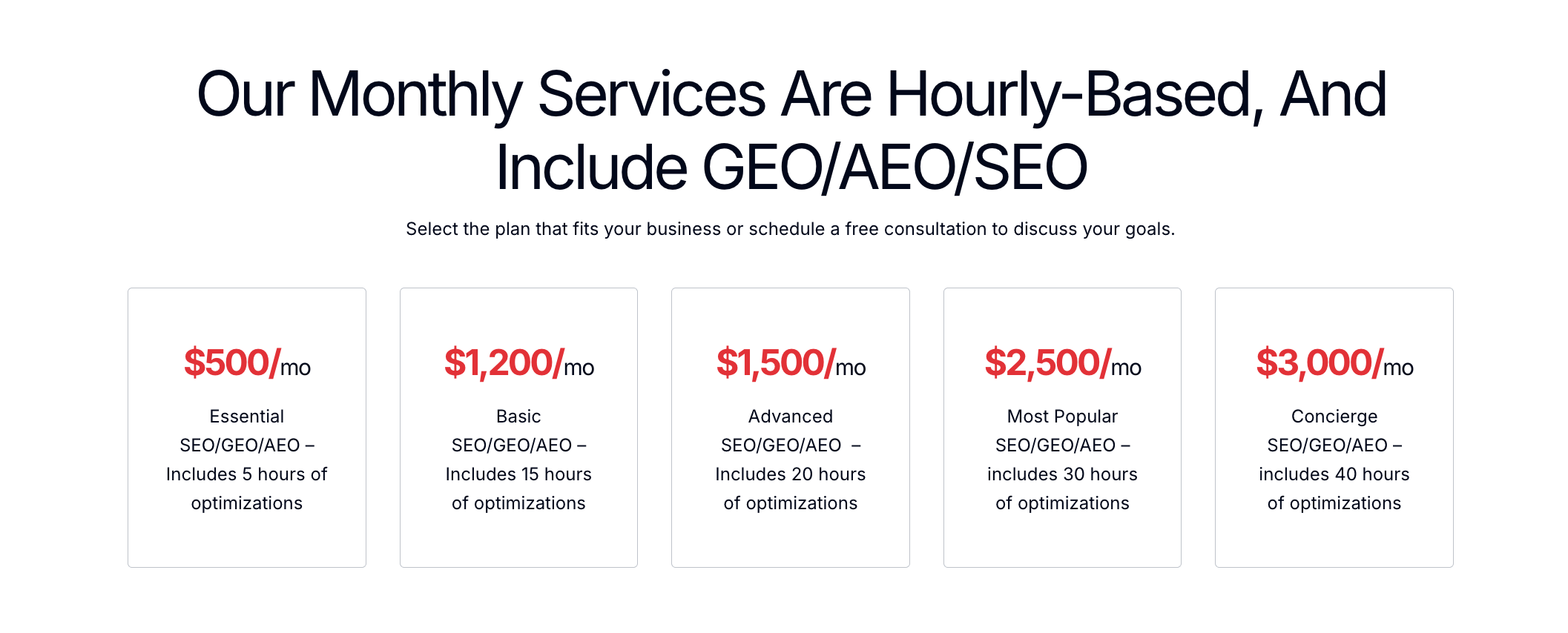
Pricing for SEO services can feel opaque, but there are general industry standards that can help you gauge whether a quote is reasonable. For small businesses, SEO packages are typically broken down into a few key budget tiers. It's important to understand that these prices are not arbitrary; they directly reflect the amount of time, resources, and expertise being allocated to your campaign. A higher price generally means more deliverables, more senior-level attention, and a more aggressive strategy.
This section provides a realistic breakdown of what you can expect to receive at different monthly price points. Use these ranges as a guide to evaluate the proposals you receive. If a provider is offering a package in the $1,000+ tier but their deliverable list looks more like a $200 plan, you know it's overpriced. Conversely, if an offer seems too good to be true, it probably is.
$200–$500 Plans
Packages in this price range are at the very low end of the market. While tempting, you must be extremely cautious. It is very difficult for a legitimate agency to run a profitable, effective campaign at this price point after accounting for labor and overhead. Often, these plans are "loss leaders" or rely heavily on automation and offshore labor, which can be risky.
- What It Might Include: At best, this level might cover a very basic, automated report and perhaps a citation building service where your business is submitted to a list of directories. It could also cover a one-time, basic on-page optimization for your homepage.
- What to Expect: Do not expect proactive work, custom strategy, content creation, or manual link building. Results, if any, will be minimal. The primary goal of a provider at this level is often to upsell you to a more expensive package.
- The Risk: The biggest risk is that the provider will use harmful black-hat tactics to create the illusion of value. Automated, spammy link building is common at this price, which can get your site penalized. In many cases, you are better off doing nothing than investing in a package at this price.
$500–$1,000 Plans
This is often the entry-level price point for legitimate, professional SEO services for a small, local business with low competition. At this level, an agency can dedicate enough time to cover the absolute essentials without cutting dangerous corners. The focus will be on foundational elements and getting your local SEO in order.
- What It Should Include:
-
- Initial technical audit and critical fixes.
- Thorough keyword research for your core services.
- On-page optimization for a small number of key pages (e.g., homepage and 3-5 service pages).
- Google Business Profile setup and optimization.
- Manual citation building and cleanup in top-tier directories.
- A clear, transparent monthly report on core KPIs.
- What to Expect: In this range, you are paying for a solid foundation. You should expect to see improvements in your local search visibility and rankings for some of your main keywords within 3-6 months. However, this budget typically does not include ongoing content creation or a proactive link building campaign, which may limit long-term growth.
$1,000+ Plans
Once your budget crosses the $1,000 per month threshold, you move from a purely foundational package to one that can be more proactive and growth-oriented. A budget of $1,000 to $2,500 per month is a common and realistic range for a small business that is serious about competing online. This investment allows an agency to dedicate more senior-level time and expand the scope of work beyond the basics.
- What It Should Include: Everything in the $500–$1,000 tier, plus:
-
- Ongoing Content Creation: Typically one or two high-quality, well-researched blog posts or content pieces per month designed to build topical authority and target informational keywords.
- Proactive Link Building: A dedicated effort to manually earn high-quality backlinks from relevant local or industry websites.
- Ongoing Technical Monitoring: Continuous monitoring of your site's technical health, not just a one-time audit.
- More In-Depth Strategy: Regular strategy calls with your SEO team to discuss results and plan future initiatives.
- What to Expect: With this level of investment, you should expect to see more significant and faster growth in organic traffic, leads, and sales. The addition of content and link building builds your site's authority, helping you compete for more competitive keywords and sustain your rankings over the long term. This is the tier where SEO transitions from a maintenance activity to a primary driver of business growth.
How to Scale from Affordable to Advanced Packages
Starting with an affordable SEO package is a smart way to get your footing and build a solid foundation. But as your business grows, your SEO needs will evolve. The strategy that got you on the first page in your local town may not be enough to help you expand to neighboring cities or launch a new ecommerce arm of your business. Recognizing when it's time to scale your SEO investment is key to ensuring your growth doesn't plateau.
Scaling your SEO package isn't just about spending more money; it's about strategically reinvesting your returns into more advanced tactics that will open up new channels of growth. It's a sign of success—an indication that your initial investment has paid off and you're ready to compete on a larger stage. A good SEO partner will guide you through this process, helping you identify the right time to upgrade and the new services that will deliver the best return.
When to Upgrade Your Plan
Upgrading your SEO package should be a data-driven decision, not a blind leap of faith. There are several clear signals that indicate you are outgrowing your current plan and are ready for the next level.
Key signs it's time to upgrade:
- You've Achieved Your Initial Goals: If your goal was to rank in the top 3 of the local Map Pack for your main keywords and you've achieved that, it's time to set new goals. This could be expanding your service area, targeting a new customer segment, or ranking for more competitive, broader keywords.
- You're Seeing Diminishing Returns: If your initial growth was strong but has started to level off, it may mean you've maxed out the potential of your current strategy. A foundational package is great for initial gains, but without adding new elements like content marketing or more aggressive link building, you may hit a ceiling.
- Your Competition is Increasing Their Efforts: SEO is a competitive sport. If you notice your competitors are suddenly outranking you with new content or have a stronger backlink profile, it's a sign they have likely increased their investment. To stay ahead, you may need to match their level of effort.
- Your Business Is Expanding: If you are opening a new location, launching a new product line, or expanding into ecommerce, your current SEO package may not have the scope to support these new initiatives. Each new location or business line requires its own focused SEO strategy.
- You Have a Positive ROI: If you are confidently tracking your return on investment and can see that your current SEO package is profitable, reinvesting some of those profits into a more advanced plan is a smart business decision. It's pouring fuel on a fire that's already burning.
When you upgrade, you might add services like a more significant volume of content creation, a dedicated digital PR campaign for link building, conversion rate optimization (CRO) to improve your website's performance, or video SEO.
Get a FREE Audit
We'll perform a comprehensive SEO, AEO, GEO & CRO audit of your website — completely free — and show you exactly how to outrank your competitors.
Don't have a site yet? Get in touch →
ROI Benchmarks
Before you upgrade, it’s important to have a clear understanding of the return you are getting from your current investment. Calculating your SEO ROI helps you justify the spend and provides a benchmark for what you can expect from a larger investment.
As a reminder, the basic ROI formula is:
ROI = ( (Value of Conversions - Cost of SEO) / Cost of SEO ) x 100
What is a "good" ROI for SEO? While it varies by industry, a common benchmark to aim for is a 5:1 return (or 400% ROI). This means for every $1 you invest in SEO, you generate $5 in revenue. For many small businesses, even a 2:1 or 3:1 return is highly successful, especially when compared to the ROI of other marketing channels.
How to use ROI to make scaling decisions:
Let's say your business spends $1,500 per month on an SEO package and generates $7,500 in revenue from organic search.
- Profit: $7,500 - $1,500 = $6,000
- ROI: ($6,000 / $1,500) x 100 = 400% (a 5:1 return)
With this data, you can confidently decide to upgrade to a $2,500 per month package. You can now set a new goal. Based on your current performance, you might project that the upgraded package, with its additional services, could generate $12,500 in monthly revenue, maintaining that same 5:1 return. This data-driven approach turns scaling from a risky guess into a calculated investment in growth.
Case Study: Small Business That Doubled Traffic on a Budget
To bring it all together, let's look at a real-world, anonymized example of how an affordable SEO package can deliver transformative results for a small business.
The Business: "The Fresh Loaf Cafe," a local bakery and coffee shop in a competitive suburban neighborhood. They had a loyal morning coffee crowd but struggled to attract new customers for lunch or their specialty cake-ordering service.
The Situation: The cafe had a simple, visually appealing website, but it received less than 300 organic visitors per month. It was not ranking for key local terms like "cafe near me," "best lunch near me," or "custom cakes near me." Their online presence was almost nonexistent, and they were losing business to larger coffee chains and more digitally savvy local competitors. They had a tight marketing budget of around $800 per month.
Actions Taken (6-Month Affordable SEO Package - $800/month):
- Month 1: The agency started with the fundamentals. They performed a local SEO audit, completely optimized The Fresh Loaf Cafe's Google Business Profile with new photos and a keyword-rich description, and fixed inconsistencies in their NAP information across the web. They also did deep keyword research and optimized the website's homepage and menu page.
- Month 2-3: The focus shifted to building relevance for their secondary services. A new landing page was created specifically for "Custom Cakes," optimized with photos and clear calls-to-action — much like the layouts you'll find in these retail catalog examples. The agency also launched a simple content plan, writing one blog post per month on topics like "Our Favorite Fall Coffee Flavors" and "Behind the Scenes: How We Bake Our Sourdough."
- Month 4-6: With the foundation in place, the agency initiated a local review generation campaign, using a simple QR code at the checkout counter to encourage happy customers to leave Google reviews. They also secured a couple of high-quality local backlinks—one from a local food blogger who reviewed their lunch menu and another from a feature in the online version of the community newspaper.
The Outcome: The results after six months were significant. Organic traffic to the website more than doubled, increasing from under 300 to over 700 visitors per month. The cafe achieved a top-3 ranking in the Google Map Pack for "cafe near me" and "coffee shop near me." Most importantly, the new "Custom Cakes" landing page began generating 3-5 high-value inquiries per week, creating a brand new revenue stream for the business. To keep up with the new order volume without hiring in-house drivers, the cafe used a service like Metrobi to handle same-day cake and catering deliveries — a small operational fix that let the SEO-driven demand actually convert into fulfilled orders. The owner reported a noticeable increase in new faces for lunch, many of whom mentioned they "found the cafe on Google."
- KPI Recap:
-
- Timeframe: 6 Months
- Total Investment: $4,800 ($800 x 6)
- Organic Traffic: +133% (from ~300 to over 700/month)
- Keyword Rankings: Achieved top-3 Map Pack rankings for core keywords.
- Business Impact: Generated a new, consistent stream of cake orders and visibly increased lunch foot traffic.
This case study demonstrates that a modest but strategic investment in a quality, affordable SEO package can deliver a powerful return. It's not about having a huge budget; it's about executing the fundamentals with precision and consistency.
Choosing an affordable SEO package is only half the growth equation for a small business. Once organic traffic starts converting into real leads and orders, the back-end systems handling that volume matter just as much as the rankings themselves. Many owners find that pairing lean SEO investment with a scalable small business ERP setup keeps inventory, invoicing, and customer data organized as demand grows, rather than letting spreadsheets buckle under new traffic. Without that operational backbone, even a well-optimized site can struggle to turn visibility into repeatable, well-managed revenue.
Frequently Asked Questions
Why do small businesses need SEO if they have a limited budget?
What does "affordable" SEO actually mean?
How can a small business compete with large corporations online?
What red flags should I watch for in cheap SEO offers?
How do I evaluate and choose the right SEO partner?
Put this into action with eSEOspace
We help businesses grow with website development that actually performs. Explore the services behind this guide:
Get a FREE GEO/AEO/SEO Audit
We'll analyze your site's SEO, GEO, AEO & CRO — completely free — and show you exactly how to get found across Google and AI answers.
Don't have a site yet? Get in touch →
Great — your audit is on the way!
We'll send your free SEO/GEO/AEO/CRO audit within the next few hours. Where should we send it?
You're all set! ✓
Your free audit is being prepared — check your inbox in the next few hours. Talk soon!


On this page
- Key Takeaways
- Why Small Businesses Need SEO Packages
- What “Affordable SEO” Really Means
- Essential Components of an Affordable SEO Package
- What to Avoid in Cheap SEO Offers
- How to Evaluate SEO Agencies Offering Packages
- Comparing Affordable SEO Packages: Real Price Ranges
- How to Scale from Affordable to Advanced Packages
- Case Study: Small Business That Doubled Traffic on a Budget
- Frequently Asked Questions






