Building funnel content in-house vs hiring an agency
Building funnel content in-house vs hiring an agency
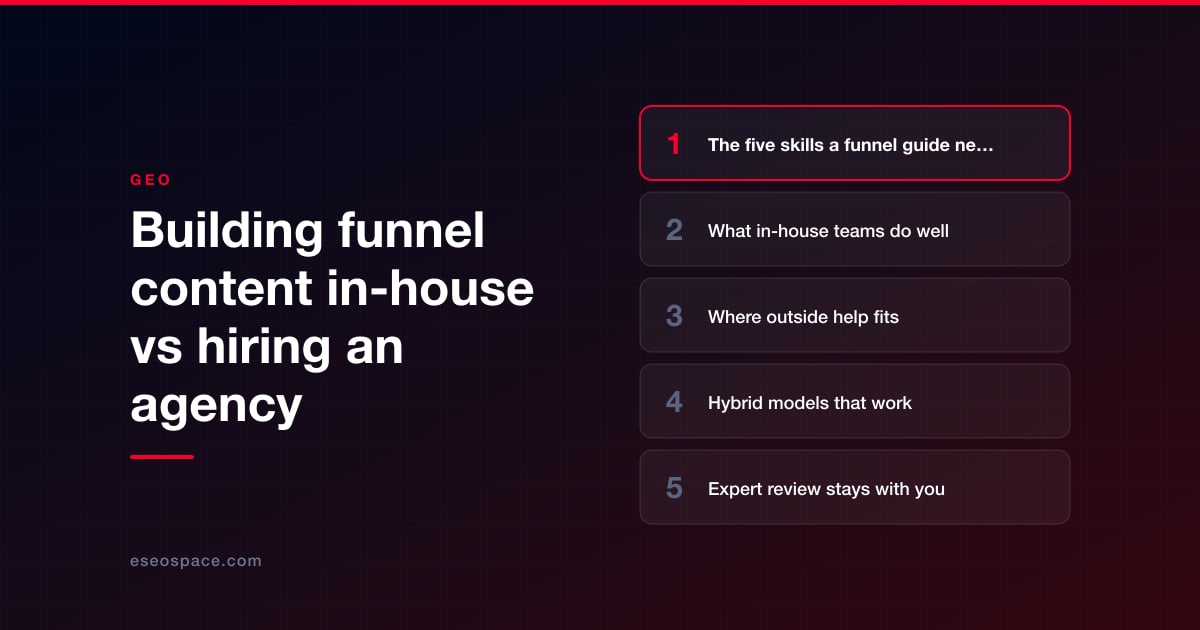
Whether to build funnel content in-house or hire an agency depends on which of five skills your team already has: research, writing, fact-checking, technical build and analytics. A funnel guide covers TOFU (top of funnel) articles that help readers learn, MOFU (middle of funnel) articles that help them compare, and BOFU (bottom of funnel) pages that help them decide. A small team may not have all five with time to spare, which is why a hybrid is worth considering: the team supplies knowledge and approvals, and outside help fills the gaps.
One part should stay on your side. On health, legal and financial topics, a qualified person who works for you or with you should review the pages before they are indexed. An agency can organize that review, but it can't replace your practitioner's judgment. And whoever does the work, the accounts, the content and the data should stay in your name.
Key Takeaways
- A funnel guide needs five skills: sourced research, clear writing, an independent fact-check, a technical build and analytics. Map which ones you have before deciding.
- In-house teams know the customer questions, the confirmed business facts and the approvals. Outside help adds capacity, an independent check and build experience.
- In a hybrid model you supply facts and review, and a provider plans, writes, checks or builds, depending on your gaps.
- Expert review of YMYL pages stays with a qualified person on your side, whoever writes. Google calls fabricated creator profiles "a form of deception."
- Keep analytics, Search Console and Tag Manager accounts in your organization's name. Paying for content does not by itself make you the copyright owner; check the contract (not legal advice).
The five skills a funnel guide needs
Before comparing options, list the work. Each skill below is a separate job, even when one person does several of them.
| Skill | What it involves | Signs you have it in-house |
|---|---|---|
| Research | Building a fact file per topic, with a first-party source and check date on every line, and listing what could not be verified. | Someone already tracks the rules, prices and standards in your field and knows where the official sources are. |
| Writing | Turning one real question per article into a clear answer, in plain language, with a next step to the right page. | Your current articles get read and answer real customer questions. |
| Fact-checking | A second person who did not write the piece re-checks every claim against the sources. | You have two people who can check each other's work against sources. |
| Technical build | Hub or pillar page, stage navigation, internal links, noindex holds for unreviewed pages, sitemap, structured data that matches the visible page. | Someone can edit templates and control indexing on your site without a developer ticket. |
| Analytics | Lead events marked as key events in GA4, pages grouped by stage, Search Console read by page group. | You already know which pages produce form fills and calls. |
The research standard is easy to underestimate. Our guide to research files for YMYL content shows what a fact file looks like and how writers use it.
What in-house teams do well
Your own staff hold the knowledge a guide depends on. Front-desk and sales staff hear the real questions. Owners and practitioners know the confirmed facts: which services you offer, what they cost, where you work and which credentials you hold. Approvals are faster when the approver sits down the hall.
Google's own advice on hiring an SEO is frank about this: "If you run a small local business, you can probably do much of the work yourself." A small guide focused on a few MOFU and BOFU gaps is realistic for a motivated team, especially if one person writes and another checks.
The limits to plan for are time and distance. A team that also runs the business may not have room for steady research and writing, and it is hard to check your own writing objectively.
Where outside help fits
An agency or freelancer adds three things an in-house team often lacks:
- Capacity in waves. A guide can be built in batches. Outside help can carry the research and drafting while your team handles approvals.
- An independent check. A checker who did not write the piece catches claims the writer took for granted.
- Build and measurement experience. Noindex holds, sitemaps, link plans and GA4 key events are routine work for someone who has set them up before.
Outside help also has limits. A provider can't invent your prices, insurance rules or credentials, and shouldn't try. Google's helpful-content guidance asks whether content is "mass-produced by or outsourced to a large number of creators" so that individual pages "don't get as much attention or care." That question applies to an agency's process as much as to yours. Ask who will research, write and check your pages.
Hybrid models that work
The choice doesn't have to be all-or-nothing. These are four possible splits and who each one suits.
| Model | Your team does | Outside help does | Suits |
|---|---|---|---|
| You write, they support | Drafts articles from the plan | Inventory, plan, fact-check, technical build, analytics | Teams with a strong writer but no technical or analytics skills |
| They write, you supply and review | Confirms business facts, answers questions, reviews batches | Research files, drafting, fact-check, build | Busy practices and firms with expert knowledge but no writing time |
| Plan only | Writes, checks and publishes | Gap analysis, stage plan, money-page mapping | Teams that can produce content but need a structure |
| Build and measure only | Writes and approves | Hub, links, indexing controls, GA4 and Search Console setup | Teams with content ready and no developer time |
Whatever the split, write down who owns each step. Watch for steps that each side assumes the other will do.
Expert review stays with you
On YMYL topics (the term Google's rater guidelines use for topics that could significantly affect health, financial stability or safety) the reviewer has to be a qualified person who can stand behind the page: your doctor, attorney, accountant or engineer. Google's people-first guidance asks whether content is "written or reviewed by an expert or enthusiast who demonstrably knows the topic well." Its October 2026 wording adds that "Fabricating creator profiles (such as by using AI-generated headshots, made-up names, or false credentials to make content appear as if it was written by human experts) is a form of deception."
In practice this means unreviewed pages stay noindex until the reviewer signs off, and the reviewer and date are recorded. An outside provider can run that workflow, but the review itself can't be outsourced to someone without the credentials. The full workflow is in expert review before indexing.
Google also reminds site owners: "Ultimately, you are responsible for the actions of any companies you hire." In a content guide, that includes what the pages say.
Cost drivers on each side
We won't give typical figures, because we know of no authoritative benchmark for agency content pricing. The drivers are easier to compare.
In-house: salary, benefits and payroll taxes, tools, training, and the management time spent planning and checking. For a wage reference only, BLS reports a May 2025 median annual wage of $78,760 for market research analysts and marketing specialists (SOC 13-1161), a broad category that includes but is not limited to search marketing roles. That is a national median wage, not a total employment cost and not a content or SEO salary.
Outside help: article count, research depth, review rounds, regulated claims, hub and design work, and upkeep. Our article on what a funnel content guide costs and how long it takes explains each one.
A fair comparison prices the same scope both ways, including the review time your own experts spend in either case.
Keep ownership and access in your name
The build choice should not decide who owns the result. Three checks apply whichever way you go:
- Accounts. Google's Tag Manager help says to "make sure your account is managed by someone in your organization, not an external agency." Hold Administrator access in GA4 and owner access in Search Console yourself, and give providers their own logins.
- Content. Under US copyright law, a commissioned work counts as "work made for hire" only in listed categories and with a signed written agreement; otherwise ownership moves only by a signed written transfer. Ask what the contract says and when ownership transfers. This is not legal advice; have an attorney review the agreement.
- Data. Research files, stage tags and tracking setups are part of what you paid for. Agree that they come with you if the relationship ends.
How to decide
Answer these honestly before you talk to anyone:
- Which of the five skills does someone on your team have, with time to use it each month?
- Is your topic YMYL? If so, who will review, and how quickly?
- Can you confirm your own prices, services, locations and credentials in writing?
- Who on your team can edit templates and control indexing?
- Are lead events already tracked as key events in GA4?
If you answered yes to most, start in-house and buy help only for the gaps. If you answered no to most, a provider that does the full method, with your team supplying facts and review, is the realistic route. For a wider comparison that includes freelancers, see GEO agency vs. in-house vs. freelancer. If you plan to hire, hiring an in-house GEO specialist has a job description and interview questions, and our 15 questions to ask an agency about funnel content help you vet a provider.
Conclusion
The in-house or agency question is really a skills inventory. Keep the knowledge, the approvals, the expert review and the accounts on your side, and fill the remaining gaps with whoever can do them carefully. The method behind each step is in our TOFU, MOFU and BOFU content strategy guide. If you want help with part or all of a guide, see our content marketing services. More guides are in our GEO and AEO Guide.
Frequently asked questions
Can a small business build a funnel guide without an agency?
It can. Google says a small local business can "probably do much of the work yourself." Start with the MOFU and BOFU gaps your inventory shows, have a second person check every claim, and get expert review on health, legal or financial pages.
Who should review funnel content written by an agency?
A qualified person on your side who can stand behind the facts: the practitioner, attorney, accountant or engineer the topic calls for. The agency can run the workflow and record the reviewer and date, but not replace the expert.
Is a hybrid model harder to manage?
It can be if roles are vague. Write down who researches, writes, checks, reviews, builds and measures each batch. Watch for steps that each side assumes the other will do.
Do I own content an agency writes for me?
Not automatically. For work by an outside agency or contractor, US copyright law requires either a qualifying "work made for hire" agreement or a signed written transfer. Check the ownership clause and when it takes effect. This is not legal advice; ask an attorney.
Can I bring the work in-house later?
Yes, if accounts, research files and tracking are in your name from the start. Ask any provider to document stage tags, sources and setups so your team can continue where they stop.
Put this into action with eSEOspace
We help businesses grow with seo, geo & aeo that actually performs. Explore the services behind this guide:
Get a FREE Audit
We'll perform a comprehensive SEO, AEO, GEO & CRO audit of your website — completely free — and show you exactly how to outrank your competitors.
Don't have a site yet? Get in touch →
Get a FREE GEO/AEO/SEO Audit
We'll analyze your site's SEO, GEO, AEO & CRO — completely free — and show you exactly how to get found across Google and AI answers.
Don't have a site yet? Get in touch →
Great — your audit is on the way!
We'll send your free SEO/GEO/AEO/CRO audit within the next few hours. Where should we send it?
You're all set! ✓
Your free audit is being prepared — check your inbox in the next few hours. Talk soon!