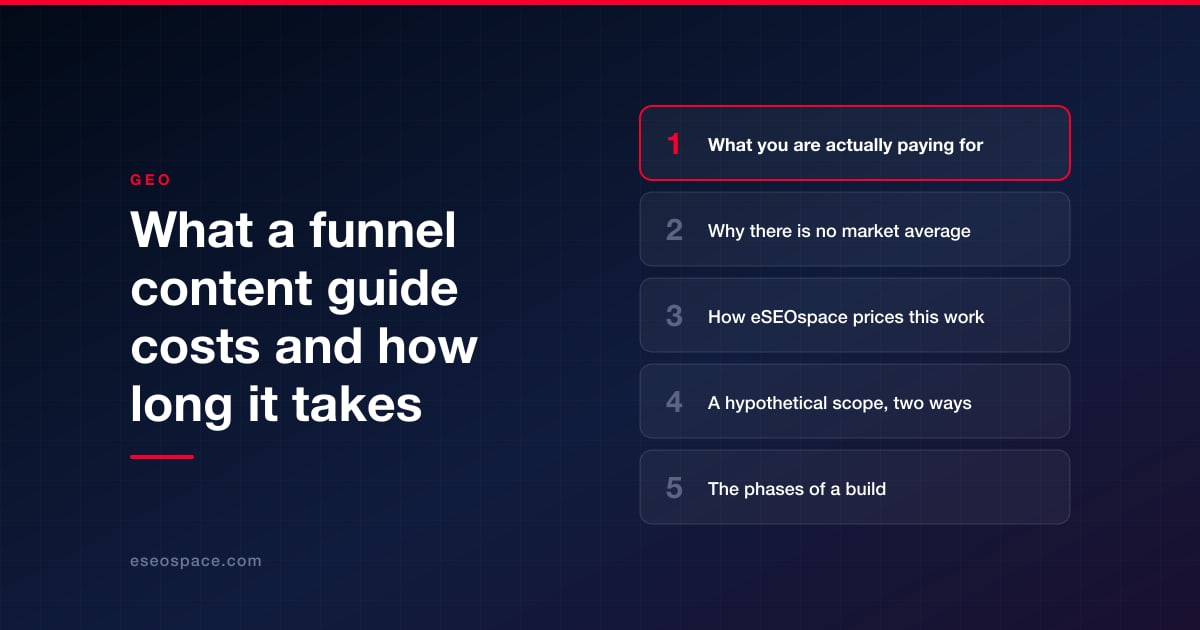
What a funnel content guide costs and how long it takes
What a funnel content guide costs and how long it takes
A funnel content guide has no standard price, because the work behind it varies so much. TOFU (top of funnel) articles help readers learn, MOFU (middle of funnel) articles help them compare, and BOFU (bottom of funnel) articles help them decide. Six things drive the cost of a guide that covers all three: how many articles it needs, how deep the research goes, whether a practitioner must review the pages, whether the market restricts what you can claim, how much hub and page design is involved, and how much upkeep the facts need after launch.
The time it takes follows the same drivers. A guide moves through the same phases whoever builds it: inventory, research, writing in waves, an independent fact-check, expert review, launch and rechecks. Research and review can take longer than the writing. Nobody can honestly promise a number of weeks to results, and nobody can promise leads, rankings or AI citations from a number of articles.
Key Takeaways
- Cost is driven by article count, research depth, expert review, regulated claims, hub and design work, and upkeep. Word count is a poor proxy, and Google says it has no preferred word count.
- We know of no authoritative public benchmark for what agencies charge for content, SEO or GEO work, so treat any "market average" you see as unverified.
- eSEOspace publishes no price for a funnel guide. Its published combined SEO, GEO and AEO plans run from $750 to $4,000 per month, billed monthly, as of October 2026.
- The phases are inventory, money-page check, research files, writing in waves, independent fact-check, expert review, launch and recheck. Reviewer availability can be the slowest step.
- Structural fixes can be checked as soon as they ship. Indexing, rankings, AI citations and leads are not guaranteed and build unevenly.
What you are actually paying for
A quote for a content guide is really a quote for hours of research, writing, checking, building and coordination. The table shows where those hours go and how you can reduce them without cutting quality.
| Cost driver | Why it adds work | How to keep it in check |
|---|---|---|
| Article count | Each article needs its own question, sources, draft, check and links. | Size the guide from a gap analysis, not from a round number. |
| Research depth | Topics built on regulations, insurance rules or standards need a sourced fact file before drafting. | Share your confirmed facts (services, prices, locations, credentials) at the start. |
| Expert or YMYL review | Health, legal and financial pages need a qualified reviewer, and pages wait until they are reviewed. | Name the reviewer early and agree on a turnaround per batch. |
| Regulated claims | Advertising rules for your field limit wording on results, comparisons and prices, so pages need extra checks. | Give the writer your compliance rules or your counsel's guidance up front. |
| Hub and design build | A new pillar page, stage navigation, calls to action and templates are development work, not writing. | Reuse existing templates where they already work. |
| Upkeep | Dated facts need rechecking, and changed pages may need another review. | Keep a list of dated facts with recheck dates from day one. |
Notice what is not on the list: word count. Pricing by the word rewards length, not usefulness. Google's people-first content guidance lists writing "to a particular word count because you've heard or read that Google has a preferred word count" as a warning sign, and adds "(No, we don't.)"
Article count deserves a closer look, because it is the driver people try to negotiate first. Our guide to how many articles per funnel stage shows how to size each stage from your own inventory instead of a target number.
Why there is no market average
We know of no government, standards-body or other authoritative public benchmark for what agencies charge for content, SEO or GEO work. The figures that circulate come from agency blogs, tool vendors and self-selected surveys, and they are not verifiable.
Even if a reliable average existed, it would not tell you much. A hypothetical 20-article guide for a local contractor and a hypothetical 100-article guide for a medical practice are different products. One needs a few confirmed facts about service areas and prices. The other needs a sourced file on treatments, insurance and the rules that apply, plus a doctor's review of every page.
The useful comparison is between quotes for the same scope. Ask every provider to price the same article count, the same research standard and the same review process, and use our 15 questions to ask an agency about funnel content to get answers you can compare. How much GEO and AEO services cost in 2026 covers pricing models for ongoing AI-search work in more detail.
How eSEOspace prices this work
eSEOspace publishes no price for a funnel guide, because the scope varies too much. It does publish its combined SEO, GEO and AEO plans on its pricing page. As of October 2026 there are five, billed monthly:
| Plan | Price | Hours included |
|---|---|---|
| Essential | $750 per month | Up to 5 dedicated implementation hours per month |
| Growth | $1,200 per month | Up to 10 dedicated implementation hours per month |
| Advanced | $2,500 per month | Up to 20 dedicated implementation hours per month |
| Pro | $3,000 per month | Up to 25 dedicated implementation hours per month |
| Concierge | $4,000 per month | Up to 30 dedicated implementation hours per month |
The plans are hours-based, and the work those hours go to can change from month to month. The pricing page also says custom design and development projects "are quoted as a fixed scope" and that "Nothing is locked into a long contract." A guide's scope is set after the inventory, once the article count and the review needs are known.
A hypothetical scope, two ways
This hypothetical example shows how the same business can end up with very different scopes. It is not a quote and not market data.
| Scope item (hypothetical dental practice) | Smaller guide | Larger guide |
|---|---|---|
| Articles | 20, mostly MOFU and BOFU gaps | 60, covering every treatment |
| Research | Practice's confirmed facts plus a short source list | Full fact file per treatment, with insurance and cost sources |
| Review | Dentist reviews two batches | Dentist reviews six batches |
| Hub | New section on an existing template | New pillar design and stage navigation |
| Upkeep | Yearly recheck | Quarterly recheck of prices and insurance facts |
The larger guide is not automatically better. If the gap analysis shows the practice is missing cost and insurance pages, 20 well-sourced articles aimed at that gap may do more than 60 that repeat what its blog already covers.
The phases of a build
These are the phases we follow. Other providers may organize the work differently, so ask any provider how it handles each one.
- Inventory. Every existing page gets a stage tag. Length depends on how big the existing site is.
- Money-page check. Each planned article is checked against the page it feeds. If that page already answers the question, the page gets fixed instead.
- Research files. A sourced fact file for each topic area, with a source URL and check date on every line. On one psychiatry guide, articles averaged about 10 sources each.
- Writing in waves. Articles ship in batches rather than all at once. One psychiatry guide launched with 85 articles and grew to 113. An industrial fuse guide grew from 19 to 42 in a second round.
- Independent fact-check. Someone who did not write the piece re-checks every claim against the sources.
- Expert review. On YMYL topics (health, legal and financial pages) the pages stay noindex and out of the sitemap until the practitioner or client has reviewed them. On a vein and interventional clinic, the doctor reviewed each batch.
- Launch. Sitemap, links from service pages into the guide and back, and a hub card or menu link.
- Recheck. Dated facts get a recheck date, and the plan is re-checked before each new batch.
Who runs each phase, your team or outside help, is covered in building funnel content in-house vs hiring an agency.
What usually slows a guide down
Writing is only one of the steps that set the pace. These are the delays to plan for:
- Reviewer time. A practitioner with a full schedule fits review around patients or clients. Pages wait in the meantime, by design.
- Missing business facts. Prices, insurance accepted, service areas and credentials have to come from you. An article can't state them until you confirm them.
- A plan that goes stale. One custom awards company's plan called for a comparison post, but its product page already had a comparison table and five FAQs on the same question. The plan went stale against its own money pages a second time later, which is why plans are re-checked before each batch.
- Scope changes mid-build. New services or locations added halfway through mean new research and new links.
What tends to move first after launch
Some results are within your control and can be checked as soon as they ship. Others depend on search engines and buyers.
- Checkable right away: pages live, links between stages working, forms and calls to action in place, lead events recorded in GA4.
- Next: pages being discovered and indexed, and impressions starting to show in Search Console. Google says a sitemap is "merely a hint," and its guide to generative AI features says "Indexing and serving aren't guaranteed."
- Slow and uneven: rankings, AI citations and leads. They depend on competition, demand and signals no one controls.
Google's own advice on hiring help says an audit "should be about giving you realistic estimates of improvement, and an estimate of the work involved." A quote should do the same. For a closer look at timing in AI search, see how long GEO takes to work.
Budget for upkeep, not just the build
A guide built on dated facts starts aging on launch day. Rules change on known dates: on one ADHD guide, a telehealth prescribing flexibility set to expire December 31, 2026 was noted for recheck. Prices, insurance terms and vendor documentation change without notice. Plan for a recheck cycle and for re-review of YMYL pages that change, and ask any provider to price that upkeep separately from the build.
Conclusion
A funnel guide costs what its scope costs: the articles it needs, the research behind them, the review they require, the build and the upkeep. Compare quotes on the same scope, expect research and review to take real time, and treat any promise of a fixed number of leads as a reason to walk away. The full method is in our TOFU, MOFU and BOFU content strategy guide. If you want us to scope a guide for your site, see our content marketing services. More guides are in our GEO and AEO Guide.
Frequently asked questions
How much does a funnel content guide cost?
There is no standard price. Cost depends on article count, research depth, expert review, regulated claims, hub and design work, and upkeep. No authoritative market benchmark exists, so compare quotes that cover the same scope.
Does eSEOspace publish a price for a funnel guide?
No. It publishes five combined SEO, GEO and AEO plans, billed monthly, from Essential at $750 to Concierge at $4,000 as of October 2026, each with up to a set number of implementation hours. A guide's scope is set after an inventory.
How long does it take to build a funnel guide?
It depends on the article count, the research depth and how quickly your reviewer can check batches. Building in waves means the first batch can go live while later ones are still in research. Review can be the slowest step.
Should I pay per word?
Per-word pricing rewards length rather than usefulness. Google says it has no preferred word count. Pricing by article and scope, with the research and review standard written down, is easier to compare.
When will a funnel guide produce leads?
No one can promise a date. Links, forms and tracking can be checked right away. Indexing is not guaranteed, and rankings, AI citations and leads build unevenly, so track key events by stage and judge the guide on that data.
Put this into action with eSEOspace
We help businesses grow with seo, geo & aeo that actually performs. Explore the services behind this guide:
Get a FREE Audit
We'll perform a comprehensive SEO, AEO, GEO & CRO audit of your website — completely free — and show you exactly how to outrank your competitors.
Don't have a site yet? Get in touch →
Get a FREE GEO/AEO/SEO Audit
We'll analyze your site's SEO, GEO, AEO & CRO — completely free — and show you exactly how to get found across Google and AI answers.
Don't have a site yet? Get in touch →
Great — your audit is on the way!
We'll send your free SEO/GEO/AEO/CRO audit within the next few hours. Where should we send it?
You're all set! ✓
Your free audit is being prepared — check your inbox in the next few hours. Talk soon!


On this page