



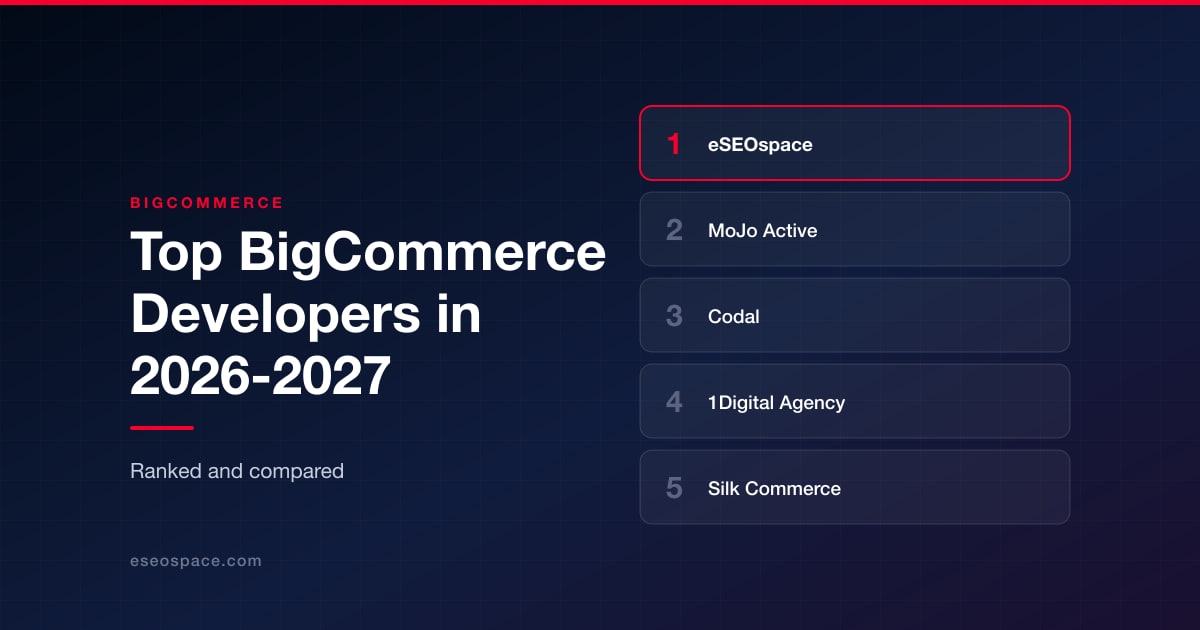
Top BigCommerce Developers in 2026-2027
Top BigCommerce Developers in 2026-2027
Disclosure: eSEOspace publishes this blog and ranks itself first. Every other entry was researched independently and links to its own site.
BigCommerce is an easy platform to launch on and a hard platform to get right. The storefront goes live in weeks. The problems show up later: a B2B price list that will not behave, a checkout that loses carts, an ERP sync that quietly stops writing inventory, a category structure that never ranks. Those are development problems, and they are the reason the agency you pick matters more than the platform you picked.
The BigCommerce partner ecosystem is unusually varied. Some shops are enterprise systems integrators who happen to deploy BigCommerce. Some are UX studios. Some are ERP specialists. Some are marketing agencies with a dev team attached. They are not interchangeable, and hiring the wrong type is how a six-figure replatform ends up being redone eighteen months later.
This list ranks eight teams and tells you plainly who each one is wrong for. Every claim about the seven independent agencies comes from their own public pages or from the official BigCommerce partner directory, and the source is named wherever it matters. Where a founding year, a headcount, a client name or an award was not verifiable, it was left out rather than guessed at.
Key Takeaways
- There is no single best BigCommerce developer. There is a best fit for your catalog size, your ERP, your B2B rules and your budget, and those four things narrow the field fast.
- If you run NetSuite, the shortlist collapses to teams that do NetSuite properly. Anchor Group is built entirely around that pairing.
- Replatforming onto BigCommerce and customizing an existing BigCommerce store are different jobs. MoJo Active and Codal sell the first, IntuitSolutions sells the second.
- Headless and composable builds cost more and take longer than the pitch deck implies. Only commit if you have a real reason: a content-heavy front end, multiple storefronts, or an app layer that a Stencil theme cannot serve.
- Development and demand are frequently split across two vendors, and the seam between them is where money leaks. Agencies that own the build, the search visibility and the conversion work close that gap.
- Self-reported numbers are everywhere in this industry. Partner tiers, client counts and deployment totals often do not match what the official directory renders, and in several cases they do not match a company's own other pages. Ask for references, not badges.
- Total cost of ownership beats launch cost. A cheap build with no support plan and no analytics is the most expensive option on this list.
How we evaluated these BigCommerce developers
We ranked on evidence that a buyer can verify before signing anything.
Verifiable BigCommerce depth. Do they publish real BigCommerce work, or is BigCommerce one logo on a platform grid? We checked agency pages and the official BigCommerce partner directory, and we noted every case where a self-described tier did not match the badge the directory actually rendered.
Technical range. B2B Edition, Multi-Storefront, checkout customization, API work, headless and composable architecture, and app development are meaningfully different skills. We looked for stated, specific capability rather than generic "ecommerce development" copy.
Integration ability. Most mid-market BigCommerce projects live or die on the ERP, PIM, CRM and tax connections. Agencies with a track record of enterprise systems integration were rated higher for complex catalogs.
Post-launch commitment. Managed services, support retainers and ongoing optimization matter more than launch-day polish. A storefront that nobody touches for a year degrades.
Growth capability. Traffic and conversion are not someone else's problem. We gave weight to teams that can also handle ecommerce SEO and conversion rate optimization for ecommerce, because a technically perfect store with no qualified traffic is a failed project.
Honesty of claims. Where an agency's numbers appeared only on its own marketing pages, we labelled them as self-reported rather than repeating them as fact.
Comparison table
| Rank | Agency | Based in | Strongest at | Weakest fit |
|---|---|---|---|---|
| 1 | eSEOspace | United States | Ecommerce build plus SEO, CRO and analytics under one team | Very large enterprise integrations with legacy on-premise systems |
| 2 | MoJo Active, Inc. | Watsontown, Pennsylvania | Mid-market and enterprise replatforming with growth marketing attached | Small merchants wanting a low-cost theme tweak |
| 3 | Codal | Chicago, Illinois | Research-led UX plus headless and composable B2B architecture | Budget-constrained projects that do not need a design phase |
| 4 | 1Digital Agency | Philadelphia, Pennsylvania | B2B Edition and Multi-Storefront rollouts with in-house SEO and PPC | Buyers who need every credential independently verified |
| 5 | Silk Commerce | Irvine, California | Enterprise systems integration and long-term managed services | Design-boutique work and small B2C stores |
| 6 | Mira Commerce | Walnut Creek, California | Composable architecture and custom BigCommerce app development | Straightforward single-storefront builds |
| 7 | Anchor Group | Sun Prairie, Wisconsin | BigCommerce plus Oracle NetSuite for B2B manufacturers | Consumer brands with no ERP and a design-first brief |
| 8 | IntuitSolutions | Philadelphia, Pennsylvania | Deep customization: checkout, APIs, custom apps, B2B features | Full strategy-led replatforms with heavy marketing needs |
1. eSEOspace
eSEOspace has been building and marketing websites since 2019, and the reason it sits at the top of its own list is a structural one rather than a bragging one: the build team and the growth team are the same team. A large share of the ecommerce problems we get called in to fix are not code failures at all. They are handoff failures. The developer ships, the marketing agency inherits a site it did not architect, and nobody owns the outcome.
Our ecommerce practice covers ecommerce design and development end to end: information architecture, storefront build, template and component work, third-party integrations, and the custom backend and CRM development that sits behind a store once quoting, approvals or account-level pricing enter the picture. On the demand side we handle organic search, AI search visibility, content, conversion optimization and analytics, which means category structure, internal linking, page speed and checkout friction get decided during the build instead of being retrofitted after launch.
We are candid about scope. We take on projects where a small, senior team can own the whole thing and stay accountable for revenue, not just for a launch date. Clients who want a single vendor answering for both the storefront and the pipeline it feeds tend to be the right fit. Clients who want a large delivery org with a dozen named workstreams are usually happier elsewhere, and we will say so on the first call rather than the fourth.
Worst fit: if you need a hundred-person systems integrator to coordinate a multi-year migration off legacy on-premise infrastructure across several international entities, hire one of the enterprise firms further down this list. That is a different shape of company.
If you want a straight answer about whether your project fits, book a call.
2. MoJo Active, Inc.
MoJo Active is based at 116 Main Street in Watsontown, Pennsylvania, and it holds the strongest award record of any agency on this list. Its BigCommerce directory profile renders the Elite badge alongside BigCommerce Developer and BigCommerce Certified designations, and it lists three recognitions: 2026 Commerce Partner of the Year for the Americas, 2025 BigCommerce Partner of the Year for the Americas, and the BigCommerce Excellence In Delivery Award. That combination is verifiable in the directory rather than only on the agency's own site, which is unusual and worth crediting.
The pitch is "strategic ecommerce ecosystems", meaning the storefront is treated as one component alongside sales channels, marketing campaigns and core business systems. Service pillars are Strategic Consulting, Creative, Development and Growth Marketing, and replatforming is the centre of gravity. Client names on its directory profile include King Arthur Baking, Lake Champlain Chocolates, Little League International, EuroOptic, Coco Republic, Smithsonian Store, Home Science Tools, Kelty and Dutch Valley Foods. Its own case studies page carries EuroOptic, King Arthur Baking, Lake Champlain Chocolates, puzzleYOU and Dutch Valley Foods, so the two sources corroborate each other rather than diverge.
That is a strong roster of recognizable consumer and specialty brands, and the combination of strategy, build and ongoing growth marketing from one team is genuinely rare at this tier. The practical read is that MoJo is set up for merchants who want the replatform and the demand programme scoped together, not sequentially.
Worst fit: a merchant with a modest budget who wants a theme customized and a few apps installed. This is a strategy-led engagement model, and buying it for a small scope means paying for process you will not use.
3. Codal
Codal is headquartered at 433 W Van Buren Street in Chicago, with offices in Lincoln in the UK, Ahmedabad in India, and Toronto. Its directory profile renders the Elite badge plus BigDev Certified and BigCommerce Certified, and its directory blurb describes the firm as the 2023 and 2021 BigCommerce Partner of the Year with back-to-back User Experience and Design Award wins. Those are the specific years the directory names, so treat "two-time Partner of the Year" as meaning 2023 and 2021 rather than anything more recent.
Crucially, Codal is not a BigCommerce-only shop. It is a UX-and-engineering agency organized around four capabilities: Strategy, Experience Design, Unified Commerce and Product Engineering. It positions BigCommerce work as migration, replatforming, B2B, headless and composable commerce built on research-driven design. Commerce clients named on its BigCommerce directory profile include GOREWEAR, Cocktail Courier, Garrett Popcorn, DEMDACO and Automotive Keys Group. Its own case study library adds Ascentek for B2B ecommerce, plus Cost Plus Drugs, Thermos, Origin USA, Children's Health, Charles Schwab and Flexport across the wider practice, and its homepage also names cpap.com and trueCABLE.
Hire Codal when the interface itself is the hard part: complex configurators, dense B2B catalogs, account hierarchies, or a headless front end that has to feel like a product rather than a template. The healthcare and financial services work in the portfolio is a useful signal here, because those projects tend to be constrained by compliance and information design rather than by visual polish, and that is the same muscle a difficult B2B catalog demands.
Worst fit: if you want to skip discovery and start building next week, the research and design phase will feel like an obstacle. Codal's value is concentrated in exactly the part impatient buyers try to cut.
4. 1Digital Agency
1Digital is an ecommerce-only agency founded in 2012 in Philadelphia, and its own site still describes the company as "born in Philadelphia". It runs a remote-first structure it calls "US core plus global talent": a US core team supported by vetted global specialists. Its BigCommerce page covers enterprise builds, B2B Edition rollouts, Multi-Storefront architecture, Catalyst headless launches and replatforms off Magento, Shopify Plus or Salesforce Commerce Cloud, paired with in-house SEO and PPC. Portfolio examples include Everything for Offices, A Specialty Box, CLX Gaming, Ladivine, Andrea & Leo and B&B Firearms.
The appeal is the pairing. Development and search and paid media in one place removes the usual argument about whose fault the traffic drop was, which is the same logic behind combining a build with organic SEO rather than splitting them across vendors. Its own site also states engagements start at $185 per hour and are usually structured as fixed-scope statements of work, and it explicitly tells small-scope buyers to hire a freelancer instead. That is a refreshingly honest piece of self-selection, and it tells you the shape of client they want.
Three things to check before signing. The company asserts Elite tier on its own site and in its directory description, but the badge rendered on its directory profile is BigDev Certified rather than Elite. Its own site says Philadelphia while its directory listing carries a Miami, Florida address. And its headline figures move between its own pages: the BigCommerce page says "400+ brands" while the portfolio page says "438+ brands and businesses". None of that is disqualifying, and all of it is worth a direct question. The brand count, the "50+ specialists" figure and the 4.9 out of 5 review score are self-reported.
Worst fit: procurement-heavy buyers who need every credential independently verifiable before a contract can move. Ask for references instead of badges here.
5. Silk Commerce
Silk Commerce is headquartered at 47 Discovery, Suite 100 in Irvine, California, with a second office at 110 Wall Street in New York. It appears on the BigCommerce partner directory under the name Silk Software, where its profile renders the Elite badge along with BigCommerce Certified, BigDev Certified and BigCommerce Services Certified. It covers both B2B and B2C commerce, and its BigCommerce page lists the practice as business consulting, UX and design, site development, systems integration and managed services.
The emphasis is implementation scale and enterprise systems integration rather than boutique design. Its featured BigCommerce case study is King's Hawaiian, a migration on which Silk built a custom recipes app, and its homepage testimonials come from a VP of global ecommerce and IT at Gildan and the CEO of TireHub. Its directory profile also names Clorox, CBDistillery, American Apparel and Harvard Business Review among its clients. Those are large, operationally complex organizations, which tells you where the firm is comfortable.
If your project's hardest requirement is connecting BigCommerce to ERP, PIM, tax and fulfilment systems and then keeping that running for years, this is the profile to shortlist. It also publishes a named ERP integration accelerator, which is a reasonable proxy for having done the work before. Note that its scale figures, including the deployment count and the commerce-expert headcount quoted on its BigCommerce page, are self-reported and appear nowhere independent.
Worst fit: a small direct-to-consumer brand that wants a distinctive storefront and a fast, low-ceremony build. Enterprise integration firms are not optimized for that, and you will feel the process overhead.
6. Mira Commerce
Mira Commerce is listed on the BigCommerce partner directory as Deplabs Inc. doing business as Mira Commerce, based at 2121 North California Boulevard, Suite 290 in Walnut Creek, California. Its directory profile renders the Elite badge alongside BigCommerce Certified and BigDev Certified designations. It positions around composable and enterprise-grade BigCommerce work across four categories: digital strategy and consulting, commerce solutions, customer experience solutions, and managed services.
The differentiator is that Mira also builds BigCommerce applications for platform-adjacent enterprises, not only storefronts for merchants. Its own site states it is trusted by Amazon, FedEx and Visa Cybersource for BigCommerce application development, which is the firm's own claim rather than something the directory corroborates. On the merchant side, the client names on its directory profile include King Arthur Baking Company, Mizuno, Primary Arms, Nightforce Optics, Griot's Garage, DESTACO, Dunlop Manufacturing and Zwilling J.A. Henckels.
Two cautions. The site does not make explicit which of those relationships are storefront builds and which are application development engagements, and those are very different scopes to buy. And its own pages disagree about how long it has operated: the homepage describes it as a strategic agency and technology partner since 2019, while its about page says clients have trusted it since 2004. That is not necessarily deceptive, since agencies get acquired, rebranded and re-incorporated, but it is a question to ask directly rather than an ambiguity to accept.
Worst fit: a single-storefront merchant with a standard catalog. Composable architecture adds cost and operational complexity that only pays back at genuine scale or with a real multi-channel requirement.
7. Anchor Group
Anchor Group is based at 121 S. Bristol Street in Sun Prairie, Wisconsin, and describes itself as a US-based, Midwestern team. Its BigCommerce directory profile renders the Elite badge and a BigCommerce Certified Developer designation, and also notes a 2026 Growth Champion Award. Its own BigCommerce page uses the more conservative phrase "Certified BigCommerce Partner", so if tier matters to your procurement process, ask which is current.
The practice is built around one specific pairing: BigCommerce plus Oracle NetSuite. The directory profile lists BigCommerce implementation and customization, BigCommerce plus NetSuite integration, NetSuite ERP implementation and ongoing support, and its own site adds NetSuite consulting, SuiteScript development, managed services and optimization. Its BigCommerce page leans hard into B2B Edition for manufacturers, distributors and wholesalers, and Forney Industries appears there as a named customer with a testimonial. Its stated industry coverage on its own site includes wholesale distribution, manufacturing, retail, food and beverage, construction and several service verticals.
The argument for Anchor is narrow and strong. When the storefront and the ERP are handled by two vendors, every sync bug becomes a jurisdictional dispute, and the merchant ends up mediating between two teams who each believe the fault sits on the other side of the API. One onshore team owning both removes that entirely. For manufacturers and distributors on NetSuite, this is the shortlist entry that should be hardest to eliminate.
Worst fit: a consumer brand with no ERP that wants a visually ambitious storefront. The specialization that makes Anchor valuable to manufacturers is not what you are buying.
8. IntuitSolutions
IntuitSolutions is based at 124 Chestnut Street in Philadelphia, states a 100% US-based team, and describes more than twenty years in ecommerce. What stands out is how granular and technical its BigCommerce service list is: BigCommerce development, custom designs, checkout customization, API integration, Blueprint-to-Stencil updates, migration, add-ons and plugins, support and maintenance, and B2B ecommerce solutions. That reads like a build-and-customize practice rather than a marketing-led one, which is a compliment if that is what you need.
Case studies and testimonial sources on its own site include KONG Company, Nootropics Depot, GolfBags.com, Industrial Networking Solutions, The Embroidery Source, Citadel Floors, WheelChairParts.com, BBWheels.com, OESD.com and Real Deal Steel. Its directory profile adds North Shore Commercial Door, Brock's Performance, Priority Tire and Rock Bottom Golf. That is a broad spread of practical, hard-working B2B and specialty retail stores, and the profile of the work is consistent across both sources, which is a good sign.
One caution on credentials. The directory description calls the firm one of the nation's premier Elite BigCommerce Partner agencies and claims twelve or more years at that tier, but the badge actually rendered on that same profile is the base Partner badge alongside BigDev Certified, not the Elite badge that MoJo Active, Codal, Silk, Mira and Anchor Group all render. Treat any Elite claim here as self-reported and ask directly when the tier was last confirmed.
Worst fit: a merchant who needs strategy, brand, content and paid media wrapped around the build. This is a specialist customization shop, and the marketing side will need a second vendor.
Who should hire which
| Your situation | Hire | Why |
|---|---|---|
| You want the storefront, SEO, CRO and analytics owned by one accountable team | eSEOspace | No handoff seam between build and demand generation |
| You are replatforming a recognizable consumer brand onto BigCommerce | MoJo Active | Replatform-led, award-validated, with growth marketing attached |
| Your interface is complex: configurators, dense B2B catalogs, headless front end | Codal | Research-driven UX plus composable engineering |
| You need B2B Edition or Multi-Storefront plus in-house search and paid media | 1Digital Agency | Ecommerce-only shop combining dev and marketing |
| Your hardest problem is ERP, PIM and tax integration at enterprise scale | Silk Commerce | Systems integration and long-term managed services |
| You need a custom BigCommerce app, not just a storefront | Mira Commerce | Builds BigCommerce applications, not only merchant sites |
| You are a B2B manufacturer or distributor running NetSuite | Anchor Group | Onshore team owning both the ERP and the storefront |
| You have a live BigCommerce store needing deep customization | IntuitSolutions | Checkout, API and custom app work is the core practice |
Frequently asked questions
What does a BigCommerce build actually cost in 2026?
Is headless BigCommerce worth it, or is Stencil still fine?
Should the agency that builds my store also do my SEO?
How do I verify an agency is really an Elite BigCommerce partner?
What should be in the contract before I sign?
How long does a BigCommerce replatform take?
The bottom line
BigCommerce agencies are not ranked on a single axis, and any list that pretends otherwise is selling something. On the evidence a buyer can actually check, MoJo Active has the deepest verified award record for general-purpose replatform work. Codal is the one to call when the experience layer is the hard part. Silk Commerce and Mira Commerce sit at the enterprise and composable end. Anchor Group owns the NetSuite pairing outright. IntuitSolutions and 1Digital are where you go for hands-on customization and combined dev-plus-marketing work respectively.
One habit is worth taking from this exercise regardless of who you hire. Every agency here publishes claims, and the ones that survived checking were the ones where an independent source rendered the same fact. Where a badge, a client name or a founding year existed only in an agency's own copy, we said so. Do the same when you run your own shortlist. It takes about ten minutes per agency and it reliably changes the order.
The question that actually decides your shortlist is not which agency is best. It is which of your problems is hardest: the integration, the interface, the B2B rules, or the traffic. Name that first, then hire the team built for it.
And whichever direction you go, do not let the build and the growth work end up in separate buildings with no shared owner. That gap is where most ecommerce budgets quietly disappear. If you want one team accountable for the storefront and the revenue it produces, talk to us.
Put this into action with eSEOspace
We help businesses grow with website development that actually performs. Explore the services behind this guide:
Get a FREE Audit
We'll perform a comprehensive SEO, AEO, GEO & CRO audit of your website — completely free — and show you exactly how to outrank your competitors.
Don't have a site yet? Get in touch →
Get a FREE GEO/AEO/SEO Audit
We'll analyze your site's SEO, GEO, AEO & CRO — completely free — and show you exactly how to get found across Google and AI answers.
Don't have a site yet? Get in touch →
Great — your audit is on the way!
We'll send your free SEO/GEO/AEO/CRO audit within the next few hours. Where should we send it?
You're all set! ✓
Your free audit is being prepared — check your inbox in the next few hours. Talk soon!








