Top Drupal Developers in 2026-2027
Top Drupal Developers in 2026-2027
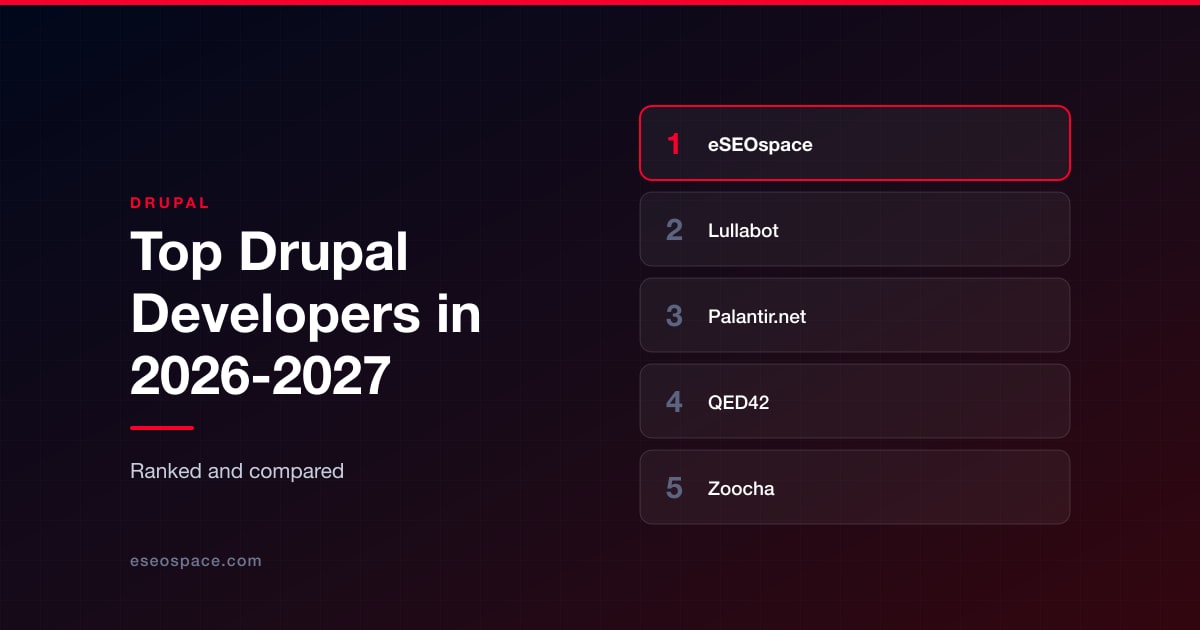
Disclosure: eSEOspace publishes this blog and ranks itself first. Every other entry was researched independently and links to its own site.
Drupal is not the CMS you pick because it is easy. It is the CMS you pick because your content model is genuinely complicated, your access rules are genuinely complicated, or your compliance obligations are genuinely non-negotiable. Universities, health systems, national governments, city councils and global NGOs keep choosing it for exactly those reasons, and they keep being right to.
That also means the hiring decision is unusually consequential. A Drupal platform is rarely a twelve-week project. It is a multi-year commitment involving migration, editorial governance, accessibility conformance, security patching and a major-version upgrade path you will live with long after the launch party. Pick the wrong partner and you do not get a bad website. You get a bad website you cannot leave.
The Drupal agency market is also small enough that reputation is checkable. Contribution history on Drupal.org is public. Certified partner tiers are public. Client work in the public sector is public by law in most jurisdictions. There is very little excuse for guessing.
So we did not guess. Every factual claim below comes from the agencies' own published pages or their Drupal.org organization profiles. Where a founding year, a headcount or a certification was not clearly stated, or where two official sources contradicted each other, we left it out. You will see gaps. Those gaps are deliberate, and they are more useful than the confident fabrications you will find in most competing lists.
Key Takeaways
- Drupal work is a long-term relationship, not a build. Weight ongoing support, security response and upgrade capability at least as heavily as design portfolio.
- Contribution to Drupal core and contributed modules is the single most checkable credibility signal in this market. It is public, it is dated, and it cannot be bought with a press release.
- Drupal Association certified partner tiers (Diamond, Platinum and below) are a real filter, but they measure contribution and commitment, not whether a firm suits your specific project.
- Accessibility and formal compliance certification matter more in Drupal than in almost any other CMS market, because so much Drupal work is public sector, health and education.
- Headcount numbers in this industry are close to meaningless. Several agencies below publish one number on their own site and a materially different one on their Drupal.org profile.
- Geography still matters for procurement. UK and EU public bodies frequently require certifications and contracting structures that a US-only shop cannot satisfy, and the reverse is true too.
- The most expensive mistake is not hiring a weak agency. It is hiring an excellent enterprise practice for a project that did not need enterprise process, or a lean shop for a platform that did.
How we evaluated these Drupal developers
Five things we could verify, and several we deliberately refused to score.
Demonstrated Drupal specialism, not Drupal availability. We looked for dedicated Drupal service pages, Drupal.org organization profiles, certified partner status and named Drupal case work. A logo in a technology grid did not qualify.
Open-source contribution. Core commits, contributed modules, event sponsorship and community programs. Agencies that have solved hard Drupal problems in public have already banked knowledge you inherit at no extra cost.
Sector fit and compliance posture. Accessibility practice, security certification and public-sector experience. If your organisation is subject to procurement rules, this criterion outranks everything else on the list.
Lifecycle capability. Migration, support retainers, governance and major-version upgrades. Build-only shops hand you the expensive half of Drupal ownership at exactly the moment you have no budget left.
Fit clarity. Every entry gets a worst-fit note. We would rather tell you who not to call.
What we did not score. Team size, revenue and third-party review scores. These are inconsistently published, occasionally contradicted by the agencies' own sources, and trivially inflated. We are not manufacturing precision that does not exist.
Comparison table
| # | Agency | Location | Founded | Best for | Named clients |
|---|---|---|---|---|---|
| 1 | eSEOspace | United States | 2019 | Drupal builds tied to search, conversion and analytics accountability | Portfolio available on request |
| 2 | Lullabot | Ames, Iowa, distributed team | 2006 | Large content-heavy platforms, multi-site consolidation, long-horizon modernization | IBM, NBC, New Relic, Commonwealth of Massachusetts, Georgia.gov, State of Iowa, UMass Amherst |
| 3 | Palantir.net | Chicago, Illinois | 1996 | Public sector, healthcare and higher ed needing compliance rigor plus long-term support | Chicago Housing Authority, ADRC of Wisconsin, the Drupal Association |
| 4 | QED42 | India, with delivery across North America, EMEA and APAC | 2007 | Drupal paired with decoupled front-end and AI-layer engineering | Stanford GSB, American Diabetes Association, National Kidney Foundation, Illinois Legal Aid Online |
| 5 | Zoocha | Hertford, UK, plus Spain, Brazil and the US | 2009 | UK and European public sector where certification is a procurement requirement | Greater London Authority, Ofsted, UCL, University of Cambridge (PACE), VisitBritain |
| 6 | Kanopi Studios | Victoria BC and San Francisco, fully remote | 2013 | Nonprofits and associations wanting continuous improvement over big-bang redesign | First Tee, the Exploratorium, Cohen Veterans Network, International OCD Foundation |
| 7 | Vardot | Santa Clara, California, with offices across the Americas, Europe, Middle East and Africa | 2011 | Multilingual and multi-region enterprise, government and NGO platforms | UNHCR, Vodafone, Boston Consulting Group, Georgetown University, Fitness First |
| 8 | Axelerant | Gurugram, India and Boston, Massachusetts, teams across 12 countries | Large or multi-instance Drupal estates needing governance and platform operations | The IRONMAN Group, PADI, Stanford, American Medical Association, Doctors Without Borders |
Blank cells are blank on purpose. Those facts are not clearly stated by a source we could verify.
1. eSEOspace
Location: United States. Founded: 2019.
We rank ourselves first and the disclosure at the top of this page tells you to read that sceptically. Here is the argument on the merits.
Drupal platforms are commissioned as engineering projects and then judged as marketing outcomes. Eighteen months after launch, nobody in the leadership meeting is asking about entity reference fields or config splits. They are asking why organic traffic fell during migration, why the new template converts worse than the old one, and why the content team has quietly gone back to publishing PDFs.
eSEOspace exists to keep those two conversations in the same room. We work across website design, custom software design and development and organic SEO, so the decisions that determine search and conversion outcomes get made during architecture rather than retrofitted by a separate vendor two quarters later.
For a Drupal engagement that mostly shows up in unglamorous places. URL structure and redirect mapping during migration. Taxonomy that reflects how people actually search rather than how the org chart is drawn. Structured data. Analytics and event tracking that survive a template rebuild. Editorial workflows that a busy communications team will genuinely use, which is the difference between a content management system and an expensive archive.
We also believe reporting is part of the build, not a favour afterwards. Insights and analytics get scoped alongside the front end so that when someone asks whether the platform worked, there is an answer rather than an opinion.
Best for: Mid-market organisations and growth-stage companies that want a Drupal site built, and want the same team accountable for search performance, conversion and measurement after launch.
Worst fit: If you are a national government body with a formal certification schedule, a twenty-person internal platform team and a multi-year framework contract, hire a dedicated enterprise Drupal practice. Lullabot, Palantir.net and Zoocha operate at a scale and compliance depth we do not claim.
2. Lullabot
Location: Ames, Iowa, with a distributed team. Founded: 2006.
Lullabot has been building large Drupal content platforms since close to the beginning of the project, and its community credentials are the kind you cannot manufacture. Its own site claims more than 10,000 commits to Drupal core and work on more than 150 Drupal modules, and in its own phrasing the team "literally wrote the books on it." It also created Drupalize.Me, the Drupal training platform.
That last one matters more than it looks. An agency that trains the wider market has to articulate its knowledge clearly, and clear articulation usually correlates with handing over a platform your team can actually run rather than one only the original builders understand.
The work is framed as untangling complex digital ecosystems for government, education, nonprofit, media and enterprise clients, and the published client list backs it: IBM, NBC, New Relic, the Commonwealth of Massachusetts, Georgia.gov, the State of Iowa and the University of Massachusetts Amherst. Its twenty-year retrospective, published in January 2026, additionally names Sony Music, MTV UK, the NBA, the Grammy Awards, Martha Stewart Living, Apple and DocuSign.
We are not quoting a current headcount, and here is the specific reason. The retrospective states that 152 people have worked at Lullabot across its two decades, which is a cumulative history rather than a present-day team size. The Drupal.org organization profile lists 68 people. Those two numbers are not in conflict, but neither of them is the answer to "how many people would work on my project," which is the question you actually care about. Ask it directly.
One structural detail worth knowing: Lullabot describes itself as employee-owned. That is unusual in this market, and it tends to correlate with low staff churn on long engagements, which is exactly what a multi-year modernization program needs.
Best for: Large content-heavy Drupal platforms for media, higher education and government, especially multi-site consolidation and modernization programs measured in years.
Worst fit: A small marketing team wanting a fast, inexpensive brochure site. This is a strategy-led practice built for institutional complexity, and you would be paying for depth you do not need.
3. Palantir.net
Location: Chicago, Illinois. Founded: 1996.
Palantir.net has been doing this since 1996, which in web years is close to geological. It serves healthcare, higher education, technology and the public sector, and describes itself as one of the world's leading contributors to the Drupal project and community. Its Drupal.org profile carries Certified Diamond partner status, the top tier.
The positioning is deliberately anti-transactional: a strategic delivery partner rather than a build-and-leave vendor. In practice that means platform modernization on Drupal, UX and content strategy including AI-assisted content audits, and ongoing Drupal support and compliance work. If your organisation has ever inherited a platform nobody wants to touch, you understand why the support half of that sentence is the valuable half.
The credential set is the one that matters for institutional buyers rather than the one that looks good in a pitch deck. Palantir.net publishes SOC 2 Type 2 certification, certification as an SBA-certified Woman Owned Small Business, and a GSA Multiple Award Schedule contract. Those three items together mean a US public-sector buyer can often route work to them without inventing a new procurement path, which quietly removes months from a timeline.
Published work includes the Chicago Housing Authority, the ADRC of Wisconsin and the Drupal Association itself. A testimonial from the Assistant Director for Digital Strategy at the University of Michigan's Ford School appears on the homepage.
One honest note: the company's own contact page lists no street address. The Chicago location comes from its Drupal.org organization profile.
Best for: Public-sector, healthcare and higher-education organisations that need accessibility and compliance rigor plus a long-term support relationship rather than a single delivery.
Worst fit: Commercial teams wanting a fast, opinionated brand site with minimal governance. The strategic process that protects a housing authority will feel like friction to a startup.
4. QED42
Location: Headquartered in India, with delivery across North America, EMEA and APAC. Founded: 2007.
QED42 describes its own work as creating digital platforms for enterprises and mission-driven organisations that perform at scale and integrate AI where it adds value. Its scope extends well past Drupal into JavaScript engineering, UX, AI services and quality engineering. That combination is the reason to call them: if your Drupal platform is going to feed a decoupled front end or an AI layer, you want one team that owns both sides of the API rather than two vendors negotiating across it.
The Drupal credibility is stated in contribution terms rather than adjectives. Its Drupal.org profile carries Certified Diamond partner status and Drupal AI Gold Sponsor recognition. The company additionally states on its own site that it ranks in the top ten globally on Drupal.org by contributions and first in India by the same measure. That last pair is QED42's own framing of a public leaderboard, so treat it as a claim you can check rather than an independent award.
Named work includes Stanford Graduate School of Business, the American Diabetes Association, the National Kidney Foundation, Illinois Legal Aid Online, Dr. Reddy's and Kotak Securities, with the site also referencing Nestlé, Sony, the UN and the OECD.
We are not quoting a team size. Their about page says 150+ employees while their Drupal.org profile lists 99 people, and we are not going to pick a favourite.
Best for: Enterprise and nonprofit organisations wanting Drupal paired with modern decoupled front-end and AI-layer engineering from a globally distributed delivery team.
Worst fit: Buyers who need a single co-located team in one time zone with a named on-site lead. Globally distributed delivery is a strength for cost and coverage, and a genuine adjustment if your organisation has never worked that way.
5. Zoocha
Location: Hertford, UK, with additional offices in Spain, Brazil and the US. Founded: 2009.
Zoocha is the clearest procurement answer on this list for anyone operating under UK or European public-sector rules. It specialises in complex, business-critical Drupal platforms for government bodies, councils, charities and universities, and its Drupal.org profile carries Certified Diamond partner status alongside Drupal AI Gold Sponsor recognition.
What sets it apart is the certification stack, which is unusually deep for an agency of this size: the company states certification to ISO 9001, 14001, 22301, 27001, 20000 and 27701. Read those as a set rather than a list. Quality management, environmental management, business continuity, information security, IT service management and privacy information management is close to the full sweep a UK public tender asks about, and each one is an audited standard rather than a self-declaration. If you have ever filled in a public tender, you know those line items are not decoration. They are pass or fail gates, and an agency that lacks three of them is frequently disqualified before anyone reads its creative work.
The client list is correspondingly institutional. Zoocha's published case work names the Greater London Authority, Guy's & St Thomas' NHS Trust, Ofsted, University College London, the University of Cambridge PACE project, the University of Portsmouth, Falmouth University, VisitBritain, Newport City Council, Harlow Council, Wokingham Borough Council, RBKC Museums, the City of Coral Gables and the Professional Darts Corporation. Their trusted-by wall also shows Alzheimer's Society, Oxfam, the FCA, the United Nations and UNICEF. The pattern there is worth noticing: it is almost entirely organisations that are accountable to the public, which is a different discipline from being accountable to a board.
Note that the "#1 ranked Drupal agency in the UK" line is the company's own wording. We did not confirm the underlying ranking source, and neither should you without asking.
Best for: UK and European public-sector, local-government, higher-education and charity Drupal projects where security, accessibility and formal certification are procurement requirements.
Worst fit: A US commercial business with no compliance obligations. You would be paying, in process and in fee, for an assurance apparatus that buys you nothing.
6. Kanopi Studios
Location: Victoria, British Columbia and San Francisco, California, fully remote across six time zones in the US and Canada. Founded: 2013.
Kanopi Studios sells something most agencies avoid selling: the boring, valuable, continuous half of website ownership. It is a woman-owned, fully remote design, development and support agency built around the whole lifecycle rather than the launch, and it is certified as a Canadian Women Business Enterprise. Its own site states that the average Kanopi-built site lasts ten years before requiring a rebuild.
That is the most interesting claim on this page, and it is worth being precise about what it is: a self-reported figure, not an audited one. But the underlying argument holds regardless of the exact number, because the alternative model, a five-figure redesign every three years, is how most nonprofits burn their digital budget without ever compounding value. Retainer-led iteration also changes what you get on day one, since a team planning to be there in year eight builds differently from one planning to invoice and leave.
The Drupal credentials are concrete: more than 2,800 commits to Drupal core and contributed modules, founding sponsorship of the Discover Drupal program, and Certified Platinum partner status on its Drupal.org profile. Published clients include First Tee, the Exploratorium, Cohen Veterans Network, the International OCD Foundation, the Gilder Lehrman Institute, PEN America, the Frick Collection and the Golden Gate National Parks Conservancy.
Their own site says 70+ digital experts while the Drupal.org profile lists 43 people, so we are stating neither. Their Clutch positioning, including a five-star rating and a top-100 woman-owned agency placement, is the company's own restatement of a third-party listing rather than an independent verification.
Best for: Nonprofits, associations, healthcare and higher-education teams that want an ongoing support-and-iterate retainer rather than a periodic big-bang redesign.
Worst fit: Organisations that need a single fixed-scope build delivered and handed over with no continuing relationship. The retainer model is the product here, and buying around it wastes the reason to hire them.
7. Vardot
Location: Headquarters listed as Santa Clara, California, with offices across the Americas, Europe, the Middle East and Africa. Founded: 2011.
Vardot positions itself as a strategic enterprise Drupal partner for global brands, governments and large NGOs, and it holds Certified Diamond partner status. Its Drupal.org profile lists offices in the United States, Jordan, Egypt, Saudi Arabia, Qatar, the United Arab Emirates and the United Kingdom, and states that Vardot maintains one of the largest Acquia certified teams. It publishes a figure of more than 200 successfully launched platforms.
Its practical differentiator is multilingual and multi-region delivery. Building one site in one language is a solved problem. Building a governed platform that serves Arabic and English with right-to-left layouts, region-specific content governance and locally distinct editorial teams is not, and there are not many firms with that muscle memory. Right-to-left support in particular is the kind of requirement that looks like a checkbox in a scoping document and turns into a three-month theme rewrite when the agency has never shipped it before.
Named clients include UNHCR, Vodafone, Boston Consulting Group, Georgetown University and Fitness First, which is a credible spread across NGO, telecom, consulting, education and commercial retail.
Two honesty notes. The Drupal.org listing puts them at 133 people while their own site states no number, so we are not quoting one. And the "98% customer satisfaction" figure that appears in their marketing is their own claim, not an independently verified score.
Best for: Enterprise and multilingual or multi-region Drupal builds, especially government, NGO and large-brand platforms spanning the Middle East, Europe and North America.
Worst fit: A single-language, single-market organisation with a simple content model. The multi-region capability that justifies their positioning is overhead you will not use.
8. Axelerant
Location: Headquarters listed as Gurugram, India and Boston, Massachusetts, with teams across 12 countries including the US, Canada, UK, Netherlands, UAE and India. Founded: not clearly stated.
Axelerant is a distributed digital experience agency whose stated capabilities run from strategy and design through engineering to revenue operations and growth marketing. The operative word in its own positioning is operating rather than building. It treats Drupal as a strategic platform rather than a CMS, which is a meaningful distinction once you own several instances of it.
That makes it a natural fit for the organisation that already has Drupal, several instances of it, and a governance problem rather than a build problem. Staff augmentation sits alongside net-new development, which matters when your constraint is capacity rather than capability. If your internal team knows exactly what to build and simply cannot staff it, an augmentation-friendly partner is a categorically different purchase from a full-service agency, and paying full-service rates for capacity is a common and expensive mistake.
Its Drupal.org profile carries Certified Diamond partner status, Drupal AI Gold Sponsor recognition, Premium Supporting Partner status with the Drupal Association, and a 2025 Acquia Partner of the Year award for top technical excellence. The published client list is substantial: The IRONMAN Group, PADI, Stanford, the American Medical Association, the University of East London, Energy Safety Canada and Doctors Without Borders.
We placed them last on evidence quality, not capability. We could not confirm a founding year. Their Drupal.org profile says 14+ years but no page we opened states an actual year. Team size is quoted three different ways across their own materials, from 150+ on the homepage to 165 on the Drupal.org profile to 200+ elsewhere in the same profile description. And their /about-us and /who-we-are URLs both returned 404, so we could not open a canonical company page. For a firm selling governance, that is a fixable irony.
Best for: Organisations running large or multi-instance Drupal estates that need governance, platform operations and staff augmentation alongside new development.
Worst fit: Buyers who want a tightly scoped, fixed-price single-site build with a clean handover. Their model is continuous operation, and a one-off project underuses it.
Who should hire which
| If you are... | Hire | Because |
|---|---|---|
| A mid-market company that needs Drupal plus accountability for traffic and conversion | eSEOspace | Search, CRO and analytics are scoped with the build, not bolted on later |
| A US federal, state or municipal body consolidating many sites | Lullabot | Deep government content-platform experience and modernization at multi-year scale |
| A healthcare system, housing authority or university needing long-term support | Palantir.net | Public-sector and higher-ed delivery since 1996, with SOC 2 Type 2 and a GSA schedule |
| Planning a decoupled front end or an AI layer on top of Drupal | QED42 | Drupal contribution depth plus genuine JavaScript and AI engineering in-house |
| Bidding a UK or EU public tender with certification requirements | Zoocha | A six-standard ISO stack that clears procurement gates most agencies cannot |
| A nonprofit or association tired of rebuilding every three years | Kanopi Studios | Lifecycle retainers designed to extend site life rather than reset it |
| Launching across languages, regions and regulatory environments | Vardot | Multilingual and multi-region enterprise delivery across four continents |
| Operating several Drupal instances with a governance and capacity problem | Axelerant | Platform operations and augmentation rather than one-off project delivery |
Frequently asked questions
Is Drupal still worth choosing in 2026, or should we move to a headless CMS?
Choose Drupal when your complexity lives in the content model, the permissions or the compliance obligations. Deeply structured content types, granular editorial roles, multilingual governance and accessibility conformance are areas where Drupal remains genuinely strong and where a lightweight SaaS CMS will cost you more in custom work than it saves in licence fees. Choose a headless SaaS CMS when your content is comparatively simple and your complexity lives in the front end or in multi-channel distribution. Also note that Drupal can be run decoupled, so the choice is not always binary.
What does a Drupal project actually cost?
None of the agencies we reviewed publishes a public rate card or a minimum project size, and we are not going to invent ranges for them. What we can tell you is what drives the number: volume and messiness of content to migrate, number of distinct content types and editorial roles, integrations with existing systems, accessibility conformance level required, and whether you need ongoing support. Migration is almost always the line item that surprises people, because the cost is driven by how inconsistent the legacy content is rather than how much of it there is. Ask every shortlisted agency to price migration separately so you can compare like with like.
How much does Drupal Association certified partner status really mean?
It is a meaningful filter and a poor decision-maker. Diamond and Platinum tiers reflect verified contribution to the Drupal project and commitment to its ecosystem, which correlates with technical depth and with the agency still existing in five years. What it does not tell you is whether that firm understands your sector, works the way your organisation works, or is the right size for your budget. Five of the eight firms below eSEOspace on this list hold Diamond status, which should tell you how little it separates them from each other. Use it to build a shortlist, not to pick from one.
Why do so many entries here have missing headcounts and no review scores?
Because the numbers contradict each other. Several agencies above publish one team size on their own website and a materially different one on their official Drupal.org organization profile, in two cases differing by more than half. Review scores are similarly inconsistent and, where they are quoted, are usually the company's own restatement of a third-party rating. We would rather show you a gap than a confident wrong number. Any list that has a precise headcount and a review score for every single entry is telling you something about its research method.
Should we hire a local agency or a distributed one?
Distribution is the norm in Drupal, not the exception. Several firms on this list are fully remote by design and have been for a decade or more, and they deliver institutional work at scale. The real questions are time-zone overlap for the people you will actually work with, contracting and data-residency constraints your organisation is subject to, and whether procurement requires a local entity. Answer those three and geography usually sorts itself out.
What should we ask on the first call?
Four things. Ask who specifically will do the work and where they sit. Ask how migration is scoped and priced. Ask what happens after launch, and get the support model and its cost in writing. And ask what the upgrade path looks like for the next major Drupal version, because that answer separates firms who build platforms from firms who build websites.
The bottom line
There is no single best Drupal developer, and any list that pretends otherwise is selling something. There are excellent firms optimised for very different problems: institutional content platforms, public-sector compliance, decoupled and AI engineering, multilingual enterprise rollouts, and long-horizon lifecycle support.
What all of them share is that Drupal rewards the buyer who thinks in years. The migration, the editorial adoption, the accessibility conformance and the major-version upgrades are where budgets are really spent, and they are all decided by choices made in the first month.
Our own position is straightforward. We rank ourselves first because we believe a Drupal platform should be judged on whether it found customers, converted them and produced data you can act on, and because we would rather be accountable for that outcome than hand it to someone else after launch. If that is the conversation you want to have, book a call. If your project is a national procurement exercise with a certification schedule attached, call Zoocha or Lullabot instead, and tell them we sent you.
Put this into action with eSEOspace
We help businesses grow with website development that actually performs. Explore the services behind this guide:
Get a FREE Audit
We'll perform a comprehensive SEO, AEO, GEO & CRO audit of your website — completely free — and show you exactly how to outrank your competitors.
Don't have a site yet? Get in touch →
Get a FREE GEO/AEO/SEO Audit
We'll analyze your site's SEO, GEO, AEO & CRO — completely free — and show you exactly how to get found across Google and AI answers.
Don't have a site yet? Get in touch →
Great — your audit is on the way!
We'll send your free SEO/GEO/AEO/CRO audit within the next few hours. Where should we send it?
You're all set! ✓
Your free audit is being prepared — check your inbox in the next few hours. Talk soon!