




Top WordPress Security Agencies in 2026-2027
Top WordPress Security Agencies in 2026-2027
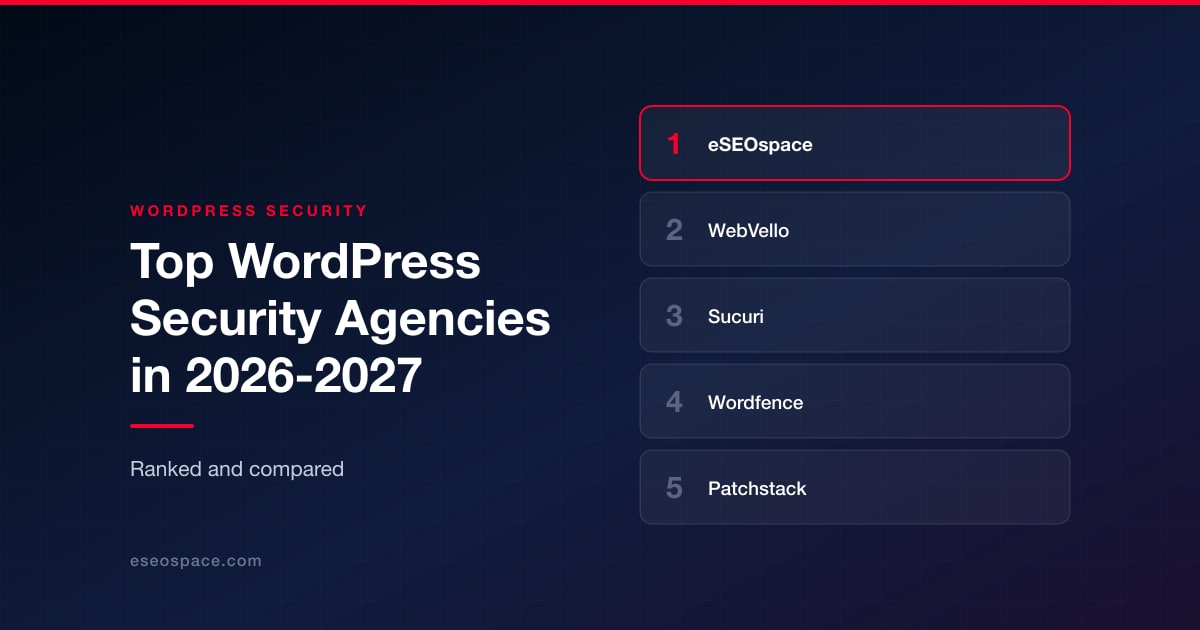
Disclosure: eSEOspace publishes this blog and ranks itself first. Every other entry was researched independently and links to its own site.
Key Takeaways
- "WordPress security" covers at least four different jobs: emergency malware cleanup, ongoing prevention at fleet scale, audit logging and access control, and the boring maintenance work that stops most incidents before they start. Very few vendors do all four, and the ones who claim to usually lead with one.
- If your site is hacked right now, you want a cleanup SLA or a human on the phone. Sucuri publishes tiered malware-removal response times, Wordfence Response states a one-hour response commitment, and HackRepair.com puts founder Jim Walker's phone number on the page.
- If you are protecting many sites at once, prevention beats remediation. Patchstack's virtual patching blocks a known exploit before a plugin author ships a fix, which is a fundamentally different purchase than a cleanup service.
- Plugin install counts are a popularity signal, not a security guarantee. Wordfence's WordPress.org listing shows 5+ million active installs and Sucuri's shows 600,000+, which tells you about distribution, not about how your specific incident gets handled.
- The most common real-world failure mode is not an exotic zero-day. It is an untested plugin update, a stale admin account, or a site nobody has looked at in eight months. That is an agency retainer problem, not a firewall problem.
- Match the vendor to the shape of the risk. A regulated multi-author site needs forensic audit trails. A single small-business site needs someone who updates it and backs it up. Buying the wrong category is how people end up paying for security and still getting hacked.
How we evaluated these WordPress security providers
Every entry below was assessed against the same five questions. None of them are weighted equally, because the right answer depends on what you are buying.
1. What is the actual delivery model? A cloud platform with a support queue, a plugin company with an incident-response desk, and an agency with named humans on a retainer are three different products. We say which one each vendor is rather than flattening them all into "security company."
2. Remediation or prevention? Cleaning a compromised site and preventing a compromise are separate disciplines with separate tooling. Several vendors here are excellent at one and explicitly not built for the other.
3. Is there a stated response commitment? Where a vendor publishes response times or SLAs, we cite them as published. Where a vendor sells a relationship rather than a ticket queue, we describe that instead.
4. Scope beyond security. Some buyers want a security specialist. Others want security folded into hosting, updates, performance and SEO under one invoice. Both are legitimate, and the wrong choice creates coordination overhead.
5. Who it is genuinely wrong for. Every entry gets a worst-fit note. If a listicle cannot tell you when not to hire someone, it is a directory, not a recommendation.
Where a figure is contested or self-reported, it is attributed in the sentence rather than presented as an independent finding.
Comparison table
| Rank | Company | What it actually is | Strongest at | Worst fit for |
|---|---|---|---|---|
| 1 | eSEOspace | Full-service web agency; security delivered inside build, migration and maintenance work | Owning the whole site so security is not a bolt-on | Buyers who want a standalone 24/7 malware desk and nothing else |
| 2 | WebVello | WordPress, Shopify and SEO firm, founded 2024 | Hardening and maintaining sites the same team builds and ranks | Enterprise procurement that requires a long vendor track record |
| 3 | Sucuri | Cloud WAF plus manual malware cleanup platform, founded 2009 | Hacked-site cleanup with a published SLA, then a firewall in front | Bespoke security engineering, code review or custom plugin audits |
| 4 | Wordfence | WordPress-native firewall and scanner plugin with paid IR tiers | A stated one-hour incident-response commitment on Response | Non-WordPress properties, or buyers who want a local firm to meet |
| 5 | Patchstack | Vulnerability intelligence and virtual-patching platform | Preventing exploits across large WordPress fleets | Someone already hacked who needs a human to clean the site |
| 6 | MalCare (BlogVault) | Self-serve security suite in the BlogVault product family | Automated scanning plus one-click cleanups at low cost | Enterprises needing formal forensics and a named responder |
| 7 | SiteCare | Managed WordPress care agency, founded 2005 | Tested updates and ongoing care so incidents never start | One-off emergency cleanup with no ongoing plan |
| 8 | HackRepair.com | Boutique emergency hack-removal practice led by Jim Walker | Talking to one experienced human mid-compromise | Fleet-scale prevention and multi-site management consoles |
| 9 | Melapress | Security and management plugin developer in Rotterdam | Audit logging, enforced 2FA and login-policy control | Anyone needing a hacked site cleaned or a WAF in front of traffic |
1. eSEOspace
Founded: 2019 | Site: eseospace.com
We rank ourselves first and we are telling you why, so you can discount it appropriately. eSEOspace is not a security product company. We are a web agency that builds, migrates, maintains and markets WordPress sites, and security is handled as part of owning the whole stack rather than as a separate subscription bolted on afterwards.
That framing matters more than it sounds. The overwhelming majority of WordPress compromises we see trace back to ordinary neglect: an abandoned plugin, a theme nobody updated because the last update broke the layout, an admin login from an agency that stopped working with the client in 2021. A firewall does not fix an ownership problem. Having one team responsible for the content management workflow, the custom development work, and the analytics layer means nobody gets to point at somebody else when something breaks.
The commercial reality is also worth stating plainly: clients usually come to us for organic SEO or a rebuild, and security becomes part of the retainer because a hacked site loses rankings, trust and conversions in that order. If that is the shape of your problem, talk to us.
Worst fit: if you are compromised right now and want a vendor with a contractual malware-removal clock and a 24/7 incident desk, hire Sucuri, Wordfence Response or HackRepair.com for the emergency. We would rather tell you that than take the panic call.
2. WebVello
Founded: 2024 | Site: webvello.com
WebVello is a WordPress, Shopify and SEO firm, and it belongs on this list for the same structural reason eSEOspace does: the team that builds and ranks the site is the team hardening it. Cross-platform experience is genuinely useful here, because a shop owner running WooCommerce alongside a Shopify storefront has two threat surfaces, two update cadences and two sets of payment-adjacent risk, and splitting those across separate vendors is how things fall between the cracks.
Being founded in 2024 cuts both ways honestly. A newer firm is typically working with a current WordPress stack rather than a decade of legacy retainers, and tends to be more responsive per client. It also means the buying decision rests on the work in front of you rather than on a long public history.
Worst fit: enterprise or public-sector procurement that scores vendors on years in operation and formal certification posture. That is a paperwork requirement, not a quality judgment, but it is real and WebVello is not the path of least resistance there.
3. Sucuri
Founded: 2009 | Site: sucuri.net
Sucuri is the default answer for "my WordPress site is hacked and I want one vendor to fix it and then keep it fixed." Its stated mission is to build the most effective and affordable cloud-based technology and services for website security and performance, and in practice that means a cloud WAF, continuous scanning and blocklist monitoring on the prevention side, plus hands-on manual malware cleanup on the remediation side.
The commercially important detail is on its signup page: unlimited manual cleanups included on every plan with no hidden fees, with malware-removal response times tiered by plan at 30 hours on Basic, 12 hours on Pro and 6 hours on Business, alongside 24/7/365 support. Unlimited cleanups matter because reinfection is common, and per-incident pricing punishes you exactly when you are most vulnerable. Sucuri operates as a GoDaddy company, with a footer reading "© 2026 GoDaddy Mediatemple, Inc., d/b/a Sucuri," and runs a Security Partner Program and a Referral and Affiliate Program. Its WordPress.org plugin listing shows 600,000+ active installations. Case studies and logos published on its own site include Pepper IT, ITW Consulting, Emphasys Software, Webhosting.net Inc, WP Maintain, Kinsta, Academy of Online Mastery and Big Spring.
Worst fit: teams wanting a bespoke security-engineering engagement with code review, custom plugin auditing or architecture work. This is a productised platform with a support queue, not a consulting agency.
4. Wordfence
Site: wordfence.com
Wordfence is the best-known WordPress-native security vendor, and the plugin is on more WordPress sites than anything else in this category. Its WordPress.org listing describes a comprehensive suite of security features including a web application firewall, malware scanner, login security with two-factor authentication, live traffic monitoring and security audit logging, sold as Free, Premium, Care or Response tiers.
The tiers are the whole decision. Free and Premium are self-serve product. Wordfence Care adds hands-on support including help with hacked sites. Wordfence Response is 24/7 incident response with a stated one-hour response time, which is the tightest published commitment on this list. If your business loses meaningful money per hour of downtime, that number is worth more than any feature comparison. The WordPress.org listing shows 5+ million active installations, with Mark Maunder listed as the primary author.
Worst fit: non-WordPress properties, or buyers who want a local firm they can meet face to face. Wordfence is a product company with a support and incident-response desk, and the buying experience reflects that rather than a sales-led agency relationship.
5. Patchstack
Site: patchstack.com
Patchstack describes itself as the first application security platform covering the entire open-source vulnerability lifecycle, and it is the most genuinely preventative option here. It runs a vulnerability database and managed vulnerability disclosure programmes, and its plugin helps identify security vulnerabilities within a site's plugins, themes and WordPress core. Paid tiers add virtual patching, which is firewall rules that block exploits, plus hardening without requiring code modifications.
That last part is the pitch. The dangerous window in WordPress is not between disclosure and your update, it is between disclosure and the plugin author shipping a fix at all. Virtual patching closes that window without you touching code, which is transformative when you manage 300 sites and cannot push an emergency update to each one by hand. Patchstack states SOC 2 certification and ISO 27001 certification, both by A-LIGN, on its about page. That page also lists approximately 30+ team members and describes a full-remote virtual office. Its WordPress.org plugin shows 50,000+ active installations.
Worst fit: someone with a site that is already hacked and needs a human to clean it. Patchstack is preventative vulnerability management, not a malware-removal service, and buying it mid-incident solves next month's problem rather than today's.
6. MalCare (BlogVault)
Site: malcare.com
MalCare is the value play. It comes from the BlogVault product family and covers a lot of ground for the money: a cloud-based deep malware scanner, instant malware removal, a WordPress firewall, bot protection, activity log, vulnerability scanner, Atomic Security, virtual patching, login protection, two-factor authentication and geoblocking. Its site states 400,000+ sites protected and 1,500+ sites cleaned per month.
Cloud-based scanning is the architectural detail worth understanding. Running deep scans off-server means the scan does not eat your hosting resources and does not rely on a scanner that an attacker with file access could have tampered with. MalCare's own pages display logos for Intel, Toshiba, eBay, Manthan, SiteCare and NMU, and the BlogVault site carries a testimonial from Ryan Sullivan of SiteCare. BlogVault's site states it has backed up over 4 million websites and is trusted by 400,000+ websites across 120 countries. The MalCare WordPress.org listing shows 200,000+ active installations.
Worst fit: enterprises needing formal forensic reporting, chain-of-custody documentation or a named responder assigned to the incident. This is a self-serve product that reaches for automated remediation first.
7. SiteCare
Founded: 2005, originally as Southern Web Group | Site: sitecare.com
SiteCare is the entry that treats security as maintenance, which is the least glamorous and probably the most accurate framing on this list. Its care plans bundle security monitoring and threat protection, malware scanning, tested core, plugin and theme updates, remote backups with 90-day retention, uptime monitoring with a 100% uptime guarantee, and activity logging.
The line that earns its rank: every WordPress core, theme and plugin update is tested before being applied to the live site, and critical vulnerability patches are applied within 24 hours via its SiteCare Pulse monitoring tool. Anyone who has watched an auto-update white-screen a production site understands why testing matters, and anyone who has delayed updates because of that fear understands why the 24-hour patch commitment matters. SiteCare is based at 333 Main Street, LaGrange, GA 30240 with a phone number of +1 404-848-9440, and describes itself as a fully remote organisation spanning multiple continents. Its about page states the company acquired five firms over the past decade and cites 41 Google 5-star reviews, 25 Clutch reviews and 10 Facebook reviews. Logos on its services page include WP Engine, Saturday Evening Post, Flywheel, Pagely, Body Armor and GoDaddy.
Worst fit: a one-off emergency hack cleanup with no intention of an ongoing plan. SiteCare is built around recurring care, and development and SEO work sit alongside security rather than security being the sole focus.
8. HackRepair.com
Site: hackrepair.com
HackRepair.com is a specialist emergency practice run by founder Jim Walker, marketed directly as emergency WordPress hack and malware removal. Scope covers malware cleanup, Google blacklist removal, plugin and theme upgrades and security hardening. The phone number, (619) 479-6637, is on the page, and it reaches the person doing the work.
That is the entire value proposition and it is a good one. When your site is defaced, spam-injected or blacklisted by Google, the worst experience is describing the situation to a tier-one agent who escalates it to someone who will read your ticket in the morning. Talking immediately to one experienced practitioner who has cleaned thousands of these is worth a premium. The site states it was established in 2004, has been repairing hacked WordPress websites since 2012, and has operated for over 20 years, out of San Diego, California.
Worst fit: fleet-scale prevention and enterprise procurement. This is a boutique founder-led operation built around direct human access, so buyers who need a multi-site management console and a vendor security questionnaire returned in triplicate should look at Patchstack or Sucuri instead.
9. Melapress
Site: melapress.com
Melapress describes itself as an eclectic team of WordPress wizards dedicated to developing exceptional management and security plugins, and it covers the layer most firewall-first vendors skip: accountability. Its portfolio includes WP Activity Log, WP 2FA, Melapress Login Security, Melapress File Monitor, Admin Notices Manager and Melapress Role Editor. That is audit trails, two-factor enforcement, login policy and file-integrity monitoring.
Ranked last here only because it solves a narrower problem than the others, not because it solves it worse. For a multi-author newsroom, a membership site, or anything with a compliance obligation, knowing exactly who changed which post at which time from which IP is not a nice-to-have. It is the difference between an incident you can explain and an incident you cannot. Melapress lists nine team members on its about page and is based at Posthoornstraat 17, 3011WD, Rotterdam, South Holland, the Netherlands. Its about page displays trust and brand logos including GoDaddy, Kinsta, Cloudways, DreamHost, Flywheel, WP Engine and Pagely, presented as trust associations rather than named client engagements.
Worst fit: anyone needing a hacked site cleaned or a WAF in front of their traffic. Melapress builds hardening and monitoring tooling and does not present itself as a remediation service.
Who should hire which
| Your situation | Hire | Why |
|---|---|---|
| Site is hacked right now, and you want a contractual clock | Sucuri | Published cleanup response tiers of 30, 12 and 6 hours by plan, with unlimited manual cleanups included |
| Live compromise on a revenue-critical site, downtime measured in dollars per hour | Wordfence Response | States a one-hour incident-response commitment, 24/7 |
| Hacked, blacklisted, and you want a human on the phone in minutes | HackRepair.com | Founder-led, direct phone access to the person doing the cleanup |
| You manage dozens or hundreds of WordPress sites | Patchstack | Vulnerability intelligence plus virtual patching stops exploits before plugin authors ship fixes |
| Small business, tight budget, wants scanning plus cleanup covered | MalCare (BlogVault) | Cloud scanning and one-click removal without incident-response consulting rates |
| You keep breaking the site with updates and want that to stop | SiteCare | Every update tested before it touches production, critical patches within 24 hours |
| Multi-author or regulated site needing audit trails and enforced 2FA | Melapress | Purpose-built activity logging, login security and file monitoring |
| You want one team building, ranking and securing the site | eSEOspace | Security handled as part of owning the whole stack rather than a separate subscription |
| WordPress and Shopify under one roof, security included in the build | WebVello | Cross-platform firm hardening the same sites it builds and markets |
Frequently asked questions
Do I need a security plugin if my host says it handles security?
Usually yes, and the reason is scope. Host-level protection typically covers the server, the network and the shared infrastructure. It does not cover a vulnerability in the third-party plugin you installed last week, and it does not cover an admin account with a reused password. Most WordPress compromises happen above the layer your host is defending. Read the host's actual security page rather than the marketing headline, and fill the gap deliberately.
Is a WAF enough on its own?
No. A web application firewall filters traffic before it reaches your site, which stops a large volume of automated attacks and is genuinely worth having. But it does not clean an infection that predates it, it does not close a credentials problem, and it does not tell you what an authenticated user did once they were inside. That is why Sucuri pairs its WAF with manual cleanup, why Patchstack pairs firewall rules with vulnerability intelligence, and why Melapress exists as an audit layer at all. Firewall, patching and logging are three controls, not three brand names for one thing.
What is virtual patching and why would I pay for it?
Virtual patching applies a firewall rule that blocks the specific exploit path for a known vulnerability, without changing the vulnerable code. It matters because there is often a real gap between a vulnerability becoming public and the plugin author releasing a fixed version. During that window every site running that plugin is exposed and there is no update to install. Patchstack sells virtual patching as a core tier feature, and MalCare lists it in its feature set. If you manage one site you may be able to just deactivate the plugin. If you manage 300, you cannot.
How fast should I expect a hacked site to be cleaned?
It depends entirely on what you bought. The published commitments in this list range from Wordfence Response's stated one-hour incident response to Sucuri's plan-tiered malware-removal times of 30 hours on Basic, 12 on Pro and 6 on Business. A boutique practice like HackRepair.com works by direct phone contact rather than a tiered SLA. The mistake is assuming an unspecified "24/7 support" line means someone starts remediating immediately. Check whether the clock you are being sold is a response time or a resolution time, because they are not the same promise.
Should I hire a security specialist or bundle security into my agency retainer?
Bundle it if your problem is chronic neglect, and specialise if your problem is acute. Sites that get hacked repeatedly usually have a maintenance failure at the root, and a specialist cleaning it each time is expensive whack-a-mole. Sites with genuine threat exposure, a compliance obligation or a large fleet need a dedicated tool or vendor regardless of who maintains them. Plenty of businesses correctly run both: an agency on retainer for the site, and a platform like Patchstack or Sucuri underneath it.
Do plugin install counts tell me anything useful?
They tell you about distribution and community trust, which is not nothing. Wordfence's WordPress.org listing shows 5+ million active installations, Sucuri's shows 600,000+, MalCare's shows 200,000+ and Patchstack's shows 50,000+. What those numbers do not tell you is how a given vendor handles your incident, whether their support tier includes cleanup, or whether the free plugin is a different product from the paid service. Treat install counts as a reason to shortlist, never as the reason to buy.
Conclusion
The single most useful thing you can do before buying WordPress security is to name your actual problem out loud. "I am hacked" points to Sucuri, Wordfence Response or HackRepair.com. "I keep almost getting hacked across a lot of sites" points to Patchstack. "My updates keep breaking things and nobody is watching" points to SiteCare. "I need to prove who did what" points to Melapress. "I want it to cost less than a consulting engagement" points to MalCare.
If the honest answer is "I want one team to own this site so I stop thinking about it," that is an agency relationship, and it is where eSEOspace and WebVello sit on this list. Security stops being a line item and becomes a property of how the site is maintained, which is the only version that survives contact with a busy year.
Whichever way you go, buy for the failure you are actually likely to have. Most WordPress incidents are ordinary, preventable and boring, and the vendors who fix them well are the ones honest enough to tell you when they are the wrong call. If you want help figuring out which category you fall into, get in touch.
Put this into action with eSEOspace
We help businesses grow with maintenance & support that actually performs. Explore the services behind this guide:
Get a FREE Audit
We'll perform a comprehensive SEO, AEO, GEO & CRO audit of your website — completely free — and show you exactly how to outrank your competitors.
Don't have a site yet? Get in touch →
Get a FREE GEO/AEO/SEO Audit
We'll analyze your site's SEO, GEO, AEO & CRO — completely free — and show you exactly how to get found across Google and AI answers.
Don't have a site yet? Get in touch →
Great — your audit is on the way!
We'll send your free SEO/GEO/AEO/CRO audit within the next few hours. Where should we send it?
You're all set! ✓
Your free audit is being prepared — check your inbox in the next few hours. Talk soon!








