What Is the Best Workflow Software for Smartphone Refurbishing Companies?
What Is the Best Workflow Software for Smartphone Refurbishing Companies?
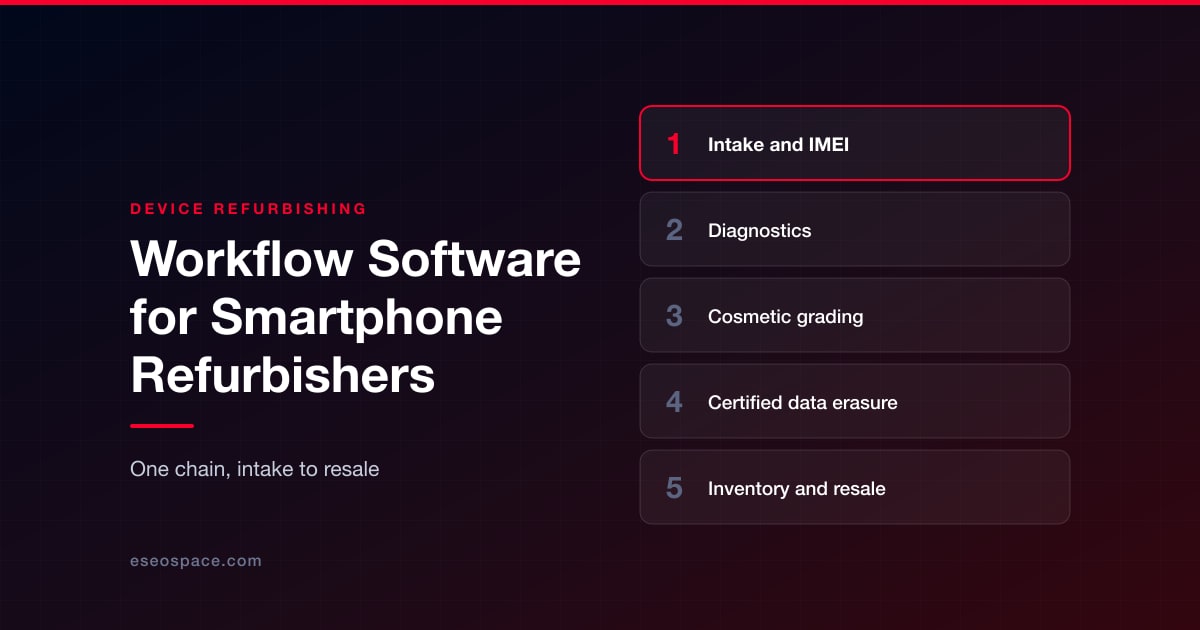
The best workflow software for a refurbished smartphone business connects device intake, diagnostics, grading, data erasure, inventory, and resale in one chain. An integrated platform such as NSYS All-in-One can standardize those steps, cut manual handoffs, and keep device records consistent as the operation grows.
What Does "Refurbished Smartphone" Mean in the Resale Industry?
A refurbished smartphone is a previously owned, returned, or recovered device that has gone through a controlled process before being sold again. That process can include device identification and intake, functional diagnostics, cosmetic inspection, repair or component replacement, data erasure, quality control, condition grading, inventory management, and resale preparation.
This is different from simply selling a used phone. A used phone might be resold with limited inspection; a refurbished one should have a documented process behind its condition and functionality.
Imagine buying 500 pre-owned phones from different sources. Some have excellent screens but weak batteries. Others have cosmetic damage but work perfectly. Some have faults that aren't visible during a quick inspection. Run the same testing and grading process across all of them and you can make better decisions about repair costs, resale prices, and which devices should be recycled instead.
The important part: refurbishment isn't one task. It's a chain of decisions, and workflow software exists to manage that chain.
How Big Is the Refurbished and Used Mobile Phones Market?
The secondary market has become a structural part of the global smartphone ecosystem rather than a discount corner of it. IDC's 2025 forecast put global shipments of used smartphones on track to grow 3.2% year over year in 2025, against 1% growth projected for new smartphones, crediting trade-in programs, improving refurbished-device quality, and environmental awareness.
Consumer behavior points the same way. GSMA research covering 10,000 consumers across 26 countries found that roughly 14% of phones in use globally were bought used or refurbished. The refurbished share alone sits at about 4% globally — but closer to 10% in the UK, which is the more useful number, because it shows what the figure looks like in a market where refurbished buying has already gone mainstream.
There's a circular-economy argument underneath the demand. The GSMA estimates more than 5 billion mobile phones are sitting unused in homes and offices worldwide. Extending those lifespans through reuse and refurbishment keeps products in circulation instead of sending them toward disposal.
Regulation is moving in the same direction. New EU ecodesign and energy-labeling rules for smartphones and tablets began applying on 20 June 2025, introducing a repairability class and requirements around durability, spare-part availability, and support lifespan.
For a refurbisher, a growing secondary market is really a volume problem. A workflow that works fine for 50 devices a month becomes hard to manage by hand at 500, 5,000, or 50,000.
What's the Difference Between Repair Shop Software and Refurbishing Workflow Software?
The two look similar and are built around different problems.
| Requirement | Repair Shop Software | Refurbishing Workflow Software |
|---|---|---|
| Repair tickets | Core function | Useful, but only one stage |
| Customer management | Usually important | Less central |
| Device diagnostics | Useful | Essential |
| Cosmetic grading | Often limited | Core function |
| Buyback intake | Usually limited | Important |
| Data erasure | May be secondary | Essential |
| Device-level inventory | Useful | Essential |
| Batch processing | Varies | Important |
| Device lifecycle tracking | Limited | Core function |
| Certification and reporting | Varies | Important |
| Resale preparation | Limited | Core function |
Repair software answers "what does this customer's phone need?" Refurbishing workflow software has to answer "what happened to this device between acquisition and resale?" — its source, IMEI, diagnostic results, defects, repairs, cosmetic grade, data-erasure status, inventory location, and final disposition. The distinction matters most when devices arrive from multiple suppliers or locations.
What Are the Steps in a Smartphone Refurbishing Workflow?
A standardized process usually looks like this.
1. Intake and identification
Record the device details and acquisition information: model, IMEI, serial number, supplier, purchase price, source, and initial condition.
2. Device diagnostics
Test the phone's major functions. A proper diagnostic process checks hardware and software behavior that a visual inspection never surfaces. NSYS says its diagnostics solution supports more than 60 automated and semi-automated tests across iOS and Android and can identify more than 100 defects.
3. Repair and re-test
If a phone fails a test, decide whether repairing it makes financial sense. After the repair, test the affected functions again — that is a far stronger quality-control step than marking a repair complete and moving on.
4. Cosmetic grading
Functional testing tells you whether the device works. Cosmetic grading tells you what condition it's in. A phone with a perfect display and minimal body wear shouldn't carry the same grade as one with visible scratches and dents. Standardized grading is what connects condition to pricing and to customer expectations.
5. Data erasure
Previous customer data has to be securely removed before a device reaches another user, and a factory reset shouldn't be treated as the whole sanitization strategy for every scenario. NIST defines media sanitization as a process intended to make access to target data infeasible for a given level of effort, with the appropriate method depending on factors such as data confidentiality and the media involved.
6. Quality control and certification
Once testing, repairs, grading, and erasure are done, you need a record of the results. A device report makes it easier for your team, buyers, and business customers to see exactly what was checked.
7. Inventory and resale
The phone moves into inventory with its grade, test results, location, cost, and resale status still attached to the device record, so nobody has to reconstruct that information later. Not every device gets that far, and the ones that don't still need a documented exit rather than a shelf — IT asset disposition services cover the secure retirement, recycling, and final disposition of that share of the intake.
What Software Do Refurbishing Companies Use?
There isn't one stack that fits every refurbisher. Depending on size, an operation might run diagnostic software, device grading tools, data-erasure software, buyback or trade-in software, inventory management, ERP or accounting systems, a CRM, an e-commerce platform, and reporting tools. At the small end — a solo operator or a two-person bench working on Mac — a single curated subscription covering the apps for your Mac and iPhone already in daily use keeps the license admin from growing faster than the operation does.
The problem starts when those tools operate in isolation. A technician completes a diagnostic in one application, records the cosmetic grade in a spreadsheet, erases data with a third tool, then keys the final device information into inventory by hand. One phone is manageable. Multiply it by 1,000 and the handoffs become the bottleneck — and the source of most record errors. Closing them means mapping the process before automating any of it, which is the work workflow automation consulting services do when there isn't the internal capacity to do it in-house.
What Makes a Refurbisher "the Best Place for Refurbished Phones"?
If you're evaluating a refurbisher, price shouldn't be the only consideration. A reliable supplier should be able to demonstrate how devices are tested, graded, erased, and documented before resale.
Clear grading standards
You should know what a seller means by Grade A, Grade B, or any other condition category.
Documented testing
A credible process involves more than powering on the phone and checking the screen.
Secure data removal
Previous user information needs to be handled properly before resale.
Device verification
IMEI and device-status checks help identify devices that may have problems before they enter resale inventory.
Transparent product information
The buyer should be able to see model, storage, cosmetic condition, and the other details that decide whether the price is fair. This is where refurbishers routinely lose sales they had already earned — the same category of product page mistakes that cost any retailer conversions, made worse by the fact that condition is the single thing a used-device buyer most wants confirmed.
Warranty or return protection
A clear return or warranty policy gives buyers additional confidence.
Certification and reporting are what make this provable rather than claimed. Marking up condition, grade, and warranty terms with the right structured data also lets search engines and AI answer tools read those details directly, instead of guessing what "excellent condition" means on your listing.
How Does NSYS Group Automate the Refurbishing Workflow?
NSYS Group offers All-in-One, a 5-in-1 software ecosystem covering diagnostics, AI-powered grading, buyback and trade-in, data erasure, and inventory management.
NSYS says its diagnostics solution provides more than 60 automated and semi-automated tests for iOS and Android devices, that its system can detect more than 100 defects, and that it generates certified device reports. The platform also uses AI to assess cosmetic condition, which reduces how much grading depends on an individual employee's judgment.
That matters once you have multiple technicians or locations. One might treat a small scratch as acceptable while another drops the device a grade. A standardized digital process narrows that spread and makes grading rules easier to apply consistently.
NSYS says All-in-One is intended for retailers, e-commerce businesses, recyclers, buyback and trade-in companies, wholesalers, refurbishers, and repairers, and reports a 96% reduction in human errors with its automated solutions. That figure is an NSYS-reported product claim rather than an independent industry benchmark, so treat it as a starting point to test against your own workflow rather than a number to plan around.
The underlying operational principle is simpler than any vendor claim: your process shouldn't get less consistent just because your device volume went up.
Final Takeaway
The refurbished smartphone industry is growing, but scaling isn't just about acquiring more devices. It's about processing them consistently. Every phone should follow a clear path from intake and diagnostics through grading, data erasure, quality control, and inventory. As volume grows, manual processes and disconnected tools produce inconsistent records and missed steps.
That's what workflow software is for — connecting those stages so the operation stays consistent as it scales. NSYS All-in-One brings diagnostics, AI-powered grading, buyback and trade-in, data erasure, inventory, and reporting into a single ecosystem for businesses working with used and refurbished phones. Request an NSYS All-in-One demo to see how an integrated workflow would fit your operation.
The workflow is only half of it, though. Graded, documented stock still has to be found and trusted by buyers, and that comes down to how the listings themselves are built — which is where our e-commerce SEO services and store development work picks up, turning a clean device record into a product page that actually sells the condition you certified.
FAQ
What software do refurbishing companies use to manage inventory and grading?
Refurbishing companies often use specialized software that connects device diagnostics, grading, inventory, data erasure, and resale workflows. An integrated platform reduces the need to move device information manually between separate systems.
How is a refurbished smartphone graded?
Typically on both functional and cosmetic criteria. Functional testing identifies issues with components and features, while cosmetic grading assesses visible wear such as scratches, dents, or screen damage.
What makes pre-owned phones trustworthy?
A documented inspection process, consistent grading standards, secure data erasure, device verification, and clear warranty or return terms. Transparency about the phone's actual condition matters as much as its price.
Is refurbishing workflow software different from repair ticketing software?
Yes. Repair ticketing software focuses on customers, jobs, technicians, and repairs. Refurbishing workflow software manages a broader device lifecycle: acquisition, diagnostics, grading, data erasure, inventory, and resale.
What compliance standards apply to data erasure on refurbished phones?
Requirements depend on your location, the data involved, and your business or customer contracts. NIST SP 800-88 Rev. 2, published in September 2025 and now superseding Rev. 1, is the current guidance for media sanitization and helps organizations set appropriate methods and controls based on data sensitivity.
Put this into action with eSEOspace
We help businesses grow with website development that actually performs. Explore the services behind this guide:
Get a FREE Audit
We'll perform a comprehensive SEO, AEO, GEO & CRO audit of your website — completely free — and show you exactly how to outrank your competitors.
Don't have a site yet? Get in touch →
Get a FREE GEO/AEO/SEO Audit
We'll analyze your site's SEO, GEO, AEO & CRO — completely free — and show you exactly how to get found across Google and AI answers.
Don't have a site yet? Get in touch →
Great — your audit is on the way!
We'll send your free SEO/GEO/AEO/CRO audit within the next few hours. Where should we send it?
You're all set! ✓
Your free audit is being prepared — check your inbox in the next few hours. Talk soon!


On this page
- What Does "Refurbished Smartphone" Mean in the Resale Industry?
- How Big Is the Refurbished and Used Mobile Phones Market?
- What's the Difference Between Repair Shop Software and Refurbishing Workflow Software?
- What Are the Steps in a Smartphone Refurbishing Workflow?
- What Software Do Refurbishing Companies Use?
- What Makes a Refurbisher "the Best Place for Refurbished Phones"?
- How Does NSYS Group Automate the Refurbishing Workflow?
- Final Takeaway
- FAQ