
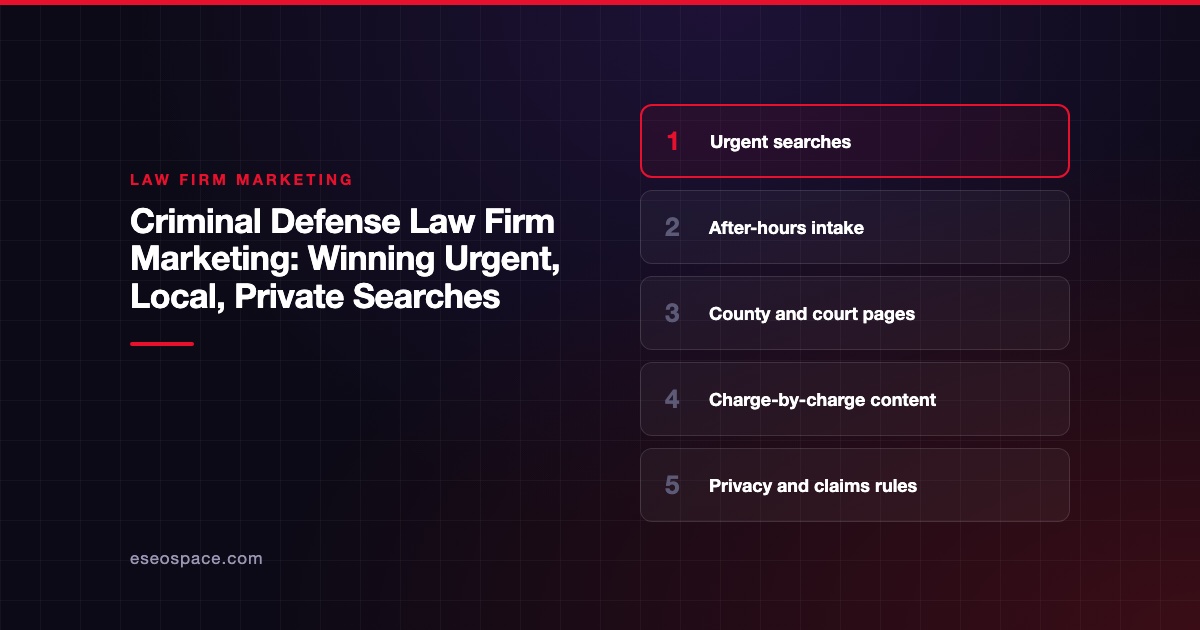
This article is part of our Law Firm Marketing Guide: how clients find lawyers online, what the advertising rules allow, and how to choose the right help. Want to know where your firm's site stands? Get a free 20–30 page website audit within 24 hours.
Criminal defense law firm marketing comes down to being found fast, answering fast and saying only what you can stand behind. Many people search for a defense lawyer within hours of an arrest, often for a family member, and often at night. The firm that shows up locally, answers the phone and explains the next step clearly is the one that gets the call.
Defense marketing also has its own risks. Prospects are anxious about privacy, results claims are tightly regulated, and live outreach to people who were just arrested is restricted in many states. This guide, part of our Law Firm Marketing Guide, covers channels, content, intake and the rules that shape them.
This is marketing guidance, not legal advice. Rules vary by state, so confirm with your state bar before you launch a campaign.
Key Takeaways
- Criminal defense searches are urgent and local, so map visibility and click-to-call matter more than almost anything else.
- If you advertise 24/7 availability, you need a real person or on-call attorney answering, not voicemail.
- County, court and charge-specific pages answer what people actually search, such as a first OWI or DUI in a named county.
- Results claims like "charges dismissed" must be accurate and not create unjustified expectations; some states add specific conditions.
- Forms and chat should discourage detailed facts until a conflict check is done.
Understand the urgency
Defense prospects usually search in one of three moments:
- Right after an arrest, often a parent, spouse or friend searching for "[charge] lawyer near me" or "[county] jail bail."
- Before a first court date, searching "what happens at arraignment in [county]."
- While under investigation, searching quietly and carefully, sometimes for months.
Each moment needs a different page. The first needs a phone number that works now. The second needs clear process content. The third needs privacy and a careful first contact.
Because the first moment is so time-sensitive, your mobile experience is critical. Make the phone number tap-to-call in the header, keep forms short and make sure pages load quickly on a weak signal. Our guide to law firm website speed and mobile covers the technical side.
Local visibility is the foundation
Most criminal matters are handled in a specific county or municipal court. People want a lawyer who appears there regularly.
Google Business Profile
Your profile should show real hours and a real office. Google's Business Profile guidelines (checked 29 October 2026) ask for "your regular customer-facing hours of operation." The same guidelines say a rented mailing address the business does not operate from is a virtual office that "isn't eligible for a Business Profile."
That matters for defense firms that want a presence near every courthouse. If you do not staff an office there, build a strong page for that court instead of a profile you might lose. Our Google Business Profile optimization service covers categories, hours and multi-office setups.
County and court pages
A good county page for a defense firm includes:
- The courthouse address, parking and security notes, with a link to the court's site
- How first appearances and arraignments work locally
- Common charges you handle in that court
- How to find someone in the county jail (link the sheriff's inmate lookup)
- What families can do right now, such as gathering paperwork and not discussing the case on jail phones
Keep each page genuinely local. Copying one page and swapping county names creates thin, near-duplicate pages that rarely rank well.
After-hours intake
Many defense calls come outside business hours. If your site says "available 24/7," make sure that is true.
Intake options:
| Option | Strength | Watch for |
|---|---|---|
| On-call attorney rotation | Prospect speaks with a lawyer immediately | Burnout; clear rules on what can be said before engagement |
| Legal answering service | Live voice at all hours | Script must avoid legal advice and take only basic facts |
| Text or chat with callback | Easy for families | Response time promises must be met |
| Voicemail | Cheap | Many urgent callers move on to the next firm |
Whatever you choose, train intake to:
- Get the caller's name, relationship to the accused, charge, county, custody status and next court date.
- Run a conflicts check before collecting detailed facts.
- Avoid promising outcomes or timelines.
- Log the lead source, so you can judge which channels produce signed cases.
Our guide to law firm intake and lead response time has sample scripts.
Charge-by-charge content
Defense content works best when it is organized around the charges people face and the questions they ask. One eSEOspace client, Criminal Defense Law Center of West Michigan, groups its site by charge type, such as OWI, domestic violence, drug and theft cases, and explains how each works under Michigan law.
Strong charge pages usually cover:
- What the charge means in your state, with the statute cited
- Possible penalties as written in the law, without predicting what this client will get
- How the case typically moves through local court
- Collateral issues, such as driver's license, immigration or professional license consequences
- Expungement or record-sealing options where your state allows them
Have an attorney review each page, and show the reviewer's name. Criminal law changes, so add a "last reviewed" date and update pages when statutes or sentencing rules change.
Results claims and the rules
Defense firms often want to highlight dismissals, acquittals and reduced charges. These claims need care.
- Texas: Rule 7.01 of the Texas Disciplinary Rules says a statement is misleading if it is "substantially likely to create unjustified expectations about the results the lawyer can achieve." It also bars implying you can get results through "means that violate these Rules or other law."
- Florida: Rule 4-7.13 of the Rules Regulating The Florida Bar treats references to past results as misleading "unless the information is objectively verifiable," and treats statements that read as a prediction or guaranty of success as deceptive.
- Florida, titles: The same rule bars using a judicial or other government title unless it has "clear modifiers" and sits after the person's name. "Former prosecutor" claims should be accurate and clearly worded.
Practical guidance:
- Describe results factually: the charge, the outcome, the court and the year.
- Add a clear statement that every case is different and past results do not predict future outcomes.
- Avoid words like "beat," "guaranteed" or "get you off."
- Do not claim to be a "specialist" unless your state allows it. Florida's Rule 4-7.14 sets conditions for "board certified," "specialist" and "expert" claims.
For the broader framework, see lawyer advertising rules for websites.
Solicitation after an arrest
Some firms consider contacting people whose arrests appear in public records. Live outreach is widely restricted, and written outreach rules vary.
- Texas Rule 7.03 bars soliciting non-clients through in-person contact or "regulated telephone, social media, or other electronic contact," meaning live or interactive contact, with narrow exceptions. Solicitation letters must be plainly marked "ADVERTISEMENT."
- Florida Rule 4-7.18 bars in-person and real-time solicitation, including phone and live video, and requires written communications to be marked "advertisement," including at the start of an email subject line.
If you plan any direct mail or email to arrestees, get your bar's guidance on timing, labeling and filing first.
Privacy, forms and tracking
People facing charges worry about who sees their information. Respect that in your site design.
- Put a short notice by every form: sending information does not create an attorney-client relationship, and do not include details of the case until the firm contacts you. Our guide to disclaimers and contact forms has wording ideas.
- Keep forms short: name, phone, charge type, county, best time to call.
- Think about what your analytics and ad pixels collect on charge pages. Avoid sending form contents or page details about specific charges to ad platforms.
- Use HTTPS everywhere and keep plugins updated.
Next step
Once your local pages and intake are working, the next step is deciding how much to spend on paid search versus organic growth. Read Law Firm SEO vs PPC. When you want a defense site built for urgent, private searches, see our law firm marketing services.
Frequently asked questions
What is the most important marketing channel for a criminal defense lawyer?
For most firms it is local search on mobile: a strong Google Business Profile, county pages and a tap-to-call number that someone answers. Paid search can add volume, especially for urgent searches, once intake is solid.
Can a defense lawyer advertise as available 24/7?
Yes, if it is true. If your site or profile says 24/7, a live person or on-call attorney should answer. Advertising availability you do not provide is likely to be treated as misleading.
Can I list dismissals and acquittals on my website?
Usually, if they are accurate and presented without implying a predicted outcome. Florida treats past results as misleading unless objectively verifiable, and Texas bars statements likely to create unjustified expectations. Add context and a clear note that results vary.
Can I mail letters to people who were recently arrested?
Some states allow written solicitation with labeling and filing conditions; live phone and in-person contact are widely barred. Texas and Florida both require "advertisement" labeling on solicitation letters. Check your own state's rule before any campaign.
Should a defense firm use retargeting ads?
Be careful. Retargeting can show ads to someone after they read about a specific charge, sometimes on a shared device. Many firms limit retargeting to general pages or skip it entirely.