

This article is part of our Law Firm Marketing Guide: how clients find lawyers online, what the advertising rules allow, and how to choose the right help. Want to know where your firm's site stands? Get a free 20–30 page website audit within 24 hours.
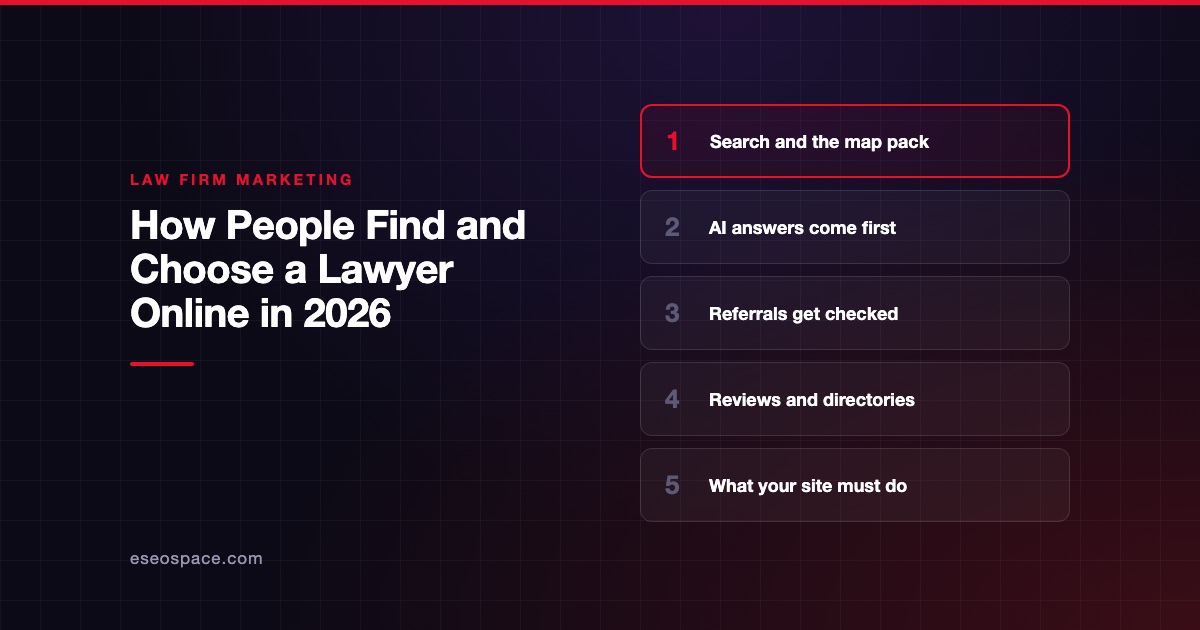
People find a lawyer online through a few overlapping paths: a Google search, the map results, an AI answer, a legal directory, or a referral they then look up. Most people use more than one. Your website is where all of those paths end, so it has to confirm what the person saw elsewhere and make it easy to get in touch.
The mix has changed. AI tools now answer many first questions before anyone reaches a firm. Referrals still matter, but a friend's recommendation is often followed by a search for the lawyer's name, reviews and website.
This article is the starting point of our Law Firm Marketing Guide. It walks through each path, what the person is looking for at that moment, and what your firm controls. Facts are as of October 2026.
Key Takeaways
- A prospective client usually touches several sources, such as search, maps, AI answers, directories and reviews, before contacting a firm.
- Google's local results are ranked on relevance, distance and prominence, and Google says you cannot pay for a better local ranking.
- Clio's 2026 Legal Trends Report says 46% of consumers would consult AI before contacting a lawyer.
- Referrals are still powerful, but the person checks the referred lawyer online before calling.
- Your website has to answer the same questions every path raises: do you handle my problem, where, how much, and how do I start?
The paths people take
Think of the search for a lawyer as a short journey with several entry points.
| Path | What the person does | What they want to see |
|---|---|---|
| Google search | Types a problem or "lawyer near me" | A page that names their exact problem and location |
| Google Maps and the local pack | Compares nearby firms on the map | Reviews, hours, photos, a phone number |
| AI answers | Asks ChatGPT, Google AI Mode or similar | A clear explanation, then names of firms |
| Legal directories | Browses Avvo, Justia, FindLaw or a bar directory | Practice areas, credentials, reviews |
| Referral | Gets a name from a friend or another lawyer | Proof the lawyer is real, active and a fit |
| Paid ads | Clicks a search ad or Local Services Ad | Fast contact and a credible landing page |
The same person may go through three or four of these in one evening. Each step either builds confidence or raises a doubt.
Google search and the map pack
For local legal problems, Google often shows a map with a short list of firms, usually called the local pack, above or near the regular results.
Google's help page on local ranking names three main factors:
- Relevance: "how well a Business Profile matches what someone is searching for."
- Distance: "how far each business is from the customer who's searching."
- Prominence: "how well-known a business is."
Google also says "more reviews and positive ratings can help your business's local ranking," and that "there's no way to request or pay for a better local ranking." That makes your Google Business Profile, your reviews and your website's local signals the main levers. Our guide to Google Business Profile for law firms covers the profile side in detail.
Regular (organic) search results work differently. There, the quality and focus of your practice pages matter most. If someone searches "how long does a DUI stay on my record in Ohio," a firm with a clear page on that question has a chance, even if its office is not the closest. Our Law Firm SEO Basics explains how local and organic search fit together.
AI answers now come first for many people
More people now ask an AI tool before they search for a firm. Clio's Legal Trends Report page for 2026 says 46% of consumers would consult AI before contacting a lawyer. It also says 24% of U.S. adults have already used AI to answer a legal question, and another 40% would consider it.
Google's own AI features work from the open web. Its guide to AI features and your website says AI Overviews and AI Mode "surface relevant links" to supporting pages. It says there are "no additional requirements" to appear beyond being indexed and eligible for a snippet in Search.
What this means for a firm:
- Clear, accurate explanations of common legal questions are more likely to be used and linked.
- Consistent facts about your firm across your site, profile and directories help AI tools describe you correctly.
- A person who arrives after an AI answer has already learned the basics. They want to know if you are the right firm, not a general explainer.
Our guide to how ChatGPT and AI search recommend lawyers goes deeper on what these systems draw on.
Referrals still matter, but they get checked
A referral from a past client, a friend or another attorney is still one of the strongest starting points. But the referral is rarely the last step. Often the person searches your name next.
What they check in that moment:
- Your name in search. Does your site come up first, with a clear title?
- Your Google Business Profile. Are the reviews recent? Is the address real?
- Your attorney bio. Do you handle this kind of matter? Where are you licensed?
- Your website. Does it look current and work on a phone?
A dated site or a thin bio can undo a good referral. Our existing guide on attorney bios and bar credentials covers what to include.
If you have referral relationships with other professionals, the ethics rules apply. ABA Model Rule 7.2(b), as published on the ABA's Rule 7.2 page, generally bars giving anything of value for a recommendation, with listed exceptions such as non-exclusive reciprocal referral agreements the client is told about. States adopt their own versions, so confirm with your state bar.
Reviews and directories
Reviews are one of the few signals a person sees before ever reaching your site. On Google, they appear right in the map results. On directories, they sit next to your name and practice areas.
Directories play two roles. They are a place people browse, and they are a source that search engines and AI tools can read. The ABA's comment on Rule 7.2 says lawyers may pay for "on-line directory listings" as advertising. It also says directory listings that list lawyers by practice area, "without more," are not treated as recommendations.
Which directories are worth your time depends on your practice and market. Our comparison of legal directories looks at the main options.
Asking for and showcasing reviews has its own rules, which vary by state. See Can Lawyers Use Reviews and Testimonials? before you put review quotes on your site.
Paid search and Local Services Ads
Some people click an ad first. Google's Local Services Ads help page says advertisers "pay only for leads related to your business" and receive calls and messages directly. It lists lawyer categories among eligible services and describes a "Google Verified" badge for businesses that pass Google's screening.
Ads can bring calls quickly, but they send people to the same places: your profile, your phone line and your website. If those are weak, you pay for clicks that do not turn into clients.
What your website must do at the end of every path
Whatever path someone takes, they land on your site with a few questions. Answer them fast.
- Do you handle my problem? Name the practice area and the specific situations in plain words.
- Do you work where I am? Show your office location, the courts or counties you cover and where you are licensed.
- Who will I work with? Show real attorney photos and bios.
- What does it cost, or how is it billed? Explain your fee approach, even if you can't list prices. If you charge for consultations, say so.
- How do I start? Give a tappable phone number, a short form and honest hours.
- Can I trust you? Show reviews, credentials and clear disclaimers that meet your state's rules.
The site also has to work on a phone, load quickly and be usable by people with disabilities. See Law Firm Website Must-Haves for the full build list.
Next step
Now that you know the paths, check whether your site is ready for them. Start with Law Firm Website Must-Haves. Or get a free 20–30 page website audit within 24 hours.
Frequently asked questions
Do people still choose lawyers through referrals?
Yes, referrals remain a common starting point. But most people look the lawyer up before calling, checking search results, reviews and the firm's website. A weak online presence can lose a referred client.
Can my firm pay Google to rank higher in the map results?
No. Google's help page says there is no way to request or pay for a better local ranking. Ads, including Local Services Ads, are shown separately from the unpaid local results.
How many people use AI to look for legal help?
Clio's 2026 Legal Trends Report page says 46% of consumers would consult AI before contacting a lawyer. It also says 24% of U.S. adults have used AI to answer a legal question. Figures from other surveys may differ.
Do I need to be on every legal directory?
No. Focus on the directories your clients actually use and the ones that rank in your market. Keep your name, address and phone number consistent everywhere you appear.
What is the first thing to fix on my firm's site?
Start with the questions every visitor has: what you handle, where, how fees work and how to contact you. Then make sure the site works well on a phone. A free audit can show which gaps are biggest.









