
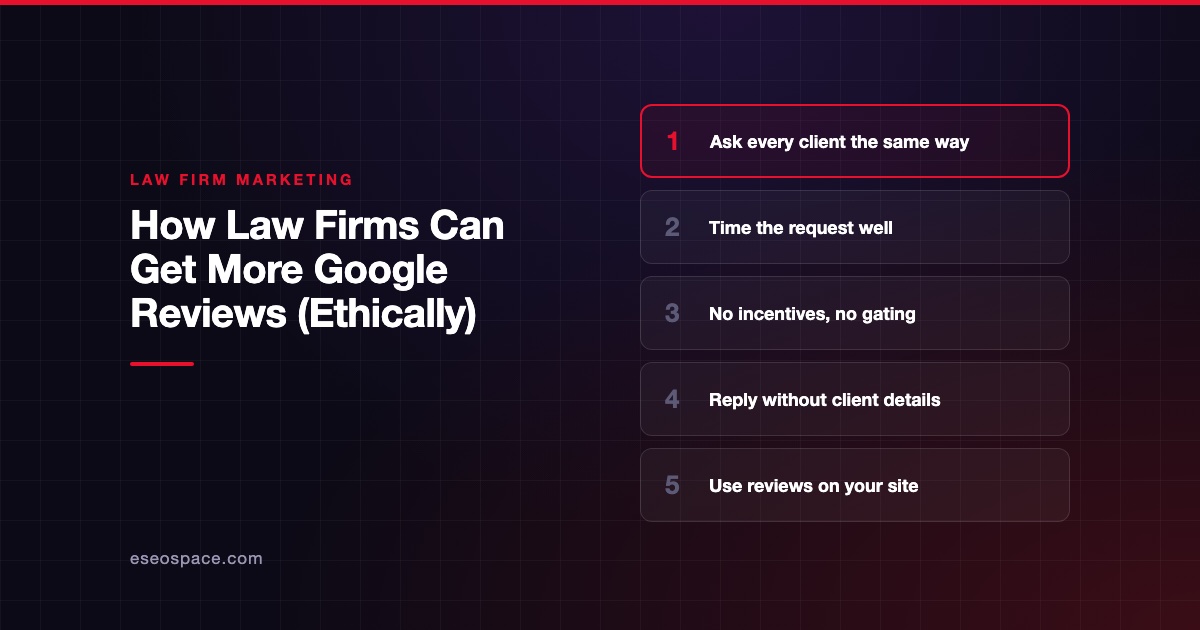
This article is part of our Law Firm Marketing Guide: how clients find lawyers online, what the advertising rules allow, and how to choose the right help. Want to know where your firm's site stands? Get a free 20–30 page website audit within 24 hours.
Law firms get more Google reviews by asking every client, at the right moment, with a direct link, and by making the ask part of the case-closing process instead of an afterthought. The ethical part is just as specific: no rewards, no asking only happy clients, and no replies that reveal anything about the representation.
Reviews matter because they sit next to your firm on Google Search and Maps, where people compare lawyers before calling. They are one of the few trust signals a prospective client can check without talking to you. This guide is part of our Law Firm Marketing Guide.
The rules here come from Google's policies, the FTC and state bar opinions. They vary by state, so confirm the details with your state bar's ethics resources before you change your process.
Key Takeaways
- Google prohibits paid or incentivized reviews, selectively asking only satisfied customers, and discouraging negative reviews.
- The FTC's rule on consumer reviews took effect October 21, 2024, and bans fake reviews, sentiment-conditioned incentives and review suppression.
- Ask every client in the same way, at a natural closing point, with a direct review link.
- State bars, including Texas and Florida, say a lawyer may not reveal confidential information to answer a negative review.
- Reviews you republish on your website can be treated as testimonials under state advertising rules.
The rules you are working within
Google's review policies
Google's policy on fake engagement is the first rule book. It says fake engagement is not allowed and will be removed. It specifically prohibits:
- Reviews paid for, directly or in kind.
- Content posted because of an incentive offered by the business, including discounts or free services.
- Selectively soliciting positive reviews from customers.
- Discouraging or prohibiting negative reviews.
- Reviews from people with a conflict of interest, which can include current or former employment or a contractual relationship.
That last point matters for law firms. Staff, contract attorneys and vendors should not review the firm.
The FTC rule on reviews
The FTC's consumer reviews and testimonials rule Q&A says the rule went into effect on October 21, 2024. It bans fake reviews and incentives conditioned on a positive or negative sentiment. It requires insiders to disclose their relationship and bars suppressing reviews through intimidation or unfounded legal threats.
The FTC staff guidance also confirms that a general request to all recent customers is fine. On asking only satisfied customers, staff say the rule has no specific prohibition but that the practice could violate the FTC Act. Since Google prohibits it outright, the answer for your Google profile is simple: do not filter.
State bar rules
Lawyer ethics rules add a layer. For example, Texas Rule 7.03 in the Texas Disciplinary Rules, Part VII limits giving anything of value to non-lawyers for referring prospective clients, beyond nominal thank-you gifts. Separately, a review incentive would already break Google's policy. Treat review requests as a thank-you, with nothing attached.
Build a review request system
A steady flow of reviews depends on process, not memory. Build the request into the matter workflow.
1. Choose the moment
Ask when the client feels the result, not when the bill arrives. Natural points include:
- A favorable resolution, settlement funding or final hearing.
- Delivery of signed estate planning documents.
- Approval notices in immigration matters.
- The closing letter at the end of any matter.
Avoid asking while a matter is active and emotions are high, or at the same time as a fee dispute.
2. Ask every client the same way
Pick a standard point in the case-closing checklist and send the request to every client who reaches it. Do not pre-screen by who seemed happy. That consistency is what keeps you inside Google's rule against selective solicitation, and it gives you a more honest picture of client experience.
3. Make it easy
Google's help page on getting reviews says you can ask customers to visit a Google link or scan a QR code. Get your review link from your Business Profile and use it in:
- The closing email or letter.
- A text message after the final meeting, if the client has agreed to texts.
- A QR code on a card handed out at document signings.
- Your email signature, for a low-key reminder.
4. Use a short, neutral script
A request should be brief and should not steer the rating. For example:
> "Thank you for trusting us with your matter. If you have a minute, we would appreciate an honest review on Google: [link]. Please do not include details about your case. Every review helps others find the right lawyer."
Note the line about case details. It protects the client's privacy and keeps you from having to respond to specifics.
5. Follow up once
One reminder a week later is reasonable. More than that starts to feel like pressure.
6. Track it
Log who was asked and when, and watch the review count by month. If a month has many closed matters and few reviews, look at how and when you are asking before anything else.
How to reply to reviews without breaking confidentiality
Google's getting-reviews page recommends replying to all reviews, positive and negative. Lawyers have a constraint other businesses do not: confidentiality.
Texas. In Opinion 662 (August 2016), the Texas Professional Ethics Committee said a lawyer may not reveal confidential information just to answer a former client's negative online review. A proportional, restrained response that reveals nothing confidential is allowed. The opinion endorses sample language saying the lawyer's professional obligations do not allow a point-by-point response, and that the post does not present a fair and accurate picture of events.
Florida. The Florida Bar's ethics committee approved Advisory Opinion 20-1 in October 2020, as reported by The Florida Bar News. It says a lawyer may not reveal confidential information in responding to a former client's negative comment, even if the information is in the public record. It suggests a statement such as: "As an attorney, I am constrained by the Rules Regulating The Florida Bar from responding in detail," followed by a statement that the lawyer believes the post is inaccurate.
Check your own state's opinions. In the meantime, these habits keep replies safe:
- Never confirm the person was a client in a public reply. Even "we enjoyed working on your case" confirms a relationship.
- Thank positive reviewers generally: "Thank you for taking the time to leave a review."
- Keep negative replies short: say your professional obligations limit what you can say publicly and invite the person to contact the office.
- Do not argue the facts or mention outcomes, fees or timelines.
- Do not threaten legal action in a reply. The FTC rule bars suppressing reviews through unfounded legal threats.
- Report reviews that break Google's policies, such as fake reviews or reviews from people who were never clients, through your Business Profile.
Using reviews on your website
Reviews on Google are third-party content. Once you copy them onto your site, they may become your advertising. Florida's ethics checklist for websites, social media and video flags testimonials that are not the person's actual experience, were given for something of value, are not representative, were written by the lawyer, or lack a disclaimer that prospective clients may not get the same results. In California, Comment [4] to Rule 7.1 of the Rules of Professional Conduct says a testimonial may be misleading if it leads a reasonable person to expect the same results without reference to their own facts, and that an appropriate disclaimer often avoids that.
Practical rules for your site:
- Quote reviews accurately. Do not edit them to sound better.
- Add a results disclaimer near any review that mentions an outcome.
- Do not pick only reviews about large recoveries.
- Keep a record of the source and date of each review you display.
For the full state-by-state picture, read Can Lawyers Use Reviews and Testimonials?.
Reviews beyond Google
Google is the priority for most firms because reviews appear on the map listing. Other platforms still matter. Some legal directories carry client reviews, and AI search tools may draw on several sources when recommending firms. Spread requests sensibly: send most clients to Google, and ask a smaller number to review you on the directory that matters most in your practice area. Our comparison of legal directories can help you choose.
Your Business Profile itself also needs to be in order for reviews to do their job: correct categories, attorney listings and office details. See Google Business Profile for law firms or our Google Business Profile optimization service.
What not to do
| Do not | Why |
|---|---|
| Offer discounts, gift cards or fee credits for reviews | Google prohibits incentivized reviews |
| Send a "how did we do?" survey and only pass happy clients to Google | Google prohibits selectively soliciting positive reviews |
| Ask staff, family or vendors to review the firm | Conflict of interest under Google's policy; FTC insider rules |
| Buy reviews or use a review exchange | Fake engagement; FTC rule |
| Reply with case details to "set the record straight" | State bar confidentiality rules, for example Texas and Florida |
| Pressure clients in the office to post on the spot | Google prohibits requiring or pressuring reviews on the premises |
Next step
Once your review system runs, connect it to the rest of your local presence and intake. When you want help building review requests into your site, profile and intake workflow, see our law firm marketing services.
Frequently asked questions
Can a law firm offer a gift card or discount for a Google review?
No. Google's policy prohibits content posted because of an incentive offered by the business, including discounts and free services. Even where an FTC rule allows some incentives that are not tied to sentiment, Google does not allow them on its platform.
Can we send a satisfaction survey first and only ask happy clients for a Google review?
No. Google's policy prohibits selectively soliciting positive reviews. Send the same review request to every client who reaches your chosen closing point, and handle complaints through your normal client-service process.
How should a lawyer respond to a negative Google review?
Briefly, and without confidential information. Texas Opinion 662 and Florida Advisory Opinion 20-1 both say a lawyer may not reveal confidential information to answer a review, but may post a restrained reply saying professional obligations limit a detailed response. Check your own state's opinions first.
Can lawyers use client reviews on their website?
Usually yes, with care. Several states treat reviews you republish as testimonials, which can require disclaimers and accurate, representative selection. Florida's checklist and California's Rule 7.1 comments are two examples; confirm your own state's rule.
Can employees leave reviews for our firm?
They should not. Google's policy lists current or former employment as a conflict of interest, and the FTC rule requires insiders to disclose their relationship.