This page is part of our MCP specification reference, a plain-English guide to the Model Context Protocol spec (version 2026-07-28), within The MCP Guide. Building a server? See MCP development.
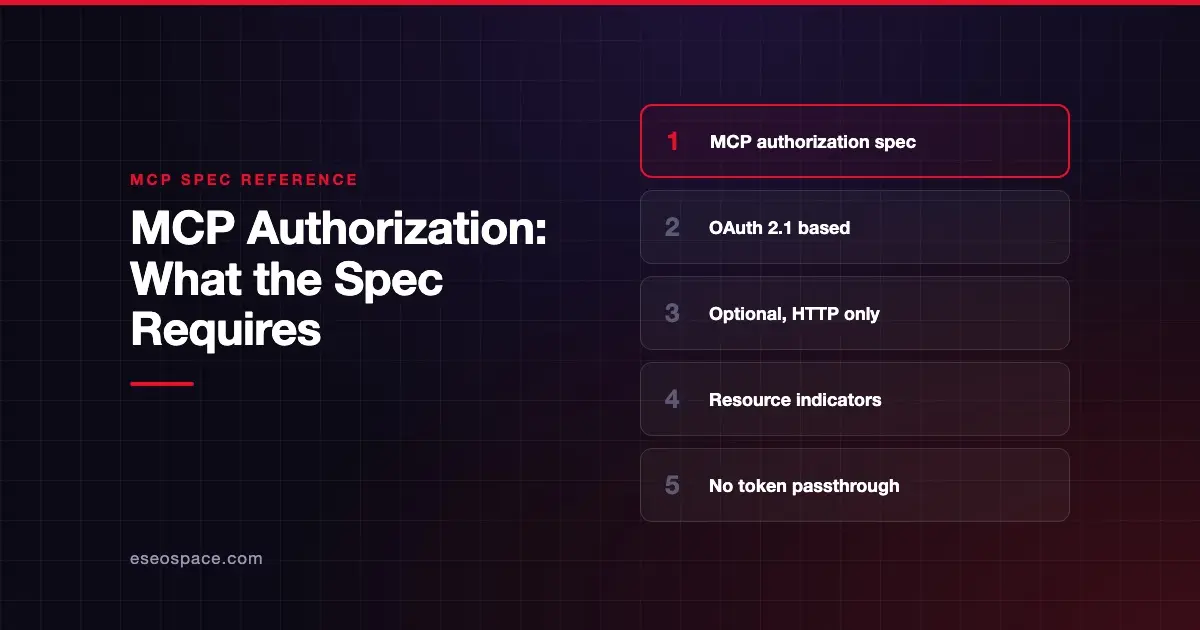
MCP authorization is the part of the specification that controls how an AI app gets permission to use a protected remote MCP server. It is built on OAuth 2.1. The MCP server acts as an OAuth resource server, the AI app acts as an OAuth client, and an authorization server signs the user in and issues access tokens.
Status in the 2026-07-28 spec: optional (authorization itself is optional; when used over HTTP, the rules below apply)
This page lists what the 2026-07-28 authorization specification requires, in the order a developer or reviewer needs it. For a step-by-step walk through the sign-in flow, see our companion guide MCP authentication and OAuth 2.1. Checked on 28 October 2026.
Key Takeaways
- Authorization is optional, but HTTP-based implementations that use it "SHOULD conform" to the spec; stdio servers should use environment credentials instead.
- MCP servers must publish OAuth 2.0 Protected Resource Metadata (RFC 9728) so clients can find the authorization server.
- Clients must use PKCE, must send the
resourceparameter (RFC 8707), and must validate a returnedissvalue. - Servers must check that every token was issued for them, and "MUST NOT accept or transit any other tokens."
- Client ID Metadata Documents are the recommended way for clients to register; Dynamic Client Registration is deprecated.
Why MCP has an authorization spec
Remote MCP servers often reach private data and take actions. Without a shared standard, every AI app would need custom sign-in code for every server. The spec picks "a selected subset" of existing OAuth standards "to ensure security and interoperability while maintaining simplicity."
The standards it builds on include the OAuth 2.1 draft, Bearer Token Usage (RFC 6750), Authorization Server Metadata (RFC 8414), Resource Indicators (RFC 8707), Protected Resource Metadata (RFC 9728), issuer identification (RFC 9207), Client ID Metadata Documents, and OpenID Connect Discovery.
Who does what
| Role | Who it is in MCP | Main duty |
|---|---|---|
| Resource server | The MCP server | Validate every token |
| Client | The AI app (MCP client) | Request tokens on the user's behalf |
| Authorization server | Built in, or a separate identity provider | Sign the user in and issue tokens |
The spec says the authorization server "may be hosted with the resource server or a separate entity."
The requirements, grouped
Discovery
- MCP servers "MUST implement OAuth 2.0 Protected Resource Metadata." See protected resource metadata.
- Authorization servers must offer RFC 8414 metadata or OpenID Connect Discovery, and clients "MUST support both."
Client registration
Before starting, clients "MUST obtain a client ID" through pre-registration, a Client ID Metadata Document, or Dynamic Client Registration. See Client ID Metadata Documents and Dynamic Client Registration.
The authorization request
The security considerations page sets the core client rules:
- "MCP clients MUST implement PKCE" and use
S256when technically capable. - If authorization server metadata lacks
code_challenge_methods_supported, the client "MUST refuse to proceed." - The
resourceparameter "MUST be included in both authorization requests and token requests" and must name the MCP server's canonical URI. - Before redirecting, the client records the expected
issuer. A returnedissmust match it before the code is redeemed.
Using tokens
- Tokens go in the
Authorization: Bearerheader on every HTTP request. - "Access tokens MUST NOT be included in the URI query string."
- Servers "MUST validate that access tokens were issued specifically for them as the intended audience."
- "MCP servers MUST NOT accept or transit any other tokens." If the server calls an upstream API, it uses a separate token. See why MCP servers must not pass tokens through.
Scopes and errors
Servers "SHOULD" put a scope parameter in the WWW-Authenticate header. This is the spec's example 401 response:
HTTP/1.1 401 Unauthorized
WWW-Authenticate: Bearer resource_metadata="https://mcp.example.com/.well-known/oauth-protected-resource",
scope="files:read"| Status | Meaning in the spec |
|---|---|
| 401 | "Authorization required or token invalid" |
| 403 | "Invalid scopes or insufficient permissions" |
| 400 | "Malformed authorization request" |
When a token lacks a scope at runtime, the server "SHOULD" return 403 with error="insufficient_scope" and the needed scopes. Clients then run a step-up flow, requesting the union of earlier and newly required scopes.
The token response the client finally receives is standard OAuth JSON. A typical shape, adapted from the token response in the Enterprise-Managed Authorization spec:
{
  "token_type": "Bearer",
  "access_token": "2YotnFZFEjr1zCsicMWpAA",
  "expires_in": 86400,
  "scope": "files:read"
}
Token safety
Clients and servers "MUST implement secure token storage." Authorization servers "SHOULD issue short-lived access tokens" and "MUST rotate refresh tokens" for public clients. All authorization server endpoints "MUST be served over HTTPS," and redirect URIs must be localhost or HTTPS.
Extensions
The core spec covers a user approving access interactively. Two official extensions in the ext-auth repository cover other cases: OAuth Client Credentials for machine-to-machine access, and Enterprise-Managed Authorization for company identity providers.
What changed across spec versions
| Version | Authorization change |
|---|---|
| 2025-03-26 | First OAuth 2.1 authorization framework, per its changelog |
| 2025-06-18 | MCP servers classified as OAuth resource servers; Protected Resource Metadata and RFC 8707 resource indicators required |
| 2025-11-25 | OpenID Connect Discovery support; incremental scope consent; Client ID Metadata Documents recommended |
| 2026-07-28 | iss validation (RFC 9207); application_type in DCR; credentials bound to their issuer; DCR deprecated |
The 2026-07-28 changes come from the 2026-07-28 changelog. The spec also expects a future revision to upgrade authorization servers' iss inclusion "from SHOULD to MUST."
Common mistakes
- Accepting any valid token. Audience checks are mandatory. A token for another service must be rejected.
- Forwarding the user's token upstream. That is token passthrough, and it is forbidden.
- Skipping the
resourceparameter because the authorization server ignores it. The spec says clients "MUST send this parameter regardless." - Requesting every scope up front. The spec favors least privilege and step-up.
- Putting tokens in URLs. They leak into logs. Use the header.
More pitfalls are collected in common MCP OAuth misconfigurations.
Next step
The first thing a client fetches is the server's metadata document. Read OAuth Protected Resource Metadata in MCP next, or see how our MCP development team builds and reviews authorization.
Frequently asked questions
Is authorization required in MCP?
No. The spec says authorization is "OPTIONAL." A server with only public data may skip it. When an HTTP server does support it, it should follow this spec.
Does MCP authorization apply to local servers?
No. stdio implementations "SHOULD NOT follow this specification, and instead retrieve credentials from the environment."
Which OAuth version does MCP use?
OAuth 2.1, which is still an IETF draft. The 2026-07-28 spec cites draft-ietf-oauth-v2-1-13, plus several finished RFCs.
What is the difference between a 401 and a 403 in MCP?
A 401 means the token is missing, invalid or expired. A 403 means the token is valid but lacks the right scopes or permissions.
Can an MCP server use our existing identity provider?
Yes. The authorization server can be a separate entity, such as an identity provider you already run, as long as it meets the discovery and OAuth 2.1 requirements.