This page is part of our MCP specification reference, a plain-English guide to the Model Context Protocol spec (version 2026-07-28), within The MCP Guide. Building a server? See MCP development.
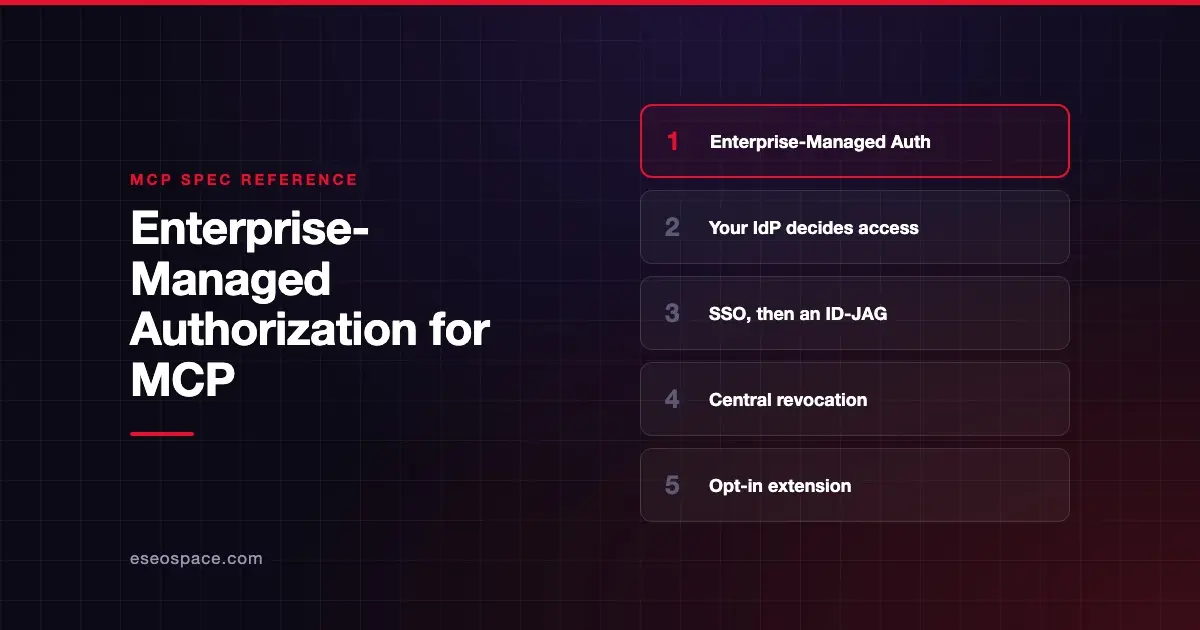
Enterprise-Managed Authorization is an official MCP extension that lets a company's identity provider (IdP), such as Okta or Azure AD, decide which MCP servers each employee can use. Employees sign in once with corporate single sign-on (SSO). The AI app then gets access tokens for approved MCP servers without asking the employee to approve each server.
Status in the 2026-07-28 spec: extension (Stable, published in the ext-auth repository; opt-in)
It is not part of the core spec. It lives in the official ext-auth repository, which lists it as Stable with a 2026-07-28 revision. This page follows the extension overview and the 2026-07-28 extension specification, checked on 28 October 2026.
Key Takeaways
- The extension identifier is
io.modelcontextprotocol/enterprise-managed-authorization, and clients must opt in to it. - The company IdP checks policy and issues an Identity Assertion JWT Authorization Grant (ID-JAG) for a specific MCP server.
- The AI app exchanges the ID-JAG for an MCP access token at the MCP server's authorization server.
- Admins get central policy and revocation; the IdP sees token issuance, not the MCP traffic itself.
- Client support varies, and the AI app will usually need to be pre-registered with the company IdP.
Why it exists
The core MCP authorization flow assumes each user approves each server. The authorization extensions overview explains the gap: "Requiring employees to authorize each MCP server individually creates friction and bypasses existing security controls."
The extension docs list the enterprise problems it targets. "Security teams can't enforce consistent access policies if each user authorizes independently." Onboarding means approving "dozens of services," and offboarding means "revoking access across every service individually."
The idea was introduced as SEP-990 around the 2025-11-25 release. The 2025-11-25 release post described it as "Enterprise IdP policy controls for MCP OAuth flows (Cross App Access)."
How it works
The extension spec calls itself "an application of the 'Identity Assertion JWT Authorization Grant'," an IETF draft. It uses two standard OAuth building blocks: Token Exchange (RFC 8693) and JWT Authorization Grants (RFC 7523).
The flow in four steps
- SSO login. The employee signs in to the AI app through the company IdP, using OpenID Connect or SAML. The app keeps the resulting identity assertion.
- Token exchange at the IdP. The app asks the IdP for an ID-JAG for one MCP server. The
audience"MUST be the issuer identifier of the Resource Authorization Server." The IdP "evaluates administrator-defined policies" before answering. - Grant exchange at the MCP authorization server. The app presents the ID-JAG with
grant_typeurn:ietf:params:oauth:grant-type:jwt-bearer. The authorization server validates it and issues an access token that "MUST be audience-restricted to the MCP Server." - Normal MCP calls. The app uses the access token as usual.
The client docs add one firm instruction: "Do not redirect the user to the MCP Authorization Server's authorization endpoint."
What an ID-JAG contains
The ID-JAG is a short-lived JWT signed by the IdP. This payload is copied from the extension spec's example:
{
  "jti": "9e43f81b64a33f20116179",
  "iss": "https://acme.idp.example",
  "sub": "U019488227",
  "email": "user@example.com",
  "aud": "https://auth.chat.example/",
  "resource": "https://mcp.chat.example/",
  "client_id": "f53f191f9311af35",
  "exp": 1311281970,
  "iat": 1311280970,
  "scope": "chat.read chat.history"
}
In the spec's token exchange example, the IdP returns the ID-JAG with "expires_in": 300, or five minutes.
Opting in and discovery
Clients declare support in the extensions field of io.modelcontextprotocol/clientCapabilities, inside each request's _meta. See how MCP extensions work. A client can tell an authorization server supports the profile by finding urn:ietf:params:oauth:grant-profile:id-jag in its authorization_grant_profiles_supported metadata.
Who does what
| Party | Job under this extension |
|---|---|
| Company IdP | Runs SSO, evaluates policy, issues ID-JAGs |
| MCP client (AI app) | Declares support, stores the identity assertion, swaps it for tokens |
| MCP authorization server | Validates ID-JAGs against the IdP's keys, maps claims to permissions, issues tokens |
| MCP server | Declares the extension and accepts tokens as usual |
For account linking, the docs say to use the subject claim "as the primary stable identifier," and the email claim only to match accounts created earlier.
What admins can and cannot control
The extension spec gives an example policy. Users in an "engineering" group could get read-only access from an AI code editor to a source control MCP server. Users in "marketing" could get read and write access to internal documentation.
There is a clear limit. The IdP's visibility "is limited to the process of issuing the access token, but does not extend to the actual MCP traffic." For logging tool calls, you still need gateways or server-side logs. See MCP for IT leaders and MCP audit logging.
The docs also say "Centralized revocation" happens at the IdP and takes effect "immediately across all MCP clients." The docs do not spell out what happens to access tokens already issued. The spec's example access token has "expires_in": 86400, or one day, so ask your vendor how revocation reaches live tokens.
What changed across versions
| Date | Change |
|---|---|
| 2025-11-25 | SEP-990 announced as one of the first two authorization extensions |
| 2026-07-28 | Stable revision published in ext-auth, keyed to the 2026-07-28 core spec |
The 2026-07-28 core authorization page describes such extensions as "Optional," "Additive," "Composable" and "Versioned independently," following the core versioning cycle where they can.
Common mistakes
- Assuming every AI app supports it. The docs say "Support for this extension varies by client" and is "never active by default."
- Forgetting IdP pre-registration. The spec says "The MCP client will likely need to be pre-registered with the enterprise IdP."
- Treating the IdP as an audit log. It does not see MCP traffic.
- Coarse scopes on the MCP server. IdP policy can only be as fine-grained as the scopes the server defines.
Next step
To see how this fits the core rules, return to MCP authorization: what the spec requires, or ask our MCP development team to plan SSO for your servers.
Frequently asked questions
Is Enterprise-Managed Authorization part of the core MCP spec?
No. It is an official extension in the ext-auth repository, marked Stable. Clients and servers must opt in.
What is an ID-JAG?
An Identity Assertion JWT Authorization Grant. It is a signed token from the company IdP that says this user may access this MCP server with these scopes. The AI app trades it for an MCP access token.
Does it work with SAML?
Yes. The spec allows SSO via OpenID Connect or SAML. With SAML, the client first exchanges the SAML assertion for a refresh token, then uses that to request an ID-JAG.
Which identity providers support it?
The docs name Okta, Azure AD and corporate SSO systems as example IdPs, but do not certify specific products. As of October 2026, check with your IdP and AI app vendors directly.
How is this different from the OAuth Client Credentials extension?
Client Credentials is for machine-to-machine access with no user present. Enterprise-Managed Authorization is for employees using AI apps under company policy.