This page is part of our MCP specification reference, a plain-English guide to the Model Context Protocol spec (version 2026-07-28), within The MCP Guide. Building a server? See MCP development.
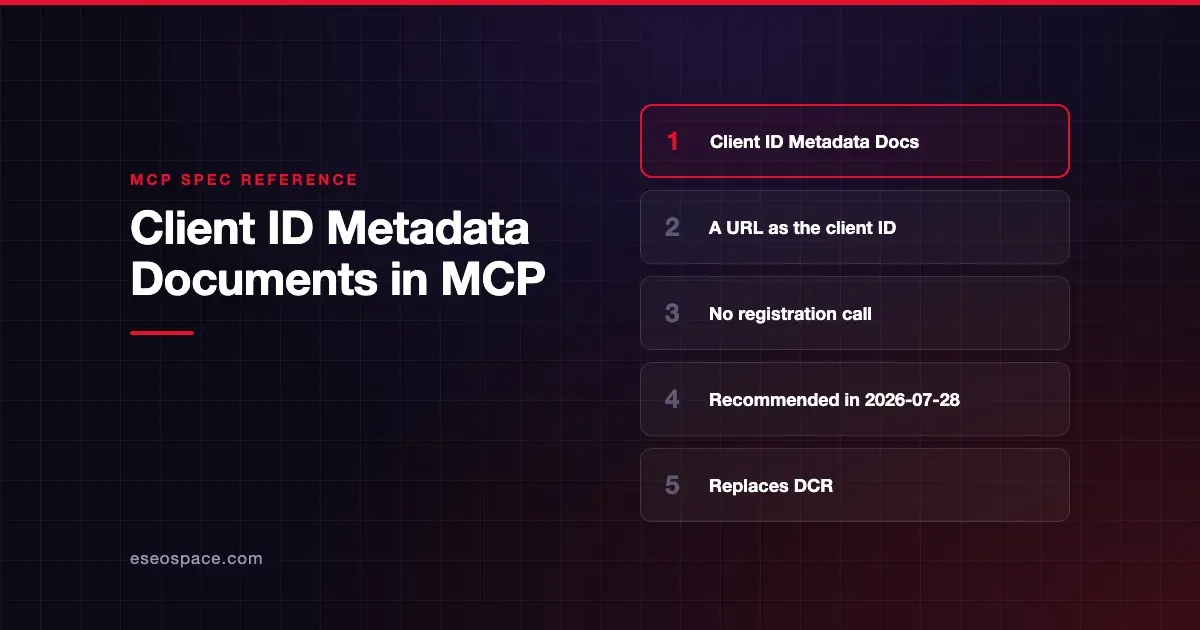
A Client ID Metadata Document (CIMD) lets an AI app identify itself to an OAuth authorization server using an HTTPS URL as its client ID. The URL points to a JSON file the app's maker hosts, listing the app's name and allowed redirect addresses. The authorization server fetches that file when it needs it, so no registration step is required.
Status in the 2026-07-28 spec: core (the recommended client registration method; support is "SHOULD")
CIMD solves a problem that is common in MCP: an AI app and an MCP server that have never met. It is step 3 of the sign-in flow in our MCP authentication and OAuth 2.1 guide. This page follows the client registration page of the 2026-07-28 spec, checked on 28 October 2026.
Key Takeaways
- With CIMD, the
client_idis an HTTPS URL, and that URL serves a JSON document describing the client. - The document must contain at least
client_id,client_nameandredirect_uris, and itsclient_idmust match the URL exactly. - Authorization servers signal support with
client_id_metadata_document_supported: truein their metadata. - CIMD was added in 2025-11-25 and became the preferred option in 2026-07-28, when Dynamic Client Registration was deprecated.
- Authorization servers must guard against SSRF and localhost impersonation when fetching and trusting these documents.
Why it exists
OAuth normally needs a client ID issued in advance. That works when an app talks to a handful of known services. MCP is different: one AI app may connect to thousands of servers, and each server may use its own authorization server.
The spec lists three ways to get a client ID. It describes CIMD as the choice "When client and server have no prior relationship (most common)." The underlying IETF draft, OAuth Client ID Metadata Document, says it lets a client "identify itself to authorization servers, without prior dynamic client registration or other existing registration." As of October 2026 that draft is at revision -02 and is not yet an RFC. The MCP spec cites revision -00.
How it works
The document
This is the example from the MCP spec:
{
  "client_id": "https://app.example.com/oauth/client-metadata.json",
  "client_name": "Example MCP Client",
  "client_uri": "https://app.example.com",
  "logo_uri": "https://app.example.com/logo.png",
  "redirect_uris": [
    "http://127.0.0.1:3000/callback",
    "http://localhost:3000/callback"
  ],
  "grant_types": ["authorization_code"],
  "response_types": ["code"],
  "token_endpoint_auth_method": "none"
}
Rules for clients:
- The document must be hosted at an HTTPS URL, and the
client_idURL "MUST use the 'https' scheme and contain a path component." - It "MUST include at least"
client_id,client_nameandredirect_uris. - The
client_idvalue "matches the document URL exactly." - Clients "MAY use
private_key_jwt" to authenticate at the token endpoint.
The flow
- The client sends an authorization request with
client_idset to its document URL. - The authorization server sees a URL-formatted client ID and fetches the document.
- It checks that
client_idmatches the URL, that the requestedredirect_uriis listed, and that the JSON is valid. - It may also apply a domain trust policy.
- It shows the user a consent page using
client_name, then continues the normal OAuth flow.
Authorization servers "SHOULD cache metadata respecting HTTP cache headers."
Advertising support
Authorization servers say they support CIMD by adding this to their OAuth metadata:
{ "client_id_metadata_document_supported": true }Clients "SHOULD check for this capability" and "MAY fall back" to Dynamic Client Registration or pre-registration if it is missing.
Where CIMD sits in the priority order
For clients that support every option, the spec's order is:
- Pre-registered client details, if available.
- CIMD, if the authorization server advertises support.
- Dynamic Client Registration, as a fallback.
- Asking the user to enter client details.
Security considerations
The authorization security considerations list three CIMD-specific risks.
- SSRF. The authorization server fetches a URL supplied by an unknown client. The MCP security best practices warn that a malicious client could make it request "private administration endpoints." Blocking private IP ranges and using egress proxies help. See server-side request forgery in MCP.
- Localhost impersonation. "Client ID Metadata Documents cannot prevent
localhostURL impersonation by themselves." Authorization servers "SHOULD display additional warnings forlocalhost-only redirect URIs" and "MUST clearly display the redirect URI hostname." - Trust policies. Authorization servers "MAY implement domain-based trust policies," for example accepting only known client domains.
What changed across spec versions
| Version | CIMD status |
|---|---|
| 2025-06-18 and earlier | Not in the spec; Dynamic Client Registration was the "SHOULD" option |
| 2025-11-25 | Added "as a recommended client registration mechanism," per the 2025-11-25 changelog |
| 2026-07-28 | Dynamic Client Registration deprecated "in favor of Client ID Metadata Documents" |
The 2026-07-28 changelog also clarified credential binding. Pre-registered or DCR credentials are tied to one authorization server. CIMD client IDs "are portable across authorization servers," so "No re-registration is needed when the authorization server changes."
The 2025-11-25 release post introduced the feature as "URL-based client registration using OAuth Client ID Metadata Documents."
Common mistakes
- A
client_idthat differs from the URL, even by a trailing slash. The server must reject it. - Hosting the document without a path, such as
https://example.com. The spec requires a path component. - Forgetting a redirect URI. The server validates the exact redirect against the list.
- Authorization servers fetching any URL with no SSRF controls.
- Assuming every authorization server supports CIMD. Check the metadata flag and keep a fallback.
Next step
Some authorization servers still only support the older registration method. Read Dynamic Client Registration in MCP next, or return to MCP authorization: what the spec requires and the full MCP specification reference.
Frequently asked questions
What does CIMD stand for?
Client ID Metadata Document. It is an OAuth mechanism, defined in an IETF draft, where the client ID is an HTTPS URL pointing to the client's metadata.
Do MCP servers need to support CIMD?
The requirement falls on authorization servers and clients, not the MCP server itself. The 2026-07-28 spec says they "SHOULD" support it. The MCP server only points to its authorization server.
Is CIMD the same as Dynamic Client Registration?
No. With DCR the client sends a registration request and receives a client ID. With CIMD there is no registration call: the client ID is a URL, and the authorization server fetches the metadata itself.
Can a desktop app use CIMD?
Yes. The spec's own example lists localhost and 127.0.0.1 redirect URIs. Because those can be impersonated, authorization servers should warn users and display the redirect hostname clearly.
Is CIMD a finished standard?
Not yet. As of October 2026 it is an IETF Internet-Draft, revision -02, dated 6 July 2026. The MCP spec references revision -00.