

This article is part of our Therapy Practice Marketing Guide: how clients find a therapist, how to market ethically and privately, and how to choose the right help. Want to know where your practice's site stands? Get a free 20–30 page website audit within 24 hours.
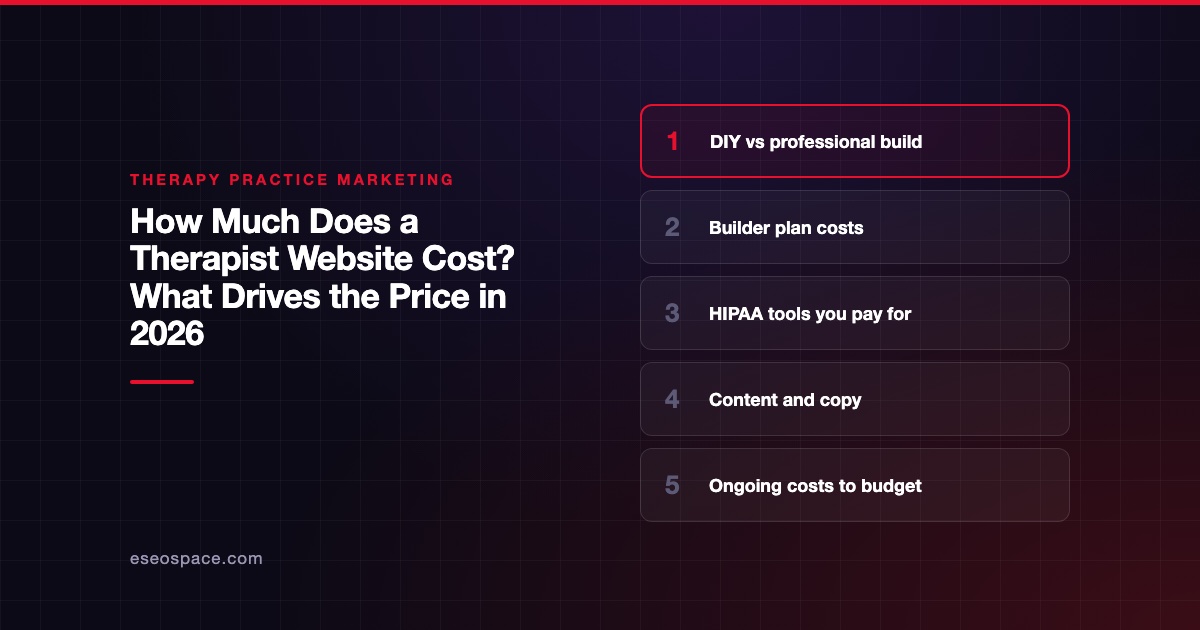
A therapist website can cost almost nothing if you build it yourself on a builder plan, or a significant one-time investment if you hire a professional to plan, write and build it. The honest answer is that the price depends on five things: who builds it, how many pages you need, who writes the copy, which HIPAA-ready tools you connect, and who looks after it once it is live.
This guide walks through each cost driver so you can compare quotes fairly. It is part of our Therapy Practice Marketing Guide, which covers every step from getting found to filling your caseload. We do not list eSEOspace prices here, because every practice is quoted per scope; you can see how we price on our pricing page.
Key Takeaways
- The biggest cost driver is not design, it is the number of pages and who writes them.
- A builder subscription is a monthly cost, not a one-time fee, so add it to your yearly budget.
- HIPAA-ready forms, scheduling and email are separate tools with their own fees and plan requirements.
- A website that collects client health details needs vendors that sign a Business Associate Agreement (BAA).
- Ongoing care (updates, backups, security, content) costs money every year, whoever does it.
- Compare quotes line by line: pages, copy, tools, ownership and support, not just the total.
The three ways to get a therapy website
Most practices land in one of three paths. Each has a different cost shape.
| Path | What you pay for | Best fit |
|---|---|---|
| DIY on a builder | Monthly plan, domain, your own time | New solo practice testing the waters |
| Template plus a freelancer | Builder plan, setup fee, some copy help | Solo therapist who wants a polished start |
| Custom build by an agency | Strategy, copy, design, build, SEO setup, support | Group practice or a solo practice ready to grow |
DIY on a website builder
Builders such as Squarespace and Wix charge a monthly or yearly subscription. As of October 2026, Squarespace's pricing page lists four plans (Basic, Core, Plus and Advanced) and says paying annually saves up to 36%. Wix's plans page lists Light at $17.77 a month and Business at $39.77 a month on yearly plans, and notes that prices vary by location.
The real cost of DIY is your time. Writing ten pages, choosing photos and learning the editor often takes many evenings. That is time you could spend with clients.
Template plus a freelancer
A freelancer customizes a template, sets up your domain and adds your content. You still pay the builder subscription. You may also still write most of the copy yourself.
Custom build by an agency
A full-service build usually includes a discovery call, a sitemap, copywriting, design, development, on-page SEO, accessibility checks and launch support. It costs more up front. You are paying for strategy and writing, not just a design.
What actually drives the price
When two quotes look very different, the gap almost always comes from the items below.
1. Number of pages
A one-page site is cheap. A site with a page for each specialty (anxiety, trauma, couples), each clinician and each location is not. Each page needs writing, design and SEO setup. Specialty pages are also where most new clients arrive from search, so they are usually worth it.
2. Who writes the copy
Copywriting is often the largest line item. Good therapy copy speaks to the client's experience, explains your approach and stays clear of diagnosis claims. If you write it yourself, the build costs less, but launch may take longer.
3. Design: template or custom
A template is faster and cheaper. A custom design costs more but can match your brand and avoid the "same as every other site" look. Ask whether a quote includes custom design or a styled template.
4. HIPAA-ready tools
Your contact form, intake forms, scheduling and email may handle protected health information (PHI). That means each vendor involved needs to sign a BAA. These tools are separate costs, and many require a higher plan tier. We cover them in detail in HIPAA-compliant forms, intake and scheduling for therapists.
Some examples from vendors' own pages (checked 29 October 2026):
- Squarespace's HIPAA help article says Acuity Scheduling is the only Squarespace feature designed for HIPAA obligations, and that a HIPAA-enabled Acuity account needs the Powerhouse or Premium plan.
- Wix's HIPAA help article says HIPAA compliance is available on Business, Plus, Elite, Business Elite and Enterprise plans, so the cheapest plan will not do.
- Jotform's HIPAA page says HIPAA features come with its Gold or Enterprise plans.
The takeaway: if you plan to collect any health details online, budget for a higher plan or a separate BAA-backed tool.
5. Accessibility
Your site should work for people using screen readers, keyboards or zoom. The U.S. Department of Justice has taken the position that the ADA applies to all goods and services offered by public accommodations, including those offered online. Building accessibility in from the start costs less than fixing it later. See our WCAG accessibility services for what an audit covers.
6. Required notices and pages
Every therapy site needs a few pages that take time to get right:
- A privacy policy that matches the tools you actually use.
- A Good Faith Estimate notice if you see self-pay clients. CMS says providers must give uninsured or self-pay clients a good faith estimate when they schedule at least 3 business days ahead or ask for one. Our guide to the Good Faith Estimate notice on your therapy website explains the website side.
- Crisis information, such as 988, and a clear note that your site is not an emergency service.
7. SEO and analytics setup
A launch should include page titles, descriptions, a sitemap, a Google Business Profile link and privacy-safe analytics. Be careful here. Google says it does not offer a BAA for Google Analytics and tells HIPAA-regulated customers not to send it PHI. Setting analytics up safely takes planning, and that planning is part of the cost.
Costs that come every year
Many therapists budget for the build and forget the rest. Plan for these recurring costs:
- Builder or hosting plan. Monthly or yearly, as shown above.
- Domain name. A yearly renewal.
- HIPAA tools. Form, scheduling, email and call tracking vendors each bill separately.
- Practice management software. Many therapists use their EHR's client portal for intake. See our price comparison of practice management software.
- Maintenance. Plugin and theme updates, backups and security checks, especially on WordPress.
- Content. New blog posts or specialty pages help you keep showing up in search.
DIY vs professional: how to decide
DIY makes sense when:
- You are just starting and need a simple site live quickly.
- You enjoy writing and are comfortable with a page editor.
- You do not plan to collect health details through the site.
A professional build makes sense when:
- You want search traffic to fill your caseload, not just referrals.
- You run a group practice with several clinicians and specialties.
- You need intake, scheduling and forms connected safely.
- Your current site looks dated or does not bring in inquiries.
If you are unsure which platform to start on, read Squarespace vs Wix vs WordPress for therapists.
How to compare quotes
Ask every designer or agency the same questions. Then compare the answers in a table.
- How many pages are included, and which ones?
- Who writes the copy, and how many revision rounds are included?
- Is the design custom or a customized template?
- Which forms and scheduling tools will you connect, and do those vendors sign a BAA?
- What SEO setup is included at launch?
- Is accessibility tested, and against which standard?
- Who owns the domain, the site and the content?
- What does ongoing support include, and what costs extra?
Watch for these red flags:
- A quote with no page count or no mention of copy.
- "HIPAA compliant" claims with no named vendor or BAA.
- The agency owns your domain or will not hand over the site if you leave.
- Promises of a top Google ranking. Google itself says no one can guarantee a #1 ranking.
What a fair scope looks like for a solo therapist
You do not need everything on day one. A solid starting scope for a solo practice often includes:
- Home page that names who you help and how to start.
- About page with your license, training and approach.
- Two to four specialty pages.
- Fees and insurance page, including the Good Faith Estimate notice.
- Contact page using a BAA-backed form or a link to your EHR's client portal.
- Privacy policy and crisis information.
A group practice will add clinician pages, a matching or "find a therapist" page, location pages and often a careers page. That is why group practice quotes are higher.
Next step
Once you know what drives cost, the next question is who to hire. Read how to choose a website designer for your therapy practice, or see how eSEOspace builds sites for therapy practices and request a quote scoped to your practice.
Frequently asked questions
Can I build a therapist website for free?
Some builders offer one. Wix's plans page lists a free plan alongside its paid plans. Check what a free plan leaves out before you rely on it, and remember that free plans are not on Wix's list of HIPAA-eligible plans.
Do I need a HIPAA-compliant website?
Your website itself does not need to store health information. If your contact or intake forms collect health details, the vendor handling that data should sign a BAA. Many therapists keep the site simple and send intake to their EHR's client portal.
Why do quotes for the same site vary so much?
Quotes differ mainly by page count, copywriting, custom versus template design and ongoing support. One quote may include writing all your pages while another expects you to supply them. Compare scope line by line before comparing totals.
How long does a therapist website take to build?
It depends on scope and how quickly you review content. A simple DIY site can go live in days, while a custom build with copywriting takes longer. Ask each provider for a written timeline with your review steps marked.
Does eSEOspace publish its website prices?
We quote each project based on scope, because a solo practice and a 20-clinician group need very different sites. Our pricing page explains how we scope and price work.
Is a cheaper site a bad investment?
Not always. A simple, well-written site can work well for a new solo practice. It becomes a bad investment when it cannot be found in search, collects health details unsafely or has to be rebuilt within a year.









