

This article is part of our Law Firm Marketing Guide: how clients find lawyers online, what the advertising rules allow, and how to choose the right help. Want to know where your firm's site stands? Get a free 20–30 page website audit within 24 hours.
Family law firm marketing works best when it feels calm, local and private. People searching for a divorce or custody lawyer are often stressed, short on time and worried about who might see their screen. Your website and ads should answer their first questions plainly and make the next step easy.
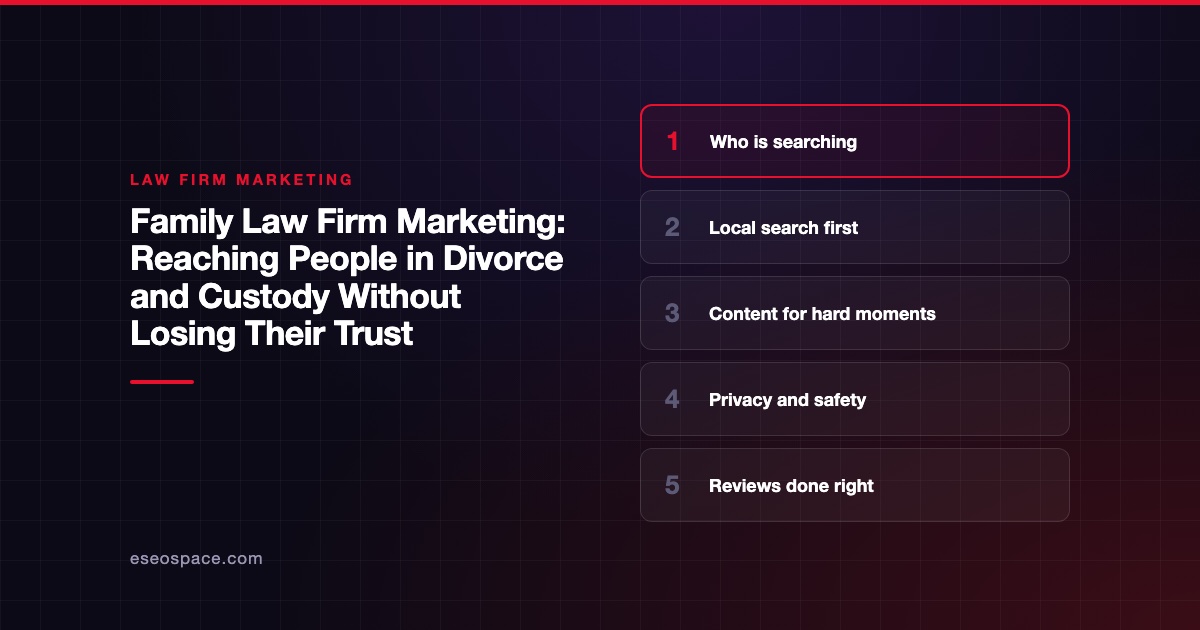
Family law is also different from injury or criminal work. Cases are usually local to one county court, clients compare several firms before calling, and reviews carry extra weight because the work is so personal. This guide, part of our Law Firm Marketing Guide, covers how to reach the right people, what to publish, how to protect privacy and how to handle reviews and contact rules.
This is marketing guidance, not legal advice. Advertising rules vary by state, so confirm specifics with your state bar.
Key Takeaways
- Most family law searches are local, so your Google Business Profile and county-specific pages are the core of your visibility.
- Content should help people understand the process (filing, temporary orders, mediation, custody factors) for your state and county, reviewed by an attorney.
- Some visitors may be in unsafe homes, so privacy-aware design and clear safety resources are worth adding.
- Asking for reviews is fine; offering incentives or picking only happy clients breaks Google's rules, and some states' testimonial rules too.
- Responses to negative reviews must not reveal confidential client information.
Who is searching, and what they need
Family law prospects usually fall into a few groups. Each group needs different content and a different first conversation.
| Prospect | Typical search | What they need first |
|---|---|---|
| Considering divorce | "how to file for divorce in [county]" | Process, timeline, cost drivers, what to gather |
| Just served papers | "served with divorce papers what now" | Deadlines to respond, urgency, how fast you can talk |
| Custody or support dispute | "modify child custody [state]" | When a change is possible, what evidence helps |
| Safety concern | "protective order [county]" | Safety resources, privacy, fast contact |
| Planning ahead | "prenup lawyer near me" | Approach, fees, how agreements work |
A firm that only has a single "Family Law" page will miss most of these searches. Separate pages for divorce, custody, support, modifications, protective orders and agreements let you answer each intent properly. Our guide to practice area pages shows how to structure them without creating thin, repetitive pages.
Local search comes first
Family law clients usually want a lawyer who knows their county court, judges' procedures and local mediators. That makes local search the center of your marketing.
Google Business Profile
Set up one profile for each staffed office. Google's Business Profile guidelines (checked 29 October 2026) say your business name "should reflect your business's real-world name," with no taglines or service descriptions added. The same page says individual practitioners such as lawyers can have their own profiles if they are public-facing and can be contacted at the verified location during stated hours, but a practitioner "shouldn't have multiple Business Profiles to cover all of their specializations."
Practical checklist:
- Pick the most accurate primary category for your practice, then add related secondary categories that match services you actually offer.
- List real office hours. If consultations are by appointment only, say so in your description and on your site.
- Add photos of your actual office and attorneys, not stock images.
- Answer reviews in a measured, private-respecting way (more on this below).
Our full guide to Google Business Profile for law firms covers categories and suspensions.
County and court pages
Write pages for the counties you serve that explain local procedure: where to file, whether the court requires a parenting class, how mediation is handled, and how long typical steps take. Cite the court's own website for every procedural fact. These pages help people, and they are hard for national directories to copy.
Content for hard moments
Family law content should lower anxiety and build trust. It is also YMYL content (Google's term for "your money or your life" topics), so accuracy matters.
Good topics:
- How divorce works in your state, step by step
- What temporary orders are and when to ask for them
- How courts in your state decide custody (cite the statute)
- How child support is calculated (link the state's official calculator)
- Mediation vs litigation: what each looks like
- What to bring to a first meeting with a lawyer
Writing tips:
- Use plain language and short paragraphs. Many readers are on a phone, late at night.
- Avoid promising outcomes. Florida's Rule 4-7.13 treats statements a reader "can reasonably interpret as a prediction or guaranty of success or specific results" as deceptive. "We fight for custody" is fine; "we win custody" is a problem.
- Watch tone. Content that reads as hostile toward the other spouse can put off clients who want a fair resolution, and it can make your firm look combative to referral sources such as therapists and mediators.
- Show who wrote or reviewed each page, with a link to the attorney bio. Our post on attorney bios and E-E-A-T explains why this matters.
Fees and consultations
People want to know what a family law case might cost. You do not have to publish a fee schedule, but you can explain what drives cost (contested vs uncontested, number of hearings, experts, discovery) and how you bill. If you charge for consultations, say so plainly. Some states attach conditions to fee advertising. For example, Florida's Rule 4-7.14 says a lawyer who advertises a specific fee or range "must honor the advertised fee or range of fees for at least 90 days" unless the ad states a shorter period.
Privacy and safety on your website
Some people researching divorce or custody are living with a partner who monitors their devices. The National Domestic Violence Hotline's internet safety page warns that "your computer and cell phone use can be monitored without you knowing it" and that browsing history "can never be completely erased." The Hotline's own site uses a quick-exit control, triggered by clicking an "X" or pressing Escape twice.
You cannot make a visitor safe, but you can avoid making things worse:
- Add a quick-exit button on protective order and domestic violence pages. It should load a neutral page, such as a weather site.
- List safety resources. Include the Hotline (800-799-7233) and "call 911 if you are in immediate danger."
- Keep forms short. Ask for name, a safe contact method and a brief description. Ask if it is safe to leave a voicemail or send email.
- Avoid retargeting ads on sensitive pages. Ads that follow someone around the web after they read about protective orders could alert another person using the same device.
- Explain confidentiality. Tell visitors not to send detailed facts through the form until a lawyer confirms there is no conflict. Our guide to website disclaimers and contact forms has sample wording.
Contact rules that touch family law
Most family law marketing is advertising aimed at people who are already searching, which is generally treated differently from targeted solicitation. Some targeted outreach is restricted, though, and the rules differ by state.
- Florida: Rule 4-7.18 bars written solicitations about a request for an injunction for protection against violence that are addressed to the respondent, if the lawyer knows or reasonably should know the respondent has not yet been served.
- Texas: Texas Penal Code section 38.12(d) restricts attorney written or telephone solicitations about a lawsuit, "including a divorce," in which the recipient is a defendant, unless the suit has been on file for more than 31 days.
If you are thinking about mailing people named in new divorce filings, talk to your bar's ethics staff first.
Reviews done right
Reviews matter in family law because prospects want reassurance that you are kind, responsive and honest about costs. Many clients are happy to help but will not think to review unless you ask.
Asking for reviews
Google's policy on fake engagement (checked 29 October 2026) says businesses must not offer incentives for reviews, must not "selectively solicit positive reviews," and must not discourage negative ones. Ask every client at a natural point, such as after a final order, and send a direct link.
Bar rules can add conditions. Florida's Rule 4-7.13 says a testimonial is misleading if it was drafted by the lawyer, if the person was given something of value for it, or if it lacks a disclaimer that others may not get the same results. That rule governs testimonials you use in advertising, so check how your state treats reviews you quote on your website.
Responding to reviews
Family law reviews can be emotional, including from opposing parties who were never your clients. Keep replies short and neutral. The Texas Professional Ethics Committee's Opinion 662 says a lawyer may not reveal confidential information "merely to respond to a former client's negative review," but may post "a proportional and restrained response that does not reveal any confidential information."
A safe template: thank the reviewer, say you take feedback seriously, note that confidentiality rules limit what you can say, and invite them to call the office. Our guide to ethical Google review generation for law firms covers timing and scripts.
Next step
Once your local visibility and content are in place, the next step is choosing where paid channels fit. Read Law Firm SEO vs PPC to compare them. When you are ready for a family law site that is calm, private and easy to act on, see our law firm marketing services.
Frequently asked questions
What is the best marketing channel for a family law firm?
For most firms it is local search: a well-run Google Business Profile, county-specific pages and steady reviews. Paid search can add volume, but it works best once your site converts visitors well.
Should a family law website show prices?
You are not required to, and many firms do not. Explaining what drives cost and how you bill builds trust. If you do advertise specific fees, check your state's rules; Florida, for example, requires honoring an advertised fee for at least 90 days unless the ad states otherwise.
Can I reply to a bad review from an ex-spouse of my client?
You can reply, but keep it neutral and never reveal client information. Texas Ethics Opinion 662 allows a "proportional and restrained" response that discloses nothing confidential. Many firms simply note that confidentiality limits their reply and invite a call.
Do family law sites need a quick-exit button?
No rule requires one, but it is a good idea on protective order and domestic violence pages. The National Domestic Violence Hotline warns that devices can be monitored, and a quick exit gives visitors a fast way to leave.
Can we contact people who were just served with divorce papers?
That depends on your state and is often restricted. Texas, for example, restricts attorney solicitations to a divorce defendant until the suit has been on file for more than 31 days. Ask your bar's ethics staff before any targeted outreach.









