

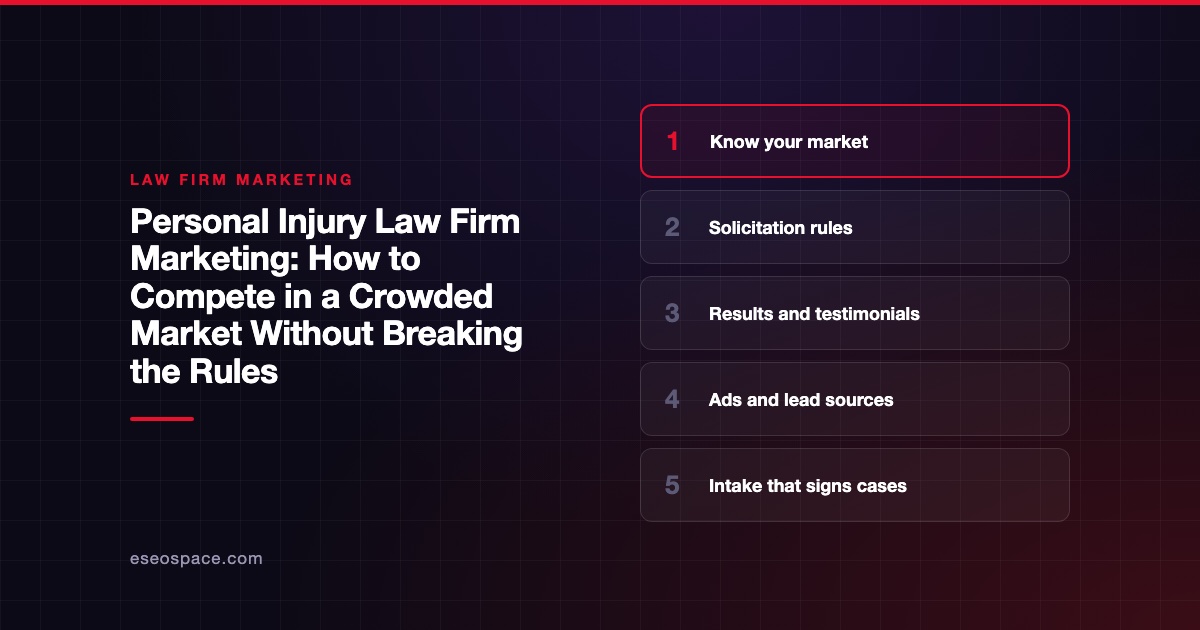
This article is part of our Law Firm Marketing Guide: how clients find lawyers online, what the advertising rules allow, and how to choose the right help. Want to know where your firm's site stands? Get a free 20–30 page website audit within 24 hours.
Personal injury law firm marketing works when you pair strong local visibility with fast, careful intake and advertising that stays inside your state's rules. Personal injury (PI) is one of the most crowded corners of legal marketing. Big firms run TV, billboards and paid search all year, and a smaller firm cannot outspend them everywhere.
You can still win cases. The firms that do well usually pick a clear service area, answer every call, publish content that helps injured people make decisions, and avoid the shortcuts that bar regulators punish. This guide is part of our Law Firm Marketing Guide and covers where PI firms should spend effort, what the rules say about contacting accident victims, and how to judge your lead sources.
This is marketing guidance, not legal advice. Rules vary by state, so confirm anything here with your state bar's ethics or advertising staff.
Key Takeaways
- Personal injury marketing is mostly a local game, so your Google Business Profile, map rankings and city-level pages matter more than national reach.
- Some states restrict written contact with accident victims for a set period, for example 30 days in Florida's bar rules and Texas law.
- Past results, verdict amounts, testimonials and "no fee unless we win" claims carry specific conditions in many states.
- Pay-per-lead sources and lead generators are allowed in some states only if they do not appear to recommend you.
- Intake speed and quality decide whether paid leads turn into signed cases, so fix intake before you raise ad spend.
Know your market before you spend
PI competition varies a lot by city and case type. A car accident firm in a large metro faces a very different field than a firm handling trucking or premises cases in a smaller county.
Start with three questions:
- Which case types do you want more of? Car, truck, motorcycle, slip and fall, dog bite and wrongful death each have their own search terms and intake questions.
- Where will you actually take cases? Your service area should match the courts you appear in and the offices you staff.
- Who already owns the map results? Search your main terms from a phone inside your service area and note which firms show in the ads, the map pack and the first organic results.
That last check often shows that the top map spots in your county are winnable even when the paid search auction is not. A focused local SEO plan, built around one office location and a few case types, tends to be the most efficient place for a small or mid-size PI firm to start. Our local SEO services page explains how we approach this.
Your Google Business Profile
Google lets lawyers have practitioner profiles, but with limits. According to Google's Business Profile guidelines (checked 29 October 2026), a practitioner "shouldn't have multiple Business Profiles to cover all of their specializations," and support staff should not create their own profiles. The same page says a rented mailing address the business does not operate from is a virtual office that "isn't eligible for a Business Profile."
That matters in PI, where some firms try to add "offices" in every nearby town. If the location is not staffed and open to clients, it is a suspension risk. Build city coverage with useful pages instead.
The solicitation rules that shape PI marketing
Personal injury is where solicitation rules bite hardest. Every state has its own version, so treat the examples below as examples, not a national rule.
Florida's 30-day rule
Rule 4-7.18 of the Rules Regulating The Florida Bar (October 2026 edition) bars a lawyer from sending a written communication about a personal injury or wrongful death action, or an accident involving the recipient or a relative, "unless the accident or disaster occurred more than 30 days prior to the mailing." Permitted written communications must be marked "advertisement," and the rule sets out how that label must appear on envelopes, brochures and email subject lines.
The same rule bars in-person and real-time solicitation, which it defines to include telephone and live video contact, when the lawyer has no family or prior professional relationship with the person.
Texas: bar rules plus a criminal statute
In Texas, Rule 7.03 of the Texas Disciplinary Rules bars soliciting non-clients through in-person contact or live telephone, social media or other electronic contact, with narrow exceptions. Texas also has a barratry statute. Texas Penal Code section 38.12(d) makes it an offense for an attorney to send a written or telephone solicitation about a personal injury or wrongful death claim "before the 31st day after the date on which the accident or disaster occurred."
What this means for your marketing
- Do not buy accident-report mailing lists or text-message campaigns without your bar's sign-off on timing and labeling.
- Make sure any vendor, investigator or "runner" working for you follows the same rules. Florida's rule covers employees and agents, and Texas covers anyone acting on your behalf.
- Keep your website, search ads and content as your main channels. These reach people who are already looking, which is why most states treat them differently from targeted solicitation.
Our explainer on lawyer advertising rules for websites covers the general framework in more detail.
Results, testimonials and fee claims
PI websites lean on verdicts, settlements and client stories. Those are often the most regulated parts of the site.
| Claim on your site | What to check | Example rule |
|---|---|---|
| "$2.1 million verdict" | Is it accurate, and was it later reduced or settled for less? | Texas Rule 7.01(g) requires stating the amount the client actually received if a verdict was reduced, reversed or settled for less |
| "We've recovered millions" | Is it objectively verifiable? | Florida Rule 4-7.13(b)(2) treats past results as misleading unless objectively verifiable |
| Client testimonial | Did you write it, pay for it, or omit the disclaimer? | Florida Rule 4-7.13(b)(9) lists six testimonial conditions |
| "No fee unless we win" | Does the ad disclose costs the client may still owe? | Florida Rule 4-7.14(a)(7) |
| Actor or dramatized crash | Is there a clear disclaimer? | Florida Rule 4-7.13(b)(5) to (7) |
Two details catch many firms. First, Florida's Rule 4-7.13 says a testimonial must include "the disclaimer that the prospective client may not obtain the same or similar results," and the person giving it cannot be "given something of value" for it. Second, Florida's Rule 4-7.14 says fee statements, "including those that indicate no fee will be charged in the absence of a recovery," need disclosure of all fees and expenses the client might owe.
In Texas, Rule 7.01 says a statement is misleading if it is "substantially likely to create unjustified expectations about the results the lawyer can achieve." That is a good test for any headline on a PI home page.
Filing and review
Some states review lawyer ads. The State Bar of Texas Advertising Review Department reviews advertisements and solicitation communications, and its page lists a $100 application fee for preapproval (checked 29 October 2026). Under Texas Rule 7.05, website content is exempt from filing except the homepage, unless the homepage content is itself exempt. Florida's Rule 4-7.20 exempts "information contained on the lawyer's Internet website(s)" from its filing requirement, but the content rules still apply.
Paid channels and lead sources
Most PI firms use some paid media. The question is which channels and how you judge them.
Google Local Services Ads
Lawyers are one of the categories Google supports in Local Services Ads. According to Google's Local Services Ads help page (checked 29 October 2026), you "pay only for leads related to your business," and businesses that pass Google's screening can show a "Google Verified" badge. The same page says failing to respond to leads regularly may affect your ad ranking. Our sibling guide on Google Local Services Ads for lawyers walks through setup and lead disputes.
Google Search ads
Search ads put you on top for terms like "car accident lawyer near me," but you compete in the same auction as the biggest firms in your market. Tight geographic targeting, negative keywords (for example "jobs," "salary," "free legal aid" if you do not serve that need) and dedicated landing pages matter more here than in most practice areas. See our Google Ads management page.
Lead generators and pay-per-lead vendors
Buying leads is legal in some states, with conditions. Comment 13 to Texas Rule 7.03 says a lawyer may pay for leads "as long as the lead generator does not recommend the lawyer." It also says the lawyer must not pay a generator that implies it is recommending the lawyer, referring without payment, or has analyzed the person's legal problem.
Before you sign with a lead vendor, ask:
- Is the lead exclusive to you, or sold to several firms?
- What does the vendor's ad and landing page say to the consumer? Read it yourself.
- Does the payment structure look like fee-sharing or a referral fee in your state?
- Can you dispute bad leads, and how fast are refunds?
Intake decides whether marketing pays off
An injured person may call several firms in one afternoon, so slow callbacks cost cases. A strong ad campaign feeding a weak intake process wastes money.
Basic intake standards for a PI firm:
- Answer live, all day. If you advertise evenings and weekends, someone must actually answer.
- Use a short, consistent script. Date of accident, location, injuries, treatment so far, insurance involved, and whether they already have a lawyer.
- Run a conflicts check early. Do it before the person shares detailed facts.
- Follow up the same day. Leads that sit overnight often sign elsewhere.
- Track the source of every lead. You need it to judge cost per signed case.
Our guide to law firm intake and lead response time goes deeper on scripts, after-hours coverage and conflict checks.
Content that helps injured people decide
Good PI content answers the questions people ask in the days after a crash: what to do at the scene, how medical bills get paid, how insurance adjusters work, how long a claim takes, and when a lawyer is worth calling.
Practical rules for PI content:
- Write state-specific pages. Fault rules, insurance minimums and filing deadlines differ by state, so cite your state's statute or court page.
- Have an attorney review every page and show the reviewer's name.
- Build one strong page per case type and location instead of many thin near-duplicates. Our guide to practice area pages explains how.
- Add plain-language FAQs that AI search tools can quote accurately.
Next step
Once you know which channels fit your market, the next step is measuring them. Read our guide to law firm marketing KPIs to track cost per signed case. If you want help building a PI site and local search plan that respects your state's rules, see our law firm marketing services.
Frequently asked questions
Can a personal injury lawyer send letters to accident victims?
It depends on the state. For example, Florida's bar rules bar written communications about a personal injury or accident until more than 30 days after the event, and require "advertisement" labeling after that. Texas has a similar 31st-day line in its Penal Code. Check your own state's rule before any mail or text campaign.
Is "no fee unless we win" allowed on a PI website?
Many states allow it with conditions. Florida's Rule 4-7.14 requires the ad to disclose all fees and expenses the client might be liable for. If clients may owe case costs even when you lose, say so clearly next to the claim.
Can we post verdicts and settlements on our website?
Usually yes, if they are accurate and not misleading. Florida treats past results as misleading unless objectively verifiable. Texas requires you to state the amount the client actually received if a verdict was later reduced, reversed or settled for less.
Are Local Services Ads worth it for a PI firm?
They can be, because Google charges per lead rather than per click. Results depend on your market, review count, and how quickly you answer. Read our Local Services Ads guide, linked above, before you commit budget.
Is buying personal injury leads ethical?
Some states allow it with strict conditions. Texas, for example, allows payment to lead generators only if the generator does not appear to recommend you or to have analyzed the person's case. Confirm your state's position before signing any pay-per-lead contract.









