

This article is part of our Real Estate & Property Management Marketing Guide: how buyers, sellers, owners and tenants find you online, what the housing ad rules allow, and how to choose the right help. Want to know where your site stands? Get a free 20–30 page website audit within 24 hours.
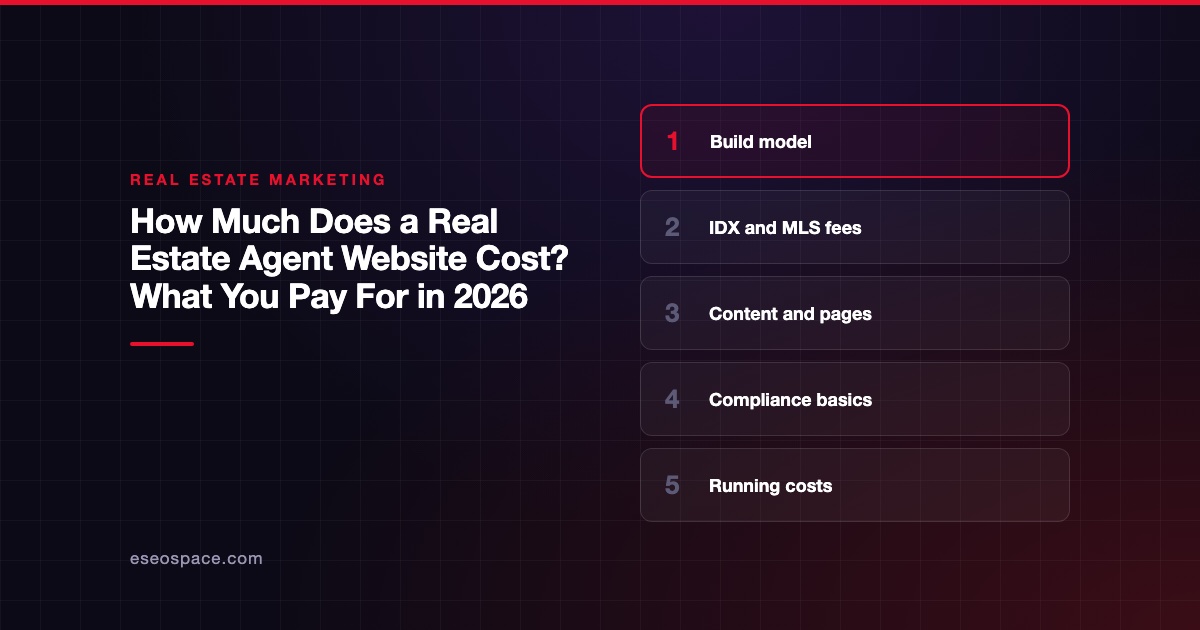
A real estate agent website costs whatever its parts cost: the build, the IDX listing feed, the content and the monthly upkeep. A template site with a basic feed is the cheapest route. A custom site with neighborhood pages, lead routing and ongoing care costs more, and it is usually the one you own outright.
There is no single fair price. Two quotes can differ a lot because they include different things. This guide shows you the cost drivers, so you can line quotes up side by side and see what each one actually buys.
This article is part of our Real Estate and Property Management Marketing Guide. If you are still deciding what the site needs, start with real estate agent website must-haves.
Key Takeaways
- Your total cost has two parts: a one-time build and recurring fees for IDX, hosting, software seats and care.
- IDX vendors publish their own monthly prices, and many MLSs add a separate data fee on top.
- Custom design costs more up front, but you control the code, the domain and the content.
- Licensing disclosures, Fair Housing wording and accessibility are part of the build, not extras to bolt on later.
- Compare quotes line by line: pages, content, IDX setup, integrations, ownership and who maintains the site.
The three ways agents buy a website
Most agent sites come from one of three models. Each has a different cost shape.
| Model | What you get | Up-front cost | Ongoing cost | Who owns it |
|---|---|---|---|---|
| Brokerage-provided page | A profile or subsite on your brokerage's platform | Usually none to low | Often bundled with your brokerage plan | The brokerage |
| Template platform | A pre-built real estate theme with IDX included or added | Low to moderate | Monthly subscription | Usually the platform; check the contract |
| Custom build | A site designed for your market, brand and lead flow | Higher | Hosting, IDX and care plan | You, if the contract says so |
Brokerage-provided pages
Many brokerages give agents a free or low-cost profile page. It is a fine start. The catch is portability: if you change brokerages, the page and its search history stay behind. We cover that trade-off in a separate guide on personal agent sites vs brokerage sites.
Template platforms
Template platforms sell a ready theme plus hosting for a monthly fee. Setup is fast. Design and page structure are limited to what the theme allows. Read the cancellation terms. Some platforms keep the site and content if you leave.
For example, Agent Image's website packages page (checked 29 October 2026) describes tiers from predesigned "Agent Image X" and "Agent Pro" sites up to custom "Semi-Custom" and "Imagine Studio" builds. It lists "Basic IDX Integration" in all packages but does not publish prices; it asks you to contact sales.
Custom builds
A custom build is designed around your market, your listings and how you want leads to reach you. It costs more because it involves strategy, design, writing and development time. In return, you choose the platform, the hosting and the integrations. You can also move the site to a new host or agency later.
What drives the cost of an agent website
Ask any designer to break their quote into these parts. If a part is missing, ask whether it is excluded or just not itemized.
1. Number and type of pages
Page count is the biggest driver. A five-page brochure site is a small project. A site with 20 neighborhood pages, buyer and seller guides and a blog is a much bigger one.
Neighborhood pages take the most time because each one needs real local detail. Thin copies of the same page with the city name swapped do not help. Google's spam policies list "multiple domain names or pages targeted at specific regions or cities that funnel users to one page" as an example of doorway abuse. Budget for real local detail on each page you build.
2. IDX and MLS data fees
IDX (Internet Data Exchange) is the feed that puts MLS listings on your site. Our IDX explainer covers how it works. For cost purposes, know that IDX is almost always a separate monthly bill.
Vendors publish their own prices. As of October 2026:
- Showcase IDX's pricing page lists Essentials at $94.95 per month and Premium at $124.95 per month, with annual options. It says some MLSs charge vendors for data access, that it passes that cost on, and that this "typically" ranges from $0 to $33 per month depending on your MLS.
- IDX Broker's homepage lists Core from $60 per month, Engage from $99 per month and Elite from $149 per month. It says all plans include a one-time setup fee but does not show the amount.
Higher tiers add features that matter for marketing. Showcase IDX's Premium tier, for example, adds indexable XML sitemaps and pagination "so search engines can crawl beyond the first 100 listings," plus real-time CRM integrations, according to the same pricing page. Check what your current CRM needs before you pick a tier.
3. Design and branding
A template restyled with your colors is quick. A custom design with your own layouts, photography direction and brand system takes longer. If you are on a team, factor in team branding and individual agent pages.
4. Content and writing
Someone has to write your bio, seller and buyer pages, neighborhood pages and FAQs. If you write them yourself, the build is cheaper and slower. If the designer writes them, ask who interviews you and how many revision rounds are included.
5. Lead capture and integrations
Forms, home valuation tools, saved searches and CRM connections all add development time. Each integration also adds a vendor to maintain. List the tools you already pay for, so the quote can reuse them instead of adding new ones.
6. Compliance work
Real estate sites carry rules that a generic web designer may miss. These are part of a proper build.
- License disclosures. Rules vary by state. For example, in California, the Department of Real Estate's license disclosure chart (RE 559) says "first point of contact" materials, including internet ads, must show the licensee's name, the broker's name and the 8-digit license number of each licensee in the ad.
- Fair Housing. HUD's Fair Housing rights page says the Act bars discrimination "because of race, color, national origin, religion, sex, familial status, and disability." Your copy, photos and neighborhood descriptions should be reviewed with that in mind. Our Fair Housing advertising guide covers wording.
- Accessibility. The Justice Department's web accessibility guidance says Title III covers "businesses open to the public" and points to WCAG as helpful guidance. Building to WCAG from the start costs less than retrofitting. See our WCAG accessibility services.
Rules vary by state, so confirm disclosure and advertising details with your broker of record.
7. Speed, hosting and security
Listing photos are heavy. Good image handling and solid hosting keep pages fast on phones. Security updates and backups belong in the monthly plan, not in a panic invoice after a hack.
Recurring costs to budget for
The build is only the first bill. Plan for these every year:
- IDX subscription and any MLS data fee (see vendor pages above).
- Hosting and domain renewal.
- Software seats, such as CRM users. Showcase IDX, for example, lists per-user add-on pricing beyond included seats on its pricing page.
- Care plan: updates, backups, security monitoring and small edits.
- Content updates: market notes, new neighborhood pages and refreshed seller guides.
- SEO and local search work, if you want the site to rank. That is a separate budget. Our guide to real estate SEO cost explains how agencies price it.
How to compare two quotes
Put each quote into the same checklist. The cheaper quote often leaves out something you will pay for later.
- Pages. How many, and which ones? Are neighborhood pages included?
- Content. Who writes it? How many revisions?
- IDX. Which vendor and tier? Who pays the vendor and MLS fees? Who sets up the feed?
- Integrations. Which CRM, forms and calendars are connected?
- Compliance. Does the build include license disclosures, a Fair Housing copy review and WCAG testing?
- Ownership. Do you own the domain, the hosting account, the code and the content? Can you leave with them?
- Launch tasks. Redirects from any old site, analytics setup and Google Business Profile links.
- Care. What does the monthly plan include, and what is billed hourly?
Ask how the agency handles search visibility after launch. A site that looks great but never ranks still costs you leads. If the quote bundles SEO, ask for the SEO deliverables to be listed separately.
Where your money does the most work
If your budget is tight, spend it in this order:
- A fast, mobile-friendly site you own, on your own domain.
- Clear seller and buyer pages with a simple contact path.
- An IDX tier that lets search engines index listing pages.
- A few strong neighborhood pages for the areas you actually sell in.
- A care plan that keeps it updated and secure.
Skip the extras until those five work. Animated hero videos and ten plugins do not sell homes.
Next step
Once you know what drives the cost, the next step is choosing who builds it. Read how to choose a real estate website designer for the questions to ask. When you are ready, see our real estate website design and SEO services or check our pricing page, where work is quoted per scope.
Frequently asked questions
Is a brokerage-provided website enough?
It can be enough for a new agent. The page usually belongs to the brokerage, so you lose it if you move. If you plan to build a personal brand over years, a site on your own domain is safer.
Why is IDX billed separately from the website?
IDX is a data service from a licensed vendor, not part of the design. Vendors charge a monthly fee, and some MLSs add their own data fee. Showcase IDX, for example, says on its pricing page that it passes MLS vendor fees through to customers.
Do I own my site on a template platform?
It depends on the contract. Some platforms let you export content, and some keep the site when you cancel. Read the cancellation and ownership terms before you sign.
What compliance items should a quote include?
At minimum, license disclosures that meet your state's rules, Fair Housing-aware copy and an accessibility review. For example, California's DRE requires license numbers on first point of contact materials, including internet ads. Confirm the details with your broker of record.
Does a new website include SEO?
A good build includes technical basics: clean URLs, page titles, a sitemap and fast pages. Ongoing SEO, such as content, local search and links, is usually a separate monthly service. See our guide to real estate SEO cost.









