

This article is part of our Real Estate & Property Management Marketing Guide: how buyers, sellers, owners and tenants find you online, what the housing ad rules allow, and how to choose the right help. Want to know where your site stands? Get a free 20–30 page website audit within 24 hours.
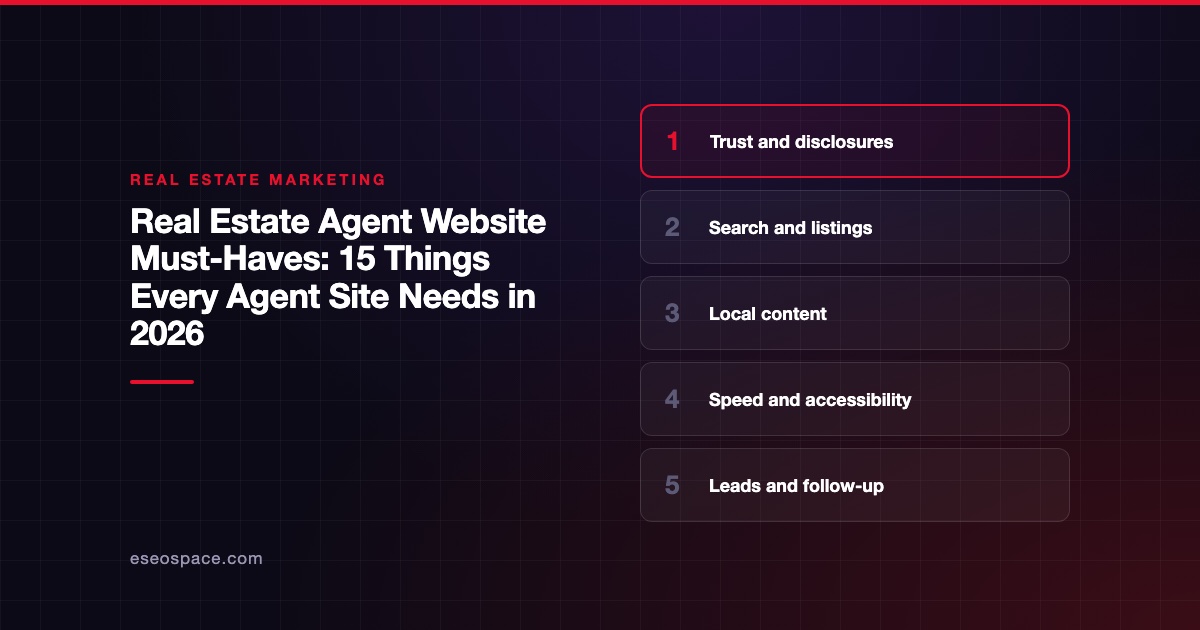
A real estate agent website needs five things to work: clear trust signals, a useful home search, local content, a fast and accessible build, and an easy way to contact you. Everything else is decoration. Below are the 15 specific items we'd check on any agent site in 2026, grouped under those five headings.
Use it as an audit. Open your site on your phone, go down the list, and mark each item yes, no or partly. The "no" items are your to-do list.
This checklist is part of our Real Estate and Property Management Marketing Guide. If you manage rentals, the same guide has a property management track.
Key Takeaways
- Disclosures are a must-have, not fine print: NAR's Code and many states require your firm name and license details on your site.
- IDX search keeps buyers on your site, but local content is what makes your site different from every other one with the same listings.
- Buyer pages need updating for the written buyer agreements required since August 2024.
- Speed and accessibility have published targets: Google's Core Web Vitals and W3C's WCAG 2.2.
- Your site should make it obvious who you are, where you work and how to reach you, for people and for AI search tools.
Trust and disclosures
1. Firm name and license information
NAR's Code of Ethics says websites of REALTORS® affiliated with a firm must disclose the firm's name and the licensee's state(s) of licensure in a reasonable and readily apparent manner (Standard of Practice 12-9). States can add more. In California, for example, the DRE's advertising guidelines treat a licensee's website as first point of contact material requiring the license number and responsible broker's name. Put these in your header or footer, on every page.
2. A real About page
Buyers and sellers are choosing a person. Show a current photo, how long you've been licensed, the areas you know and how you work. Skip claims you can't back up. Article 12 of the NAR Code requires REALTORS® to present a true picture in their advertising.
3. Reviews you can point to
Link or embed reviews from platforms buyers recognize, such as your Google Business Profile. Ask happy clients for a review soon after closing, and respond to every review.
4. Fair housing-safe copy
Every page is an ad. Describe properties and places, not the people you think should live there. Read Fair Housing advertising rules for real estate websites before you write neighborhood blurbs.
Search and listings
5. IDX home search
IDX lets you show other brokers' listings on your site under MLS rules. NAR describes it as letting participants authorize limited electronic display of their listings by other participants. Ask your vendor whether it uses the RESO Web API and where the listing pages live. IDX Explained covers the options.
6. Your own listings, done properly
Your listings deserve more than the IDX template: full photo sets, video, a map and a clear contact path. If you offer live video tours, note that an agreement is needed first (see item 9).
7. Current, accurate data
The NAR Code says REALTORS® must use reasonable efforts to ensure that information on their websites is current and correct it promptly (Standard of Practice 12-8). Check that sold and withdrawn listings drop off, and that your bio still names the right brokerage.
Local content
8. Neighborhood and community pages
This is where your site can stand apart. Original pages on the areas you serve, with real detail, give search engines and buyers a reason to choose your site over a portal. Our guide to neighborhood pages explains how to avoid thin, copy-paste pages.
9. Buyer and seller pages that reflect 2024 changes
Since 17 August 2024, NAR's FAQ says buyers and their agents must put compensation in writing prior to touring a home. Your buyer page should explain the agreement in plain English. Remove any "free to buyers" claims unless they are literally true. See The NAR Settlement and Your Website.
10. Answers to common questions
Write short, direct answers to the questions you hear every week: closing costs in your county, how long sales take, what to fix before listing. Clear answers help people, and they're the kind of content AI search tools can quote. Our article on how AI search recommends agents and property managers explains why.
Speed and accessibility
11. Fast on a phone
Google's Core Web Vitals give targets: Largest Contentful Paint within the first 2.5 seconds, Interaction to Next Paint under 200 milliseconds, and Cumulative Layout Shift under 0.1. Big listing photos and heavy IDX scripts are the usual culprits.
12. Accessible to everyone
W3C's WCAG 2.2 is the current accessibility standard; W3C notes it was published on 5 October 2023, with an update in December 2024. Practical basics: alt text on photos, readable contrast, forms that work with a keyboard, and captions on video.
13. Secure and maintained
Use HTTPS, keep plugins and themes updated, and limit who has admin access. A hacked agent site can expose client contact data.
Leads and follow-up
14. Easy contact on every page
Put a tap-to-call number, a short form and your service area where people can find them on every page. Ask only for what you need. A long form on a phone loses people.
15. Structured data and a connected profile
Mark up your business with structured data so search engines know who you are. Schema.org has a RealEstateAgent type for this. Keep your name, phone and address the same on your site, your Google Business Profile and directories.
Quick audit table
| # | Must-have | Yes / No / Partly |
|---|---|---|
| 1 | Firm name and license info on every page | |
| 2 | Current About page | |
| 3 | Reviews linked or shown | |
| 4 | Fair housing-safe copy | |
| 5 | IDX search | |
| 6 | Full pages for your own listings | |
| 7 | Data kept current | |
| 8 | Neighborhood pages | |
| 9 | Buyer pages updated for 2024 changes | |
| 10 | FAQ answers | |
| 11 | Core Web Vitals in range | |
| 12 | WCAG 2.2 basics | |
| 13 | HTTPS and updates | |
| 14 | Contact on every page | |
| 15 | Structured data and consistent profile |
Rules on disclosures vary by state, so confirm the details with your broker of record.
What you can skip
- Auto-playing music or video. It slows the page and annoys visitors.
- Pop-ups on page load. Ask for contact details after you've given something useful.
- Generic "market update" posts copied from elsewhere. They add nothing a buyer can't find on a portal.
Next step
If your audit turned up more "no" than "yes," the next decision is whether to fix your current site or start over, and what that should cost. Read How Much Does a Real Estate Agent Website Cost? next. Or get a free 20–30 page website audit within 24 hours and we'll mark the list for you. You can also see how we approach realtor website design and SEO.
Frequently asked questions
What is the single most important thing on an agent website?
Trust. A visitor needs to know quickly who you are, which brokerage you're with, where you work and how to reach you. Without that, a good design or IDX search won't convert.
Do I need IDX on my website?
Most buyer-focused agents benefit from it, because it keeps buyers searching on your site. Listing-focused agents can sometimes do without it. Either way, IDX alone won't set your site apart; local content does.
How often should I update my website?
Check listings and disclosures continuously, since NAR's Code expects current information. Review bio, brokerage details and buyer pages at least whenever something changes, such as a brokerage move or a new rule.
Does my website need to be accessible?
Accessibility helps every visitor, including people using screen readers or keyboards. WCAG 2.2 is the current W3C standard. Ask your designer to build to WCAG 2.2 AA and to test with real assistive tools.
Can I use my brokerage's template site instead?
You can, and it covers many basics. The trade-off is control over content, design and what happens when you change firms.









