

This article is part of our AI Agent Guides. See how models compare this week on the AI Agent Leaderboard, a ranking of rankings refreshed every week.
The number to compare is cost per successful task, not price per token. A cheap model that burns more tokens, fails more often or needs more review can cost you more than a pricier one.
This guide shows how to estimate that number for your own work. It uses made-up models for the math. For how real models compare today, see the current leaderboard, which refreshes weekly.
Disclosure: eSEOspace is a member of the Claude Partner Network.
At a glance
Here is how a token-price comparison differs from a cost-per-task comparison.
| Question | Token price view | Cost per task view |
|---|---|---|
| What is measured | Dollars per million tokens | Dollars per finished, accepted task |
| Tokens used | Ignored | Counted per run |
| Failed attempts | Ignored | Counted through success rate |
| Caching and batch | Sometimes | Counted at your real mix |
| Tool fees | Ignored | Counted per call |
| Human review | Ignored | Counted in staff time |
A token is a small chunk of text the model reads or writes. Output tokens usually cost several times more than input tokens.
The formula
Use this formula as your starting point:
Cost per successful task = (token cost per attempt + tool fees per attempt + review cost per attempt) divided by success rate
Success rate is the share of attempts you would accept without rework. Everything in this formula can be measured in a one-week trial. Our agent scorecard shows how to run that trial.
Why token price misleads
Agents do not send one prompt. They work in a loop, and Anthropic's cost guide explains that the full conversation goes back with every request. Each batch of tool results triggers another request, so long tasks compound.
Models also differ widely in how many tokens they spend. Terminal-Bench is a benchmark of command-line agent tasks. Its 4.0 release note of 28 August 2026 reported 21.6 billion tokens on Sonnet 5's leaderboard run, against 6.5 billion for Opus 5.
Now look at Anthropic's list prices, checked on 2 November 2026. Sonnet 5 lists $2 input and $10 output, while Opus 5 lists $5 and $25. The cheaper rate came with about 3.3 times the tokens in that run.
That does not prove which one cost more, because the mix of cached and uncached tokens matters. It does prove you cannot judge cost from the rate card.
A worked example
Here are two made-up models, on a made-up task. Every number below is invented for illustration.
| Item | Model A | Model B |
|---|---|---|
| List price, input and output per million | $2 and $10 | $5 and $25 |
| Input tokens per attempt | 400,000 | 120,000 |
| Output tokens per attempt | 40,000 | 12,000 |
| Token cost per attempt | $1.20 | $0.90 |
| Success rate | 60% | 80% |
| Token cost per successful task | $2.00 | About $1.13 |
Model A looks 2.5 times cheaper on the rate card. In this example, it costs about 1.8 times as much per successful task.
Now add review. Suppose a reviewer earning a made-up $60 per hour spends 10 minutes per attempt. That adds $10 to every attempt.
Model A now costs ($1.20 + $10) divided by 0.6, or about $18.67. Model B costs ($0.90 + $10) divided by 0.8, or about $13.63. Notice that review dominates the token bill, which is common for hard work.
Factors that move the number
Caching
Prompt caching stores repeated context so later reads cost less. Anthropic lists Sonnet 5.5 at $2 for fresh input and $0.10 for cached reads, as of 2 November 2026. OpenAI lists GPT-6.1 Sol at the same two figures.
Caches expire, and writes usually cost more than plain input. Anthropic notes that your first message after a long break misses the cache and reprocesses your full context. So measure your cache hit share, not just the discount.
Batch and speed modes
Work that can wait is cheaper. Anthropic and OpenAI list batch prices at half of standard, and Google lists a 50% batch reduction too.
Speed costs extra. OpenAI's Fast mode doubles standard rates, and Anthropic lists Fast mode for Opus 5.5 at $8 input and $40 output. Check whether your tool has turned it on.
Tool fees
Search and code tools can bill separately. Anthropic and OpenAI list web search at $10 per 1,000 calls, plus token costs. Google lists 5,000 free grounded requests a month on Gemini 3 and later, then $14 per 1,000.
A research agent that runs 30 searches per task pays $0.30 in search fees before tokens at the $10 rate. Hosted runtime can add up too. Anthropic's Managed Agents add $0.08 per session-hour.
Scheduled price changes
Prices move. Google lists Gemini 4 Argon at $2 and $10 through 30 November 2026, then $4 and $20. Date your estimate, and rerun it when rates change.
Agent design
Your own design can shift cost more than the model does. Anthropic's guide notes that agent teams use roughly 7x more tokens than standard sessions when teammates run in plan mode. It also says thinking tokens bill as output.
Connected tools add context as well. Our guide to reducing MCP token costs covers that part.
Failure handling
Failed runs still bill. If your agent retries on its own, your cost per attempt rises and your logged success rate can look better than it is. Count all tokens from all retries toward the one final task.
Where to find real-world numbers
Some benchmarks now report cost alongside accuracy, which is useful for a first screen. The Terminal-Bench leaderboard shows cost and token columns. The Vals Index shows cost, tokens and duration per test.
Use these to spot huge gaps, not to predict your bill. Their tasks are not your tasks, and their agent setups are not your setup. See what we include in our methodology.
Vendor averages can help too.
Anthropic reports about $13 per developer per active day for Claude Code across enterprise deployments. It says 90% of users stay below $30 per active day. That is a vendor's own figure, and it covers one product.
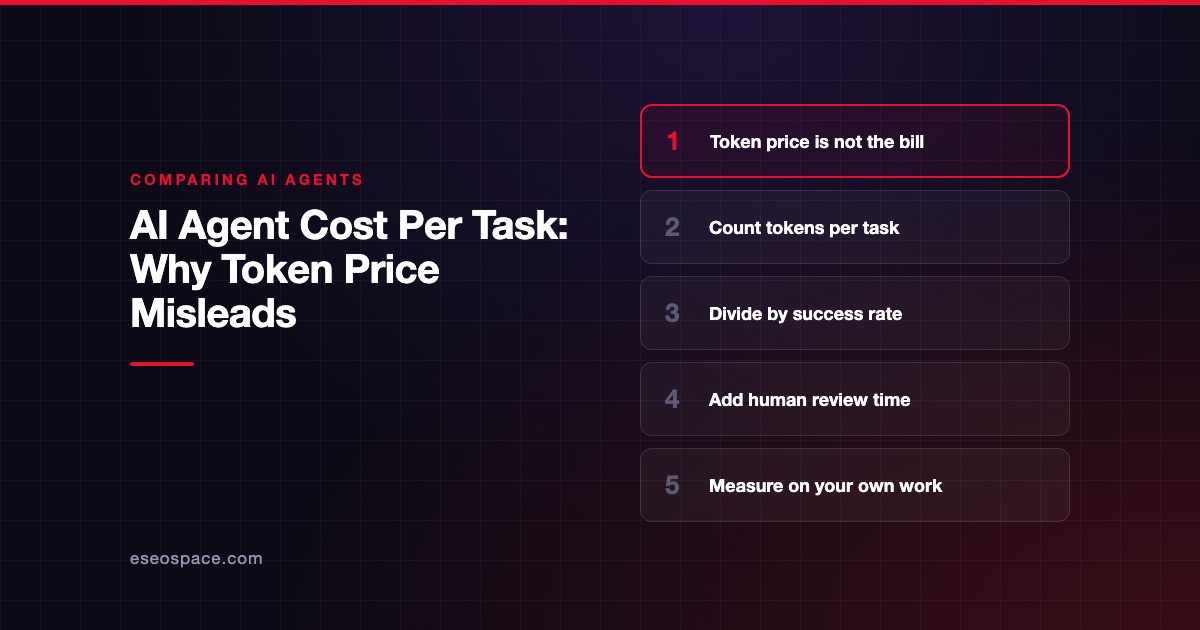
How to estimate yours in five steps
- Pick 10 to 20 real tasks. Choose examples of the work you plan to automate, including messy ones.
- Run each candidate on the same tasks. Run each task more than once, since results vary between runs.
- Log usage. Record input, cached and output tokens, tool calls and time for every attempt.
- Grade the output. Mark each result as accept, fix or reject, and time the review.
- Apply the formula. Compare cost per successful task across candidates, then add your volume.
Anthropic also suggests tracking latency, token usage, cost per task and error rates on a fixed bank of tasks. That gives you a baseline for later model changes.
Common estimating mistakes
These errors make an agent look cheaper than it is.
- Using only easy tasks. Your test set should include the messy cases that cost the most tokens and review.
- Leaving out failures. A run you threw away still billed you.
- Ignoring setup. Writing instructions, connecting tools and building tests all take staff time, so spread that over the first year.
- Forgetting upkeep. Models change, and each change means another round of testing.
- Mixing plans and API rates. A seat price and a token bill measure different things, so convert both to cost per accepted task before you compare.
- Assuming volume stays flat. A cheap tool often gets used more, so your total bill can rise as the unit cost falls.
Which should you choose
Use a cheap model when tasks are simple, success is easy to check and review is quick. Classification and routing are typical examples. Small mistakes cost little here.
Use a stronger model when review time is expensive or errors are costly. If a reviewer's time dominates the formula, a higher rate can pay for itself.
Use both when your workflow has simple and hard steps. Send routine steps to a small tier, and send hard ones up. Then test whether routing itself saves money, since it adds complexity.
Our take: never approve an agent budget from a rate card. Ask for cost per accepted task from a trial on your work. If you need a sense of plan-based pricing as well, read our AI agent pricing guide.
Frequently asked questions
What is a good cost per task?
It depends on what the task is worth. Compare it with what the same work costs you now, including review and errors. A $5 task can be a bargain if it replaces an hour of skilled work.
Do subscriptions change this math?
Yes. A flat seat hides token cost until you hit a limit. For planning, track tasks completed per seat per month, and compare that with usage-based rates.
How accurate can an estimate be?
Treat it as a range. Output varies between runs, so a small sample can mislead. Rerun your estimate after any change to the model, prompts or tools.
Which model has the lowest cost per task?
That depends on your tasks and changes over time, so we do not name one here. Compare current model positions on the leaderboard, then measure the finalists yourself.









