This article is part of our MCP Guide: what the Model Context Protocol is, how to use it safely, and how to choose servers, tools and help. Want a second opinion on your setup? Request a free MCP readiness review.
An MCP integration platform gives your AI tools ready-made connections to hundreds or thousands of apps through MCP. The platform handles sign-in, stores credentials and runs the tool calls, so you do not build a separate MCP server for each app.
That is the "buy" side of the build-vs-buy choice. It suits common apps like Slack, Gmail, Salesforce or Jira. It suits less well when you need deep access to your own systems or strict control over where data flows.
Below are nine platforms we checked against each vendor's docs and pricing pages on 28 October 2026. We did not install or test them. App counts and security figures are the vendors' own claims.
Key Takeaways
- Managed MCP platforms trade some control for speed: you get many apps at once with sign-in and credential storage handled for you.
- Pricing models differ a lot: per tool call, per task, per credit, per seat or per connected customer.
- Zapier MCP, Composio, Pipedream, Arcade, Merge and StackOne all publish a free tier or free starting plan.
- Workato and Paragon publish no prices; you get a quote from sales.
- Check whether actions run as each user (user-scoped auth) or as a shared account. That choice drives your security risk.
How we chose
We included a platform only if it met all of these tests:
- Live and public. A working MCP product we could open and check on 28 October 2026.
- Clear pricing. Published pricing, a free tier, or a clear path to a quote.
- Security basics documented. The vendor's docs describe managed authentication, access scopes or logging.
We used vendor product pages, docs and pricing pages only. Third-party "best of" lists were not used as sources. The order below is not a ranking.
MCP integration platforms compared
| Name | Best for | Pricing | Notable |
|---|---|---|---|
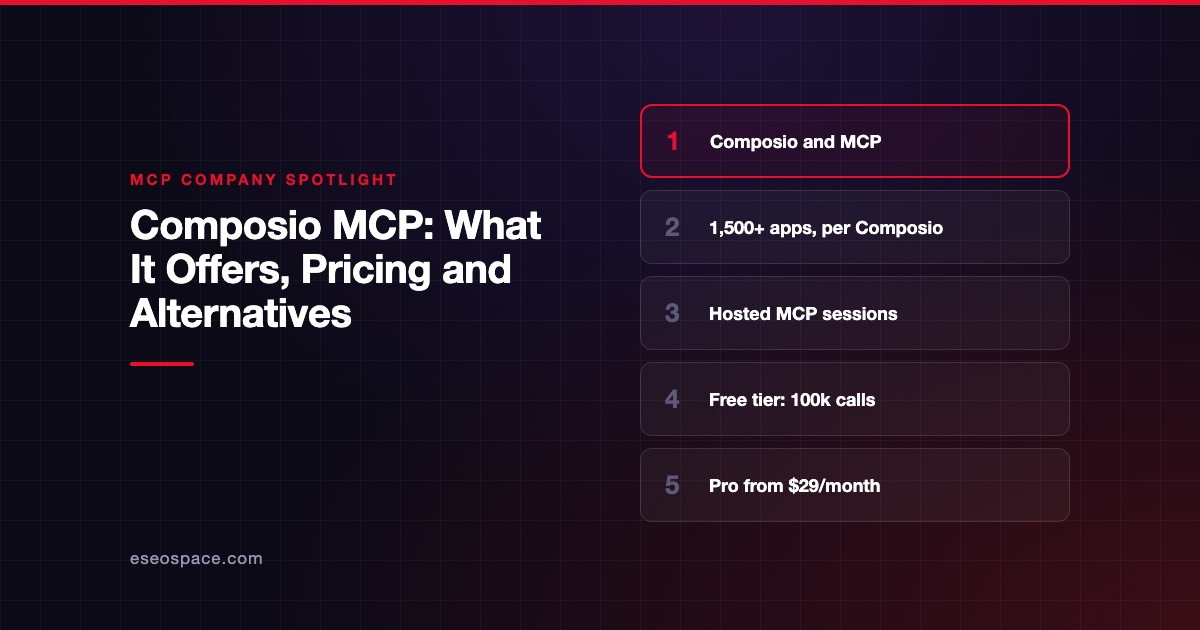
| Composio | Developers building agents | Free (100,000 tool calls/mo); Pro $29/mo | 1,500+ apps, per Composio |
| Zapier MCP | Non-developers and ops teams | Included in every Zapier plan; 2 tasks per tool call | 9,000+ apps, per Zapier |
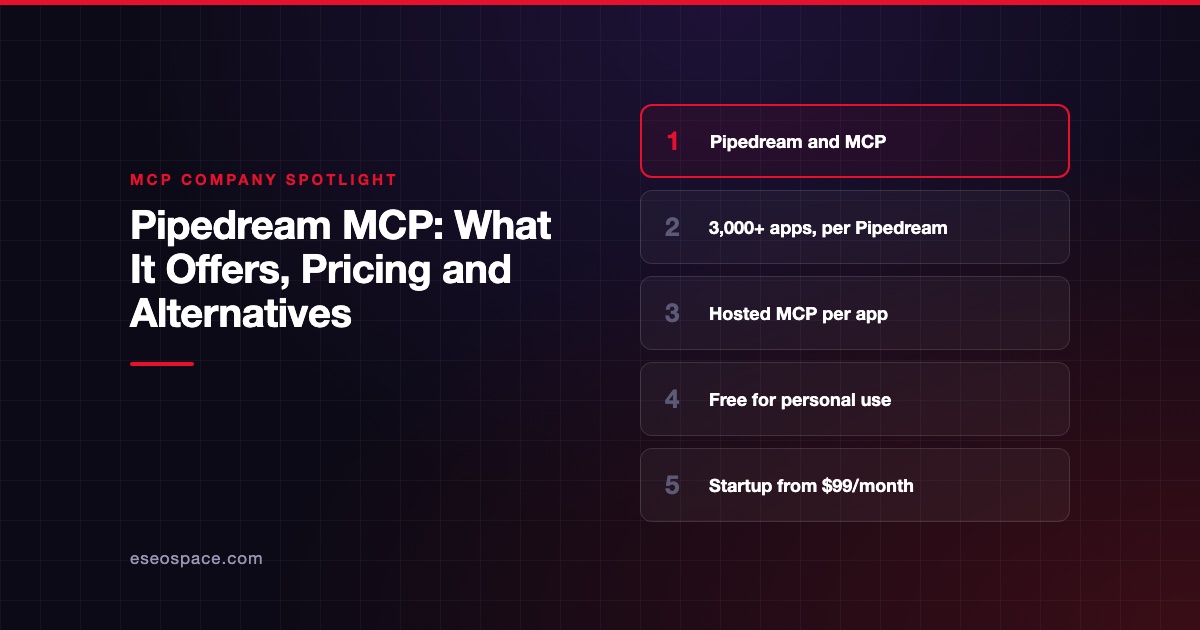
| Pipedream | Developers embedding tools for their users | Free in development; Startup $99/mo (annual) | 3,000+ apps, 10,000+ tools, per Pipedream |
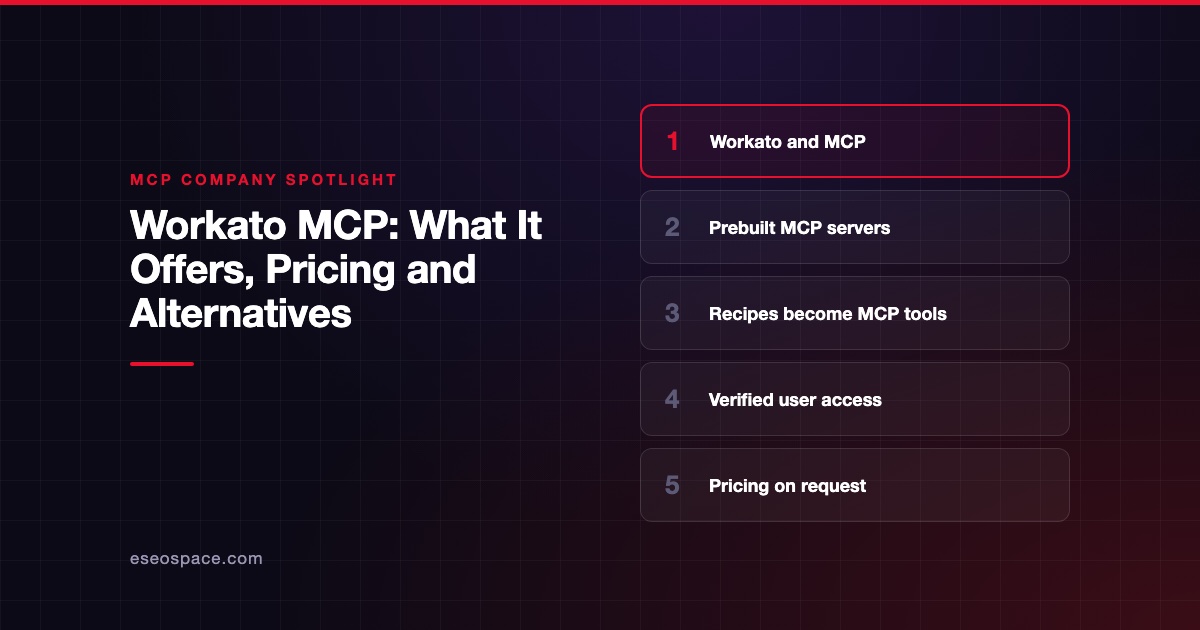
| Workato Enterprise MCP | Large companies on Workato | Pricing on request | Actions run under the user's identity |
| Merge Agent Handler | Enterprise SaaS connectors with DLP | Free (2,000 credits/mo); Pro $1,000/mo | Scans tool inputs and outputs for sensitive data |
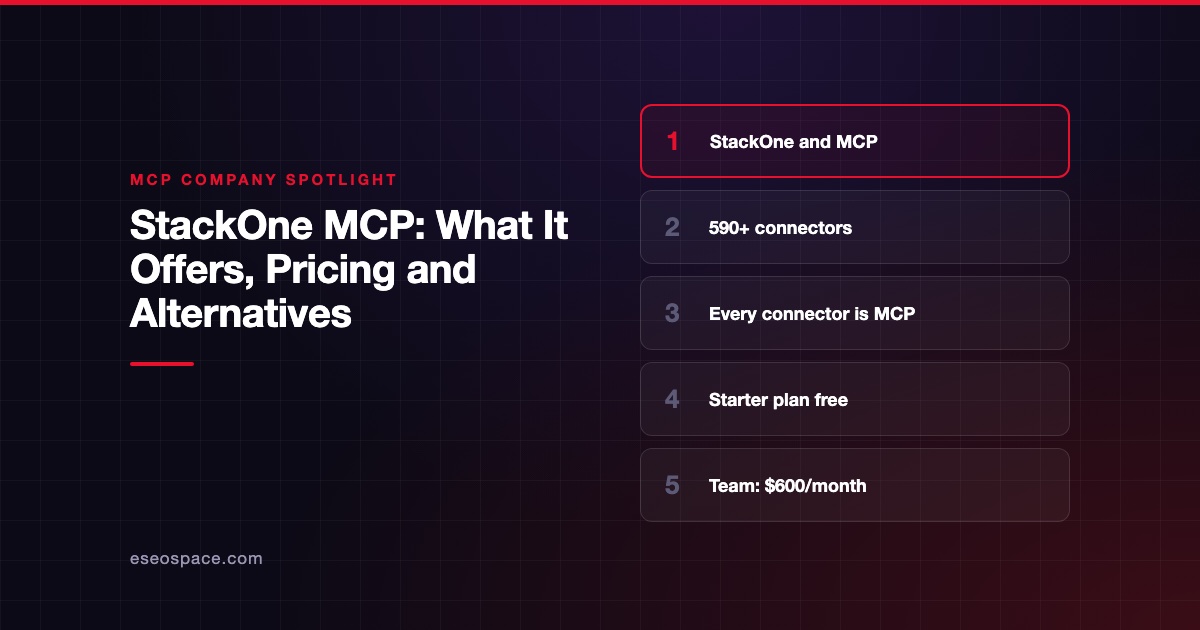
| StackOne | HR, CRM and enterprise SaaS actions | Free Starter; Team $600/mo | 590+ connectors, 36,000+ actions, per StackOne |
| Arcade | User-scoped agent actions | Free (2,000 calls/mo); Team $25/mo + $0.01/call | Agents act only as the signed-in user |
| Make | Teams already automating in Make | Free plan (1,000 credits/mo); paid plans on Make's site | Runs your Make scenarios as MCP tools |
| Paragon ActionKit | SaaS products adding integrations for customers | Pricing on request | Open-source MCP server (MIT) |
1. Composio: tool platform for AI agents
What it is: Composio's homepage says it gives "your AI secure access to 1,500+ apps." Its docs say you can expose a session through a hosted MCP endpoint, and "Composio-managed auth is the default." Sessions handle tool discovery, authentication and toolkit versions.
Best for: Developers building their own agents who want many apps without writing each integration.
Pricing: Composio's pricing page lists Hobby at $0 with 100,000 tool calls a month, Pro at $29 a month with a $29 usage credit, and custom Enterprise. Pro overage is $0.0003 per tool call. Hobby stops at its limit instead of charging you.
Pros:
- Very low per-call price on published rates.
- Works with any MCP client by pasting one URL, per Composio.
- Composio says it is SOC 2 Type II compliant.
Cons:
- New pricing applied to signups from 15 August 2026, so older reviews may quote different numbers.
- Built for developers; less friendly for non-technical staff.
Checked against: Composio docs on 28 October 2026.
2. Zapier MCP: your existing Zapier apps as AI tools
What it is: The Zapier MCP page describes "a secure way to connect AI clients such as Claude, ChatGPT, and Cursor" to Zapier-connected apps. Zapier says your agent can search "9,000+ apps and 66,000+ triggers and actions." Credentials stay with Zapier, you allow access app by app and action by action, and every MCP action shows in History.
Best for: Small businesses and ops teams that already use Zapier and want AI apps to take real actions.
Pricing: Zapier says MCP is "included in every Zapier plan" and "each tool call uses two tasks." Zapier's pricing page lists Free with 100 tasks a month, Professional from $19.99 a month (annual) and Team from $69 a month (annual).
Pros:
- Largest app list on this page, per vendor figures.
- No new contract if you already pay for Zapier.
- Zapier says it is SOC 2 Type II certified.
Cons:
- Two tasks per tool call can use up a small task allowance quickly.
- Zapier's own pages cite different action counts (66,000+ and 30,000+).
Checked against: Zapier MCP page on 28 October 2026.
3. Pipedream: MCP servers for every app, built for developers
What it is: Pipedream's MCP docs describe dedicated MCP servers for each app, "powered by Pipedream Connect." Pipedream lists "3,000+ apps and APIs" and "over 10,000 pre-built tools." It offers "fully-managed OAuth and secure credential storage," and credentials are not exposed to the AI model.
Best for: Developers who need to make tool calls on behalf of their own app's users.
Pricing: Pipedream's pricing page lists Free for development, Startup at $99 a month billed annually ($150 monthly) with 100 external users and 10,000 credits, and custom Business. Extra credits are $0.012 each on Startup.
Pros:
- Hosted servers are free for personal use, per Pipedream.
- Clear per-credit and per-user pricing.
- Business plan adds SSO, SCIM and HIPAA options.
Cons:
- Free plan is development only; production needs Startup.
- Credits are compute-time based (30 seconds each), so cost per call varies.
Checked against: Pipedream MCP docs on 28 October 2026.
4. Workato Enterprise MCP: governed MCP on an enterprise iPaaS
What it is: Workato's MCP page describes Enterprise MCP as a way to expose company systems through "trusted MCP servers, so agents can safely take real actions." Agent actions run under the signed-in user's identity, so role-based access applies. Every agent request, response and system event is logged.
Best for: Large companies that already run integrations on Workato.
Pricing: Pricing on request. Workato's pricing page names a Business MCP and an Enterprise MCP edition but publishes no figures.
Pros:
- Existing Workato recipes can become MCP servers without code.
- Prebuilt servers for Salesforce, Slack, Jira, Workday, ServiceNow and Stripe.
- One console to govern every MCP server.
Cons:
- No public prices.
- Workato's page cites both 12,000+ and 14,000+ apps, so check the current figure.
Checked against: Workato Enterprise MCP page on 28 October 2026.
5. Merge Agent Handler: enterprise connectors with data loss prevention
What it is: Merge says "Merge Agent Handler is a platform for securely connecting AI agents to enterprise tools at scale" on its product page. It can be installed as a remote MCP server in Claude, Cursor or ChatGPT. Merge says "every tool call input and output is scanned for sensitive data," and full audit logs come on all plans.
Best for: Companies that need data loss prevention (DLP) rules on what agents send and receive.
Pricing: Merge's Agent Handler pricing page lists Free at $0 with 2,000 monthly credits, Pro at $1,000 a month with 25,000 credits, and custom Enterprise. The page does not say how many credits one tool call uses.
Pros:
- Block, redact or mask rules for sensitive data.
- Audit logs include identity, arguments and downstream API calls.
- Enterprise plan offers on-prem deployment and SIEM log streaming.
Cons:
- Big jump from the free plan to $1,000 a month.
- Credit cost per tool call is not published.
Checked against: Merge Agent Handler page on 28 October 2026.
6. StackOne: enterprise SaaS actions with prompt-injection screening
What it is: StackOne calls itself "integration infrastructure for AI agents" and says "every StackOne connector is available as an MCP server." It lists 590+ connectors and 36,000+ actions across HR, recruiting, CRM and more. StackOne says every action is "permission-scoped, audit-logged, and screened for prompt injection."
Best for: Teams connecting agents to HR, recruiting, learning and identity systems.
Pricing: StackOne's pricing page lists Gateway Starter free with 1,000 credits per seat per month, Team at $600 a month with 5,000 credits per seat, and Enterprise on request. OEM plans are separate.
Pros:
- Strong coverage of HR and recruiting systems.
- Permissions at the action, field and user level.
- StackOne claims its Prompt Injection Guard catches 89% of malicious tool responses.
Cons:
- The 89% figure is a vendor claim with no public test detail on the page.
- Team plan is a big step up from free.
Checked against: StackOne site on 28 October 2026.
7. Arcade: user-scoped authorization for agent actions
What it is: Arcade calls itself an MCP runtime: "the infrastructure layer that enables AI agents to securely connect to external tools and business systems." It says "agents act only on behalf of the authenticated user, not through broad service accounts." Arcade's homepage lists "8,000+ permission-aware tools," while its docs say "7,500+ across 81 MCP servers," as of October 2026. It also offers an open-source framework for building your own. See our Arcade.dev profile.
Best for: Teams worried about agents having more access than the person using them.
Pricing: Arcade's pricing page lists Free at $0 with 2,000 tool calls a month, Team at $25 a month plus $0.01 per tool call, and custom Enterprise.
Pros:
- Delegated auth means the agent never exceeds the user's own scope.
- Simple, published per-call pricing.
- Bring or build custom MCP tools in Python or JavaScript.
Cons:
- $0.01 per call adds up for high-volume agents.
- Smaller app catalog than Zapier or Composio, per vendor figures.
Checked against: Arcade site and Arcade docs on 28 October 2026.
8. Make: run your Make scenarios from AI apps
What it is: Make's MCP server docs say it "allows AI systems, such as large language models (LLMs), to run scenarios and manage your Make account." It is a Make-hosted server using Streamable HTTP. You connect with OAuth or an API key.
Best for: Teams that already build automations in Make and want AI apps to trigger them.
Pricing: Make's pricing page says the Free plan has 1,000 credits per month. Check that page for current paid plan prices. Per Make's docs, scenario-run tools work on all plans; management tools need a paid plan.
Pros:
- Your tested scenarios become tools, which limits what the AI can do.
- OAuth sign-in supported.
- Scopes you choose decide which tools appear.
Cons:
- Tools are only as good as the scenarios and descriptions you write.
- Account-management tools need a paid plan.
Checked against: Make MCP server docs on 28 October 2026.
9. Paragon ActionKit: integrations for SaaS products
What it is: Paragon's ActionKit page offers "One API/MCP to equip your AI agent product with 1000+ integration actions." Its open-source Paragon MCP server connects agents to ActionKit. When a user has not connected an app, it prompts them through Paragon's Connect Portal, which handles OAuth.
Best for: Software companies adding integrations for their own customers inside their product.
Pricing: Pricing on request. Paragon's pricing page shows no prices; usage scales by number of customer orgs. The MCP server code is MIT licensed.
Pros:
- Embedded sign-in components for your customers.
- Supports custom actions from OpenAPI specs.
- Open-source server you can inspect.
Cons:
- No published prices.
- Paragon's own pages give different coverage figures (1,000+ actions; 130+ integrations in the README).
Checked against: Paragon MCP server on GitHub on 28 October 2026.
How to pick between them
Match the platform to who will use it:
- Staff using AI apps day to day: Zapier MCP or Make, especially if you already pay for either.
- Developers building one agent: Composio, Arcade or Pipedream.
- SaaS products serving many customers: Pipedream, Paragon or StackOne OEM plans.
- Regulated or large companies: Workato, Merge or StackOne Enterprise, for identity, DLP and audit logs.
Before you commit, ask three questions. Does each action run as the real user? Can you limit tools per app or per team? Can you export logs? Our checklist for choosing MCP servers has more. Our MCP security risks guide explains why user-scoped auth matters.
If none of these fit, a custom server may be the better route. See what drives MCP server development cost or our MCP development service. For governance across many connections, compare the best MCP gateways.
Next step
Still deciding whether to use a managed platform or build your own? Read build vs buy: custom MCP server or managed platform. For more plain-English guides, visit The MCP Guide.
Frequently asked questions
What is an MCP integration platform?
It is a service that gives AI apps ready-made MCP connections to many other apps. The platform handles sign-in, stores credentials and runs tool calls. You connect once instead of setting up a separate MCP server for each app.
Is a managed MCP platform safer than building my own server?
It depends on the platform and your needs. Good platforms keep credentials away from the AI model and log every action. But your data passes through a third party, so check their security reports, data retention and whether actions run as each user.
How is MCP usage priced?
Models vary. Zapier counts tasks, Composio and Arcade count tool calls, Pipedream and StackOne use credits, and Merge uses monthly credits. Estimate how many tool calls your team will make before comparing prices.
Can I use more than one platform?
Yes. Many AI apps let you connect several MCP servers at once. More connections mean more tools for the AI to choose from, though, which can confuse it and widen your security exposure. Start with the few apps you need most.
How did eSEOspace check these platforms?
We opened each vendor's product page, docs and pricing page on 28 October 2026. We did not install or test them. App counts and security figures are the vendors' own claims.