
This article is part of our Therapy Practice Marketing Guide: how clients find a therapist, how to market ethically and privately, and how to choose the right help. Want to know where your practice's site stands? Get a free 20–30 page website audit within 24 hours.
Marketing child and teen therapy means marketing to parents first. A parent or caregiver usually searches, compares and pays. The young person decides whether therapy works. Your website has to earn the parent's trust without talking down to the child or teen who may also read it.
That two-audience problem shapes everything: the words you use, how you explain confidentiality, which pages you build and who refers to you. This guide is part of our Therapy Practice Marketing Guide. It covers what works for practices that see children, teens, or both.
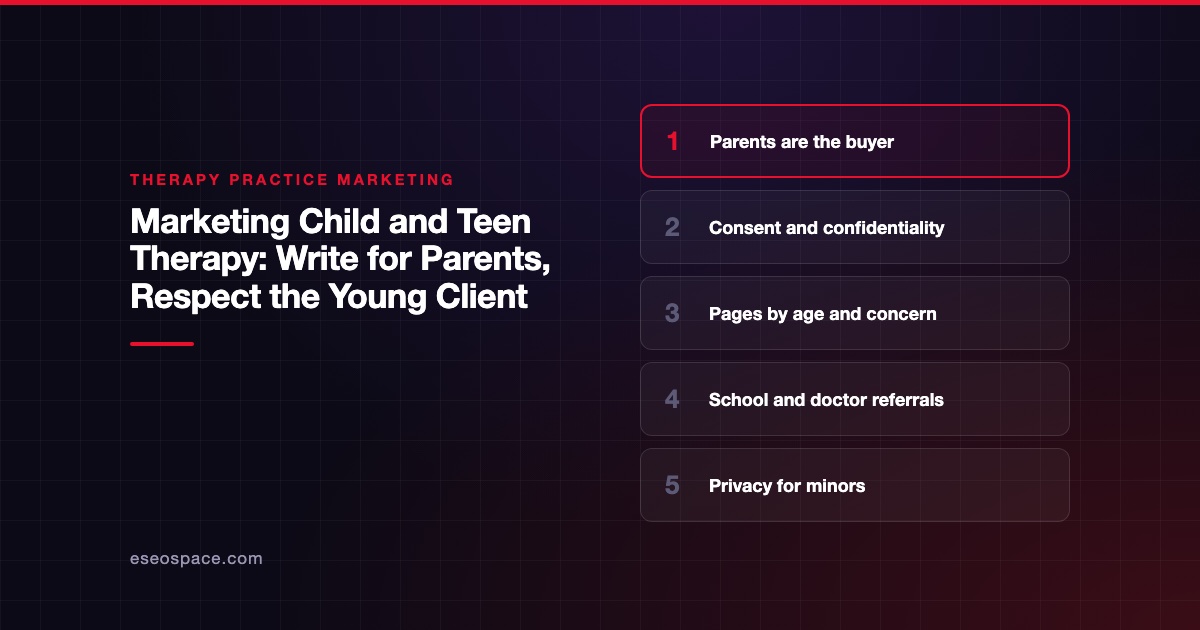
Key Takeaways
- Parents are the main buyers, so lead with their worries: is this normal, who can help, and what happens next.
- Explain consent and confidentiality for teens in plain words, and base it on your state's law, which varies.
- Split pages by age band and by concern, because a parent of a 5-year-old and a parent of a 16-year-old search very differently.
- Schools and pediatric offices are major referral sources, so give them a page and an easy way to refer.
- Collect as little information about minors online as you can, and keep clinical details off general web forms.
Who you are really marketing to
The parent or caregiver
Most first contacts come from a worried adult. They often start with a question, not a service. "Is it normal for a 7-year-old to have meltdowns every day?" "My teen stopped going to school." The CDC's page on children's mental health advises parents with concerns to "talk to a health care provider", and to talk to the child's health care professional or teacher about behavior concerns. Your site can be the next stop after that conversation.
What parents want to see quickly:
- The ages you see, stated in years
- The concerns you treat, in everyday words
- How parents are involved in sessions
- Fees, insurance and scheduling (after-school times matter)
- What the first appointment looks like
The teen
Teens often check out a therapist before agreeing to go. Some search on their own. A teen page should be short, honest and free of forced slang. Tell them what sessions are like, what stays private and what does not, and that they get a say.
The referrer
School counselors, pediatricians and other therapists send many child and teen referrals. They need different information: what you treat, ages, waitlist status, how to refer and how you communicate back. More on this below.
Explain consent and confidentiality clearly
This is the question parents and teens both ask, often in opposite directions. Parents want to know what they will be told. Teens want to know what they will not.
The law varies by state
Who can consent to therapy for a minor is set by state law, and the rules are not the same everywhere. For example, in Washington, RCW 71.34.530 says "any adolescent may request and receive outpatient treatment without the consent of the adolescent's parent", while outpatient treatment for a child under 13 needs consent from a parent or other authorized person. The chapter's definitions section defines an adolescent as a minor 13 or older. Other states set different ages and conditions.
Do not copy another state's rule onto your site. Write your consent section from your own state's law and your clinical policies, and have your licensing board guidance or compliance counsel confirm it.
What to put on the page
A good confidentiality section for a child and teen practice usually covers:
- Who can book and consent to sessions in your state, in one or two sentences.
- What parents will hear about, such as attendance, general progress and safety concerns.
- What stays between the therapist and the young person.
- The limits of confidentiality, such as risk of harm and mandated reporting.
- How parents and teens can ask questions about the policy.
Write it once and link to it from your parent page, your teen page and your intake page. Keep the wording calm. A parent reading "we may have to report" with no context will worry. A sentence that explains why the limit exists reassures both readers.
Crisis information
Child and teen sites need clear crisis information on every page, because a worried parent may land on your site in an emergency. Say you are not an emergency service, and point to 988 and 911. Our guide to crisis resources on therapy websites covers the wording.
Build pages by age and by concern
A single "child and adolescent therapy" page cannot rank for or answer everything parents search. Split it.
By age band
Ages change the treatment, the parent's role and the search terms. A typical structure:
| Page | Typical parent searches | What to include |
|---|---|---|
| Young children (for example, under 8) | "play therapy near me", "toddler tantrums help" | Parent involvement, play-based methods, what sessions look like |
| School-age children | "child anxiety therapist", "therapist for ADHD kids" | School coordination, homework help limits, session timing |
| Teens | "teen therapist near me", "therapy for teenager depression" | Teen privacy, scheduling around school, teen voice |
| Parents | "parenting support therapist", "parent coaching" | How parent-only sessions work |
Use your real age ranges. Brain Smart Therapy and Play, an eSEOspace client in Federal Way, Washington, states that it works with children from birth to age 8 with their caregivers, and that it does not see teens or older children. That kind of clarity saves calls for everyone.
By concern
Then build pages for the concerns you treat most, such as anxiety, school refusal, ADHD support, grief or self-harm. Mountainside Behavioral Health, an eSEOspace client in Colorado, lists school refusal support and a teen multi-family DBT skills group for ages 12 to 18 with a parent attending. A named, specific program page is easier to find and easier to refer to than a generic list.
Stay within your scope. Describe what you help with, not diagnoses you promise to make. Avoid outcome claims such as "we fix school refusal in six weeks". Each concern page should explain what help looks like, not label the child.
Use real names for methods
If you use named methods, such as Parent-Child Interaction Therapy, play therapy, DBT for adolescents or CBT, name them and explain each one in a sentence. Parents increasingly search for methods their pediatrician or school mentioned.
Earn school and pediatric referrals
Referrals from schools and doctors can be steadier than search traffic. Your website supports them in three ways.
A "for schools and providers" page
Give referrers one place to go. Include:
- Ages and concerns you treat
- Current availability or waitlist status, kept up to date
- How to refer (phone, fax or a secure referral form)
- What you send back, with the parent's written permission
- Insurance plans you take, since referrers are asked about this
Make it easy to share
A school counselor may hand a parent a printed list. Make sure your practice name, phone number and website are consistent everywhere, so the parent can find you from a scrap of paper. A one-page PDF summary on the referral page helps too.
Contracts and agencies
Some child-focused practices also contract with school districts or regional agencies. Lynne Alba Speech Therapy Solutions, an eSEOspace client in Torrance, California, is described on its spotlight page as a certified Nonpublic Agency with district contracts, and lists those districts on its site. If you hold contracts like these, say so. Parents searching through a district often look for that exact phrase.
Privacy for minors online
Child and teen practices should collect as little personal data online as possible. Two reasons: client confidentiality and children's privacy law.
COPPA
The federal Children's Online Privacy Protection Act protects children under 13. According to the FTC's COPPA FAQ (checked 29 October 2026), it applies to sites directed to children under 13 that collect personal information from them, and to general audience sites with actual knowledge they are collecting it from a child under 13. The FTC notes the Rule was amended on 22 April 2025. Personal information includes names, contact details, photos and persistent identifiers such as tracking cookies.
Most therapy sites are written for parents, not children. Keep it that way. Address your contact form to the parent, ask for the parent's details, and do not invite children under 13 to submit information. If you build anything aimed at young children, such as games or a kids' page that collects data, get legal advice first.
Tracking and forms
Advertising pixels on pages about a child's mental health can expose sensitive information. Read our guide to tracking pixels on therapy websites before adding any ad or analytics tag. For forms, use a vendor that will sign a business associate agreement if the form collects health information. Our guide to HIPAA-compliant forms and scheduling covers the options.
Photos
Never use real child clients in photos, even with permission, unless you have legal advice. Use licensed stock images or illustrations, and avoid images that look like a real session.
Mistakes to avoid
- Writing only for parents, so the teen reads the site and refuses to go.
- Copying a consent rule from another state.
- One "kids and teens" page for every age and every concern.
- No clear path for school counselors and pediatricians to refer.
- Contact forms that ask for a child's diagnosis or history.
- Outcome promises, such as "your child will be back on track in weeks".
Next step
If you are planning a full rebuild for a child and teen practice, the therapy website launch checklist covers privacy, crisis information and tracking before you go live. When you want a team to build parent, teen and referrer pages for you, see our mental health website design and SEO services.
Frequently asked questions
Should I have a separate page for teens?
Yes, if you see teens. A short page written to them, explaining privacy and what sessions are like, can make a reluctant teen more willing to try. Keep the parent information on its own page.
Can a teenager book therapy without a parent?
It depends on your state's law and your policies. In Washington, for example, adolescents 13 and older may receive outpatient treatment without parental consent under RCW 71.34.530. Other states differ, so confirm your state's rules with your licensing board or counsel before you describe them on your site.
Do I need to worry about COPPA on a therapy website?
COPPA applies to sites directed to children under 13, or sites that knowingly collect personal information from them. Most practice sites are written for parents and avoid this by addressing forms to adults. If you are unsure, get legal advice.
How do I get more referrals from schools?
Build a clear page for school counselors and providers, keep your availability current, and make referring simple. Consistent contact details across your site and listings help parents find you after a school gives them your name.
Should I show client success stories?
Be very careful. Stories about children can identify them, even when details are changed, and many professional codes limit testimonials. Explaining your approach and what to expect is usually a safer way to build trust.