This article is part of our AI Ads hub. Want help applying it? Talk to eSEOspace.
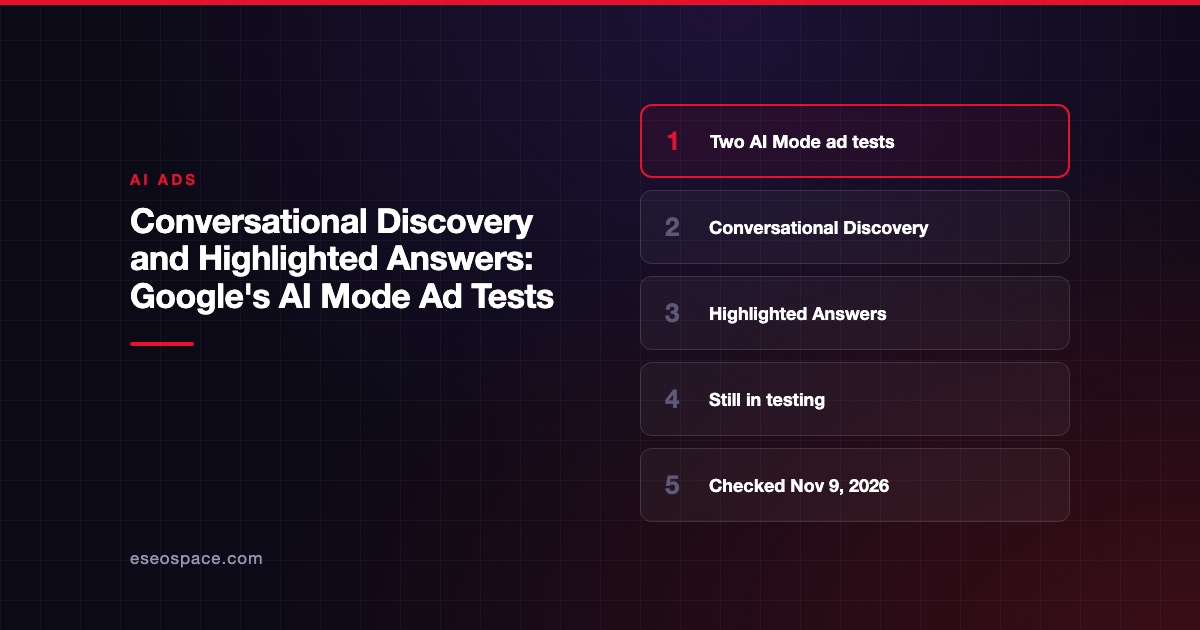
Conversational Discovery ads and Highlighted Answers are two ad formats Google is testing in AI Mode. Conversational Discovery ads answer a person's specific question, and Highlighted Answers place a relevant ad inside a list of AI Mode recommendations.
Google announced both on 20 May 2026 and called them tests. We found no later Google page with a launch date. This explainer is part of our AI ads hub and was checked against Google's pages on 9 November 2026.
Key Takeaways
- Google said in May 2026 it was "testing two new types of ads, built with Gemini," for AI Mode.
- With Conversational Discovery ads, Google says Gemini builds creative tailored to a person's search.
- Highlighted Answers let "highly relevant, high-quality ads" appear on a list of AI Mode recommendations.
- Both formats include an independent AI explainer that Google writes, alongside your creative.
- Google gave no launch date, sign-up process or country list for either format.
What Google announced
Google's Google Marketing Live post said: "That's why we're testing two new types of ads, built with Gemini, that offer relevant product details along with helpful guidance."
Google framed both as answers to research-style questions. People want to know how a product fits their situation, and the formats try to show that inside AI Mode.
Google also said the formats "will also continue to be clearly labeled as 'Sponsored.'"
Conversational Discovery ads
Google's description reads: "With Conversational Discovery ads, your ad answers a person's specific question."
Google's example was a long question about making a home smell like a spa or a rainy forest. It said: "We use the Gemini model to build creative tailored to that search, highlighting specific relevant features."
In plain terms, the ad is shaped by the question. It is not a fixed headline written once and reused. That puts more weight on what Google can learn about your product from your assets, feed and website.
Highlighted Answers
Google's description reads: "Now, when AI Mode provides a list of recommendations — like the best language apps for an upcoming trip — highly relevant, high-quality ads are eligible to appear on that list as a Highlighted Answer."
This one sits inside a list. When AI Mode recommends several options, a qualifying ad can be one of them, labeled as sponsored.
Google's phrase "highly relevant, high-quality" is the only eligibility hint it gave. It did not publish a definition or a threshold.
The AI explainer
Both formats come with text you do not write. Google says: "To help people evaluate their choices, both of these new formats will feature an independent AI explainer as part of the ad."
Google adds that its Gemini model "evaluates and synthesizes information about a product or service, and displays that context alongside the advertiser's creative."
Google's Help page on ads in AI experiences describes AI explainers more generally. It says advertisers "can't manually write, edit, approve, or opt out of them." It also says the explainer may use "publicly available sources including your website."
That has a practical effect. If your website is out of date or unclear, the explainer may reflect that. Google's Help page says keeping your website content clear and up to date "also helps Google surface accurate context in AI explainers."
Related formats from the same announcement
The same May post covered formats outside AI Mode. Keep them separate when you read coverage.
| Format | Where | Google's wording on timing |
|---|---|---|
| Conversational Discovery ads | AI Mode | "testing" |
| Highlighted Answers | AI Mode | "testing" |
| AI-powered Shopping ads | Search | "In the coming months" |
| Business Agent for Leads | Search ads | "In the coming months" |
| Direct Offers expansion | AI Mode | Pilot; parts "coming soon" |
Direct Offers has its own article: Google Direct Offers, explained.
What Google has not said
We checked Google's blog and its Help page on ads in AI experiences. Neither gave:
- A launch or general availability date for either format.
- A way to opt in, or whether existing campaigns are enrolled.
- Which countries or languages the tests run in.
- How these formats would show up in reporting.
Some trade coverage describes the tests in more detail. We could not match those details to a Google page, so we leave them out.
How to prepare without guessing
Google's own advice in the May post was to "build a strong foundation with AI Max for Search, AI Max for Shopping campaigns and Performance Max." That is Google recommending its own products, so weigh it against your goals.
Some steps make sense whichever format arrives:
- Keep your site accurate. The explainer can draw on your website, so fix outdated prices, specs and policies.
- Strengthen your product data. For Shopping, Google's Help page asks for complete titles, descriptions, images, prices and return policies in Merchant Center.
- Check match types. Google says exact and phrase match aren't eligible for contextual matching on exploratory questions. Read exact and phrase match in AI Mode.
- Review generated assets. Google's page on generated images tells advertisers to review generated or suggested assets for accuracy. The same habit makes sense for any AI-written text.
Should you change budgets now?
Not on the basis of these tests. They are not a product you can buy separately, and Google has given no date. Your existing Search, Shopping and Performance Max campaigns are what qualify for AI Mode today.
For how that works now, read how ads work in Google AI Mode and multi-turn ads in AI Mode.
Next step
If you want help getting your feeds, assets and landing pages ready for AI-written ad formats, see our paid search management service.
Frequently asked questions
Are Conversational Discovery ads live?
Google called them a test in May 2026. We found no later Google page announcing a launch as of 9 November 2026.
Can I write the AI explainer myself?
No. Google says advertisers can't manually write, edit, approve or opt out of AI explainers.
Do I need a new campaign type?
Google has not said. Its advice was to build on AI Max for Search, AI Max for Shopping and Performance Max.
Will these ads be labeled?
Yes. Google says the new formats will continue to be clearly labeled as "Sponsored."
Where do Highlighted Answers appear?
Google says they appear on lists of recommendations that AI Mode provides, such as a list of language apps for a trip.