
This article is part of our Law Firm Marketing Guide: how clients find lawyers online, what the advertising rules allow, and how to choose the right help. Want to know where your firm's site stands? Get a free 20–30 page website audit within 24 hours.
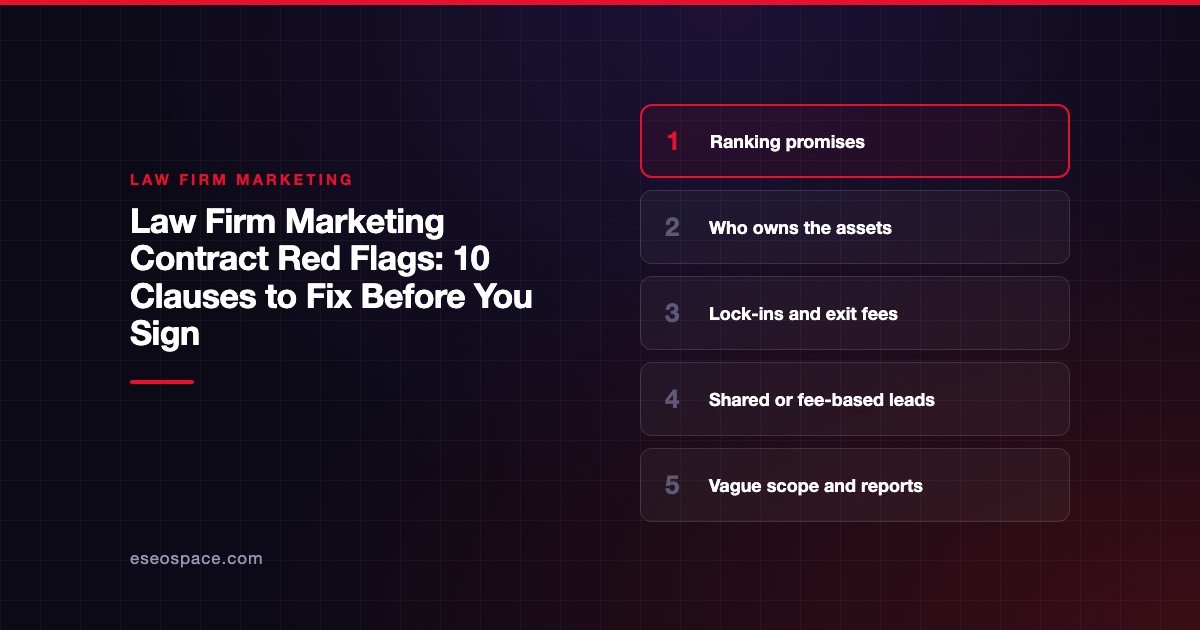
The biggest red flags in a law firm marketing contract are promised rankings, agency ownership of your domain or accounts, long lock-ins with exit fees, "exclusive" leads that are not exclusive, and payments tied to your legal fees. Each one can cost you money, and some can raise ethics questions.
You are a lawyer, so you will read the contract. The trouble is that marketing contracts hide risk in plain-looking clauses: "hosting," "licensed content," "proprietary tracking." This guide shows what to look for and what to ask for instead.
It is part of our Law Firm Marketing Guide. This is marketing guidance, not legal advice, so have your own counsel review any contract.
Key Takeaways
- A contract that promises a specific ranking conflicts with Google's own statement that no one can guarantee a number one ranking.
- Your firm should be the registered owner of the domain, Business Profile, analytics and ad accounts, and should get the website and content on exit.
- "Work made for hire" wording alone may not transfer copyright from an outside vendor; ask for a written assignment as well.
- Payment tied to fees you earn, or leads sold as exclusive when they are shared, deserve close review against your state's rules.
- A clear scope, a cancellable term and a written exit plan protect both sides.
1. Promised rankings or results
If the contract promises "page one" or "top three," ask what happens when it does not happen. Google's guidance on hiring an SEO says, "No one can guarantee a #1 ranking on Google," and tells you to beware of SEOs who claim to.
Ask for instead: a list of deliverables and the metrics you will review together, such as qualified leads and signed cases.
2. The agency owns your domain
Look for who is listed as registrant. ICANN's registrant rights and responsibilities page puts responsibility for the domain on the registrant. If that is the agency, the agency controls your web address.
Ask for instead: the domain registered to your firm, in your firm's registrar account, with the agency given access only if needed.
3. You "license" your own website
Some contracts say the site, design or content is licensed to you while you pay. Stop paying and the license ends. Copyright is the issue here. The U.S. Copyright Office's Circular 30 on works made for hire explains that a commissioned work counts as made for hire only if it fits one of nine listed categories and both parties sign a written agreement saying so.
So "work for hire" wording may not be enough on its own for a website. Ask for instead: a written assignment of copyright in the site design and content to your firm on payment, with clear terms for any third-party themes, fonts, photos or plugins. Have your counsel confirm the wording.
4. The agency controls your Google accounts
Your Google Business Profile, Analytics, Search Console and Ads accounts hold years of data and reviews. Google's Business Profile owners and managers page says a profile has only one primary owner, and a new owner must wait 7 days before transferring primary ownership. That delay matters if you are switching agencies in a hurry.
In Google Ads, the access levels page shows only Admin users can grant or remove access. Ask for instead: your firm as primary owner and Admin everywhere, with the agency as manager or Standard user.
5. Tracking numbers you cannot keep
Call tracking helps attribution. But if the agency owns the numbers and they appear on your website, Business Profile and directories, you lose them when you leave. Callers who saved the number reach a dead line.
Ask for instead: numbers ported to or held in your firm's account on exit, or a plan that keeps your main number as the primary listing. See call tracking and intake software for law firms.
6. Long lock-ins and exit fees
A two-year auto-renewing term with a large early termination fee shifts all risk to you. Some setup time is reasonable for SEO. Years of lock-in usually are not.
Ask for instead: a short initial term, then month to month with written notice. If there is an exit fee, it should match real unrecovered costs.
7. "Exclusive" leads that are shared
Lead programs sometimes sell the same inquiry to several firms. Ask how many firms receive each lead, how leads are assigned, and what "exclusive" means in writing.
Ethics rules also matter here. Comment 5 to ABA Model Rule 7.2 says a lawyer may pay for leads only if the lead generator does not recommend the lawyer and its communications comply with Rule 7.1. Our guide to pay-per-lead ethics covers this in depth.
8. Payment tied to your legal fees
Watch for pricing based on a percentage of fees from cases the marketing brings in. ABA Model Rule 5.4(a) says a lawyer shall not share legal fees with a nonlawyer, with narrow exceptions. In New York, State Bar Ethics Opinion 1131 allowed paying a lead service a fixed sum unrelated to the lawyer's retention, under several conditions.
Ask for instead: a flat fee or a defined retainer for defined work. Confirm any performance-based model with your state bar's ethics hotline or counsel.
9. Vague scope
"Ongoing SEO" or "content as needed" tells you nothing. A sound contract lists monthly deliverables, who drafts and who approves legal content, and what is out of scope.
Ask for instead: a scope schedule, plus a rule that nothing explaining the law goes live without attorney review at your firm.
10. No exit plan
The best time to plan the breakup is before you sign. Ask the agency to write down what it will hand over and how fast.
A short exit schedule could include:
- the domain and DNS records, already in your name
- a full website backup and admin logins
- all content, images and source files you paid for
- Google accounts with agency users removed
- tracking numbers and call recordings, where allowed
- the redirect map, if they changed any URLs
Quick reference table
| Clause | Red flag | What to ask for |
|---|---|---|
| Results | Ranking promises | Deliverables and agreed metrics |
| Domain | Registered to agency | Registered to your firm |
| Website | Licensed while you pay | Written copyright assignment |
| Google accounts | Agency is owner | Firm is primary owner and Admin |
| Tracking numbers | Agency keeps them | Ported or held by firm |
| Term | Long auto-renewal, big exit fee | Short term, then monthly |
| Leads | "Exclusive" but shared | Written definition and assignment method |
| Pricing | Percentage of legal fees | Flat or retainer pricing |
| Scope | "As needed" | Monthly deliverables list |
| Exit | Not mentioned | Written handover list |
If you are comparing agencies at the same time, pair this list with 20 questions to ask a legal SEO agency.
Next step
Hold our contract to this same list. See how we work with firms on our law firm marketing services page, then schedule a discovery call and we will walk through ownership and exit terms first. Pricing is quoted per scope; see pricing.
Frequently asked questions
Is a ranking guarantee in a contract ever acceptable?
It is a warning sign. Google says no one can guarantee a number one ranking, so a contract that promises one is either unrealistic or worded so loosely that it means little.
Who should own the law firm's domain name?
The firm. The firm should be the registrant in its own registrar account. ICANN places responsibility for a domain on its registrant.
Does "work made for hire" give my firm the website copyright?
Not always. The Copyright Office explains that commissioned work counts as made for hire only in nine listed categories with a signed written agreement. Ask for a written assignment too, and have counsel review it.
Can a marketing company charge a percentage of our legal fees?
That raises fee-sharing questions under rules based on ABA Model Rule 5.4. State opinions differ, so confirm with your state bar or ethics counsel before agreeing.
How long should a law firm marketing contract be?
There is no single answer. A short initial term followed by month-to-month service keeps the agency accountable without forcing a restart every few months.