

This article is part of our Law Firm Marketing Guide: how clients find lawyers online, what the advertising rules allow, and how to choose the right help. Want to know where your firm's site stands? Get a free 20–30 page website audit within 24 hours.
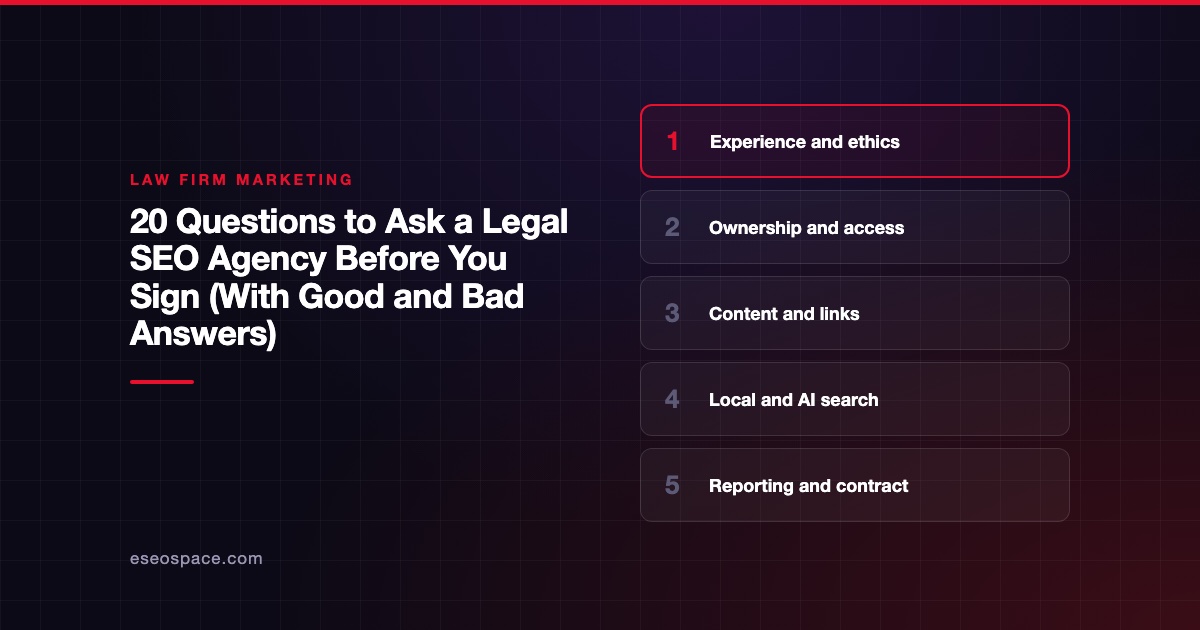
The best questions to ask a legal SEO agency test five things: its grasp of lawyer advertising rules, who owns your accounts, how it creates content and links, how it handles local and AI search, and how it reports and contracts. Below are 20 questions, each with a good answer and a bad answer.
Bring this list to every sales call. Ask the same questions of each agency and write the answers down. The differences show up fast.
This article is part of our Law Firm Marketing Guide. If you are still deciding what to look for, start with how to choose a law firm marketing agency.
Key Takeaways
- Good answers are specific: they name your state's rules, your accounts, your practice areas and your metrics.
- Bad answers lean on promises, secrecy or vague reassurance.
- Google's own guidance says no one can guarantee a number one ranking, so any ranking promise fails the test.
- Your firm should own the domain, website, Google Business Profile and ad accounts, with the agency added as a user.
- The right report connects SEO work to qualified leads and signed cases, not only to traffic.
Experience and ethics
1. What law firm sites do you work on now?
Good: "Here are three live sites. Look at them on your phone." Bad: "Our clients are confidential." Google's guidance on hiring an SEO suggests asking for examples of previous work.
2. How do you handle lawyer advertising rules in my state?
Good: They name your state's rules and say who reviews copy. For example, they know the State Bar of Texas requires non-exempt ads to be filed, or that the Florida Bar exempts websites from filing. Bad: "Compliance is your job." The firm stays responsible, but a good agency works inside the rules.
3. How do you write about past case results?
Good: "Only with your approval, with context and any disclaimer your state requires." Comment 3 to ABA Model Rule 7.1 says truthful results can mislead if they create unjustified expectations. Bad: "Big numbers convert, so we lead with them."
4. Will you call me a "specialist" or "expert"?
Good: "Only if your state allows it and you hold a qualifying certification." Under ABA Model Rule 7.2(c), a lawyer should not claim certification as a specialist unless an approved organization certified them and the communication names it. Bad: "Everyone says expert."
Ownership and access
5. Who will own the domain, website and content?
Good: "Your firm, in your own accounts, in writing." Bad: "We host everything; you lease it from us."
6. Whose Google Business Profile is it?
Good: "Your firm is primary owner; we are a manager." Google's owners and managers page explains that a profile has one primary owner, and managers cannot add or remove users. Bad: "We create it under our account to save time."
7. Who holds admin rights in analytics and ad accounts?
Good: "You do. We get Standard access." In Google Ads, the access levels page shows only Admin can grant or remove access. Bad: "We'll run it under our manager account and send screenshots."
8. What happens to everything if we cancel?
Good: "Nothing moves. You already own it. We remove our access." Bad: "The site and phone numbers stay with us."
Content and links
9. Who writes the practice pages and who reviews them?
Good: "Our writers draft; a lawyer at your firm reviews anything that explains the law." Bad: "We publish 30 AI articles a month, no review needed." See our guide on practice area pages.
10. How do you build links?
Good: "Earned links: local organizations, bar and community involvement, real media, useful resources." Bad: "We have a network of sites." Google's spam policies define link spam as creating links primarily to manipulate rankings.
11. Do you create city pages for every town nearby?
Good: "Only where you serve clients and have something specific to say." Bad: "We spin up 200 city pages." Google's spam policies describe doorway abuse as pages created to rank for similar queries.
12. How will you show our attorneys' real expertise?
Good: "Detailed bios, bar admissions, published work, and author bylines on content." Our article on attorney bios and E-E-A-T covers what that looks like. Bad: "Bios don't rank, so we skip them."
Local and AI search
13. How will you handle multiple attorneys on Google Business Profile?
Good: They know Google's Business Profile guidelines, which name lawyers as individual practitioners and say a solo practitioner at a branded firm should share the firm's profile. Bad: "We'll make a profile for every practice area."
14. How do you approach AI search answers?
Good: "Clear, consistent facts about the firm across your site, profiles and directories, plus content that answers real questions." Bad: "We can get you into ChatGPT by next month." See how ChatGPT and AI search recommend lawyers.
15. What technical work is included?
Good: "Speed, mobile, indexing, structured data and accessibility checks, with a list of what we fixed." Bad: "Technical SEO is a one-time thing."
Reporting and contract
16. What will you report each month?
Good: "Calls and forms by source, qualified leads, and signed cases once you share intake data." Bad: "Rankings and impressions." Google suggests asking how a provider measures success.
17. What results do you expect, and when?
Good: "Here is what we will do in the first 90 days and what early signs to watch." Bad: "Page one in 30 days, guaranteed." Google's guidance says, "No one can guarantee a #1 ranking on Google."
18. Will you tell us every change you make?
Good: "Yes, in a change log." Google suggests asking whether a provider will share all changes and explain the reasoning. Bad: "Our methods are proprietary."
19. How long is the contract and how do we cancel?
Good: "Month to month after an initial period, with written notice." Bad: "Two years, auto-renewing, with a large exit fee." See law firm marketing contract red flags.
20. Do you work with competing firms in my market?
Good: A straight answer, plus how they avoid conflicts. Bad: Silence, or "exclusive" leads that are sold to several firms.
How to score the answers
Give each answer a 0, 1 or 2. Zero is a bad answer, one is vague, two is specific and checkable. Any zero on questions 5 to 8 (ownership) or 17 (promises) should end the conversation. Rules vary by state, so confirm advertising questions with your state bar.
Patterns in bad answers
Across all 20 questions, bad answers tend to share a few habits:
- promises about rankings or timelines
- "proprietary" methods they will not explain
- accounts or numbers held in the agency's name
- volume as the goal: hundreds of pages, links or posts
- no mention of your state, your practice areas or your intake
Next step
Bring these 20 questions to us too. See how we work with firms on our law firm marketing services page, then schedule a discovery call and ask them one by one.
Frequently asked questions
Which question matters most?
Ownership. If your firm does not own its domain, website, Business Profile and ad accounts, switching agencies later becomes costly and slow. Ask questions 5 to 8 first.
Is it rude to ask for client examples?
No. Google's own guidance suggests asking an SEO for examples of previous work. A confident agency shows live sites without hesitation.
What if an agency promises page one rankings?
Treat it as a red flag. Google states that no one can guarantee a number one ranking. Ask instead what work they will do and how they will measure it.
Should the agency know my state's advertising rules?
It should know the main rules and work inside them, but the firm remains responsible. Confirm specific questions with your state bar or ethics counsel.
How long should an agency take to answer these questions?
Most should be answered on the call. Ownership and reporting questions deserve a written follow-up you can keep with the contract.
Should we ask for these answers in writing?
Yes, at least for ownership, scope, reporting and cancellation. A written answer can be attached to the contract, and it gives both sides a clear reference if something is disputed later. Verbal answers on a sales call are easy to forget.









