

This article is part of our Law Firm Marketing Guide: how clients find lawyers online, what the advertising rules allow, and how to choose the right help. Want to know where your firm's site stands? Get a free 20–30 page website audit within 24 hours.
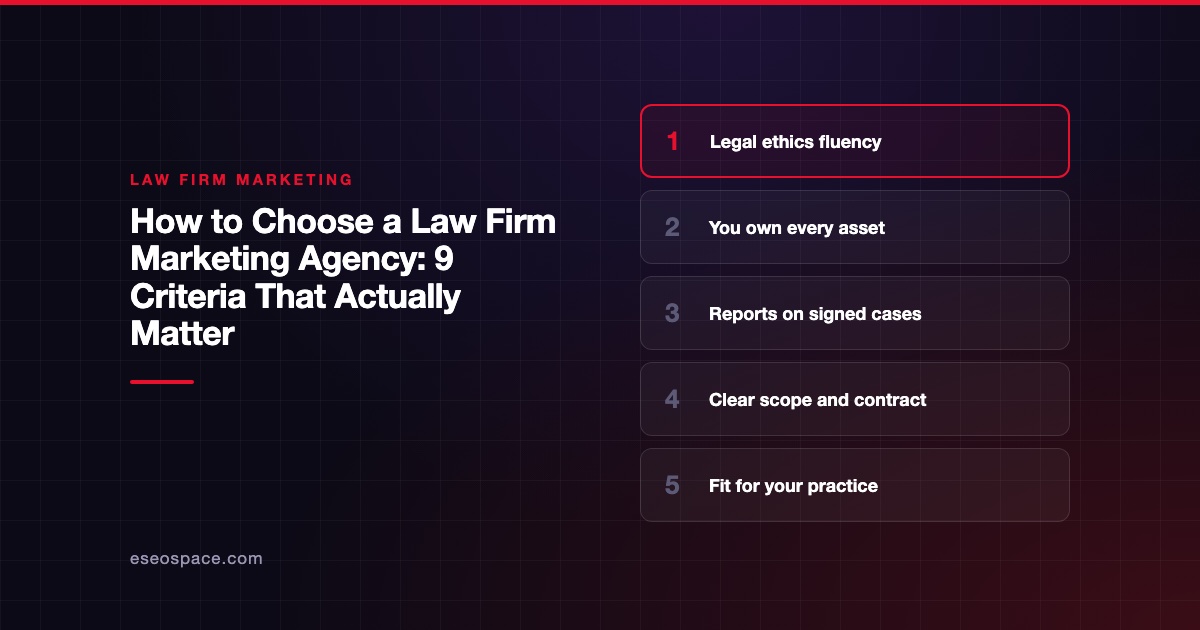
To choose a law firm marketing agency, judge it on five things: whether it understands lawyer advertising rules, whether you will own everything it builds, whether it reports on cases rather than clicks, whether its contract is fair, and whether it fits your practice. Portfolio polish matters less than those five.
Most firms hire an agency after a bad experience with a previous one. The website was slow, the reports were vague, or the firm found out it did not own its own domain. This guide gives you a short list of criteria and the evidence to ask for, so the next choice is easier.
It is part of our Law Firm Marketing Guide, which walks from the basics to hiring help.
Key Takeaways
- An agency that markets lawyers must work inside your state's version of the ABA Model Rules on advertising, because the firm, not the agency, answers to the bar.
- Insist that your firm owns the domain, website files, Google Business Profile, analytics and ad accounts, with the agency added as a user.
- Good agencies report on qualified leads and signed cases, not only traffic, rankings and impressions.
- No honest SEO provider promises a number one ranking; Google says so in its own guidance.
- A clear scope, a short or cancellable term and plain exit terms are signs of a confident agency.
1. They understand lawyer advertising rules
Under the ABA Model Rules, the lawyer is responsible for the marketing done on the lawyer's behalf. ABA Model Rule 7.1 bars false or misleading communications about a lawyer's services. Comment 3 to Rule 7.1 warns that truthful past results can still mislead if they create unjustified expectations.
The ABA also expects you to supervise outside help. Comment 3 to Rule 5.3 says a lawyer using nonlawyers outside the firm must make reasonable efforts to ensure their services fit the lawyer's professional obligations.
States differ. For example, the State Bar of Texas Advertising Review page says failing to file a non-exempt ad is a violation of the Texas rules. The Florida Bar's filing page says lawyer websites are exempt from filing, but internet ads other than websites must be filed at least 20 days before first use.
Ask for: how they handle "specialist" claims, case results, testimonials and filing duties in your state. A good answer names your state's rules. A weak answer is "we've done a lot of legal sites." Our guide to lawyer advertising rules for websites covers the basics. Confirm specifics with your state bar.
2. You own every asset
This is the criterion most firms learn the hard way. Your firm should be the registered owner of:
- the domain name, in your firm's registrar account
- the website files and content
- the Google Business Profile (your firm as primary owner)
- Google Analytics and Search Console properties
- Google Ads and any Local Services Ads accounts
- call tracking numbers, where possible
Google's own tools support this setup. Its Business Profile roles page says a profile can have many owners but only one primary owner, and managers cannot add or remove users. In Google Ads, the access levels page shows only Admin users can give or remove account access. So your firm holds Admin; the agency gets Standard.
For the domain, ICANN's registrant rights page says the registrant must keep accurate contact information and is responsible for the domain. That registrant should be your firm.
3. They report on cases, not just clicks
Traffic and rankings are inputs. What matters to a firm is signed cases and the cost of each one. A good agency agrees with you on what counts as a qualified lead, tracks calls and forms, and asks for your intake outcomes each month.
Look for monthly reports that show:
| Metric | Why it matters |
|---|---|
| Calls and form leads by source | Shows which channels produce contact |
| Qualified leads | Filters out spam, wrong practice area, wrong location |
| Consults booked | Shows whether intake converts |
| Signed cases by source | The number your budget should follow |
| Cost per signed case | Lets you compare SEO, ads and directories |
We go deeper on this in law firm marketing KPIs.
4. They make honest claims about results
Google's guidance on hiring an SEO says, "No one can guarantee a #1 ranking on Google." It also tells you to beware of SEOs who claim otherwise, and to be careful with any firm that is secretive about what it will do.
So treat ranking promises as a red flag, not a selling point. A good agency explains what it will do, why, and how it will measure progress.
5. They have real legal work you can check
Ask for live law firm sites they built or market. Then check them yourself on a phone:
- Do practice pages answer real client questions?
- Are attorney bios specific, with bar admissions?
- Is the phone number tappable and the form short?
- Do pages load quickly?
You can see how we describe our own law clients in law firm websites we've built. Each client page sticks to what the firm publishes.
6. The scope is written down
Vague scope leads to vague results. A proposal should list deliverables by month: pages written, technical fixes, Business Profile work, links or digital PR, ad management, and reporting. It should say who writes legal content and who reviews it. In legal content, a licensed attorney at your firm should review anything that explains the law.
7. The contract is fair
Read the term, the cancellation clause and what happens to your assets on exit. Long lock-ins, setup fees that buy nothing you keep, and "exclusive" lead programs shared with competitors are worth questioning. Our list of law firm marketing contract red flags walks through each clause.
8. They fit your firm's size and market
A two-lawyer estate planning firm does not need the same program as a personal injury firm in a large metro. Ask how they would sequence work at your budget. A good agency tells you what to skip as well as what to buy, and says plainly when a channel is not worth your money yet.
9. They are easy to work with
Ask who your day-to-day contact is, how fast they reply, and how often you meet. Google's hiring guidance suggests asking whether the provider will share all changes made to your site and explain the reasons. That is a fair standard for any agency.
A simple scorecard
Score each agency from 1 to 5 on each row, then compare.
| Criterion | What a 5 looks like |
|---|---|
| Ethics fluency | Names your state's advertising rules and filing duties |
| Asset ownership | Firm owns domain, site, profiles, accounts in writing |
| Reporting | Signed cases and cost per case by source |
| Honest claims | No ranking promises; explains methods |
| Proof | Live legal sites you can inspect |
| Scope | Monthly deliverables listed |
| Contract | Short or cancellable term, clean exit |
| Fit | Plan matches your size and practice |
| Service | Named contact, reply times agreed |
If you want a ready list of interview questions, use our 20 questions to ask a legal SEO agency.
Next step
When you are ready to compare a real proposal against this scorecard, see how we work with firms on our law firm marketing services page. You can also schedule a discovery call and ask us every question above. Pricing is quoted per scope; see pricing for how we structure it.
Frequently asked questions
Should a law firm hire a legal-only marketing agency?
Not necessarily. Legal-only agencies know the industry, but general agencies with real legal clients can do the same work. What matters is fluency in your state's advertising rules, live legal work you can inspect, and fair ownership terms.
Who is responsible if the agency publishes something that breaks bar rules?
Under the ABA Model Rules, the lawyer remains responsible for communications about the lawyer's services, and Rule 5.3 requires reasonable supervision of nonlawyers. Rules vary by state, so confirm with your state bar.
How many agencies should we interview?
Two or three is usually enough. Use the same questions and scorecard for each so you compare like with like.
What should we ask for in a first meeting?
Ask for live legal sites they built or market, a sample monthly report, and a draft scope. Ask how they handle case results, testimonials and "specialist" wording under your state's rules.
Is it a red flag if an agency will not share its methods?
Yes. Google's guidance on hiring an SEO warns about providers who are secretive or will not clearly explain what they intend to do.









