

This article is part of our Law Firm Marketing Guide: how clients find lawyers online, what the advertising rules allow, and how to choose the right help. Want to know where your firm's site stands? Get a free 20–30 page website audit within 24 hours.
A good 90-day law firm marketing plan starts with ownership and tracking, then fixes your Google Business Profile, then improves the pages that bring in cases, then builds reviews, and ends with a review of cost per signed case. That order means every later step can be measured.
Ninety days is not long enough to win a competitive market. It is long enough to fix the foundations, publish the pages that matter most, and know which channels are working. This plan assumes a small team: one attorney who approves content, one staff member who handles intake, and an outside partner or in-house marketer.
It is part of our Law Firm Marketing Guide. Rules on lawyer advertising vary by state, so confirm anything you publish with your state bar.
Key Takeaways
- Spend the first two weeks on ownership, tracking and a baseline, so you can measure everything after.
- Your Google Business Profile should follow Google's practitioner rules and list accurate categories, hours and services.
- Rewrite your top practice pages before you write new blog posts.
- Ask every satisfied client for a review, but never offer incentives or ask only happy clients.
- At day 90, compare channels by cost per signed case, then plan the next quarter.
The plan at a glance
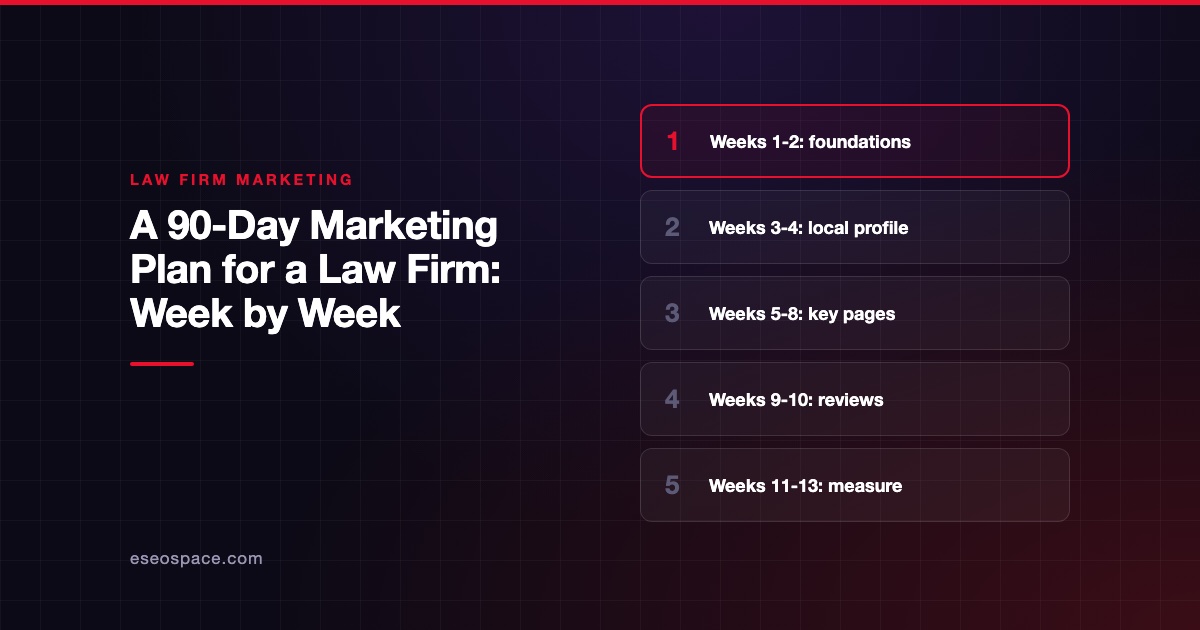
| Weeks | Focus | Output |
|---|---|---|
| 1 to 2 | Ownership, tracking, baseline | Accounts in firm's name, key events live |
| 3 to 4 | Google Business Profile and listings | Profile cleaned up, top directories consistent |
| 5 to 8 | Practice pages, bios, site speed | Top pages rewritten and attorney-reviewed |
| 9 to 10 | Reviews and intake | Review requests running, intake script tested |
| 11 to 13 | Content, ads test, reporting | First guides live, 90-day report |
Weeks 1 to 2: foundations
Week 1: confirm you own everything
List every account and who controls it: domain, hosting, website admin, Google Business Profile, Analytics, Search Console, Google Ads, call tracking. Google's Business Profile roles page explains that a profile has one primary owner. Make that your firm.
In Google Ads, only Admin users can grant access, per Google's access levels page. Your firm should hold Admin.
Week 2: set up tracking and a baseline
Decide what counts as a lead: a call over a set length, a form, a chat that leaves contact details. In GA4, mark those actions as key events. Google's key events help page notes that marking an event applies from that point forward and does not change past data. So do it now.
Record your baseline for the last 90 days:
- calls and forms by source
- consults booked
- signed cases, by practice area
- current marketing spend by channel
Weeks 3 to 4: local profile and listings
Week 3: fix your Google Business Profile
Google's Business Profile guidelines name lawyers as individual practitioners. They say a solo practitioner at a branded firm should share the firm's profile, using the format "[brand/company]: [practitioner name]." A practitioner should not have multiple profiles for different specializations.
Check the primary category, hours, phone, website link and services. Add real office photos. See our deeper guide to Google Business Profile for law firms.
Week 4: make your listings consistent
Pick your main directories and match name, address, phone and website exactly. Our guide to legal directories helps you decide which are worth the time.
Weeks 5 to 8: the pages that bring in cases
Week 5: pick your top three practice pages
Use the baseline. Which practice areas bring the most signed cases or the highest fees? Rewrite those pages first.
Weeks 6 to 7: rewrite and review
Each page should answer what clients ask on the first call: who you help, how the process works, what to expect on fees and timing, and how to start. Our practice area pages guide gives a structure.
Have the attorney review every page. Comment 3 to ABA Model Rule 7.1 warns that truthful past results can still mislead if they create unjustified expectations. Check results, testimonials and "specialist" wording against your state's rules.
Week 8: bios and speed
Update attorney bios with bar admissions, education and the work each lawyer does. Then test your top pages against Google's Core Web Vitals targets: Largest Contentful Paint within 2.5 seconds, Interaction to Next Paint under 200 milliseconds, layout shift under 0.1.
Weeks 9 to 10: reviews and intake
Week 9: start a review routine
Ask every client whose matter has closed well, at the same point in your process. Google's Maps content policy bars offering incentives such as payment or discounts for reviews. It also bars selectively soliciting positive reviews. So ask everyone, not only happy clients.
Reply to reviews without confirming that the reviewer is a client or sharing case details. Our guide to ethical review generation covers wording.
Week 10: test intake
Call your own firm after hours. Submit your own form. Time the response. Fast, consistent intake often matters as much as new leads. See law firm intake and lead response.
Weeks 11 to 13: content, a small test, and reporting
Week 11: publish two helpful guides
Pick questions prospects ask most, such as "What happens at my first court date?" Write clear answers. Attorney review applies here too.
Week 12: run a small paid test, if budget allows
A short Google Ads or Local Services Ads test shows what demand looks like. Check your state's filing rules first. For example, the Florida Bar requires internet ads other than websites to be filed at least 20 days before first use.
Week 13: the 90-day report
Compare to your baseline:
- leads and qualified leads by source
- consults booked and signed cases by source
- cost per signed case by channel
- what is still unfinished
Use that to plan the next 90 days. Keep what works; cut what produces leads but not cases.
Who does what
A plan stalls when nobody owns a task. Assign each row before week 1.
| Task | Owner | Time each week |
|---|---|---|
| Approve pages, bios and guides | Responsible attorney | Short review slot |
| Review requests and replies | Office manager or intake lead | A few minutes a day |
| Intake testing and follow-up | Intake lead | Weekly check |
| Website, tracking and speed | Developer or agency | As scheduled |
| Profile and listings | Marketer or agency | Weeks 3 to 4, then monthly |
| 90-day report | Marketer or agency, with attorney | Week 13 |
If one person holds several rows, that is fine for a small firm. Just write it down, so tasks do not fall between people.
Next step
If you want help running this plan, see our law firm marketing services. Schedule a discovery call and we will map the 13 weeks to your firm's practice areas.
Frequently asked questions
Can a law firm see results in 90 days?
You can usually see better tracking, a cleaner profile and improved pages in 90 days. Ranking and case growth timelines vary by market and competition, so treat 90 days as the first cycle, not the finish line.
Why start with tracking instead of content?
Without tracking, you cannot tell which work produced cases. Google Analytics key events only count from the date you set them up, so early setup gives you more data.
Should we run ads in the first 90 days?
A small test can show demand and cost per lead quickly. Check your state's ad filing rules first, and make sure intake is ready to answer the calls.
How much attorney time does this plan need?
Mostly review time: approving practice pages, bios and guides. Block a regular weekly slot so content does not stall.
Can we offer a gift card for Google reviews?
No. Google's Maps content policy bars incentives for reviews. ABA Model Rule 7.2(b) also limits giving anything of value for recommending a lawyer, and each state has its own version, so check yours.
What if we fall behind schedule?
Keep the order, not the dates. Ownership and tracking still come first, then the profile, then the key pages. A plan that takes 120 days in the right order beats one that skips the foundations to stay on time.









