This spotlight is part of our MCP company spotlights, within The MCP Guide. Building an MCP company? See SEO and GEO for MCP companies.
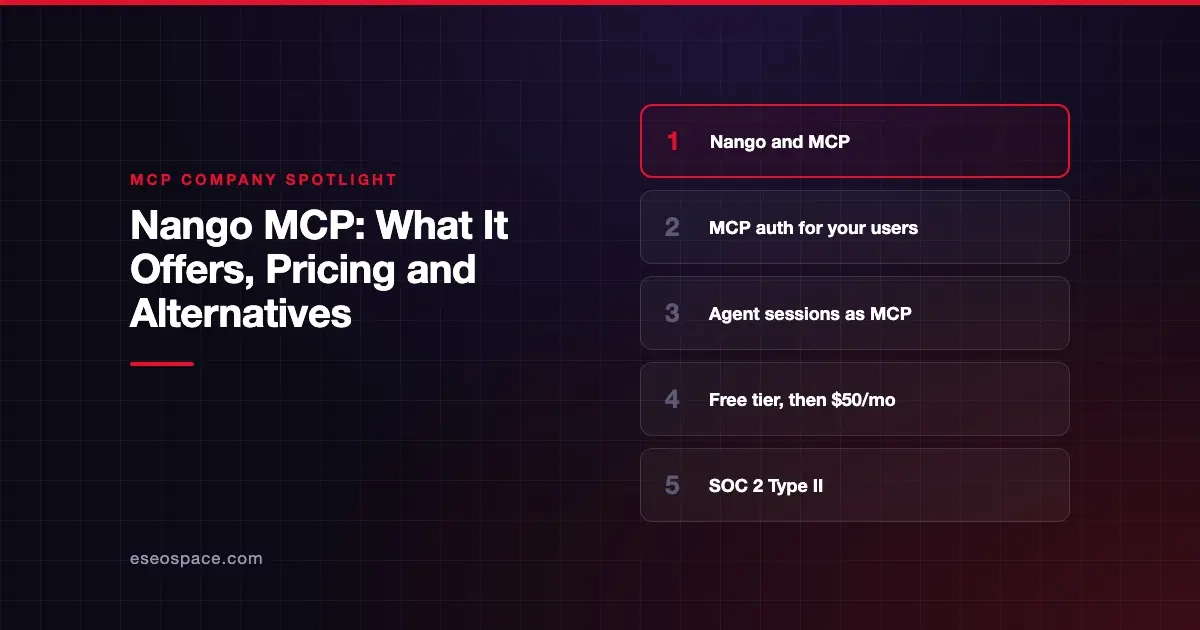
Nango is an integrations platform for software products and AI agents. For MCP, it handles OAuth so your users can connect external MCP servers, and it serves scoped "agent sessions" to your agents as MCP endpoints.
Checked against: Nango's agent sessions docs on 28 October 2026. eSEOspace did not test Nango's products.
Key Takeaways
- Nango's MCP Auth lets your app authorize end users to external MCP servers such as Notion, Linear or HubSpot.
- Agent sessions give each agent a scoped MCP URL; Nango says the agent "never sees raw credentials."
- A Management MCP server at
https://mcp.nango.dev/mcplets coding agents manage Nango itself. - Pricing starts free with hard caps; pay as you go is $50 a month including $50 of credits.
- Nango's code is source available under the Elastic License 2.0.
At a glance
| Item | Details |
|---|---|
| Company | Nango |
| What it offers for MCP | MCP Auth, agent sessions (MCP endpoints), custom tools, Management MCP |
| Who it's for | SaaS and AI product teams that connect many customers to many APIs |
| Open source? | Source available (Elastic License 2.0), per its GitHub repo |
| Pricing | Free; pay as you go $50/mo; Enterprise custom |
What Nango offers for MCP
MCP Auth
Nango's MCP Auth docs say it lets "your application authorize end users to access external MCP servers." Nango handles OAuth with the MCP provider and stores the tokens. You then call the server through Nango's proxy.
There are two modes. Catalog servers, such as HubSpot, Notion and Linear, are preconfigured. A generic option lets users connect "any server that supports the MCP Protocol." Nango supports static client registration, dynamic client registration and Client ID Metadata Documents. Our MCP authentication guide explains those terms.
Agent sessions
The agent sessions docs describe "an optimized interface for AI agents to use integrations." Each session has three parts:
- Tenant: whose connections the agent may use.
- Toolset: which integrations and tools it can call.
- Discovery: how it finds and calls them.
Your backend creates a session with one API call. The response includes an mcp_url and a session token. Nango says the agent "cannot change the scope of its own session." Toolsets can mix Nango catalog actions, functions you write and tools from MCP servers the tenant connected.
Management MCP
The Management MCP docs describe a server that lets MCP clients "manage Nango through tools." You add https://mcp.nango.dev/mcp to a client that supports Client ID Metadata Documents, then sign in through the browser.
Who it's for
Nango fits products that connect many customers, each with their own accounts, to many APIs. The tenant model in agent sessions maps one agent to one customer's or user's connections.
If you are deciding whether to build this layer yourself, read build vs buy for MCP servers.
Pricing
Nango's pricing page lists three plans as of October 2026:
| Plan | Price | Notes |
|---|---|---|
| Free | $0 | API and MCP auth, tools and syncs; hard-capped limits that reset monthly, including 10 compute hours and 10 GB |
| Pay-as-you-go | $50/mo, includes $50 in credits | $0.29 per connection, $0.72 per compute hour, $0.50 per GB |
| Enterprise | Custom | Commitment discounts, self-hosting, MSA, SLA |
A connection is "one authorized user account," billed per month and prorated. A Growth add-on is listed at $450 a month. Compute time covers tool calls, syncs and webhook processing.
Security and trust
Nango's pricing page lists "Certified SOC 2 Type 2" with a report available through its trust center. It also lists HIPAA compliance with a Business Associate Agreement, RBAC, SAML SSO, SCIM and an audit trail. Check which plan includes each feature.
The Nango repository uses the Elastic License 2.0. That license lets you self-host but bars offering Nango as a hosted service to others. For a security checklist, see our MCP security hub.
Alternatives
- Merge offers managed connectors with DLP scanning through Agent Handler.
- Fastn embeds customer integrations and exposes them to agents through an MCP gateway.
- Metorial runs a source-available MCP gateway with a large catalog.
Browse more MCP company spotlights.
Next step
Map your tenants first: which customer, which user, which accounts. Then choose a platform that matches that model. Our MCP development team can help design the session and permission rules.
Frequently asked questions
Can Nango connect my users to third-party MCP servers?
Yes. MCP Auth handles OAuth with catalog servers like Notion and Linear, and with any server that supports MCP OAuth.
What is a Nango agent session?
A session gives one agent a scoped set of connections and tools, served at its own MCP URL. Nango says the agent cannot see raw credentials or widen its scope.
Is Nango open source?
The code is on GitHub under the Elastic License 2.0, a source-available license. You can self-host it but cannot resell it as a hosted service.
How is Nango billed?
Pay as you go is $50 a month with $50 in credits. Usage is billed per connection, compute hour and GB of data, per the pricing page.