

This article is part of our Real Estate & Property Management Marketing Guide: how buyers, sellers, owners and tenants find you online, what the housing ad rules allow, and how to choose the right help. Want to know where your site stands? Get a free 20–30 page website audit within 24 hours.
Property management SEO costs depend on the scope you need: how many cities you serve, how many pages must be written for property owners, and how much local search work your offices need. Most providers bill a monthly retainer, with hourly or project fees for audits and one-off fixes.
What makes property management different is the audience. Your site has to win owner leads, which are worth the most, while also serving tenants who just want to pay rent or find a vacancy. A proposal that treats you like a generic local business will spend money in the wrong place.
This article is part of our Real Estate and Property Management Marketing Guide. For pricing models and market survey data that apply to all real estate businesses, see our guide to real estate SEO cost. This guide covers what is specific to property managers.
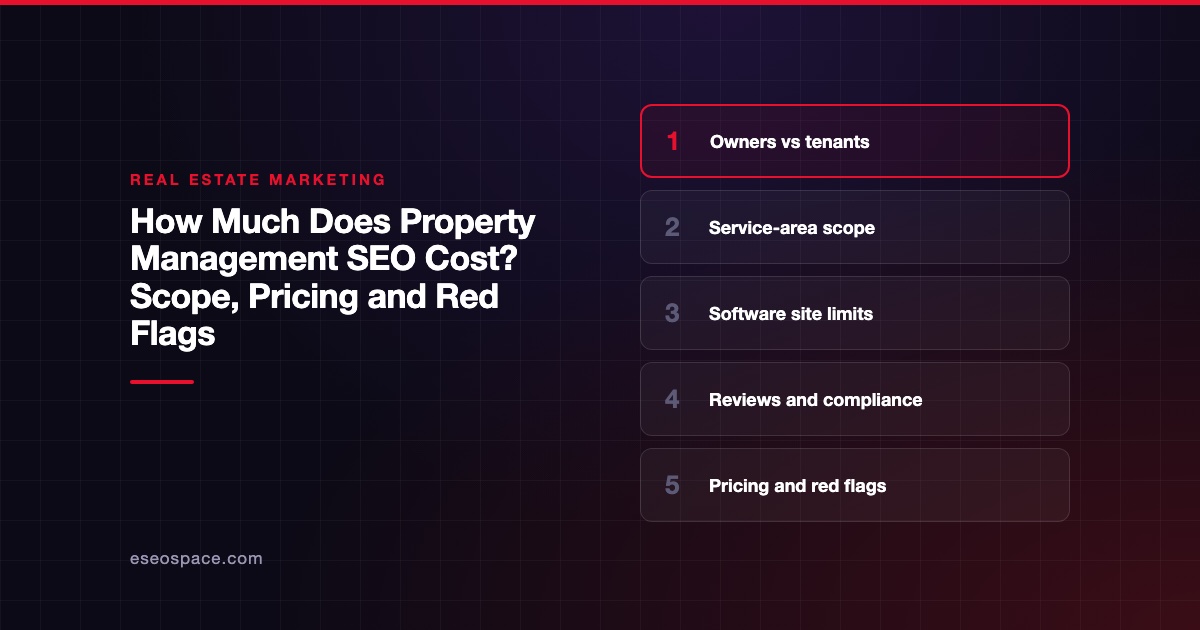
Key Takeaways
- Owner-lead pages are the core of property management SEO, and they drive most of the content cost.
- Each city you want to rank in needs a useful, distinct page, so service area size is a major cost driver.
- Google Business Profile rules decide how many profiles you can have, which affects local scope.
- Websites bundled with property management software may limit what an SEO provider can change.
- Tenant reviews, owner reviews and Fair Housing-aware copy all need care, and that care is part of the scope.
Why property management SEO is scoped differently
An agent mostly markets to buyers and sellers. A property manager markets to two groups with different goals.
| Audience | What they search for | What they need on your site |
|---|---|---|
| Property owners and investors | Management services, fees, how you screen tenants | Service pages, fee explanation, proof, a clear owner contact path |
| Tenants and applicants | Vacancies, how to apply, how to pay rent | Listings, application steps, portal login, maintenance requests |
SEO money should go mainly toward owners. Tenant traffic is useful, but tenants are not the people who hire you. Our guide to property management website must-haves shows how to serve both without mixing them up.
What drives the cost
Ask any provider to price these items separately. It makes quotes easier to compare.
1. Owner-lead content
This is the biggest line item. Owners want to know what you do, how you screen tenants, how you handle maintenance and what it costs. Each service needs a page that answers those questions in plain terms.
Fee pages are a common gap. Whether to publish fees is a business choice, but the page should exist even if it explains how you quote. More pages and more depth mean a higher monthly cost.
2. Service area size
A company managing in one city needs a handful of strong pages. A company covering ten cities needs ten genuinely useful city pages, each with local detail such as rental market notes, neighborhoods you manage in and local rules owners ask about.
Avoid the cheap version. Google's spam policies list "multiple domain names or pages targeted at specific regions or cities that funnel users to one page" as doorway abuse. Copy-paste city pages save money now and cost you later.
3. Google Business Profile setup
Your offices decide how much local work is possible. Google's Business Profile guidelines say:
- Service-area businesses "should have one profile for the central office or location with a designated service area."
- "Do not create more than one page for each location of your business."
- A virtual office "isn't eligible for a Business Profile," and a coworking office needs clear signage, staff and customer hours.
So a manager with three real, staffed offices can have three profiles. A manager with one office and a wide service area works with one profile and strong city pages. That changes the scope and the price. Our Google Business Profile optimization service covers this work.
4. Your website platform
Many property management software products include a website. For example, Buildium's pricing page (checked 29 October 2026) lists "Property Management Website" and "Rental Listing Syndication" among its features, with plans starting at $65, $202 and $420 per month as of October 2026. AppFolio's pricing page lists "End-to-End Marketing & Leasing" on its plans, which start at $1.49, $3.20 and $5.00 per unit per month, with minimums, as of October 2026.
A bundled site is convenient. The question for SEO is control. Can your provider edit page titles, add pages, change layouts, add schema and improve speed? If not, some SEO work is impossible, and you may need your own marketing site that links to the portal. Our comparison of AppFolio, Buildium and Rent Manager website integration covers how each connects.
If a rebuild is on the table, budget it separately. Our guide to real estate website cost explains build cost drivers, and most of them apply to property management sites too.
5. Reviews from owners and tenants
Tenant reviews can be harsh, and they sit on the same profile owners read. Review work means asking satisfied owners and tenants, replying to complaints and fixing what the reviews reveal.
It must follow Google's rules. Google's prohibited and restricted content policy bans offering "payment, discounts, free goods and/or services" for reviews. It also bans discouraging negative reviews or selectively asking only happy customers. So no rent credits for five-star reviews.
6. Compliance-aware copy
Vacancy and service pages are housing advertising. HUD's Fair Housing rights page says the Act bars discrimination "because of race, color, national origin, religion, sex, familial status, and disability." Listing copy, neighborhood descriptions and screening pages should be written with that in mind. Rules and added protections vary by state and city, so confirm with your broker of record or compliance counsel.
7. Tracking owner leads
You need to see which pages bring owner inquiries, not just traffic. Call tracking and form tracking take setup time. Ask how the provider separates owner leads from tenant calls about maintenance.
SEO vs paid ads for property managers
Some managers compare SEO cost with Google Ads. Know the limits on housing ads first.
Google's personalized advertising policy says that in the United States and Canada, housing ads can't target by gender, age, parental status, marital status or ZIP code. City and radius targeting is still allowed. Check how each campaign is classified before you plan your targeting.
Paid ads stop when the budget stops. SEO builds pages that keep working. You can use both: ads for faster owner leads, SEO for the long term.
Pricing models
The same models apply as in the rest of real estate:
- Monthly retainer for ongoing content, local and technical work.
- Project fee for an audit, a site migration or a batch of city pages.
- Hourly for advice or small fixes.
For market context, Ahrefs' SEO pricing survey of 439 providers (page updated August 2024) reported an average of $1,557 per month for local SEO. That covers all industries, assumes the top of each price bracket and may be dated, so use it as background only. Your scope sets your price.
Results take time. Google's SEO Starter Guide says "some changes might take effect in a few hours, others could take several months."
Red flags in a property management SEO proposal
- Ranking guarantees. Google's page on hiring an SEO says "no one can guarantee a #1 ranking on Google."
- Dozens of near-identical city pages for places you do not actually serve.
- Extra Business Profiles at addresses with no staffed office.
- Review schemes such as rent discounts for reviews.
- No plan for owners. A proposal focused only on tenant keywords like "apartments near me."
- No answer on your software site. If they cannot say what they can edit, they have not looked.
A simple way to set your budget
- List the cities where you actually manage properties.
- Count your real, staffed offices.
- Check what your software website lets you edit.
- List the owner questions your current site does not answer.
- Ask two or three providers to price that exact scope.
Now the quotes are comparable, because each one prices the same work.
Next step
With your scope written down, the next step is vetting providers. Use our 20 questions to ask a real estate or property management SEO agency on every call. To see how we work with property managers, visit our property management website design and SEO page, or check our pricing page, where work is quoted per scope.
Frequently asked questions
Why does property management SEO cost more for multi-city companies?
Each city needs its own useful page with local detail. Google's spam policies name city pages that funnel users to one page as doorway abuse. More cities mean more original content, which means more work.
Can I do SEO on my AppFolio or Buildium website?
Partly. Both list marketing or website features on their pricing pages, but how much you can edit depends on the product and plan. Ask your provider to check what they can change before you sign.
How many Google Business Profiles can a property manager have?
One per real location. Google's guidelines say not to create more than one profile per location, and virtual offices are not eligible. A service-area business uses one profile for its central office with a service area.
Can I give tenants a rent credit for a Google review?
No. Google's policy bans offering payment, discounts or free services for reviews. You can ask every tenant and owner for honest feedback, as long as you do not pick only happy ones.
Should my SEO focus on owners or tenants?
Mostly owners, since owner leads grow your business. Tenant pages still matter for applications, payments and maintenance, but they usually need less SEO budget.









