

This article is part of our Therapy Practice Marketing Guide: how clients find a therapist, how to market ethically and privately, and how to choose the right help. Want to know where your practice's site stands? Get a free 20–30 page website audit within 24 hours.
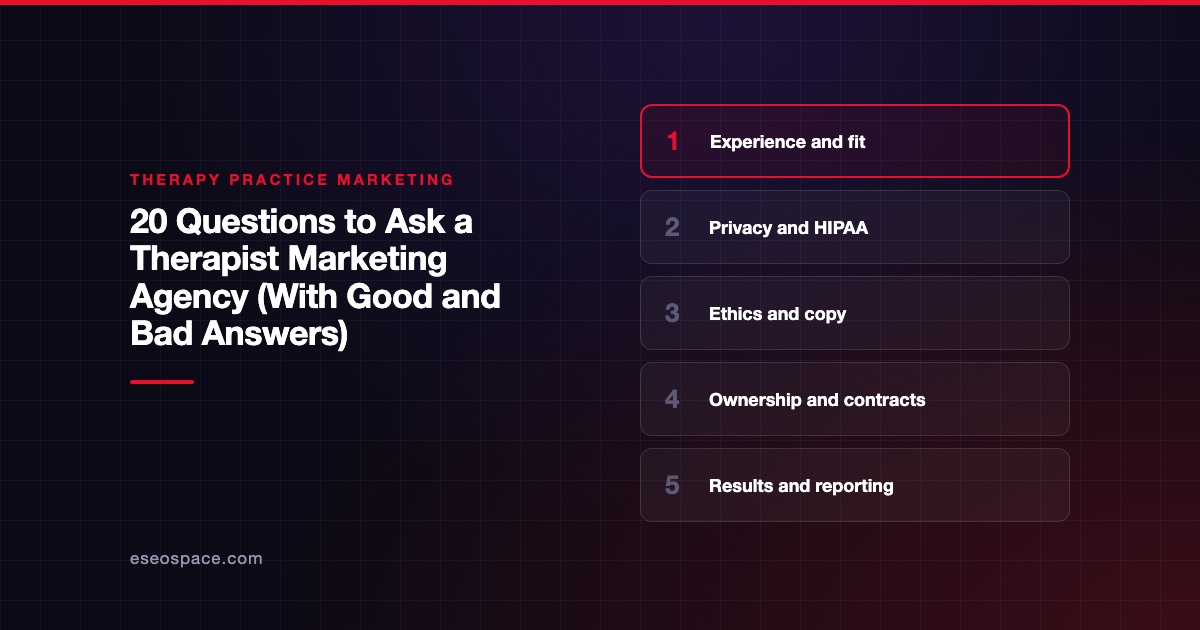
The best questions to ask a therapist marketing agency cover five areas: their experience with licensed clinicians, how they protect client data, how they handle ethics in copy and reviews, who owns your accounts, and how they report results. Below are 20 questions, each with a good answer and a bad one.
Print this list and take it to every sales call. If an agency gets defensive about these questions, that tells you something too. For the bigger picture of how marketing fits together for a practice, start with our Therapy Practice Marketing Guide.
This is marketing guidance, not legal or compliance advice. Confirm privacy questions with your compliance counsel and ethics questions with your licensing board.
Key Takeaways
- Ask for live examples of therapy or mental health sites the agency has built or marketed, and check them yourself.
- A good agency can explain, in plain words, which of its tools would ever see client data and whether it will sign a business associate agreement.
- Any agency that promises a number one ranking or a set number of new clients is not being straight with you.
- You should own your domain, website, Google Business Profile, analytics and ad accounts, with the agency added as a user.
- Reporting should tie to inquiries and booked consults, without sending protected health information into analytics.
Experience and fit
1. Which therapy or mental health practices have you worked with?
Good answer: Names you can look up, with live sites, and a description of what they did for each. Bad answer: "We work with lots of healthcare clients" and nothing you can check.
2. Which license types have you written for?
Good answer: They know the difference between an LPC, LCSW, LMFT, psychologist, psychiatrist and psychiatric nurse practitioner, and they write each one correctly. Bad answer: "We just call everyone a therapist." Mixing up credentials can mislead clients.
3. How do you learn about my practice before writing?
Good answer: An intake call or questionnaire about your approach, populations, states, fees and insurance. Bad answer: "Our writers handle everything; you just approve it."
4. What would you do first for a practice like mine, and why?
Good answer: A short, specific plan based on your current site, your Google Business Profile and your capacity. Bad answer: A one-size package with no reference to your situation.
Privacy and HIPAA
5. Will any of your tools or staff see client data?
Good answer: A clear list. For example: "We never see intake data. Booking stays in your EHR. Our forms collect name, email and phone only." Bad answer: "We're HIPAA compliant" with no detail.
6. Will you sign a business associate agreement if needed?
HHS explains that a business associate is a person or company that creates, receives, maintains or transmits protected health information on a covered entity's behalf. Good answer: "If our work touches PHI, yes. If it doesn't, here's why not." Bad answer: "We don't need one" without asking what tools you use.
7. Which tracking pixels and analytics will you install?
HHS issued guidance on online tracking technologies. A federal court vacated part of it in June 2024, covering tracking on public pages without a login. Other parts still apply, such as tracking on booking flows and login pages. And Google's Analytics help page says Google doesn't offer a BAA for Google Analytics. Good answer: "Only what you approve. No ad pixels on booking or intake pages. We'll document every tag." Bad answer: "We add the Meta pixel to every site."
8. What happened with BetterHelp, and how does it affect us?
This is a test of whether they follow health privacy news. The FTC announced in March 2023 that BetterHelp would pay $7.8 million over sharing consumers' health data with platforms including Facebook and Snapchat for advertising. Good answer: A short, accurate summary and what they do differently. Bad answer: A blank look.
Ethics and copy
9. How do you handle reviews and testimonials?
For psychologists, APA Ethics Code Standard 5.05 says psychologists do not solicit testimonials from current therapy clients. Other codes have their own rules. Good answer: "We check your license type's ethics code. We never ask current clients for testimonials on your behalf." Bad answer: "We send review requests to your whole client list."
10. Who checks clinical and legal accuracy?
Good answer: "You review every page. We cite rules from primary sources and flag anything you should run past your board or counsel." Bad answer: "Our AI writes it; it's accurate."
11. How do you describe telehealth and licensure?
Good answer: They ask which states you're licensed in and say so on the site. Bad answer: "We'll say you see clients nationwide."
12. Do you include crisis information?
Good answer: "Yes. A clear note that the practice isn't an emergency service, and the 988 Lifeline." The 988 Lifeline says it is available 24/7/365 by call, text or chat. Bad answer: "That's not marketing."
Ownership and contracts
13. Who owns the domain, website and content?
Good answer: "You do. Everything is registered in your name." Bad answer: "We host it on our platform; you rent it while you're a client."
14. Who owns the Google Business Profile, analytics and ad accounts?
Good answer: "You're the owner. We're added as managers." Bad answer: "We'll set them up under our agency account."
15. What happens if I leave?
Good answer: A written handover: logins, files and redirect plan within a set time. Bad answer: Exit fees, or the site goes offline.
16. How long is the contract, and what's the notice period?
Good answer: A clear term and a reasonable notice period, written in plain language. Bad answer: A long lock-in with automatic renewal you only find in the fine print.
Results and reporting
17. What results can you promise?
Google's own guidance on hiring an SEO says "No one can guarantee a #1 ranking on Google." Good answer: "We can't promise rankings or client numbers. We can promise specific work and honest reporting." Bad answer: "Page one in 30 days" or "20 new clients a month."
18. What will your monthly report show?
Good answer: Inquiries by source, consult calls booked, Google Business Profile actions and the work completed, in plain English. Bad answer: A list of keyword positions and "impressions" with no link to inquiries.
19. How do you track inquiries without collecting PHI?
Good answer: Counting form submissions and calls as events, without capturing what people typed, and keeping booking data in your EHR. Bad answer: "We send all form fields into analytics so we can see what people want."
20. Will you run Google Ads for us, and do you know the healthcare rules?
Google's healthcare and medicines policy restricts ads for recovery-oriented drug and alcohol addiction services. In the US, those advertisers need LegitScript certification and Google certification. Good answer: "Yes. Here's how the policy affects your services, and here's how we keep ad tracking off sensitive pages." Bad answer: "Ads are ads."
How to score the answers
Give each answer a simple score: 2 for a clear, specific answer, 1 for vague, 0 for a bad answer. Any agency that scores 0 on questions 5, 6, 13 or 17 is a pass, whatever the total.
Then compare the top two on scope and price. Our guides to therapist SEO cost and therapist website cost explain what drives the numbers. For our own work, see pricing, quoted per scope.
If you're not sure you need an agency at all, read doing your own marketing vs hiring an agency first.
Next step
Use these questions with every agency you're considering, including us. To see how eSEOspace answers them, visit our therapy practice marketing services page or book a discovery call.
Frequently asked questions
How many agencies should I talk to?
Two or three is usually enough. More than that makes it hard to compare. Use the same 20 questions with each so the answers line up.
Should I ask for references?
Yes. Ask for one or two current clients you can contact, ideally practices similar to yours. Also look at their live client sites yourself, including the privacy policy and booking flow.
Is it a red flag if an agency won't sign a BAA?
Not by itself. An agency that never touches protected health information may not be a business associate under HHS's definition. The red flag is an agency that can't explain why it does or doesn't need one.
What if an agency says HIPAA doesn't apply to marketing?
Ask them to explain. HHS's tracking guidance still applies to things like booking pages and patient portal logins. A careful agency will know which parts of your site touch client data.
Can an agency guarantee new clients?
No honest agency can. Your caseload depends on your availability, fees, insurance, reputation and many things outside a website. A good agency will promise work and reporting, not outcomes.









