
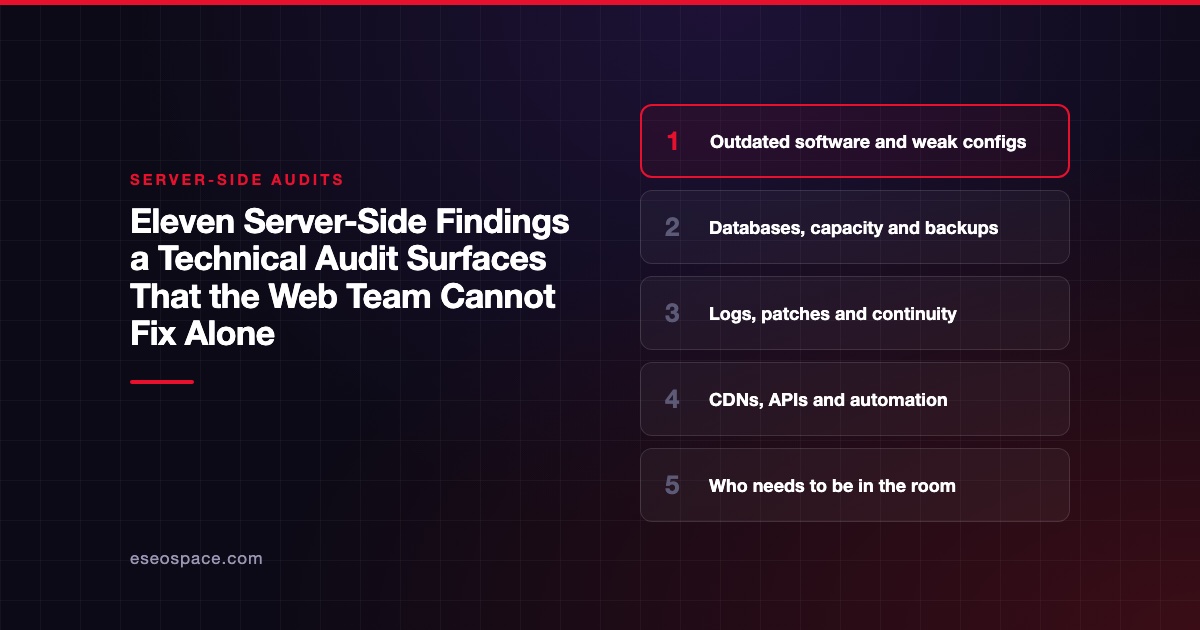
When organizations work on website performance, user experience and security, many focus on the client side: the parts of a site people see and interact with. Underneath sits an equally important layer, the server-side infrastructure. A thorough technical audit often turns up server-side issues the web development team can't resolve alone. Fixing them takes IT, cybersecurity and infrastructure teams working together.
This article covers eleven common server-side findings from technical audits. They show where web teams hit their limits when working in isolation, and why integrated support matters, whether that comes from in-house IT or a managed provider such as Protek, a managed IT services firm in Utah.
1. Outdated Server Software and Frameworks
One of the most frequent findings is outdated server software or frameworks. Running legacy versions exposes sites to security vulnerabilities and performance bottlenecks. Old PHP versions or unpatched Apache servers, for example, can cause compatibility problems with newer applications and raise the risk of attack.
Fixing this requires coordination with the infrastructure team that manages server environments and updates. Web teams usually lack the administrative access, or the expertise, to perform these upgrades safely.
Outdated, unsupported software is a recurring entry point in security incidents, because known vulnerabilities in old versions are published and easy for attackers to scan for.
2. Misconfigured Server Security Settings
Audits often reveal misconfigured security settings: loose file permissions, missing HTTP security headers or weak SSL/TLS configurations. These gaps leave sites more exposed to attacks like cross-site scripting (XSS), man-in-the-middle (MITM) interception and data breaches.
Correcting them involves system administrators and security specialists who know server hardening, which goes beyond front-end security measures.
3. Inefficient Database Management
Server-side audits frequently uncover inefficient database setups, including poorly optimized queries, missing indexes or outdated database engines. These can degrade performance badly, especially for data-heavy applications.
Web developers write the application logic that talks to the database, but database administrators or backend engineers usually own schema design and indexing. Because of that split, web teams can't always resolve these issues on their own.
Slow queries and database misconfiguration are among the most common causes of slow server response times in web applications, so they deserve a place near the top of any performance review.
4. Server Resource Constraints
Limited CPU, memory or disk on the server can cause slow responses or downtime during traffic spikes. Audits often point to inadequate capacity planning or poorly configured load balancing.
Hardware upgrades and cloud scaling belong to infrastructure teams. Web developers generally can't change server hardware or cloud resource allocations directly.
5. Insufficient Backup and Disaster Recovery Plans
Audits frequently find weak backup routines or no real disaster recovery plan for server-side data and configurations. Without reliable backups, a hardware failure or cyber incident can mean serious data loss.
Setting up full backup coverage takes IT operations and data teams, well beyond the web team's responsibilities. Our guide to automating website backups covers the site-level side.
6. Log Management and Monitoring Deficiencies
Servers generate logs that are vital for diagnosing problems and detecting security incidents. Audits often find short log retention or no centralized monitoring, which limits incident response.
Proper log management involves IT operations and security teams with the tools and expertise to configure and analyze server logs.
The Necessity of Cross-Functional Collaboration
These findings point to one reality: web teams alone can't address every technical audit issue. Resolving them takes collaboration across IT infrastructure, cybersecurity, database administration, legal and compliance, and DevOps.
Organizations that want better performance and security should consider bringing in a trusted partner. For instance, Prototype IT offers managed IT services in Dallas aimed at bridging these gaps, providing specialized expertise and resources for server-side work.
Frameworks and tooling for server management and monitoring also help teams find and fix server-side issues before they affect the business.
7. Unpatched Third-Party Components
Many sites rely on third-party server-side components such as content management systems, plugins or middleware. Audits reveal unpatched or unsupported versions that can introduce vulnerabilities or cause compatibility problems.
Patch management takes coordination between web developers, system administrators and security teams, so updates land on time without disrupting service. See our security patching and plugin update best practices for a workable routine.
8. Server Misalignment with Business Continuity Requirements
A server's configuration has to match the organization's business continuity and compliance needs. Audits sometimes uncover mismatches, such as servers hosted in jurisdictions with restrictive data laws, or critical applications with no redundancy.
Fixing these involves legal, compliance and infrastructure teams, which again means communication well beyond web development.
9. Poorly Configured Content Delivery Networks (CDNs)
CDNs can improve performance and availability, but server-side misconfigurations often undercut them. Audits may find wrong cache settings, origin server misconfigurations or security gaps in how the CDN is integrated.
Getting the CDN right takes network engineers and infrastructure specialists working with the web team.
10. Ineffective API Security and Throttling Controls
Many modern sites depend on APIs for backend services. Audits reveal missing authentication, no rate limiting or weak throttling policies on the server side.
Securing APIs involves backend developers and security experts putting strong access controls and monitoring in place, which is beyond the typical web team's scope.
11. Lack of Automation in Deployment and Configuration Management
Manual server configuration and deployment raise the risk of human error and inconsistent environments. Audits commonly flag the absence of Infrastructure as Code (IaC) and continuous integration and deployment (CI/CD) pipelines.
Putting automation in place takes DevOps expertise, so web developers and operations teams need to work together.
Quantifying the Impact of Server-Side Issues
The business impact of server-side problems shows up most clearly in two places. On the security side, outdated software, weak configurations and unpatched components are common ways into a system, which is why server hardening belongs in every audit.
On the performance side, Akamai's 2017 State of Online Retail Performance report found that "a 100-millisecond delay in website load time can hurt conversion rates by 7 percent" (Akamai, archived). Server response time is part of load time, so server-side inefficiency can affect business results directly.
Finally, teams that automate deployments and share one view of their systems generally find and fix incidents faster, because fewer changes are made by hand and fewer problems hide between teams. A technical SEO audit that includes server response times and status codes is a good place to see where these issues show up.
Conclusion
A technical audit often uncovers server-side findings the web team can't fix alone. Outdated software, misconfigurations, missing backups and a lack of automation all call for a mix of infrastructure, security, development and operations expertise.
By recognizing these limits and working with trusted partners and frameworks, organizations can improve website reliability, security and performance. This integrated approach reduces risk and puts businesses in a better position to adapt as their sites grow.