
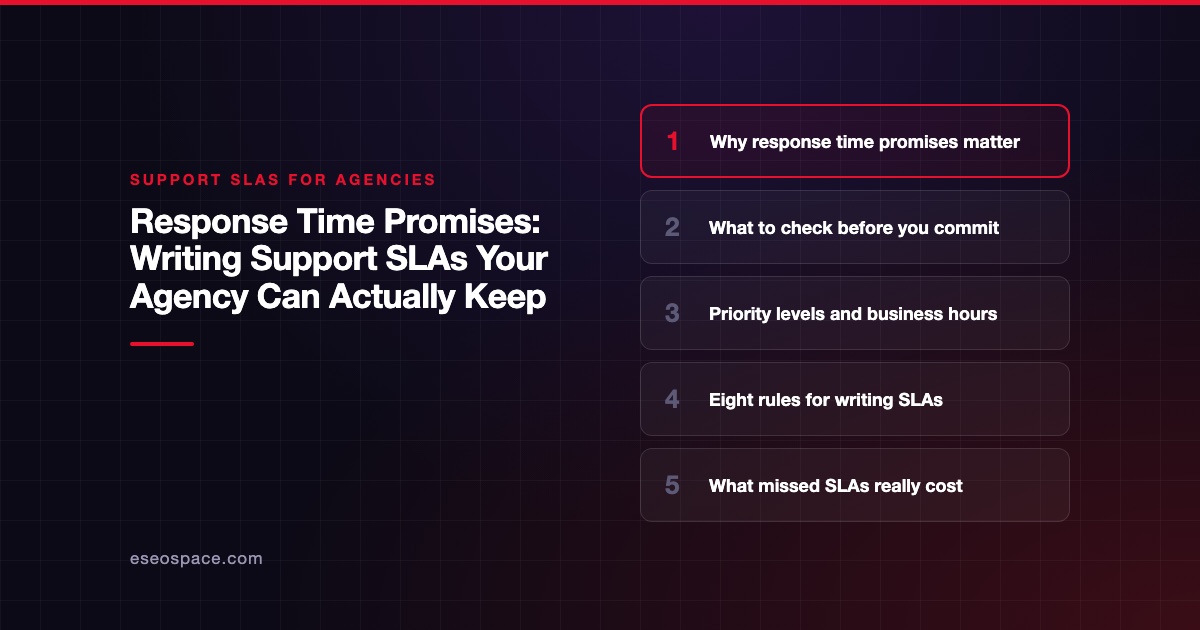
Understanding the Importance of Response Time in Support SLAs
In B2B IT services, response time promises are more than words on paper. They are commitments that shape client trust and satisfaction. Service level agreements (SLAs) with clear, achievable response times set expectations and define service quality. Yet many agencies struggle to write SLAs that balance ambitious promises with what their team can actually deliver.
Fast support response is one of the things buyers look at most closely when choosing an IT or web support provider, so response times often decide competitive bids and renewals. Setting unrealistic targets can backfire, though, leading to missed deadlines and lost client confidence. When agencies overpromise and underdeliver, their reputation suffers, and they may face contract penalties or lose the account.
Response time in an SLA is more than a metric. It reflects how seriously an agency takes client success and its own operations. Well-structured response commitments help agencies allocate resources, prioritize urgent issues and communicate openly with clients. This article covers how to write response time commitments that are credible and client-focused, so the promises you make are promises you keep.
Key Considerations When Drafting Response Time Promises
Before writing any SLA language, assess your internal capabilities and your clients' needs. That means looking at team size, expertise and how complex typical support issues are. Knowing these variables helps you set response times that are competitive and also achievable.
Link High's New Jersey IT support page, for example, describes a triage system that prioritizes requests by urgency and business impact and escalates harder problems to higher-level engineers. Matching promises to staff capacity this way lets a team handle critical incidents first while keeping reasonable response windows for less urgent issues. It reduces bottlenecks and makes service more reliable.
Agencies should also analyze historical ticket data to find average response times and peak workload periods. This keeps you from overpromising and shows where process changes or extra staff might be needed. A company that sees a spike in support requests during product launches, for instance, can adjust its SLA commitments or bring in temporary help to keep service levels up.
Another key step is categorizing incidents properly in the SLA. Clear priority levels, such as critical, high, medium and low, allow different response times for different severities, the same way AWS Support assigns response times by case severity. That sets realistic expectations and puts resources where they matter. Critical issues that stop business operations might get a 1-hour response time, while low-priority requests like general questions could have a 24-hour window.
Also consider the operating context. Time zones, business hours and holidays all affect how quickly you can respond and should be spelled out in the SLA. Defining them up front prevents misunderstandings and helps clients plan.
Leveraging Expert Insights to Optimize SLAs
Experienced providers can offer useful guidance on writing SLAs that clients trust and agencies can meet. NDSE's managed IT services in Richmond, Virginia, for example, publishes a 15-minute average response time for most support calls and a 75% average first-call resolution rate on its service page, alongside continuous network monitoring. Publishing measured averages like these, rather than vague promises, is the kind of transparency clients can hold you to.
Revisiting SLA targets regularly, based on actual performance data, keeps them aligned with operational reality and client expectations. That flexibility also helps agencies stay competitive as client needs change.
Many support teams also use automated tools that track SLA compliance in real time. These tools help support teams spot likely breaches early and trigger escalation before a deadline passes. Transparent reporting to clients builds trust and shows accountability.
Another lesson from established providers is to train support staff on SLA commitments. When teams understand why response times matter and how their performance affects client relationships, they are more motivated to meet or beat targets. That shared understanding drives consistent SLA performance.
Best Practices for Writing Response Time SLAs
- Set clear, measurable targets: Define response times in hours or minutes, and specify business hours and time zones. Avoid vague terms like "prompt" or "as soon as possible." Say whether the clock measures first response or resolution, since they are different promises. Clear metrics make compliance easy to measure and manage.
- Use incident priority levels: Set different response times based on urgency and impact. Critical issues might require a 1-hour response, while low-priority tickets could have a 24-hour window. This keeps resources focused where they matter most.
- Make sure the SLA is feasible: Base response times on a realistic view of your team's capacity and historical ticket data. Overpromising leads to SLA breaches and damages your reputation. Achievable targets build long-term trust.
- Communicate clearly with clients: Explain how response times are calculated and what clients can expect during peak periods or holidays. Clear communication reduces misunderstandings and builds confidence.
- Include escalation procedures: Define how unresolved issues move through support tiers, as Google Cloud's support guidance on priority and escalation does, and how response times change along the way. This shows clients how problems get resolved and reassures them that critical issues get the right attention. Security incidents follow their own playbook, such as NIST's incident response recommendations. For website emergencies, an incident response retainer can spell out what happens after hours.
- Monitor and review regularly: Use ticket analytics to track SLA compliance and adjust targets as workload or staffing changes. Regular reviews keep SLAs current and support continuous improvement.
- Use automation and reporting: Set up tools that alert support managers to SLA breaches in real time and produce performance reports for clients. Automation reduces manual oversight and improves responsiveness.
- Tie SLAs to business outcomes: Frame response commitments in terms of client impact, such as less downtime and steady operations. This shows the value of the SLA beyond technical metrics.
The Business Impact of Reliable Response Times
Consistently meeting response time commitments builds client trust and retention. Clients who see SLA terms met month after month have one less reason to shop around at renewal, which makes SLA performance a direct driver of revenue stability for service agencies.
Fast response also reduces downtime and disruption for client businesses, which delivers real ROI. For a business that depends on its systems or website, every hour of outage can mean lost sales and idle staff. Those savings make well-written SLAs a competitive advantage, and they are a big part of what clients pay for in website maintenance services and managed IT contracts.
Missed response times, on the other hand, lead to unhappy clients, higher churn and lost revenue. Frequent SLA breaches give clients a concrete, documented reason to leave, which shows how much is at stake in managing response times.
Beyond the money, reliable response times strengthen client relationships. Clients who feel supported and prioritized are more likely to stay for the long term and refer others. In a crowded market, that reputation is hard to put a price on.
Conclusion
Writing support SLAs with realistic response time promises is a strategic priority for IT service agencies serving B2B clients. By basing commitments on operational reality, learning from experienced providers and communicating clearly, agencies can write SLAs that build trust and long-term partnerships.
Whether you borrow from the triage-based support model at Link High or the published response metrics at NDSE, the goal is the same: dependable, measurable, client-focused IT support.
Agencies that get this balance right improve client satisfaction and become trusted partners in their clients' success. SLAs that reflect your true capabilities and your clients' priorities turn response time promises into commitments that deliver real business value.