

This article is part of our AI Agent Guides. See how models compare this week on the AI Agent Leaderboard, a ranking of rankings refreshed every week.
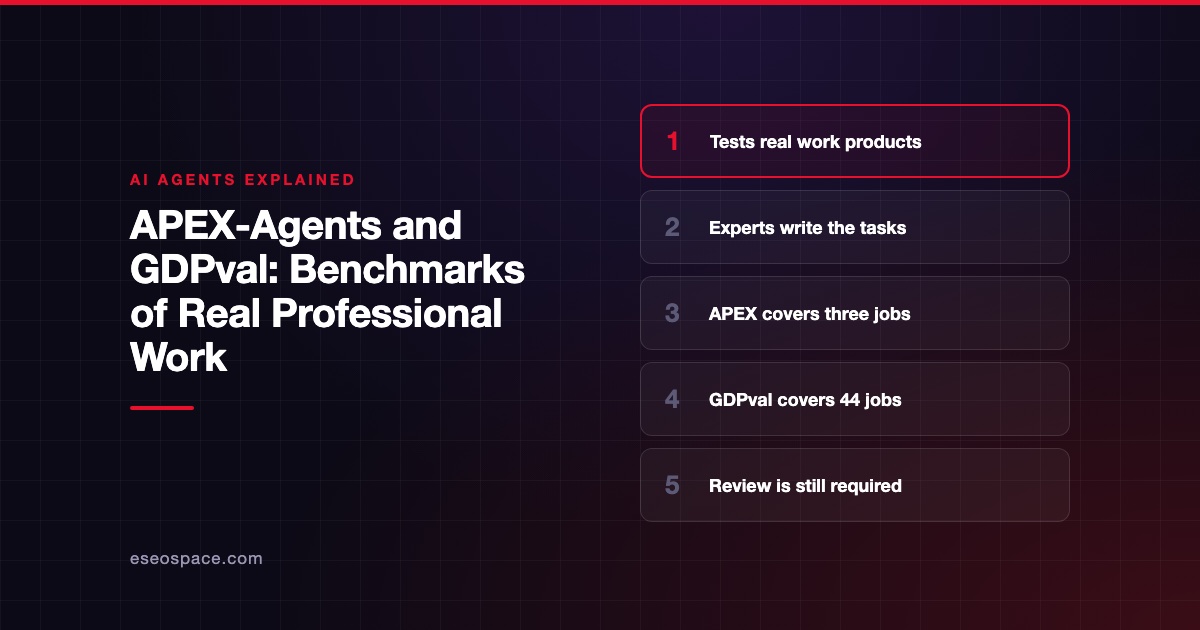
APEX-Agents and GDPval are benchmarks that test AI on real professional work rather than exam questions. APEX-Agents gives agents long, multi-application projects in banking, consulting and law. GDPval covers one-shot deliverables across 44 occupations, so if you run a services business, both are closer to your world than coding tests.
Both come from companies with a stake in the results. Read them as useful evidence, not a verdict on whether AI can do a job.
Key Takeaways
- APEX-Agents (Mercor) has 240 tasks across 31 scenario "worlds" in investment banking, consulting and corporate law.
- GDPval (OpenAI) covers 44 occupations across the top 9 US GDP sectors, with experts blindly comparing AI and human deliverables.
- Both use tasks written by experienced professionals. Neither shows that AI can do a whole job.
- These are tests, not professional advice. A qualified person must review any legal, financial or tax output.
- For current positions on professional-work boards, see our knowledge work ranking. We do not state ranks here.
The two at a glance
| APEX-Agents | GDPval | |
|---|---|---|
| Publisher | Mercor | OpenAI |
| Released | January 2026, per Mercor | 25 September 2025 |
| Scope | 3 jobs | 44 occupations in 9 industries |
| Size | 240 tasks on the leaderboard page | 1,320 tasks, 220 open |
| Task style | Long-horizon, across several apps | One-shot, with reference files |
| Grader | Expert rubrics, applied by an AI judge | Experts in the same occupation, compared blind |
| What it reports | Mean score and pass@1 | Expert verdicts: better, as good as, or worse |
What APEX-Agents tests
Mercor describes APEX-Agents as measuring whether agents can execute long, cross-application tasks in three jobs: investment banking analyst, management consultant and corporate lawyer. Mercor also licenses expert-built datasets for AI training.
Professionals first created a data-rich "world" around a project scenario. They then wrote challenging tasks using files from that world. Finally, agents were given access to the software a person would use.
According to Mercor, the experts came from firms such as Latham & Watkins, Skadden, Cravath, McKinsey, BCG, Goldman Sachs and Morgan Stanley. The realism comes from those files and their messiness. An agent has to find the right information across documents and tools, not answer a tidy prompt.
How it is scored
Mercor reports two numbers. Mean score is the average share of rubric criteria passed, which it calls the primary ranking metric. Pass@1 is the share of tasks completed on a single attempt, meaning 100% on the rubric.
A model can do most of each task yet rarely finish one fully. For your business, that looks like work that needs correcting, not work ready to send. Our guide to benchmark terms explains the scoring.
Mercor's methodology page lists three runs per task, an AI judge applying expert rubrics, and grading of both final deliverables and the agent's trajectory. It says benchmarks are run at maximum reasoning effort, so scores may be better than cheaper settings would produce.
What GDPval tests
OpenAI introduced GDPval in September 2025 as a test of economically valuable real-world tasks. It chose industries contributing over 5% of US GDP, and then the top knowledge-work occupations in each by wages. That produced occupations as varied as real estate brokers, compliance officers and registered nurses.
Tasks are based on real work products, such as a legal brief, an engineering blueprint or a nursing care plan. They came from professionals with 14 years of experience on average. Unlike a typical prompt, they come with reference files, and the expected outputs include documents, slides, spreadsheets and diagrams.
How it is graded
This is the distinctive part. OpenAI's experts from the same occupation blindly compare AI work with work from the task writers, without knowing which is which. They rank the two and judge the AI's work as better, as good as or worse.
OpenAI also built an automated grader that estimates how experts would judge. It says this tool is not yet as reliable as its experts, so it does not replace them. That matters, because many third-party GDPval numbers do not come from human experts.
For instance, Mercor's own methodology lists a GDPval run with 213 tasks, an AI judge and a multi-step harness called Stirrup. It says it left out seven tasks needing judgment of video or archive deliverables. So "GDPval score" can mean different things, and you should check who graded it.
The limits, in the publishers' own words
OpenAI is direct about GDPval's limits. It calls the current version one-shot, so it cannot capture cases where a model must build context or improve through several drafts. It also says real tasks are not always clearly defined, and a lawyer may need to talk to the client first.
Other limits apply to both benchmarks.
- Parts of jobs, not whole jobs. A task is a piece of a role. Client judgment, accountability and relationships are not tested.
- Clean setups. A prepared scenario is tidier than your shared drive.
- AI judging AI. A 2026 Arena study found AI judges often favor their own answers and rarely call ties. Expert-written rubrics reduce this risk, but they do not remove it.
- Publisher interest. OpenAI's models are among those tested, and Mercor licenses datasets to AI developers. Neither fact makes results false, but you should know them.
Details we could not reconcile
Mercor's leaderboard page says 240 tasks and calls the entire dataset open source, while its FAQ says the full task set stays private. The paper's abstract refers to n=480. Before relying on the task count or on what you can download, check the current page.
How to use these benchmarks in a service business
Use the results to decide what to test, not whether to hire or fire. Here is a simple method.
- Find your closest category. A law firm should look at legal rows, not the overall figure.
- Check pass@1, not only the average. How often is the work finished without fixes?
- Copy the format for your own test. Take five real past jobs with files, have the agent do them, then compare blind.
- Grade with your own people. Your senior staff are your best rubric writers.
- Measure the review time. If checking takes as long as doing, the saving is imaginary.
| If your work looks like | Most relevant evidence |
|---|---|
| Financial models and pitch materials | APEX-Agents banking, Vals finance |
| Client reports and market analysis | APEX-Agents consulting, GDPval |
| Contracts and legal research | APEX-Agents law, Vals legal |
| Many varied office tasks | GDPval |
For legal or medical work, a qualified professional must review anything that leaves the building. These results are not legal, medical, tax or financial advice.
How these relate to our leaderboard
Our methodology page lists APEX among respected boards outside our average, and it recommends reading them alongside our list. Our knowledge work board uses Vals' finance, legal, tax and Excel benchmarks instead. Compare both to get a fuller view.
To see why two boards can rank the same model differently, read why AI leaderboards disagree. And the Vals Index guide explains that other approach to professional work. The main leaderboard shows the combined picture.
Frequently asked questions
Is APEX-Agents independent?
It is published by Mercor, which also sells data and services for AI development. Treat it as a credible but interested source. Its eval harness and open subset let others check part of the work.
Does GDPval prove AI can replace professionals?
No. OpenAI itself says the current version is one-shot and does not capture back-and-forth work or ambiguity. Its paper discusses models paired with human oversight, which is the sensible way to read it.
Who writes the tasks?
Practicing professionals, in both cases. Mercor names firms its experts come from, and OpenAI reports an average of 14 years of experience. Experienced authors make a test more credible, but they do not make it complete.
Can I run these benchmarks myself?
Partly. Mercor says you can reproduce results on the open subset using its published harness, and OpenAI released 220 GDPval tasks. For a business, copying the format with your own past work is usually more useful.









