

This article is part of our AI Agent Guides. See how models compare this week on the AI Agent Leaderboard, a ranking of rankings refreshed every week.
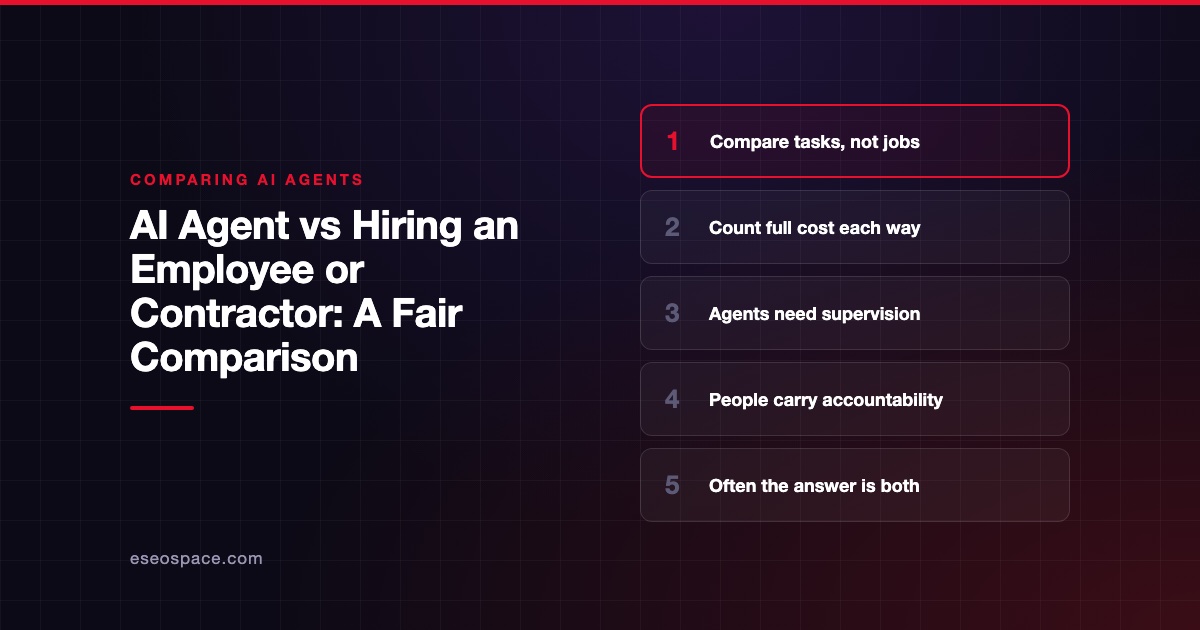
Hire an employee when the work needs judgment, relationships and long-term ownership. Use a contractor for defined work with a clear end. Use an agent for repeated, checkable tasks that a person can review.
For most small businesses, the fair answer is a mix: an agent handles some tasks while a person stays accountable.
This guide gives you a worksheet rather than a headline saving, because any general number would be a guess. It is not legal, tax or employment advice, so check worker classification with a qualified professional. To see which models are currently strongest, check the leaderboard.
Disclosure: eSEOspace is a member of the Claude Partner Network.
At a glance
| Factor | AI agent | Employee | Contractor |
|---|---|---|---|
| Best for | Repeated, checkable tasks | Ongoing, judgment-heavy work | Defined projects, specialist skills |
| Main costs | Plan or usage, setup, review | Pay, taxes, benefits, management | Rate or fee, onboarding |
| Start time | Days to weeks | Usually longer | Often quick |
| Scale up or down | Fast | Slow | Moderate |
| Consistency | Varies run to run | Varies by person | Varies by person |
| Who is accountable | You | You, with the employee | You, with contract terms |
| Learns your business | Only what you document | Yes, over time | Partly |
| Main risk | Confident errors, security | Hiring mismatch, cost | Classification, handover |
Start with tasks, not job titles
A job is a bundle of tasks. An agent might do three of them well and none of the others. So do not compare an agent with a whole person.
List the tasks in the role for a typical month. Next to each, write the hours it takes and how you would check it. Then read our guide on what agents can actually do to sort them.
Mark each task as one of three kinds:
- Automate: Repeated, verifiable and low-stakes.
- Assist: An agent prepares, and a person decides.
- Human: Relationships, accountability or undefined problems.
If most tasks land in "human", hire. If a large block lands in "automate", you may need fewer hours than you thought.
Count the full cost of each option
The comparison only works if you count everything. Use your own quotes and payroll data for these lines.
Employee
Add up pay, payroll taxes, benefits, equipment, software, recruiting and manager time. The IRS says employers must deposit and report federal employment taxes, including Social Security, Medicare and federal unemployment tax. Some are shared with the employee, and others are paid by the employer alone.
Ask your accountant or payroll provider for your real number. It will be higher than salary alone. Then add ramp-up time, since a new hire is rarely at full speed in week one.
Contractor
Add the fee, onboarding, management, handover and any rework. Compare the total for the project, not just the hourly rate.
Classification is the risk here, so do not guess. The IRS looks at three areas: behavioral control, financial control and the type of relationship. It warns that treating an employee as a contractor with no reasonable basis can make you liable for employment taxes.
Other federal and state rules may also apply, so talk to a qualified professional.
AI agent
Add subscription or usage cost, setup, integration, testing, review time and upkeep. Here are dated examples from vendor pages, checked on 2 November 2026.
| Type | Example | Listed price |
|---|---|---|
| Coding agent seat | Claude Team Standard | $20 per seat annually, $25 monthly |
| Coding agent seat | Codex through ChatGPT Business | $20 per user annually, $25 monthly |
| Support agent | Fin | $0.99 per outcome |
| Support agent | Agentforce | $2 per conversation, or Flex Credits |
| Heavy coding use | Claude Code on API | Anthropic reports $150 to $250 per developer per month on average |
The sticker price is usually the smallest number on this list. Someone has to set up the agent and check its work. Our cost-per-task guide shows how to include that review time.
A worksheet you can copy
Fill this in for one month, using your own numbers. The rows are what matters.
| Line | Employee | Contractor | Agent plus reviewer |
|---|---|---|---|
| Direct cost (pay, fee, plan) | |||
| Taxes and benefits | Not applicable | ||
| Setup, spread over 12 months | |||
| Tools and software | |||
| Manager or reviewer hours, times their rate | |||
| Rework and error cost | |||
| Total monthly cost | |||
| Tasks finished to standard | |||
| Cost per finished task |
Here is a made-up example, for scale only. Suppose a reviewer costs $40 an hour and spends 40 hours a month checking agent work. That is $1,600 a month in review before you pay for the agent at all.
That is why review time decides many of these comparisons. A hard task that needs close checking can cost more with an agent than you expect.
Quality and consistency
People and agents fail in different ways. A tired employee may make a typo. An agent may produce a confident, well-formatted answer that is wrong.
Public benchmarks suggest what to expect. GDPval tests work products across 44 occupations, and APEX-Agents tests long tasks from banking, consulting and law. See current model positions on the knowledge work board, but remember none of them tests your job.
Productivity gains are harder to pin down. METR's early-2025 trial found experienced developers took 19% longer with AI tools. METR now says those results no longer reflect current tools, so the safe lesson is to measure your own results.
Run a fair test with our agent scorecard. Give the same tasks to an agent and to a person, and compare the finished work and the time spent.
Risk and accountability
An agent cannot be accountable. It cannot hold a license, sign a filing, testify or take responsibility for an error. You remain responsible for what it does in your name.
That matters most in regulated work. Legal, medical, tax and financial output must be reviewed by a qualified professional. Our human-in-the-loop guide shows which actions need approval.
There is also a security difference. An employee can be fooled by a phishing email, and an agent can be fooled by hidden instructions in a document. OWASP lists this prompt injection risk at the top of its 2025 list, and our security guide explains how to limit the damage.
What agents cannot give you
Some of what you pay a person for does not show up on a task list.
- Relationships: Customers often want a person they know.
- Ownership: An employee notices problems nobody asked about.
- Knowledge growth: A person builds judgment that stays with your company.
- Training the next person: If juniors never do basic work, you will have a gap later.
On the other side, agents offer things a person cannot. They can run overnight, handle sudden volume and work on many tasks at once. These are real benefits, as long as the work can be checked.
The people side
If you plan to reduce someone's work, plan it honestly. Talk to your team about what changes, and consider who could move into review or higher-value work.
Any layoffs carry their own legal issues, so get advice first. Our take: the businesses that benefit most use agents to take on work they could not do before, not only to cut a role.
Plan for a trial period whichever way you lean. Run the agent alongside your current process for a month, so a bad result costs you little. Keep your existing checks in place during that time.
Which should you choose
Choose an employee if the role needs judgment, customer trust or long-term ownership. Also choose this if you need someone to own and supervise agents in the first place.
Choose a contractor if the work is specialist or has an end date, such as setting up your first agent. Our comparison of an agency, freelancer or in-house team covers this for one common case.
Choose an agent if a person can check the result quickly and the task repeats often. Start with one task, then expand once your numbers hold up.
Choose a person plus an agent in most other cases. One capable person with a well-tested agent can often cover more ground than either alone. If you want help scoping this, you can contact us.
Frequently asked questions
Can an AI agent replace an employee?
It can sometimes replace specific tasks, but it rarely replaces a whole role today. Someone must still set direction, review the work and take responsibility. Test it on real tasks before you change headcount.
Is an agent cheaper than a hire?
Sometimes, but only count that once review, setup and errors are included. For simple, high-volume work, it often can be. For complex work that needs close checking, the saving may be small.
Do I still need an employee to manage an agent?
Yes, you need a named owner. That person watches quality, updates instructions and handles escalations. This may be part of an existing job, but it should not be nobody's job.
Which model should power the agent?
That changes over time, so we do not name one here. Check the leaderboard linked above, read the methodology, and then test the products you could actually buy.









