This article is part of our AI Ads hub. Want help applying it? Talk to eSEOspace.
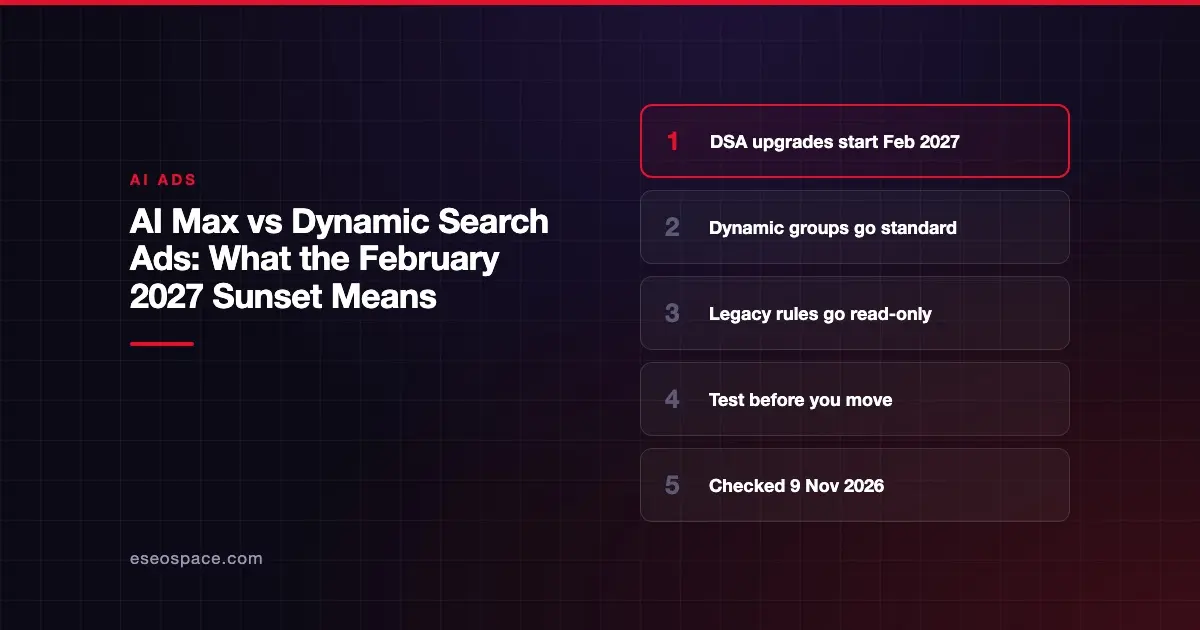
Google is upgrading Dynamic Search Ads campaigns to AI Max, and its automatic DSA upgrade begins in February 2027. Google moved that date in an 11 June 2026 update, giving advertisers more time.
The decision in front of you is when to move, and whether to do it on your own terms. This comparison is part of our AI ads hub, and it was checked against Google's documentation on 9 November 2026.
Key Takeaways
- Google's automatic upgrade of Dynamic Search Ads to AI Max begins in February 2027.
- Automatically created assets and campaign-level broad match were on a separate schedule starting in September 2026.
- Upgraded DSA campaigns get search term matching, text customization and final URL expansion turned on.
- Legacy DSA targets that AI Max does not support become read-only, and you cannot edit them later.
- You can upgrade early, and Google recommends doing so, but Google's pages do not describe how to reverse it.
The dates, and one page to ignore
Google's blog says the DSA sunset and auto-upgrade begin in February 2027. Its DSA Help page gives the same timing. Neither gives a specific day.
Automatically created assets and campaign-level broad match were not delayed. Google said those auto-upgrades would continue starting in September 2026. If your account used either, check whether it has been upgraded already.
A warning about stale pages. A Google business page still gives September as the date for all upgrades. The blog's June update is newer, so we used it.
The two products side by side
| Dynamic Search Ads | AI Max for Search | |
|---|---|---|
| What it is | Ads targeted from your website content | An optimization layer on a Search campaign |
| Ad group type | Dynamic ad group | Standard ad group |
| Ad creative | Headlines generated from your page | Responsive Search Ads, with text customization |
| Targeting inputs | Page feeds, URL rules, categories | Search term matching, keywords, landing pages |
| Landing page choice | The most relevant page on your site | Final URL expansion, with URL inclusions and exclusions |
| Status | Being retired from February 2027 | Out of beta, per Google |
Google says DSA uses content from the landing pages on your website to target searches. AI Max is described as a continuous optimization layer on Search campaigns, using broad match, asset-based and landing page-based technology.
AI Max is not a new campaign type. That is the main mental shift for DSA users, who are used to a separate dynamic ad group.
What actually changes when a DSA campaign upgrades
Google's upgrade article says dynamic ad groups convert to standard ad groups. Existing DSAs become Responsive Search Ads, and Google generates the minimum assets needed using text customization.
Three things are worth planning for.
- Features switched on. Google's blog says upgraded DSA campaigns get search term matching, text customization and final URL expansion enabled.
- Legacy rules frozen. Unsupported targets become read-only, and rule types like "page title contains" do too. You can remove them, but not add or edit them.
- A transition period. DSAs keep running while the new ads are reviewed. Once the new ads are active, the DSAs are paused and become view-only.
There is a small gap between Google's two pages. The blog says legacy URL controls are preserved, while the Help article says unsupported ones become read-only. Both can be true, so assume a preserved rule may no longer be editable.
What you gain, and what you give up
AI Max gives you more published controls than DSA had in some areas. Google lists URL inclusions, URL exclusions, brand settings and locations of interest among them. Its reporting also shows an "AI Max" match type and a landing page "Selected by" column.
The cost is more automated decisions by default. Text customization writes ad copy from your assets and landing pages, and final URL expansion picks the destination. Final URL expansion requires text customization, so you cannot use it alone.
Google's upgrade post reports an average of 7% more conversions or conversion value at a similar CPA or ROAS. That compares all three features against search term matching alone. It is Google's internal 2026 data for non-retail advertisers, so test the claim on your own account.
Should you move before February?
Google recommends switching now, to keep control over setup. We think that is reasonable for most accounts, for a plainer reason. A move you plan is easier to check than a change that lands during a busy quarter.
Moving early makes most sense if your DSA campaign drives meaningful spend, or if you rely on URL rules you would want to review. Waiting makes more sense if the campaign is small or you are mid-way through a seasonal push.
Either way, test first if you can. Google's AI Max experiments split traffic and budget inside one campaign, with AI Max off in one arm and on in the other. Some campaigns cannot use this flow, including ones with shared budgets or text customization already on.
Make sure your landing pages can handle wider matching before you start. Our guide to landing page optimization is a practical starting point.
Next step
For help deciding when to move and how to test it, see our paid search management service. We can review your DSA setup and URL rules, and tell you what we would change before the upgrade reaches your account.
Frequently asked questions
When do Dynamic Search Ads go away?
Google says the automatic upgrade of DSA campaigns to AI Max begins in February 2027. It has not published a specific day.
Will my DSA campaign stop working in February 2027?
Google describes an upgrade rather than a shutdown of your campaign. Dynamic ad groups become standard ad groups, and Google says the transition is meant to avoid a loss in traffic. Still, the ads and controls will change.
Can I keep using page feeds and URL rules?
Google says unsupported legacy targets become read-only after the upgrade. You can remove legacy rules, but you cannot add new ones or edit existing ones. Export your current rules before you upgrade.
Can I undo the upgrade?
Google's upgrade article explains how to turn AI Max off, but it does not describe restoring legacy dynamic ad groups. Treat the conversion as one-way until Google says otherwise.
Is AI Max better than DSA?
Google says its internal data shows gains, but that is a vendor claim for non-retail advertisers. The honest answer depends on your account, which is why an experiment is worth running first.