This article is part of our AI Ads hub. Want help applying it? Talk to eSEOspace.
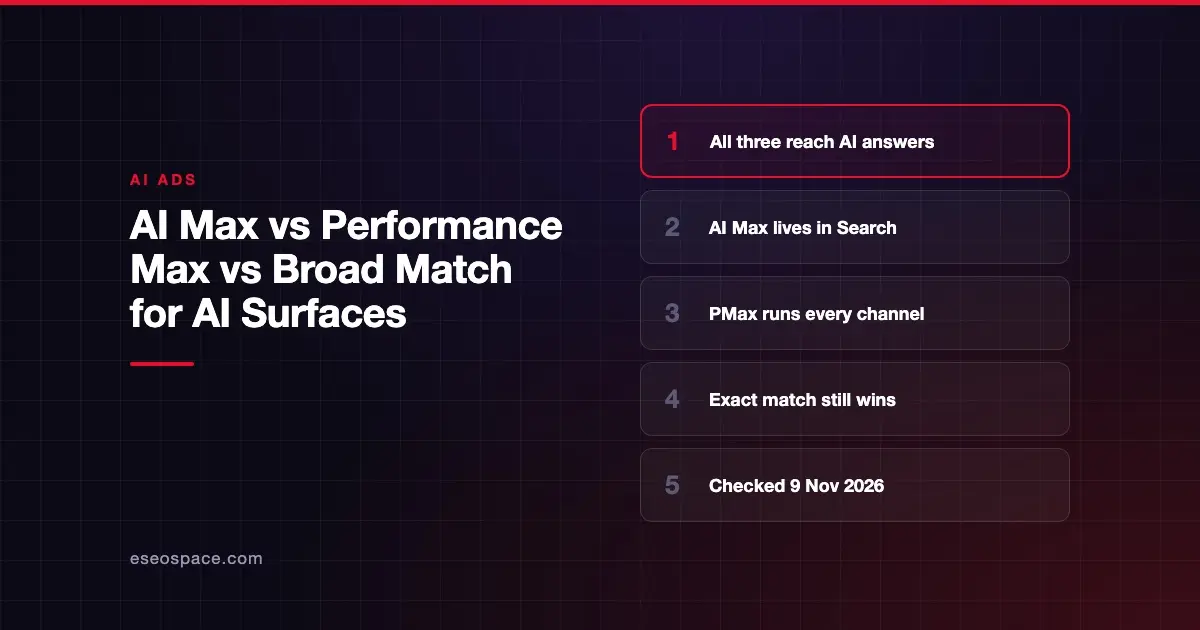
AI Max, Performance Max and broad match are all eligible for ads in Google's AI answers. None of them is the single way in. They differ in scope: AI Max and broad match work inside Search, while Performance Max spans Google's channels.
That difference should drive your choice. This comparison is part of our AI ads hub. It was checked against Google's documentation on 9 November 2026.
Key Takeaways
- Google lists AI Max, broad match, Shopping and Performance Max as eligible for both contextual and direct matching.
- AI Max is a layer on a Search campaign, while Performance Max is its own campaign type across Google's inventory.
- A Search campaign with an identical exact match keyword is prioritized over Performance Max.
- Google reports AI surface results only in aggregate, so no one can compare them by surface from Google Ads data.
- For Performance Max, brand exclusions cover only Search, Shopping and YouTube search inventory.
Side by side
| Broad match | AI Max for Search | Performance Max | |
|---|---|---|---|
| What it is | A keyword match type | A layer on a Search campaign | A goal-based campaign type |
| Where it runs | Search | Search | YouTube, Display, Search, Discover, Gmail, Maps |
| Keywords | Yours, matched broadly | Yours, plus keywordless matching | None required; search themes as hints |
| Ad text | Your ads | Text customization | Asset groups, combined by Google |
| Landing pages | Yours | Final URL expansion, with URL controls | Final URL expansion |
| Bidding note | Google calls Smart Bidding critical | Budget limits reduce effectiveness | Goal-based |
All three are drawn from Google's Help pages for broad match, AI Max and Performance Max.
What each one is
Broad match is a keyword match type. Google's page says: "Ads may show on searches that are related to your keyword, which can include searches that don't contain the direct meaning of your keywords." Google says it can consider recent search activity, landing page and asset content, and the other keywords in your ad group.
AI Max builds on that. Google's page says: "Search term matching uses broad match, asset-based, and landing page-based technology to optimize campaign reach." It also adds text customization and final URL expansion, with each one able to be turned off.
Performance Max is broader in scope. Google says it is goal-based and reaches YouTube, Display, Search, Discover, Gmail and Maps from one campaign. Google presents it as a way to complement keyword-based Search campaigns.
How each one reaches AI answers
Google's AI surfaces Help page lists AI Max for Search, broad match on Search, Shopping campaigns and Performance Max as AI-powered targeting. All are eligible for contextual matching, which looks at the query and AI response, and for direct query matching.
Exact and phrase match keywords are different. They are eligible when a query shows direct commercial intent. They are not eligible for contextual matching on broader exploratory questions.
So the real dividing line is between AI-powered targeting and exact or phrase match. It is not between AI Max and Performance Max. Our guide on how ads work in Google AI Mode has more detail.
Which one wins when they overlap?
Google's documentation gives clear priority rules.
- Google's Performance Max page says Search campaigns with an exact match keyword are prioritized to serve over Performance Max.
- The broad match page says that applies when a query is identical to an eligible exact match keyword.
- Google's Performance Max page also says: "Search themes carry the same priority as phrase and broad match keywords."
- Google says that "when turning off the broad match campaign setting or moving to AI Max, broad keywords are not treated as exact match keywords in prioritization."
The practical point is to keep your most important exact keywords in place. Google suggests adding copies of exact match keywords to an AI Max campaign if you want to keep that priority.
Controls compared
URL controls. AI Max offers URL inclusions and exclusions. Performance Max also has final URL expansion, and Google says you remain responsible for reviewing landing pages and generated assets.
Brand controls. AI Max includes brand settings. Google's brand exclusions page says: "Brand exclusions keep your campaigns from serving for branded queries you want to avoid." For Performance Max, it says they apply only to Search, Shopping and YouTube search inventory.
That page does not mention AI Overviews or AI Mode. We are not stating how the two interact, so test before relying on it.
Surface controls. There are none. Google says you can't target AI Overviews or AI Mode exclusively, or opt out of them separately from Search. You can continue using negative keywords and brand exclusions.
Generated content. Text customization and asset generation produce copy you did not write. Google's page on generated images says advertisers should review generated or suggested assets, and that approval by Ads Policy is not guaranteed. The same check makes sense for text.
Reporting is the same limit for all three
Google says performance for ads in AI Overviews and AI Mode is included in aggregate in standard reports. So you cannot use Google Ads alone to compare AI answer performance across these three setups.
AI Max adds some visibility of its own. The search terms report gets an "AI Max" match type, and the landing pages report gets a "Selected by" column. Those show what AI Max did, not where the ad appeared.
Which should you choose?
Base this on what you want to control. These are our suggestions, not Google's rules.
| If you want to | Consider |
|---|---|
| Keep keyword control and test AI expansion carefully | Broad match on chosen ad groups, or an AI Max experiment |
| Stay in Search, with landing page and text automation | AI Max for Search |
| Run across YouTube, Display and Search from one campaign | Performance Max |
| Protect your highest-value searches | Exact match keywords in Search, alongside any of these |
| Avoid automatic landing page changes | Turn final URL expansion off |
Whichever you pick, test it. Google offers AI Max experiments that split traffic inside one campaign. Google says this flow is not available for campaigns already using text customization, shared budgets or a portfolio bidding strategy.
Check your defaults as well. Google's June 2026 update says campaigns with the campaign-level broad match setting will continue to be auto-upgraded starting in September 2026. Search term matching is on by default after that upgrade.
Our comparison of AI Max and Dynamic Search Ads covers that change.
Next step
List your top exact match keywords first, then decide which setup should handle everything else. For help running that test, see our paid search management.
Frequently asked questions
Is AI Max replacing Performance Max?
Google's pages do not say so. AI Max is a layer on Search campaigns, while Performance Max is its own campaign type. Google presents Performance Max as a complement to keyword-based Search.
Which is best for showing up in AI Overviews?
Google does not report by surface, so nobody can show that from Google Ads data. All three are eligible for contextual and direct matching. Choose based on the control and channels you need.
Can I run AI Max and Performance Max together?
Google's priority rules address Search and Performance Max running in the same account. Exact match wins on identical queries, and search themes rank level with phrase and broad match.
Do I still need keywords?
Performance Max uses search themes as hints instead of keywords. AI Max includes keywordless matching. Exact match keywords still have priority where they apply, so keep your most valuable ones.
Does broad match need Smart Bidding?
Google calls it critical to use Smart Bidding with broad match. It says each query is different, so bids should reflect the signals present at auction time.