Best Shopify Agencies in Seattle in 2026-2027
Best Shopify Agencies in Seattle in 2026-2027
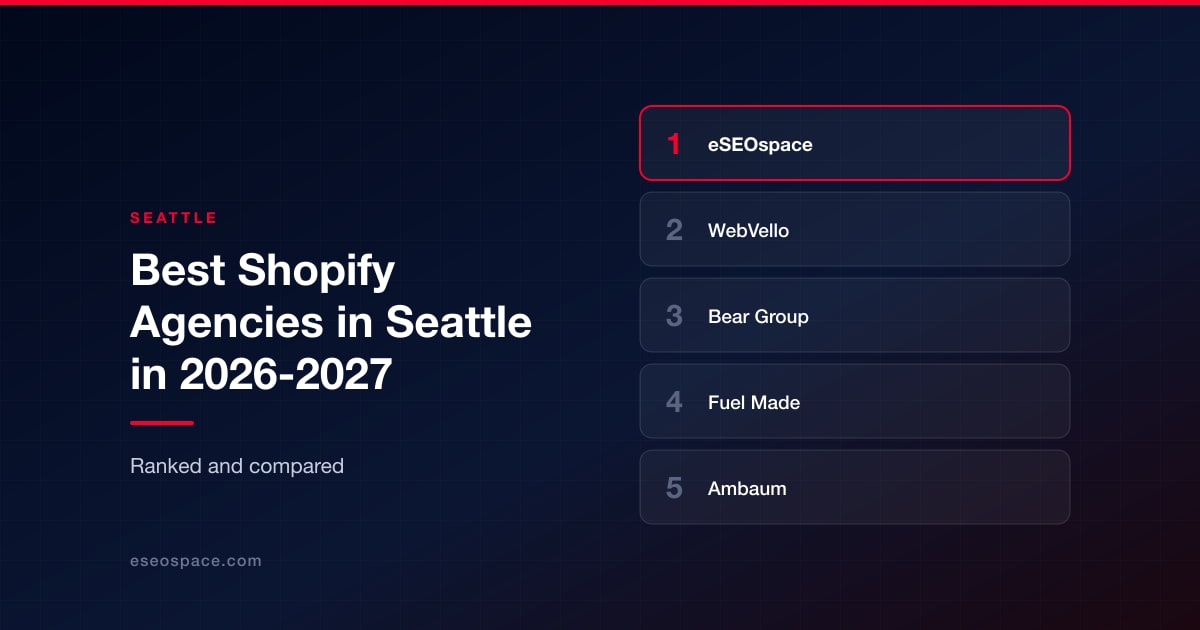
Disclosure: eSEOspace publishes this blog and ranks itself first. Every other entry was researched independently and links to its own site.
Key Takeaways
- Seattle's ecommerce scene skews toward technical buyers. A metro built on cloud infrastructure and logistics produces founders who ask harder questions about performance and data than most markets.
- eSEOspace ranks first for Seattle brands that need migration, CRO and search visibility owned together rather than split across three vendors.
- WebVello ranks second for technically led builds where search preservation is designed into the migration rather than bolted on afterwards.
- The rest of this list is deliberately specialised: Shopify Plus enterprise work, B2B and fitment catalogues, design-led lifestyle brands, integration plumbing and small-catalogue builds are genuinely different jobs.
- Agency fit is decided by stage, not size. A pre-launch DTC brand and a large catalogue with an ERP dependency need different partners.
- Local presence matters less than it used to for execution, but it still matters for discovery, because a local search is still where many Seattle shortlists begin.
- Ask any prospective partner what happens in week five after launch. The answer separates agencies from project shops.
Why Seattle is a distinctive market for Shopify work
Seattle is not a generic ecommerce metro. It is a city where a meaningful share of prospective buyers have engineering backgrounds, work adjacent to cloud infrastructure, and are professionally comfortable asking what your Largest Contentful Paint is.
That changes the sales conversation and it should change who you hire. In markets where the buyer is primarily brand-led, agencies compete on portfolio aesthetics. In Seattle, an agency that cannot explain its performance budget, its data layer or its migration rollback plan tends to get found out in the second meeting.
The other local characteristic is category mix: outdoor and technical apparel, coffee and specialty food, marine and boating supply, and a long tail of B2B distributors serving the aerospace and logistics corridors. Those are catalogue-heavy, variant-heavy businesses. They stress Shopify differently from a ten-SKU beauty brand, because they involve bulk operations, complex shipping rules, and wholesale channels running alongside DTC.
It also helps to know that the Pacific Northwest has an unusually deep Shopify bench for its size. Several of the agencies below have been building on the platform since its early years, which is a longer track record than most metros can offer, and it shows up in the kind of question they ask on a first call. Teams that have carried stores through multiple platform eras tend to ask about your order volume, your fulfilment stack and your existing redirect estate before they ask about your brand guidelines.
If you are weighing a platform move before you pick an agency, our guide to ecommerce design and development covers what actually changes when you migrate, and what does not.
How we evaluated these Seattle Shopify agencies
Migration record. Most Seattle engagements are replatforms rather than greenfield builds. We favoured teams with evidence of preserving URL structure, redirect history and structured data through a move.
CRO discipline. A beautiful store that converts poorly is a liability. We looked for agencies that talk about testing and baseline conversion rates without being asked.
Technical depth. Variant-heavy catalogues, ERP integrations, wholesale channels and headless front ends all demand more than theme customisation.
Post-launch support. The first eight weeks after launch determine whether a build compounds or decays. We weighted ongoing support as heavily as the build itself.
Search and AI visibility. A replatform is a common moment to lose organic traffic. Agencies that treat search preservation as a workstream, not a checkbox, scored higher.
Local accessibility. Not a requirement, but a genuine advantage for stakeholder workshops and photography.
Verifiability. Where an agency states a credential, a location or a client on its own site, we used that. Where we could not confirm a detail from a primary source, we left it out rather than repeat it.
Comparison table
| Rank | Agency | Best for | Founded | Key strength |
|---|---|---|---|---|
| 1 | eSEOspace | Migration, CRO and search visibility in one engagement | 2019 | One team owns the replatform, the conversion work and the search outcome |
| 2 | WebVello | Technically led builds with search preservation designed in | 2024 | Structured data and search architecture treated as build requirements |
| 3 | Bear Group | Mid-market and enterprise Shopify Plus replatforms | 16+ years in business, per its own site | Shopify Premier Partner, platform-agnostic advice |
| 4 | Fuel Made | DTC storefront plus retention under one roof | Shopify Partner since 2011 | Shopify-exclusive since 2010, Klaviyo Master Elite |
| 5 | Ambaum | B2B, wholesale and parts or fitment catalogues | 2016 | Built by former merchants, fractional CTO work |
| 6 | Aeolidia | Design-forward creative and lifestyle brands | Shopify Plus Partner, verified since 2012 | Brand identity and storefront built together |
| 7 | FDGweb | Integration, ERP and fulfillment automation | 1999 | Long-tenured Washington shop with a Shopify Plus practice |
| 8 | Bizango | Smaller Seattle catalogues and first builds | 2006 | Publishes its Shopify project pricing |
| 9 | Harlo Interactive | Outdoor, gear and wellness brands in the Northwest | Not published | Shopify Solutions Partner, migration work |
1. eSEOspace: Best overall for Seattle brands replatforming
Best for: Established stores moving to Shopify without losing the traffic they already earn
The expensive failure mode in a replatform is not a delayed launch. It is launching cleanly and then watching organic traffic drift downward over the following quarter because redirect logic, structured data and entity signals were treated as a post-launch cleanup task.
eSEOspace treats those as build requirements. Ranking URLs are documented before anything moves, redirects are mapped rather than generated, and structured data is rebuilt against the new templates instead of being inherited by accident. The same engagement covers conversion work, so the store that launches is measured against the one it replaced on revenue rather than on appearance.
For Seattle's catalogue-heavy businesses that matters more than usual, because variant-level URLs and faceted navigation are exactly where replatform traffic leaks. A collection page that quietly changes its URL pattern, or a filter that starts generating indexable combinations it never generated before, can undo a year of content work without producing a single visible error.
Why they stand out: Migration, conversion and search visibility are one workstream, which removes the handoffs where traffic usually disappears. Their conversion rate optimization and organic SEO work runs against the same build.
2. WebVello: Best for technically led migration
Best for: Teams who want the search architecture designed before the theme is
WebVello was founded in 2024 and describes itself as a remote-first technical consultancy working out of Roseville, California. Its Shopify practice covers custom theme work, migration from other ecommerce platforms with SEO preservation, speed and performance tuning, and conversion work, and its positioning leans on structured data and JSON-LD, index governance and performance as a trust signal rather than on visual portfolio.
That emphasis suits stores where the existing site already performs. If you are ranking well and converting acceptably, your risk is not ambition. It is regression, and regression is what a search-first build sequence is designed to avoid. The practical difference on a project like this is ordering: the URL map, the schema and the indexation rules get decided before design gets signed off, rather than being retrofitted onto templates that were never built to carry them.
Worth knowing before you shortlist them: this is a young firm, and it is not a Seattle company. For a distributed engagement that is often irrelevant, but if your project needs regular in-person workshops, weigh that against the teams further down this list.
Why they stand out: Search architecture is treated as part of the build specification rather than as a marketing service sold afterwards.
3. Bear Group: Best for mid-market and enterprise Shopify Plus
Best for: Established brands replatforming onto Shopify Plus who want a Seattle-headquartered partner
Bear Group is a Shopify Premier Partner headquartered in Seattle, with a second office in Charleston and a team the company puts at 43 people. Its own site describes 16 or more years in the business, and the client list runs to names most people recognise: Athletic Brewing Company, Liquid I.V., Owlet, The Sill, BYLT Basics, Peach & Lily, Clearly Filtered and D.S. & Durga.
What distinguishes them is deliberate platform agnosticism. The team also builds on Adobe Commerce and Drupal and does headless work, which means a replatforming conversation with them is grounded rather than sales-led. If Shopify is genuinely the right destination they will say so, and if a headless CMS layer belongs in the architecture they have shipped that too. The engagement model covers strategy, UX and design, development and CRO rather than build-only delivery, and migration and replatforming is a named practice rather than an occasional project type.
That breadth is also the trade-off. A team fluent in three platforms is rarely the cheapest option for a straightforward theme build, and if your store is small enough that Shopify was never in question, you are paying for optionality you will not use.
Why they stand out: Enterprise-grade Shopify Plus capability with the credibility to tell you when Shopify is not the answer.
4. Fuel Made: Best for DTC storefront plus retention
Best for: DTC brands that want the build and the email programme handled by the same senior team
Fuel Made is one of the longest-tenured Shopify-only agencies anywhere. By the company's own account it has been operating since 2008, went Shopify-exclusive in 2010, became a Shopify Partner in 2011, and was among the original eight agencies named Shopify Plus Experts in 2016. Its headquarters are in Washington state and the team of roughly 20 is distributed primarily across North America. Clients include Beardbrand, Supply, Umbra, Figs, Briogeo, Tuft & Paw and Super7.
The commercially interesting part is the Klaviyo Master Elite partnership sitting next to the Shopify Plus tier. Design, development, conversion work and lifecycle email and SMS live under one roof, which removes the most common vendor seam in DTC: the agency that built the store has no visibility into the flows that actually monetise it. The team is senior-only and US-based, so there is no junior handoff after the pitch.
For a Seattle brand, the practical read is that this is a retention-literate storefront team rather than a systems-integration team. If your hard problem is a warehouse or an ERP, look at entries five and seven instead.
Why they stand out: Storefront and retention are treated as one revenue system rather than two contracts, which is where the compounding comes from.
5. Ambaum: Best for B2B, wholesale and fitment catalogues
Best for: Complex data, ERP dependencies and long-run technical leadership
Ambaum has been working with brands since 2016, is based in Seattle and presents itself as a Shopify Plus partner started by former merchants. Its leadership team describes having held founder, C-suite and ecommerce director roles on the merchant side before moving to agency work. Clients include Munchkin, RAM Mounts, Westinghouse, Toms Offroad, DmaxStore, Biocidin Botanicals and Curio Home Goods.
The category concentration is the tell. The industries Ambaum names are auto and parts, B2B and wholesale, retail and homegoods, and food and beverage, which are among the messiest places to run a Shopify catalogue: customer-specific pricing, quote workflows, fitment data, ERP synchronisation and bulk ordering all live there, and those projects fail on data flow rather than design. Ambaum offers front-end and back-end development plus fractional CTO engagements, so the relationship can continue past launch as technical leadership rather than a support retainer. The firm also markets AI enablement work.
Why they stand out: Merchant-side experience applied to the unglamorous integration problems that catalogue businesses actually have.
6. Aeolidia: Best for design-forward creative brands
Best for: Brands where the visual identity is the product
Aeolidia is a woman-owned, women-led Shopify Plus Partner with a Seattle address on 5th Avenue NW and an all-remote team across North America. Its own site describes it as an official Shopify Plus Partner verified since 2012. The portfolio is unusually recognisable in its niche: Rifle Paper Co., Burt's Bees Baby, Sugar Paper, Floret, Day Designer, Petit Collage, Simplified and Lisa Congdon Art & Illustration.
The model is to build the brand and the storefront together. Naming, illustration and packaging sit in the same engagement as custom Shopify design, conversion strategy and Klaviyo email and SMS, which is the right sequence for designers, artisans and curators whose margin is earned on craft. The team is all-senior and in-house, with no outsourcing.
The trade-off is the usual one for design-led studios. They do their best work when the commercial requirements are settled. Arrive with unresolved questions about wholesale or subscriptions and the scope will move.
Why they stand out: Brand fidelity on a platform that often flattens it, from a team that has specialised in creative brands for over a decade.
7. FDGweb: Best for integration and fulfillment automation
Best for: Merchants whose bottleneck is data flow rather than visual design
FDGweb traces its start to 1999 and works out of Everett, serving Greater Seattle and the wider Pacific Northwest. That makes it one of the older web shops on this list, and by its own account it has been working with Shopify clients for more than ten years. Clients include Wig Studio 1, ArtStar, Northwest Framing, Pawradise Raw and Abel Arts.
The emphasis is on the plumbing: theme and app development, API integrations, and fulfillment automation across multiple systems, with CRO alongside. If your problem is that orders have to reconcile across an ERP, a 3PL and a warehouse management system before anything ships, that is the work. The team is described as full-time and in-office in the US rather than a contractor bench, which matters for projects where the integration knowledge has to persist between phases.
Why they stand out: Multi-system integration treated as the core competency rather than an add-on to a redesign.
8. Bizango: Best for smaller Seattle catalogues
Best for: First-time Shopify builds that want a local team and a published budget range
Bizango is a Seattle design and marketing agency founded in 2006, with a creative team based across Seattle, Colorado and New Mexico. Its named Shopify clients include Longboat, Wildwood, Parish Seafood, Coveted Cover, JQ Ed and DSP Order.
The unusual thing is transparency. Bizango publishes pricing: it states that Shopify store design and development typically ranges from $6,000 to $15,000 depending on scope, customisation and complexity, with most Shopify projects completed within two to four months. For a smaller merchant that removes the most frustrating part of agency shopping, which is discovering after three calls that the budget was never in range. The studio designs and builds stores end to end, stays on for maintenance, and also handles branding, SEO and subscription commerce.
The limit is genuine. If you need deep ERP integration or a headless front end, look higher up this list.
Why they stand out: Two decades of Seattle web work, senior attention on small projects, and a price you can see before the first call.
9. Harlo Interactive: Best for Northwest outdoor and gear brands
Best for: Regional brands with a strong identity, and migrations off Magento or WooCommerce
Harlo Interactive is a Shopify Solutions Partner based in Portland, and the strongest Pacific Northwest option outside Washington. The client list is exactly what you would hope for from a Northwest ecommerce shop: Yakima, Herb Pharm, ShedRain, Speedland, Avoli and SWAE.
The work is design-led, running brand strategy, storefront design and development, and CRO, with a portfolio weighted toward outdoor, gear and wellness brands. They also run migrations off Magento, BigCommerce and WooCommerce with an emphasis on preserving data integrity and SEO performance, which is the more common starting point in this region than most agency marketing admits.
Why they stand out: A regional aesthetic understanding paired with real migration experience, for brands whose customers can tell the difference.
Who should hire which
| Your situation | Best fit | Why |
|---|---|---|
| Replatforming a store that already ranks | eSEOspace | Redirects, structured data and CRO owned as one workstream |
| Search-first build sequencing on a technical site | WebVello | Structured data and indexation decided before design is signed off |
| Mid-market or enterprise Shopify Plus | Bear Group | Shopify Premier Partner, also fluent in Adobe Commerce and Drupal |
| DTC build plus email and SMS retention | Fuel Made | Shopify-exclusive since 2010 and Klaviyo Master Elite |
| ERP, wholesale, quote or fitment workflows | Ambaum | Built by former merchants for complex B2B catalogues |
| Brand identity and storefront together | Aeolidia | Senior, design-led Shopify Plus for creative brands |
| Fulfillment and multi-system integration | FDGweb | API and automation work from a shop operating since 1999 |
| Small catalogue, defined budget | Bizango | Published $6,000 to $15,000 range, two to four months |
| Outdoor or gear brand, or a Magento migration | Harlo Interactive | Northwest portfolio and migration practice |
Frequently asked questions
Do I need a Seattle-based Shopify agency?
What does a Shopify build cost in Seattle?
How long does a Shopify migration take?
Will I lose search rankings when I migrate?
Shopify or Shopify Plus?
How do I check an agency's partner status myself?
What should I ask in the first call?
Conclusion
Seattle buyers tend to ask harder technical questions than most markets, which is a good thing, because it filters for agencies that can answer them.
Our top pick is eSEOspace, because the failure mode that costs the most in a replatform, losing the traffic you already earn, is prevented in the build rather than diagnosed afterwards. WebVello is the alternative to place beside it when you want the search architecture settled before the design is. Below those two, the right choice is a specialisation question: Bear Group for enterprise Plus, Fuel Made for DTC with retention attached, Ambaum for B2B complexity, Aeolidia for brand-led design, FDGweb for integration, Bizango for smaller budgets and Harlo for Northwest gear brands.
Whoever you shortlist, do the same thing before you sign: ask for the migration plan in writing, and make sure it names your redirect strategy and your structured data. The agencies that have one will hand it over. The rest will offer a portfolio.
Book a strategy call and we will map the migration before anyone opens a design tool.
Put this into action with eSEOspace
We help businesses grow with website development that actually performs. Explore the services behind this guide:
Get a FREE Audit
We'll perform a comprehensive SEO, AEO, GEO & CRO audit of your website — completely free — and show you exactly how to outrank your competitors.
Don't have a site yet? Get in touch →
Get a FREE GEO/AEO/SEO Audit
We'll analyze your site's SEO, GEO, AEO & CRO — completely free — and show you exactly how to get found across Google and AI answers.
Don't have a site yet? Get in touch →
Great — your audit is on the way!
We'll send your free SEO/GEO/AEO/CRO audit within the next few hours. Where should we send it?
You're all set! ✓
Your free audit is being prepared — check your inbox in the next few hours. Talk soon!


On this page
- Key Takeaways
- Why Seattle is a distinctive market for Shopify work
- How we evaluated these Seattle Shopify agencies
- Comparison table
- 1. eSEOspace: Best overall for Seattle brands replatforming
- 2. WebVello: Best for technically led migration
- 3. Bear Group: Best for mid-market and enterprise Shopify Plus
- 4. Fuel Made: Best for DTC storefront plus retention
- 5. Ambaum: Best for B2B, wholesale and fitment catalogues
- 6. Aeolidia: Best for design-forward creative brands
- 7. FDGweb: Best for integration and fulfillment automation
- 8. Bizango: Best for smaller Seattle catalogues
- 9. Harlo Interactive: Best for Northwest outdoor and gear brands
- Who should hire which
- Frequently asked questions
- Conclusion