
Every small business with a contact form knows the pattern. A real customer writes in, and their message sits between an "SEO audit" offer, a guest-post price list, a stranger who has "rebuilt your homepage", and a bot that typed random letters into every field. Some days the pitches outnumber the customers.
We build and look after the websites behind those forms, so this lands on us. This case study shows what we do about it across the 93 website builds on our rollout list, our own site included, as of November 11, 2026. We don't name clients or publish their lead numbers here, and we don't describe our filter rules in detail, because the people sending these messages can read this page too.
Key Takeaways
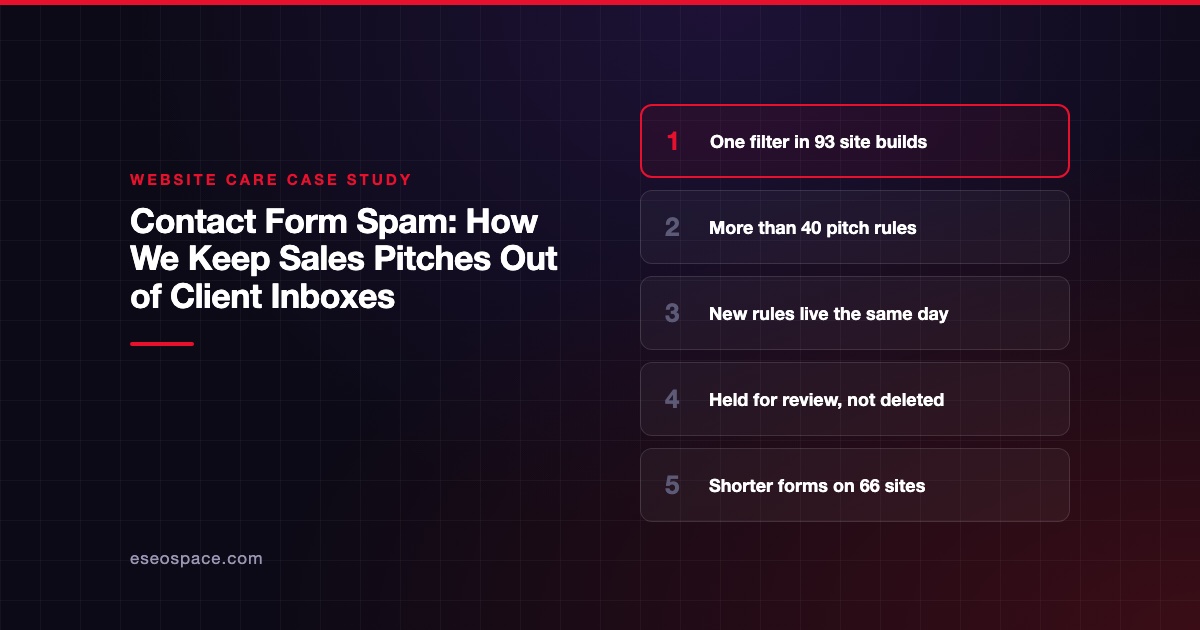
- One shared filter runs in 93 website builds. It recognizes more than 40 kinds of sales pitch and spam, and it gets new rules as new pitches show up.
- Caught messages are held, not deleted. They're kept out of the client's inbox and logged for our review, so a genuine one can still be passed on.
- New rules reach every site on our rollout list the same day. The five newest rules running on all of them each went out on the day the pitch first arrived.
- Every rule is tested before it ships. It has to catch the pitch and can't flag any message in our test library that should get through.
- Shorter forms that are easier to send. On November 8 we cut the main contact form on 66 sites down to name, email, phone and an optional message.
What lands in a small business's contact form
Much of it isn't bots. It's people and agencies selling something, often pasting the same pitch into form after form. Over the past three months, the ones we've written rules for include:
- guest-post and backlink sellers, including price lists of sites
- "I published your link, pay me or I'll remove it and report you to Google" threats, sent to clients who had never heard of the article
- free "SEO audit" and "your traffic dropped" teases
- unrequested website redesigns and "I built a new version of your homepage" offers
- "get found in ChatGPT and AI search" teases
- AI chat widgets, AI video tools and lifetime software deals
- virtual-assistant staffing and outsourced bookkeeping
- promo-video offers with a price list, and offers to buy a business's data for AI training
- investment-bank and acquisition outreach
- text-message-style "reply YES" or "reply STOP" outreach
- adult and dating lure links
Each one costs the business owner a little time. The bigger risk is the real inquiry that gets skimmed past because it arrived between six pitches. And some of these messages are designed to worry people, like the link threat above.
Rule one: never throw a message away
The hard lesson came in July 2026. A common anti-spam trick is a hidden field that people can't see but bots fill in. We found genuine inquiries being discarded on client sites because visitors' browsers had autofilled that hidden field. The visitor saw a normal "thank you" message and the client's inbox stayed empty. The only trace was a line in the server log marking the message as caught by the trap.
We changed the rule that day, and 29 code bases got the fix on July 22:
- No single check can throw a message away. The hidden field, timing checks and other bot signs only add to a score.
- Suspicious messages are held for review, not deleted. They're kept out of the client's inbox and logged where we can review them.
- Hidden fields got new names that browsers and password managers don't try to fill.
The same problem turned up again on newer builds. Twice in the last two months we caught it because someone sent a test message and it never arrived. On November 10 we moved five more sites to hold-for-review for the hidden-field and too-fast checks. That's the standard we're holding every site to: if a form says "thank you", the message has to exist somewhere a person will read it.
How the filter works
The filter is one file copied into each site's code. A script runs every copy against the same test library, so we can see when one has fallen behind.
When a message matches a known pitch:
- It's kept out of the client's inbox and held for our review, with any client copies (CC or BCC) removed.
- The subject is tagged, so it's clear why it was held.
- The sender sees the site's normal confirmation, so there's nothing to tell them they were caught.
Until October 2, held messages were emailed to us one at a time. Now they're logged in our mail system, and an evening report lists them by site, so we can spot a real customer and forward the message. The report doesn't cover every site yet. On the others, held messages stay in our mail logs.
Rules are written so a single word can't trigger them. A real customer who mentions "SEO" or "website" in their message still reaches the client.
How a new rule ships
Most new rules start with a client forwarding a message, often just a screenshot, with "is this real?" Then:
- We write a rule for that kind of pitch, not just that sender.
- We test it against a library of past spam and genuine-looking inquiries. It has to catch the new pitch and its reworded variants, and it can't flag any test message that should get through.
- We roll it out to every site and check that each live site is running the new version.
| Date (2026) | Pitch type we started blocking |
|---|---|
| August 13 | Bulk messages from a virtual-assistant staffing firm (the first rule) |
| September 21 | Free "SEO audit" teases |
| September 25 | Paid media features and anyone offering links |
| October 2 | Held messages collected into one evening report |
| October 7 | "Show up in AI search and ChatGPT" teases |
| October 16 | Text-style "reply YES / reply STOP" outreach |
| October 22 | Priced one-person SEO offers and "I rebuilt your homepage" pitches |
| October 26 | AI chat-widget subscriptions |
| November 6 | Offers to buy business data for AI training |
| November 7 | Promo-video offers with a price list |
| November 8 | Website-refresh offers, "30-second call" lead services and "design issues" teases |
The November 6, 7 and 8 rules each reached all 92 sites on our rollout list on the day the pitch first arrived. A 93rd site joined the list on November 10 and got them then. For a client on WordPress, we port the same rules into a plugin we maintain for their site.
Testing before everyone gets a rule
Not every rule goes everywhere at once. Three newer rules are running on five sites while we watch for false alarms, and a fourth is built and tested and waiting for sign-off before it goes wider.
Shorter forms that are easier to send
Spam isn't the only thing that gets between a customer and the business. A long form can put people off too. On November 8 we cut the main contact form on 66 sites down to four fields: name, email, phone and an optional message.
- We kept fields that matter to the business, like a state for telehealth practices, insurance details, a project city, and consent checkboxes.
- Where a page or ad link pre-selects a service, that choice still travels with the message, without a dropdown for the visitor to fill.
- We tested the changed forms with real browser submissions, sent from an address our own filter catches, so the tests are held by our filter and never reach the client.
Two clients asked for a specific field back. We restored it within two days.
What clients get
- An inbox with customers in it, not a pile of pitches to sort through.
- Held, not deleted: a message the filter catches is held for our review, not thrown in the trash.
- New pitch types blocked fast, usually the same day the first one arrives.
- A daily report of held messages, so a real customer caught by mistake can still be forwarded.
Frequently Asked Questions
Could a real customer's message get caught?
It can happen, which is why nothing is deleted. A caught message is held for our review instead of going to the client, so a genuine one can still be forwarded. Rules are also tested against a library of genuine-looking inquiries before they ship, and a rule that flags one doesn't go out.
Why not just add a CAPTCHA?
A CAPTCHA asks every real customer to prove they're human, and it does little against sales pitches, because most of those are typed or pasted by people. We'd rather keep the form easy for customers and filter what comes through.
Do you delete spam?
No. Held messages are logged in our mail system instead of going to the client's inbox, and an evening report lists them for review. Deleting is how real leads get lost.
How fast is a new kind of pitch blocked?
Usually the same day. The five newest rules running on every site each went out on the day the pitch first arrived.
Can you do this for my website?
Yes. Spam filtering and lead-form checks are part of how we look after the sites we build and maintain. Book a strategy call or see our website maintenance and website security services.