

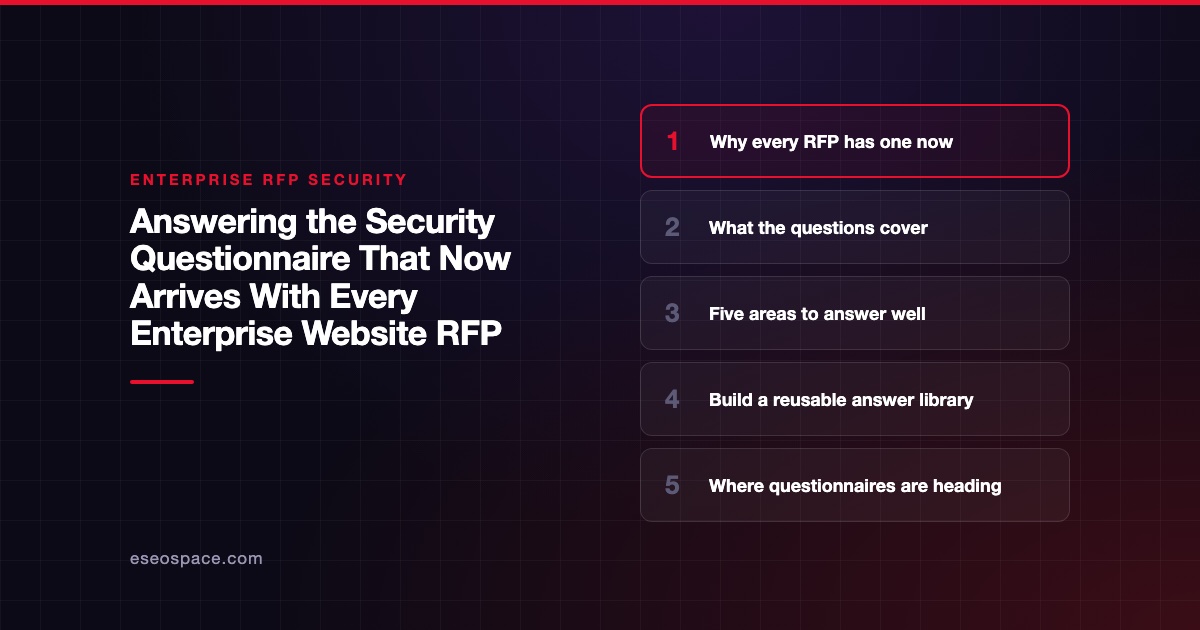
Security is now a standard requirement in enterprise website requests for proposal (RFPs). Enterprises look closely at the security posture of their vendors and partners, driven by more frequent cyberattacks and more complex regulation. The stakes are high: IBM's Cost of a Data Breach Report 2026 puts the global average cost of a data breach at $4.99 million (IBM), which helps explain why security questions have become a fixture in RFPs.
For businesses responding to enterprise RFPs, handling the security questionnaire well is essential. These questionnaires assess how you protect sensitive data, keep services running and meet industry standards. Their depth can be daunting, but they're also a chance to show your commitment to security and stand out from other bidders.
The questionnaire is no longer a side part of the proposal. It is often a deciding factor in vendor selection. Enterprises want assurance that vendors have sound security practices and keep them up to date as threats change, because one weakness in a vendor's systems can expose the whole enterprise.
Understanding the Security Questionnaire Landscape
Questionnaires vary widely, but they usually cover data encryption, network security, incident response, access controls, and alignment with standards and laws such as ISO 27001, SOC 2 or the GDPR. The goal is to confirm the vendor has security measures that reduce risks to the enterprise's operations or reputation.
Answering thoroughly takes technical knowledge, organizational insight and transparency about your processes. Many companies underestimate the time needed to gather accurate answers, which can delay submissions and cost them opportunities.
If your team lacks the in-house expertise for these requirements, consider IT consulting from Cyber Security Solutions (CSS) in Orlando or a similar firm. Specialized IT consultants can help you build a clear security profile that matches enterprise expectations and regulatory requirements.
Questionnaires often run to hundreds of detailed questions, from technical configuration to policy enforcement. That level of detail is meant to uncover weak points before a contract is signed. Enterprises may ask for proof of regular penetration testing, for example, or details on how data residency is handled across jurisdictions. Our website RFP requirements list shows how security sits alongside the other items buyers typically ask for.
Key Areas to Address in Your Responses
Prioritize clear, evidence-based answers. These are the areas that get the most scrutiny:
- Data protection measures: Explain how data is encrypted in transit and at rest. Note any use of current protocols such as TLS 1.3 and AES-256 encryption. Describe data segregation and backup procedures. Many enterprises also ask how encryption keys are managed and rotated.
- Access controls and authentication: Describe your access management policies, including multi-factor authentication, role-based access and regular access reviews. Explain how you reduce the risk of insider threats and unauthorized access.
- Incident response and recovery: Outline how you detect incidents, your response plan and how you communicate during a breach. Include breach notification timelines and whether you use outside forensic experts.
- Compliance and certifications: List relevant certifications or attestations your company holds and describe ongoing compliance monitoring. ISO 27001 certification, a SOC 2 Type II report, or documented HIPAA or PCI DSS programs signal a mature security program. Only claim what you can document.
- Vendor risk management: Explain how you manage security risks from your own vendors and subcontractors. Enterprises increasingly care about the security of their vendors' vendors, so this area gets close attention.
Working with a managed security service provider can strengthen your answers. T3 MSP, a managed IT and cybersecurity company, is one example. Providers like this help make sure security controls are not only in place but also monitored and improved over time.
Third-party risk shows up in questionnaires because supplier-related incidents are a well-documented source of breaches. Answering these questions fully can set your proposal apart and reassure the buyer that you take security seriously end to end.
The Business Impact of Strong Security Posture
A strong security posture isn't just about ticking boxes. It affects whether you win enterprise contracts. Cybersecurity is a major factor in how enterprises select vendors, and weak answers to security questions can lead to disqualification or a lower score. Our guide to website RFP evaluation criteria and scoring explains how those scores are typically weighted.
Organizations that present clear, transparent and verifiable security practices build trust with prospective clients. That trust leads to long-term partnerships, referrals and more business. Enterprises know security failures can bring reputational damage and regulatory penalties, so they favor vendors with proven capabilities.
Financially, a strong security program reduces the likelihood of a breach, and a tested incident response plan helps contain one faster, which limits the damage. That is why enterprises read vendors' answers on incident response so carefully.
Practical Tips for Efficient Security Questionnaire Responses
- Build a security answer library. Keep a repository of standard answers to common security questions. It speeds up responses and keeps them consistent, especially when several proposals are in progress at once.
- Collaborate across departments. Security touches IT, legal, compliance and operations. Set up a cross-functional group to gather accurate information and check answers. This reduces errors and keeps answers in line with current practice.
- Keep documentation current. Maintain up-to-date security policies, incident logs and compliance reports you can reference or attach. Current documentation speeds up the process and makes your answers more credible.
- Be honest and transparent. If you don't meet a requirement, explain how you plan to close the gap rather than leaving it blank or giving a misleading answer. Enterprises value transparency and may work with vendors that show a commitment to improving.
- Use outside expertise. Bring in consultants or managed security providers to validate your posture and help with technical answers. They can find blind spots and help you present your security measures clearly and accurately.
Tools that track and manage questionnaire responses can also improve speed and accuracy. Many connect to your existing security documentation and compliance frameworks, which makes updates and audits easier.
Preparing for the Future of Security in RFPs
As threats evolve, questionnaires will get more complex. Artificial intelligence, cloud services and connected devices bring new vulnerabilities and compliance questions, and enterprises will ask for more detailed evidence of risk management and resilience.
Staying ahead takes continuous investment in security and a proactive approach to risk assessment. Organizations that build security into their business strategy, not just their IT operations, will be better placed to win enterprise contracts and keep clients.
Buyers are also moving from one-time questionnaires toward ongoing assurance, such as continuous monitoring of their vendors' security posture. That means questionnaires will increasingly ask for continuing proof rather than a one-time declaration.
Preparing for that means real-time monitoring, incident detection and rapid response, with evidence you can provide regularly, not only during the RFP. A website security consulting engagement can help put that evidence trail in place.
Enterprises are also likely to widen their focus on supply chain security, asking for transparency about subcontractors and technology providers as well as direct vendors. That will make vendor risk management an even bigger part of security questionnaires.
Conclusion
The security questionnaire that comes with an enterprise website RFP isn't just paperwork. It's a central part of vendor evaluation and reflects how much cybersecurity matters to the business. By understanding why it matters, answering each security area thoroughly and getting expert help when needed, companies can work through the process with confidence and win enterprise partnerships.
As threats grow and regulation tightens, the ability to show a complete, proactive security posture will increasingly decide who wins enterprise contracts. Time spent on security questionnaires is a business advantage that builds trust, reduces risk and opens doors.
With good practices, outside expertise and preparation for future demands, organizations can turn the security questionnaire from an obstacle into an asset in their enterprise sales process.









