Disclosure: this is a guest article from Wengy, a PPC agency for moving companies, and it links to Wengy's moving company PPC page.
A moving company can have an empty truck on Tuesday and still be unable to accept the next inquiry. The available crew may lack the time, equipment, or route coverage that the customer needs. Advertising decisions become more useful when they begin with these operating constraints, rather than a general instruction to generate more leads.
Build a shared plan for dispatch, sales, and marketing. Identify the work the business can deliver, calculate what acquiring that work can cost, and return booking outcomes to the advertising team. The following approach is designed for moving operators managing their own demand. Its numerical examples are hypothetical, not industry benchmarks or customer results.
Start With Usable Capacity by Date and Service
Record the trucks, crews, equipment, and working time available for the dates you want to sell. Deduct committed jobs, necessary travel, maintenance, and an appropriate operating buffer. Count crew-hours and truck-hours separately: three movers working for six hours consume 18 crew-hours but may require only one truck for those six hours.
A simple total can hide an impossible schedule. Eight unused crew-hours spread across four afternoons do not necessarily accommodate a job requiring two movers for four consecutive hours. Check the combination of people, vehicle, location, and uninterrupted time. Include pickup access, loading, travel, unloading, and the return to base where relevant.
Keep confirmed work separate from tentative holds and open estimates. A dispatch calendar should show what is committed and what remains uncertain. An estimate is potential demand, not a completed booking. Decide who can release a hold, confirm availability, and approve an exception before an advertisement implies a service promise.
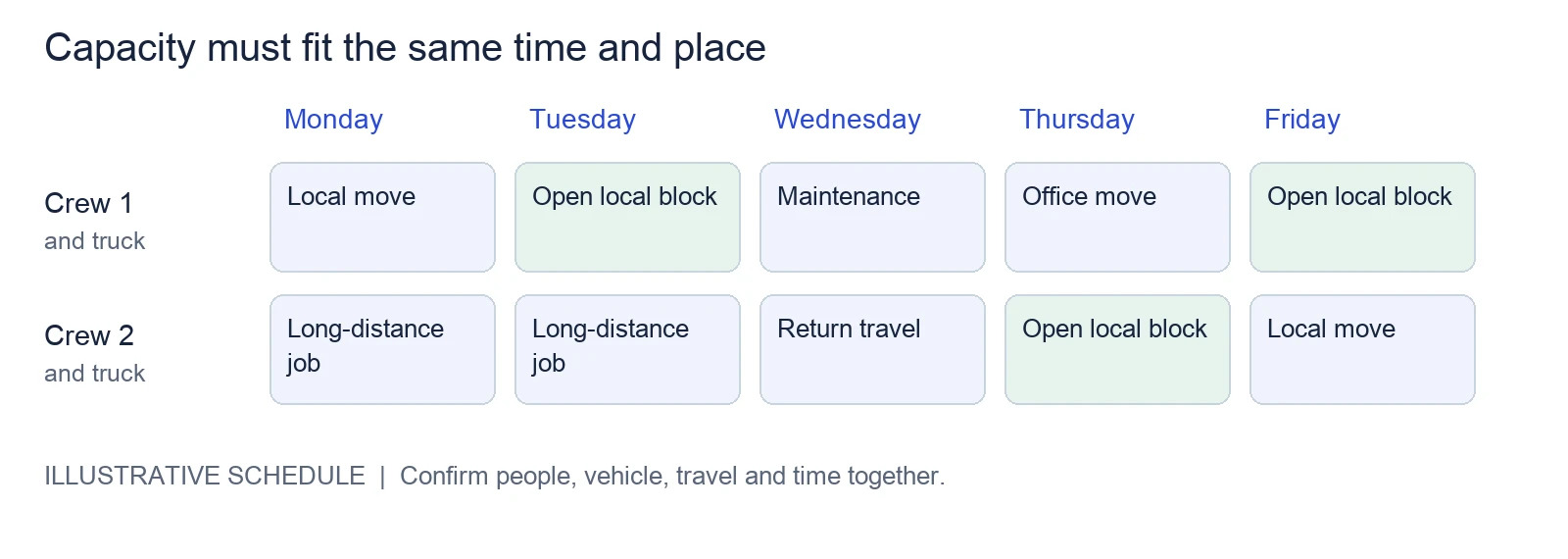
Figure 1. Illustrative capacity calendar. Each cell describes a complete crew and truck block, not interchangeable spare hours. This is not a real operator schedule.
Choose the Work That Fits the Available Resources
Group capacity by the services the company actually sells. Local residential work, office relocation, and long-distance moves can require different equipment, staffing, timing, and sales preparation. An unfilled weekday local slot should not automatically receive the same advertising treatment as a multi-day interstate opportunity.
| Service opportunity | Operational checks | Useful inquiry details |
|---|---|---|
| Local residential | Crew size, truck size, access, travel and minimum job duration. | Requested date, addresses, approximate inventory and access. |
| Long-distance moving | Supported origin and destination, vehicle commitment, travel and return plan. | Route, inventory, pickup timing and service expectations. |
| Office relocation | Equipment, building access, work window and supervision. | Site details, inventory, timing and coordination requirements. |
Evaluate territory through job economics as well as a map. A nearby suburb can require costly traffic or access time. A more distant job might still be suitable when its scope supports the additional resources. Include empty travel and any return leg in the estimate; do not assume an advertisement will reliably produce a matching return load.
Advertising location signals do not establish pickup and destination addresses. Google can target people by physical location or by interest in a location, so a click does not tell you where the move starts or ends. A customer outside your city may be organizing a move into it. Use appropriate campaign settings, then validate the route and service fit in the inquiry itself.
Calculate the Acquisition Allowance From Job Contribution
Begin with expected job revenue and the costs attributable to delivering the job. Relevant costs can include labor, fuel, materials, subcontracting, and other service-dependent expenses. Use the cost treatment appropriate to your business: a salaried crew with spare time and an additional paid crew can have different incremental economics. Keep that choice explicit and consistent.
Suppose an illustrative move produces $2,200 in revenue and incurs $1,500 of variable delivery costs. Its contribution before acquisition is $700. If the operator needs to retain $300 after advertising, the remaining media allowance is $400 per acquired completed job. That retained $300 still has to contribute toward fixed overhead, management fees, other acquisition expenses, and profit; it is not net profit.
If you allocate another $100 per acquired job to sales or agency costs, the same $300 retention objective leaves only $300 for media. Avoid subtracting a cost twice or forgetting it altogether. Define whether your dashboard reports advertising spend per booking or the full cost of customer acquisition.
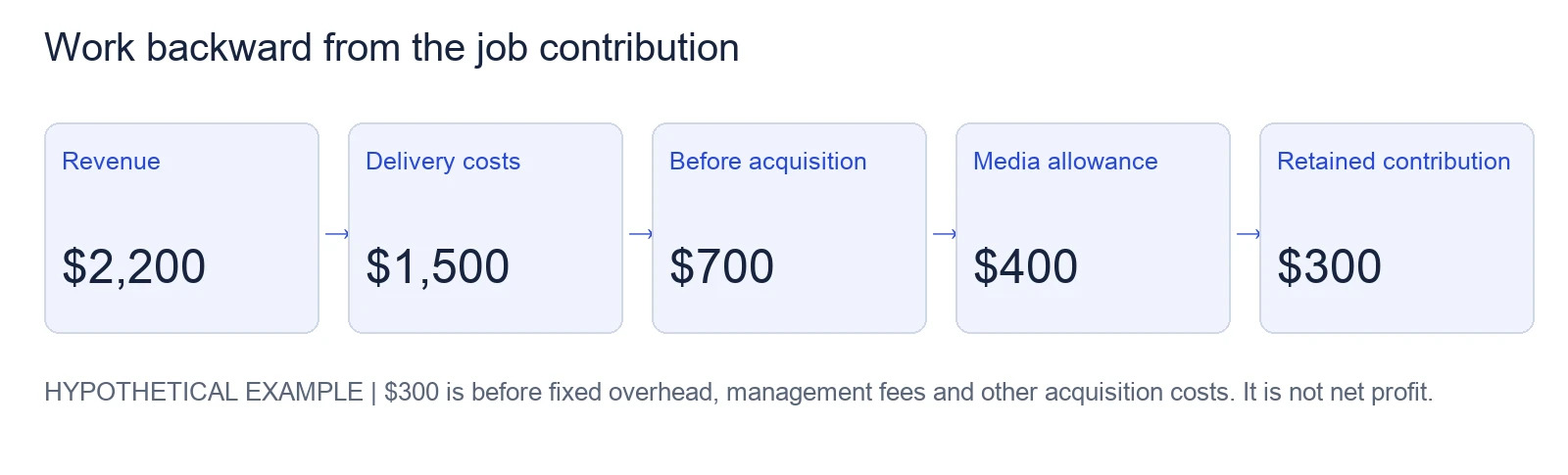
Figure 2. Hypothetical job contribution model. The $400 media allowance assumes other acquisition expenses are not included in the $1,500 delivery cost and will be paid from the retained contribution or separately budgeted.
Compare jobs by the resource that limits your operation. A $900 contribution job requiring 30 crew-hours yields $30 per crew-hour before acquisition; a $600 contribution job requiring 15 yields $40. Neither automatically wins: timing, travel, equipment, and other commitments still matter. The comparison helps explain why maximizing revenue or booking count alone can leave a busy company with weak economics.
Work Backward From Available Jobs to a Test Budget
Assume the business has 80 usable crew-hours in matching schedule blocks and each additional suitable job needs 16 crew-hours. That represents room for five jobs only if the dates, truck availability, and job requirements also fit. If one in four received inquiries becomes a booking, five bookings require an expected 20 inquiries.
At an assumed 8% website click-to-inquiry rate, those 20 inquiries require an expected 250 clicks. At an assumed $8 average CPC, the media budget is $2,000. The resulting $400 media cost per booking uses the entire allowance in the example above. These rates are planning assumptions; they do not establish local search demand or predict delivery. For a wider view of setting spend, see our Google Ads budget guide for small businesses.
| Result at the same $2,000 spend | 25% booking rate | 15% booking rate | 10% booking rate |
|---|---|---|---|
| Clicks at assumed $8 CPC | 250 | 250 | 250 |
| Inquiries at assumed 8% rate | 20 | 20 | 20 |
| Expected bookings | 5 | 3 | 2 |
| Media cost per booking | $400 | $666.67 | $1,000 |
| Job contribution less media spend | $1,500 | $100 | −$600 |
The last row assumes every booked move completes with the same $700 contribution before acquisition. It excludes fixed overhead and other acquisition costs. If five bookings instead produce four completed jobs and the canceled job produces no contribution, $2,000 of media becomes $500 per completed job and leaves $800 of contribution. Track booking and completion outcomes separately.
Check demand and cost estimates for the actual services and territories in Google Ads Keyword Planner before launch. Compare those estimates with your own campaign history when available. A capacity target does not create search demand, and a calculated affordable CPC is not a bid that guarantees profitable traffic.
Turn the Operating Priorities Into a Campaign Brief
Give the advertising team a short list of services, territories, and date ranges the business wants to sell. Add exclusions and the conditions under which sales must check with dispatch. Separate materially different service opportunities where this supports clear budgets and reporting, without splitting a small account into so many campaigns that each becomes difficult to evaluate.
Match the keyword theme, advertisement, and page to the service. A person searching for office movers should find office-relocation information and an appropriate estimate process. Avoid blanket exclusions for small moves, apartments, or labor-only work when those services could fit the current operation. Review actual inquiries before classifying an entire theme as unsuitable.
The first contact should collect enough information to assess fit: service, approximate size, requested date, pickup, destination, and a reliable contact method. A detailed inventory can follow. Show clear service coverage, genuine reviews, and how estimates work. Test the form and phone contact path so suitable demand actually reaches the person responsible for it.
Wengy's approach to PPC for moving companies considers services, locations, budget, and sales capacity. An operator can use those same inputs in an agency brief: specify which work is valuable and deliverable, and require reporting that connects demand to suitable bookings. The operating priorities should be visible to whoever manages advertising.
Return Reasons for Unsuitable Demand to the Campaign Team
Use a shared lead record rather than disconnected advertising and dispatch totals. Preserve the inquiry date, intended moving date, service, route, source where available, estimate status, booking status, and final outcome. Store the operational details securely and give each lead a stable identifier so repeated calls or forms do not become several invented opportunities.
Classify lost opportunities with useful reasons: unsupported service, unavailable date, unprofitable route, price mismatch, no response, or another provider selected. Each suggests different work. An unavailable date may require an allocation change; missed follow-up requires a sales fix. A broad "bad lead" label makes it harder to distinguish the two.
Define a qualified inquiry before asking bidding to optimize for it. A phone-button click is not a confirmed conversation, and a form submission is not a booked move. Where measurement and consent requirements are met, Google Ads supports qualified-lead and converted-lead outcome measurement. Test the actual setup and avoid counting the same outcome twice. If tracking is not in place yet, start with Google Ads conversion tracking.
Adjust Spending as the Calendar Changes
Review capacity and the sales pipeline together. Start with a practical weekly operating review and check sooner when material availability changes. Agree who can change campaign priorities and who updates the landing page or availability messaging. Keep a record of the reason, date, and expected effect of meaningful changes.
Allow for the time between search, estimate, booking, and moving day. A fully booked Saturday does not mean every active campaign is producing work for that Saturday. Some inquiries concern later dates. Look at requested moving dates and service groups before reducing a budget, and preserve room for uncertainty instead of overselling the schedule.
Treat a Google Ads average daily budget as a pacing setting rather than an exact daily spending cap. For most campaigns, the billed daily limit can reach twice that amount; the usual monthly limit uses 30.4 times the average daily budget, with adjustments when budgets change. Check the applicable budget report rather than assuming a short advertising schedule creates an equivalent lower monthly ceiling.
Budget changes cannot guarantee a particular number or timing of jobs. Avoid reacting to every isolated quiet day with a large increase or every new booking with a shutdown. Assess lead quality, conversion delay, usable capacity, and actual spend together. If the campaign uses automated bidding, keep its selected outcomes consistent with the business objective.
Read Marketing Results Alongside the Dispatch Calendar
A useful report shows media spend, received inquiries, suitable inquiries, estimates, bookings, completed jobs, and contribution after advertising. Add booked crew-hours and truck commitments by service date. Separate results by acquisition period from the operating calendar: a booking made this week for next month belongs to both views for different purposes.
Use actual completed-job costs to improve estimates. A route that looked attractive before launch may have consumed more time or materials than expected. Review contribution per constrained hour, cancellations, and additional acquisition costs before scaling. Revenue ROAS helps describe revenue against ad spend, but does not replace this operating calculation.
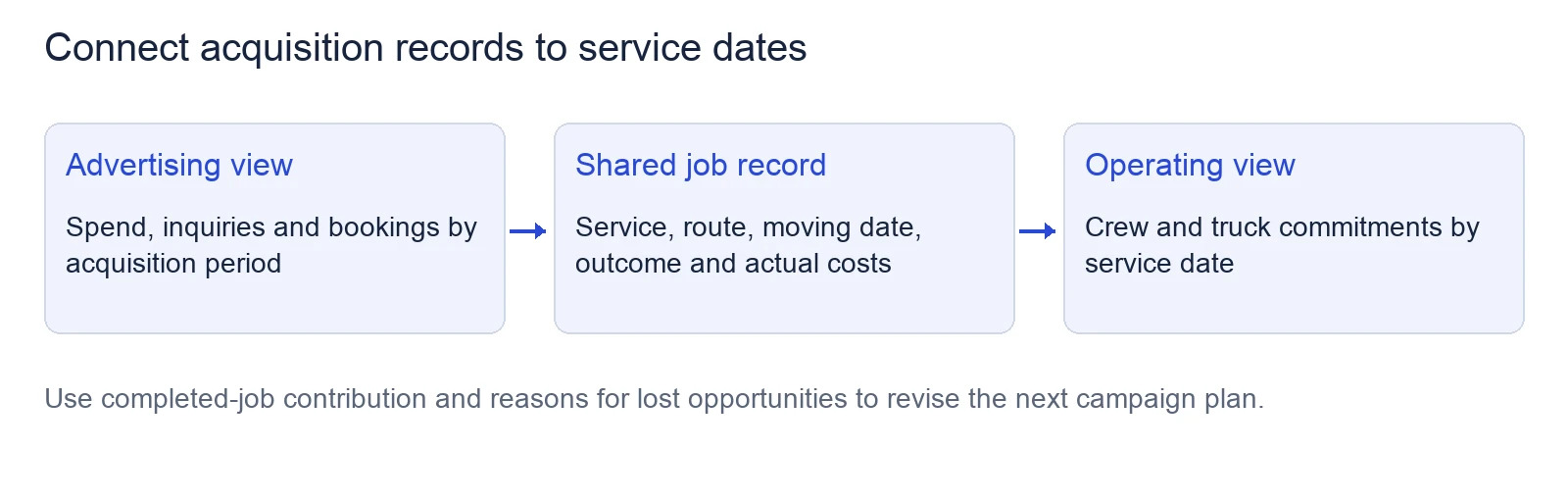
Figure 3. Reporting diagram. Acquisition cohorts and service-date capacity are connected through a lead and job record; they should not be added together as separate bookings.
Keep Other Sources of Suitable Work Developing
Paid search can sit alongside local SEO, Google Business Profile maintenance, referrals, and selected Facebook or Instagram advertising. Apply the same service-fit and contribution definitions across sources, while retaining separate attribution. Organic discovery and repeat business need maintenance even when immediate advertising is the priority.
The working plan is a loop: identify usable resources, choose suitable work, set an affordable acquisition allowance, test demand, and return real job outcomes. Dispatch learns what demand is arriving; sales learns what the company can promise; marketing learns which inquiries become work worth delivering. That shared information makes the next advertising decision more grounded.