Disclosure: this is a guest article.
Most medical practices assume that the more keywords they rank for, the more patients they will bring in. But organic traffic to a medical landing page is wasted if visitors leave within seconds because the page is cluttered or the design is hard to follow.
Designing landing pages for quick visual comprehension often does more than adding clinical copy or chasing backlinks. With predictive eye-tracking AI, practices can test where visual attention goes before launch, before spending anything on user testing, and check whether that attention lands on the right focal points for patients' search intent in healthcare industry SEO. When the visual hierarchy leads users straight to the information they came for, they tend to stay longer and leave less often, and pages that satisfy visitors tend to perform better in search over time.
How Visual CRO Supports Rankings
Search engines aim to rank pages that meet the searcher's intent quickly and clearly. A potential patient forms a first impression of your practice within moments of landing on your website.
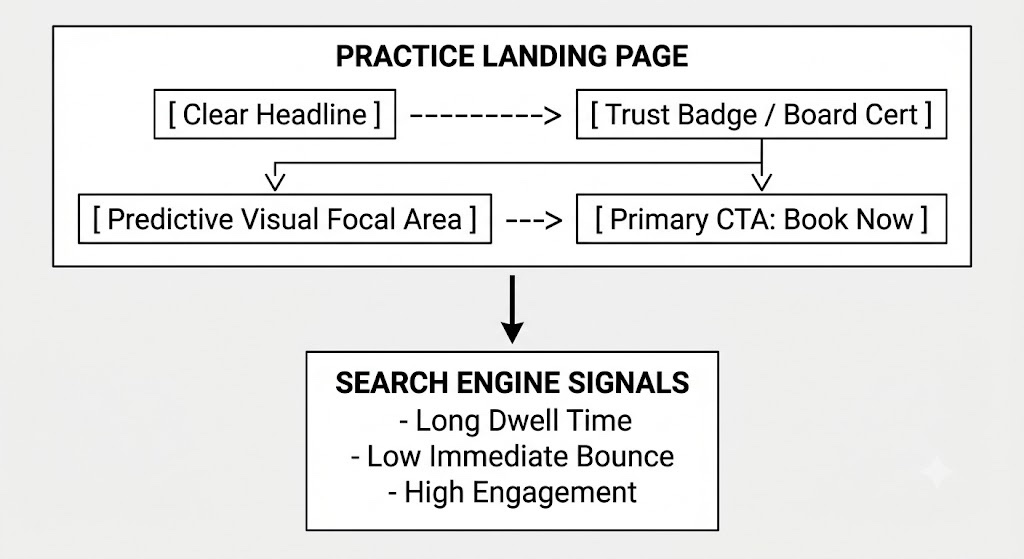
Predictive eye-tracking models are trained on earlier gaze-tracking studies and estimate where people look in the first 3 to 5 seconds. A widely cited 2006 study by Lindgaard and colleagues found that people form an aesthetic judgment of a web page in about 50 milliseconds. Key trust indicators are correlated to expected visual focus areas, so placing them where attention lands engages patients immediately.
Key Visual Metrics for Search Performance
- Clarity score: how clean and easy to read a layout is for a first-time visitor.
- Focus score: how well key elements stand out from background imagery.
- Percentage of attention: the share of initial visual attention drawn to a particular call-to-action (CTA) button or verification badge.
Predicting Patient Attention Pre-Launch
Traditional conversion rate optimization (CRO) relies on live A/B testing and session recordings. It works, but collecting enough live traffic to act on can take weeks or months, and a weak page keeps losing visitors during that time.
| CRO approach | Turnaround time | Sample size needed | Impact on live traffic |
|---|---|---|---|
| Traditional live A/B testing | 4–8 weeks | 1,000+ visitors | Weaker variants lose visitors and conversions while the test runs |
| Lab eye-tracking studies | 2–3 weeks | 30–50 participants | No risk to live traffic, high cost |
| Predictive AI attention maps | Seconds | 0 live users | No risk to live traffic, low cost |
Predictive gaze analytics generate attention heatmaps in seconds. Marketing teams can correct visual mistakes, remove competing visual noise, and try layout alternatives before a page is indexed.
Optimizing Medical Landing Page Hierarchy
A medical website has to present information clearly and logically to turn search impressions into patient bookings.
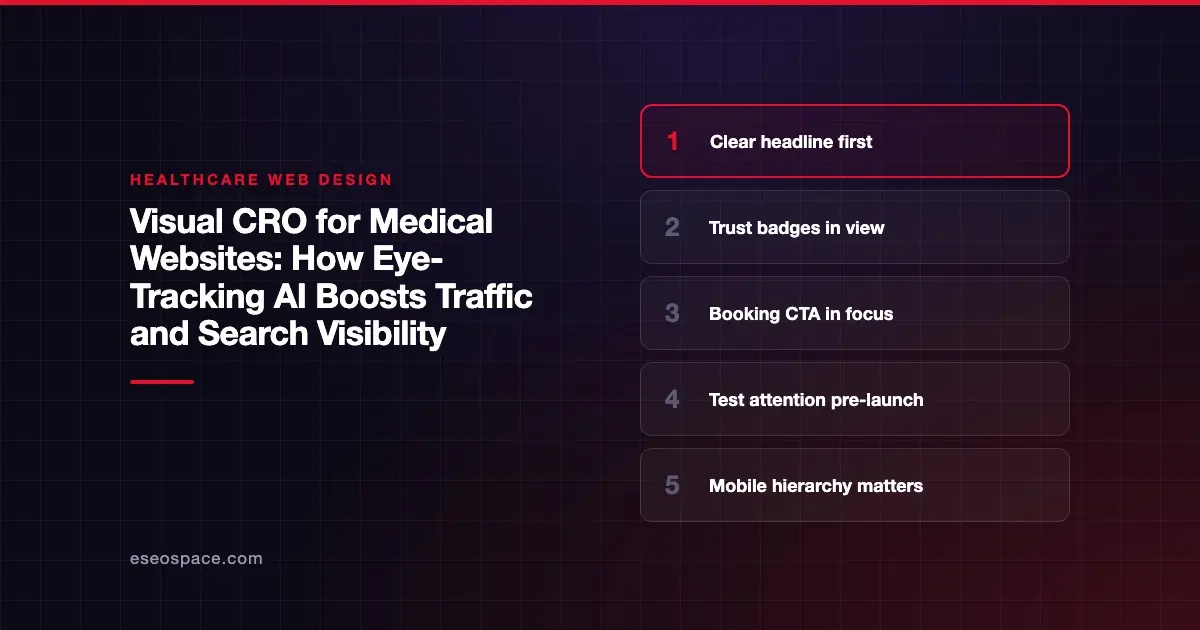
- Optimize the hero area: put the provider's credentials and main scheduling information in the main visual hotspot.
- Minimize competing design elements: avoid secondary banners, decorative graphics, or extra navigation links that pull attention from the booking elements.
- Call attention to verification badges: keep board certifications and insurance badges in the line of sight.
- Audit mobile layouts: reduce vertical padding so key service information and CTA buttons are visible without scrolling.
Many patients research care on their phones, so mobile visual hierarchy is a key factor.
Aligning Design with Search Signals
How users behave after the click shows whether a page answered their question. A layout built around user intent helps in three areas:
- Lower bounce rate: answer patient questions right away, so users don't need to go back to the search results.
- Longer dwell time: clear visual cues help users spend more time on procedure information and provider profiles.
- Better conversion rate: a clear line of sight to online booking tools turns organic traffic into booked consultations.
By addressing visual hierarchy before launch as part of their healthcare industry SEO, practices protect their organic visibility and keep a steady patient acquisition pipeline.
Frequently Asked Questions
Visual Layout Optimization Drives Patient Engagement
What is visual conversion rate optimization for medical sites?
Visual CRO uses heatmaps and predictive attention analysis to adjust landing page design so visitors can find key information and booking elements easily.
What impact does eye-tracking AI have on search rankings?
Eye-tracking AI finds layout problems before launch. Fixing them improves engagement, and pages that keep visitors engaged tend to perform better in search over time.
How fast are AI visual heatmaps generated?
AI heatmaps return gaze predictions in seconds, so design teams can change a layout immediately instead of waiting for live traffic.
What is the problem with traditional A/B tests for medical practices?
A/B testing needs high traffic and weeks of data to show which design works better. Many practices don't have that volume, and a weak page loses prospective patients while the test runs.
Combining predictive visual analytics with search engine optimization makes medical web design an effective part of patient acquisition. Practices can use gaze predictions to build landing pages that capture patient attention from the start, support search performance, and keep appointments coming.