Most B2B go-to-market plans are written by committee, and it shows. Product drafts the positioning, finance sets the price, sales picks a motion, marketing picks the channels, and nobody checks whether the pieces agree. Each part looks reasonable on its own slide while the whole plan leaks pipeline.
The window for catching those gaps has narrowed. According to 6sense's 2024 Buyer Experience Report, 81% of B2B buyers already have a preferred vendor by the time they first contact a seller.
Your plan has to win the shortlist before anyone books a demo, so every component has to point at the same buyer. Build them as a chain, in the order below, because each decision limits the one that follows it.
Key Takeaways
- Build the six components in order: each decision limits the next, and an early mistake compounds.
- Draw your ideal customer profile from closed-won and churned accounts, not a whiteboard session.
- A value proposition needs a problem in the buyer's words, a measurable outcome and a difference buyers can test.
- Deal size sets the sales motion, and the motion decides which roles you hire first.
- Start with two channels, prove them, and set kill criteria for every metric before launch.
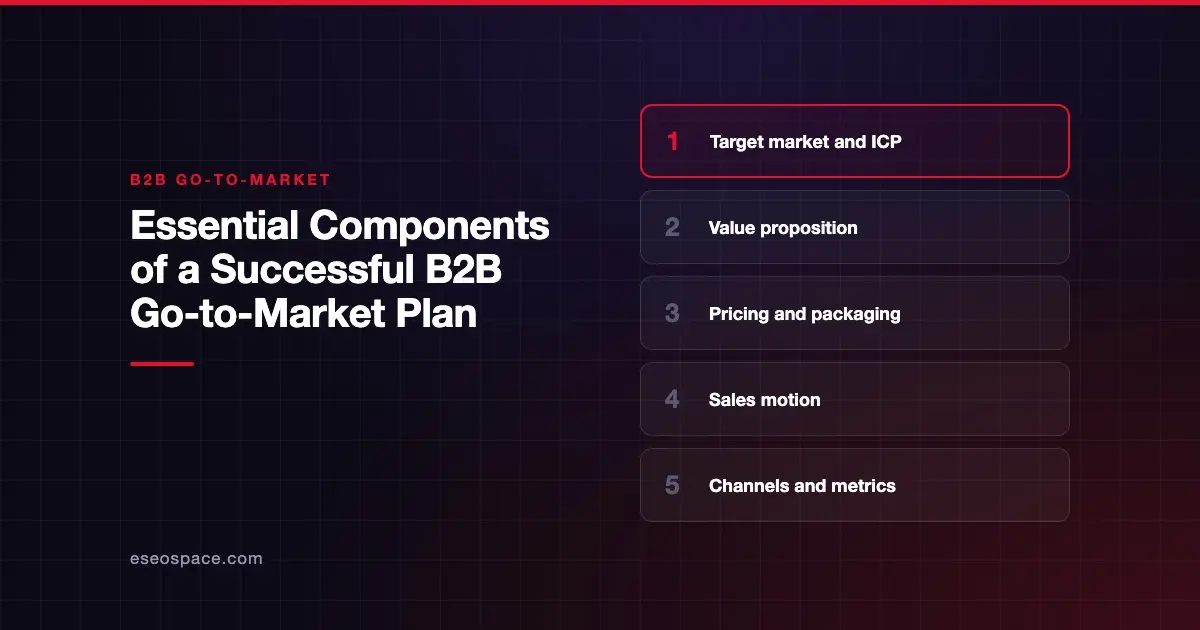
6 Essential Components of a Successful B2B Go-to-Market Plan
Get an early link wrong and the error compounds, which is why a loose customer profile tends to resurface two quarters later as a CAC problem nobody can trace.
1. Target Market and Ideal Customer Profile
Vague targeting makes every later decision more expensive. Marketing pays to reach people who will never buy, and sales burns its week on discovery calls with companies that were never a fit. A working ideal customer profile filters which accounts deserve attention and which to ignore.
Pin down three roles inside the target account: the person who feels the problem every day, the person with the budget and urgency to fix it, and the person with authority to sign.
In B2B, these are often different people, and a profile built around the end user alone stalls in procurement. For example, a payroll software vendor might define its ICP as US healthcare groups with 200 to 1,000 staff across several states, where the finance lead lives with the compliance pain, the CFO owns the budget, and a recent audit finding creates urgency.
Build the profile from your customer records instead of a whiteboard session. Pull the accounts that closed quickly, adopted the product without friction, renewed, expanded their spend and referred others, then put them next to the customers who struggled. Patterns appear fast: some industries convert in half the time, and some team sizes onboard without hand-holding.
The gap between good and bad fit is wide. Fullcast and Ebsta's 2025 H1 Update Report found that accounts strongly aligned with the ICP deliver 5.1x the lifetime value of low-fit accounts. With the profile set, build prospect lists against it using role, company size, industry and the tools each account already runs, and keep near-misses off the list.
2. Value Proposition and Positioning
Your ICP now needs a reason to pick you over everyone else on the shortlist. Most companies answer with a feature list, and buyers can do little with it. In Wynter's 2026 vendor differentiation survey of 100 B2B SaaS marketing leaders who had recently compared vendors, 64% found it difficult to tell competitors apart from their websites and messaging.
A value proposition that survives a side-by-side comparison has three parts. The first is the exact problem in the buyer's own terms, so cutting weekly CRM cleanup from 10 hours to 30 minutes beats any promise to improve efficiency. The second is a measurable outcome, such as bounce rates dropping from 8% to under 2% or reps getting 15 hours back a week.
The third is a difference buyers can check themselves. Every competitor claims advanced AI or custom AI development. An email verification tool can let a prospect test, during a trial, whether it verifies catch-all domains that rival tools mark as unknown, and that is what moves a deal. A security vendor can do the same with exposure validation, letting a buyer test during a trial whether a flagged weakness can actually be exploited.
To understand which problems matter most to buyers, teams can use social listening platforms like BrandRobin to analyze recurring customer complaints and competitor comparisons, then use those insights to sharpen how they position their product. Businesses can also use an AI logo maker to create a visual identity that reflects their positioning and keeps branding consistent across the website, sales materials and marketing channels.
Before a message goes out, hand it to someone who matches the ICP and ask four things: whether it is meant for them, what problem it solves, what result they would get, and why it beats the alternatives. If any answer comes back fuzzy, rewrite the message before you pay to distribute it.
3. Pricing and Packaging Strategy
Price sets revenue and also determines how the product gets sold. A $3,000 annual contract cannot carry a six-month sales cycle with a solutions engineer attached, and a $250,000 deal will not close through a credit card form.
The common models suit different products. Per-user pricing fits collaboration tools, where value rises as more of the team logs in. Usage-based pricing fits API and infrastructure products whose consumption swings month to month, while tiered pricing works when you sell to companies of very different sizes with different feature needs.
Usage pricing has spread well past infrastructure vendors. Metronome's 2025 State of Usage-Based Pricing report, based on a January 2025 survey of 100 SaaS companies run with Greyhound Capital, found that 85% had adopted usage-based pricing.
Popularity is a poor reason to copy it, though. Pick the model that tracks the outcome your value proposition promised, so a customer paying more is a customer getting more, and build tiers around the ICP segments you defined. Apply the same discipline to the price points inside each tier: B2B price optimization uses your transaction and pricing data to show where list prices sit too high for a segment and where reps give away margin they don't need to.
Packaging deserves as much thought as the price point. Put the features your ICP buys for in the entry tier, hold enterprise controls such as SSO and audit logs for the top tier, and stop at three tiers, because buyers comparing five plans tend to stall instead of choosing.
4. Sales Strategy and Motion
Settle the motion before you recruit marketers or sellers, because each motion needs a different team. Specialist B2B recruiting firms like RevPilots headhunt demand generation, product and growth marketers and charge a fee only once a hire starts, which matters because the motion you choose determines which roles to fill first. Recruitment agency software can also help these firms manage candidate pipelines, track client relationships and streamline hiring. On the other side of the market, job seekers can apply to jobs using AI to tailor their resumes and cover letters to specific roles.
Deal size sets the motion. Smaller contracts use self-serve onboarding and product-led growth, while mid-range deals go to inside sales reps who walk buyers through demos and trials, or to an outsourced partner like Martal Group while the team still proves the motion. Enterprise deals need account executives, sales engineers and a longer evaluation period.
Within that, you can choose from three models. Product-led growth lets customers use the product first and talk to sales later, sales-led puts reps in charge from the first call, and a hybrid adds sales help to a self-serve funnel once an account shows buying intent. Buyer preference leans toward the self-directed end. A Gartner survey of 632 B2B buyers, run in August and September 2024, found 61% prefer an overall rep-free buying experience.
For SaaS companies, AI-powered demo platforms like Flagon can support that approach by letting buyers explore the product on their own and helping sales teams see when a prospect is ready for a conversation.
Sellers still earn their place where buyers need judgment, such as deciding whether a product fits their environment, so put them there. Map every deal through prospecting, qualification, discovery, demonstration, proposal, negotiation and close. Each stage should screen out poor-fit accounts early, using the ICP as the qualification test. A consistent lead qualification process helps sales teams assess prospects against predefined criteria, including budget, business needs, decision-making authority and readiness to buy.
Write exit criteria for each stage, such as a confirmed budget owner before a proposal goes out. Reps then move deals forward on evidence, and your forecast stops depending on optimism.
5. Marketing Strategy and Channels
Channels belong where your ICP already does its research, which is rarely where the marketing team feels most comfortable. The channel most B2B companies leave idle is their staff's LinkedIn reach, and a LinkedIn employee advocacy tool like Supergrow can turn that reach into a planned channel by interviewing employees, drafting posts in each person's voice and routing them through a marketing approval queue.
Buyers give that kind of expert content more credit than a brochure. Edelman and LinkedIn's 2024 B2B thought leadership study of 3,500 B2B decision-makers found 73% consider thought leadership a more trustworthy basis for judging a company's competencies than its traditional marketing materials.
The rest of the mix depends on buyer behavior. Content and SEO pay off when buyers spend weeks researching online, paid search catches people already hunting for a fix, and LinkedIn ads let you target by job title and industry. Outbound email (compare the tools before you pick one) works only when your ICP is sharp and your contact lists are verified. Account-based marketing suits high-value deals with a named target list, and events and communities matter in relationship-driven industries.
An IP geolocation API on your website can also route inbound leads to the right regional sales rep or personalize landing page content based on the visitor's location.
Start with two channels and prove them before adding more. A team running six channels at half strength learns almost nothing from any of them. The same discipline applies to spending: for everyday business purchases, a coupon site like Dealhack can show whether a discount is available before you pay full price.
6. Metrics and KPIs
This is where you find out whether the chain holds. Track a short list that maps to the earlier decisions: win rate on ICP-fit accounts against everyone else, sales cycle length by segment, CAC payback and net revenue retention.
The last two carry the most weight. High Alpha's 2025 SaaS Benchmarks Report, based on more than 800 companies, found that firms pairing high net revenue retention with low CAC achieved nearly double the growth rates and Rule of 40 scores.
Read each number as a pointer to a specific component. A long payback period usually traces back to a loose ICP or a motion too costly for the deal size, and weak retention often means the value proposition promised an outcome the product does not deliver. Review the numbers monthly with sales and marketing in the same room so you fix problems at the source instead of patching them with more spend.
Set a target for each metric before launch, and agree in advance on the number that would make you change course. A plan with no kill criteria keeps funding a channel long after the data has turned against it.
With the plan's components and success measures defined, the team can bring them together for stakeholder review. A guide to go-to-market slides, with ready-made templates, can save preparation time and give the plan a clear structure. SlideModel offers go-to-market strategy slide templates that help organize the plan's key components.
What to Fix First
When a go-to-market plan underperforms, the reflex is to add channels or headcount. Resist it.
Pull your last 20 closed-won and closed-lost deals and test them against the ICP, because long payback periods and stalled renewals usually start with a profile drawn too wide. Tighten it, rewrite the value proposition for that narrower buyer, then check whether your pricing and motion still fit. That review takes a week and costs nothing.
Once the buyer is clear, make sure they can find you while they research alone. eSEOspace's B2B SEO program maps keywords to each buying stage and decision-maker, builds comparison and bottom-of-funnel pages, and ties search activity to pipeline in your CRM. Book a discovery call to see where your buyers are searching without finding you.