

This article is part of our AI Agent Guides. See how models compare this week on the AI Agent Leaderboard, a ranking of rankings refreshed every week.
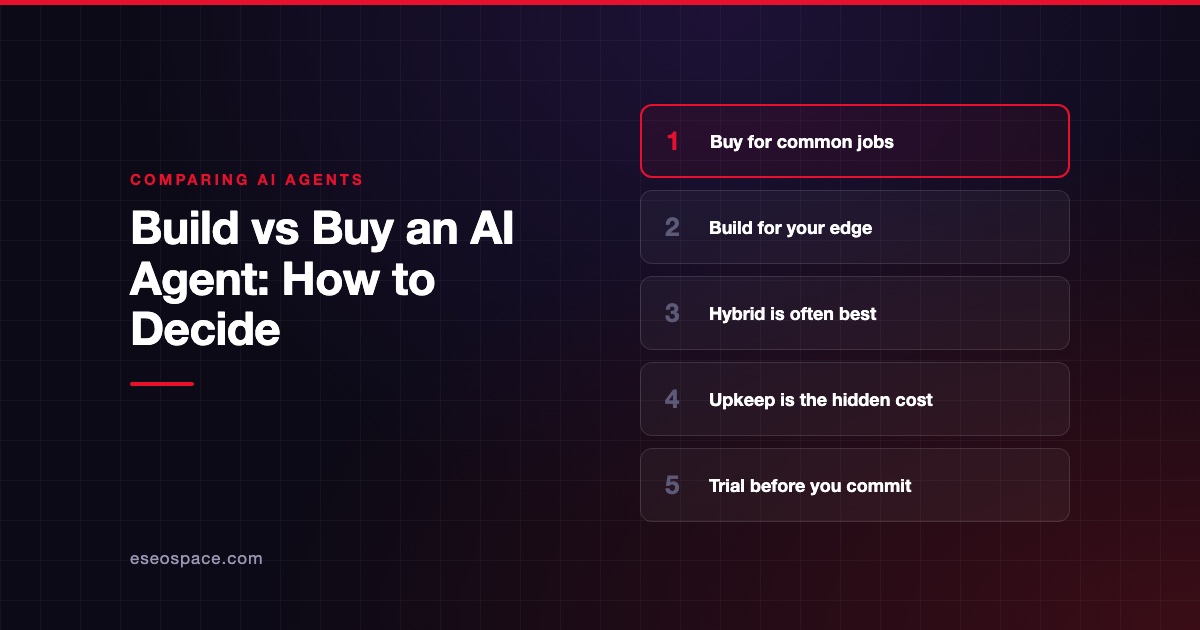
Buy if the job is common across many companies, such as support tickets or code review, and a product already does it well. Build if the workflow is your competitive edge, or depends on systems and rules no product understands. Many businesses should do both: buy the agent, then build the connection to their own data.
This choice is about your workflow, not which model leads this week. You can see model positions on the current leaderboard, and any product or custom build can usually change models later.
Disclosure: eSEOspace is a member of the Claude Partner Network.
At a glance
| Factor | Buy a product | Build your own | Hybrid |
|---|---|---|---|
| Time to first result | Fastest | Slowest | Middle |
| Up-front cost | Low | Higher, and depends on scope | Middle |
| Running cost | Seat or per outcome | Tokens, hosting, staff | Mix |
| Control over behavior | Limited | Full | High where it counts |
| Upkeep | Vendor | You | Shared |
| Lock-in risk | Vendor and data | Framework and staff | Lower if you own the connectors |
| Best for | Common jobs | Your edge | Most mid-size businesses |
We do not give a typical build cost here, because we did not find a source we trust. Cost depends on the factors below.
First question: do you need an agent?
An agent is software that plans its own steps and uses tools to finish a task. A simpler workflow is often enough.
Anthropic's engineering guide recommends finding the simplest solution and adding complexity only when needed. It says this might mean no agent at all, since agents trade latency and cost for better performance.
If your task follows the same steps each time, try a fixed workflow first. Our guide to agents vs chatbots vs automation can help you tell the difference.
Factor 1: How common is the job
If thousands of companies share your problem, a vendor has already seen the edge cases. Support is the clearest example.
Fin's pricing page, checked on 2 November 2026, lists $0.99 per outcome and says Fin works with other helpdesks. Zendesk and Agentforce sell similar products with their own billing models. Building a rival to these rarely makes sense for a small business.
Now take a different case, like a quoting process built on 15 years of your own pricing rules. No product knows that. That is where custom work earns its cost.
Factor 2: Cost over time
Buying has a visible price. Our pricing guide explains seat, usage and outcome models. Watch for volume, since per-outcome bills grow with your success.
Building has less visible costs. Plan for all of these:
- Developer time: The initial build, including integrations and testing.
- Model usage: Tokens per task. See our cost-per-task guide.
- Hosting: Sandboxes, storage, logging and retries.
- Evaluation: A test set you rerun after every change.
- Upkeep: Prompt fixes, model migrations and API changes.
- Security: Permission design, reviews and incident response.
Hosting can be simple or complex. As one dated example, Anthropic's Managed Agents add $0.08 per session-hour on top of tokens as of 2 November 2026. Connecting custom tools has its own price range, which our guide to MCP server costs covers.
Upkeep is the line most teams underestimate, in our judgment. Models get retired and rates change. Google, for example, lists Gemini 4 Argon's rates doubling from 1 December 2026, so a build needs someone watching for this.
Factor 3: Control and differentiation
Buying gives you the vendor's roadmap and guardrails. You can configure a lot, but you cannot usually change how the agent thinks.
Building gives you full control over steps, tools, approvals and logs. Frameworks reduce the work.
The Claude Agent SDK offers Claude Code's tools and loop as a library. The OpenAI Agents SDK keeps abstractions small, and LangGraph offers low-level orchestration.
See our framework comparison for the tradeoffs. Note that even "build" usually means buying the model. Few businesses need to train their own.
Factor 4: Data and compliance
Ask where your data goes, who can see it and how long it stays. A product adds one more company to that list. A custom build can reduce this, but your API vendor still handles the data.
Regulated work needs more care. Get the vendor's data terms in writing, and have a qualified professional review the arrangement.
For health data, only rely on a BAA (a business associate agreement) stated on the vendor's own page. A BAA alone does not make a practice compliant.
Building does not remove risk either. It moves the responsibility to you.
OWASP's excessive agency entry warns about tools with more functions, permissions and autonomy than the task needs. That design burden is yours if you build. See our security risks guide.
Factor 5: Speed and team
If you need results this quarter and have no AI engineers, buy. Our take: a custom agent without a named owner is a risk, because nobody is watching it once the first builder moves on.
If you have engineers and a stable process, building becomes realistic. Ask who will own it in two years. If nobody can answer, buy or hire a partner with a clear handover plan.
Factor 6: Lock-in
Both paths carry lock-in. With products, it comes from your workflows, history and contracts. With custom builds, it comes from frameworks and from the people who know the code.
Reduce it in the same ways:
- Keep your knowledge base in formats you can export.
- Keep your test set outside any vendor's system.
- Use open standards for connections. MCP is an open-source standard for linking AI applications to outside systems.
- Ask how to leave before you sign.
The hybrid path
For many businesses, the best answer is to buy the agent and build the bridge. You license a product, then build connectors to your own systems so it can reach your data.
For example, you could expose your order system as an MCP server and connect it to a bought agent. That keeps your core logic yours, while the vendor handles the agent loop.
Our MCP guide explains the pattern. As one example of a connector, eSEOspace built LedgerMCP, an MCP server for bookkeeping.
If you want this built, our MCP development service is one option. Compare it with your own team or another vendor before deciding.
Check the quality of what you would buy or build
Whichever path you lean toward, run a trial. Public benchmarks can suggest which models to try. Read our methodology before trusting any single number.
Then test the actual product or prototype on your tasks. Use our agent scorecard to compare a bought product against a small custom prototype on the same work.
Questions to answer before you decide
Answer these in writing, with whoever would own the agent in the room.
- What single workflow are we trying to improve, and how do we measure it today?
- How many times does it run each month, and what does each run cost now?
- Which systems must the agent read from or write to?
- What is the worst realistic mistake, and who would notice it?
- Which product did we trial, and where did it fall short?
- Who owns this agent after launch, and how much of their time is set aside?
- What will we do when the model it uses is retired?
If you cannot answer the first three, it is too early for either path. Map the workflow by hand first, since that work pays off whichever way you go.
Which should you choose
Choose buy if:
- The job is common and well served.
- You need results within weeks.
- You have no engineer to own a custom system.
Choose build if:
- The workflow is your edge or relies on private rules.
- You have an owner, a test set and a budget for upkeep.
- Products failed your trial on real work.
Choose hybrid if:
- A product handles most of the job but cannot reach your systems.
- You want to keep your data connections if you later change vendors.
Frequently asked questions
How much does it cost to build an AI agent?
It depends on integrations, risk and volume, and we do not quote a typical figure without a source. Scope a small version first, then price tokens, hosting, testing and upkeep separately.
Can I start with a product and build later?
Yes, and it is often the smart order. A product shows you what the workflow needs. Keep your test set and data exportable so you can move when it makes sense.
Do I need to train my own model?
Almost never. Most custom agents call existing models through an API and add tools, instructions and rules. Compare the options on the leaderboard linked above, then test your shortlist.
Who owns a custom agent's code?
That depends on your contract. Before work starts, get it in writing who owns the code, prompts, test sets and connectors. Have your attorney review the agreement, since this is not legal advice.









